Table of Contents
Self-sacrifice is one of anime’s most enduring narrative signatures, a motif that transforms heroes into icons and emotional moments into lasting memories. Whether it’s a final stand against impossible odds, a life given to protect a friend, or a quiet renunciation of personal desire for the greater good, these acts resonate deeply with audiences. Anime uses self-sacrifice not merely as a plot device, but as a lens to explore courage, duty, love, and the very meaning of heroism. The willingness of a character to forfeit something precious—often their own life—elevates the story, inviting viewers to reflect on what they themselves would be willing to lose.
This theme appears across every genre, from shonen battle epics to introspective dramas, and it carries cultural, philosophical, and psychological weight. While Western superheroes also make sacrifices, anime’s approach is uniquely shaped by Japanese traditions, religious ideals, and a narrative heritage that prizes communal over individual gain. In the pages that follow, we’ll peel back the layers of self-sacrifice in anime, examining its historical roots, its storytelling power, and its profound impact on audiences.
Key Takeaways
- Self-sacrifice in anime is deeply rooted in Japanese cultural codes like bushido, Buddhist compassion, and Shinto harmony, making it more than just a dramatic twist.
- Narratively, sacrifice functions as a crucible for character growth, a tool for exploring moral ambiguity, and a way to cement the hero’s agency and values.
- Iconic examples from Naruto, Dragon Ball Z, Fullmetal Alchemist, and Neon Genesis Evangelion show how sacrifice transcends the hero archetype, appearing even in antiheroes and flawed figures.
- The psychological impact of these scenes forces audiences to confront themes of suffering, the price of violence, and the spiritual dimensions of life and death.
- As anime evolves, contemporary series are re-contextualizing sacrifice to challenge old ideals, questioning when self-sacrifice is truly noble and when it becomes a hollow gesture.
The Roots Of Self-Sacrifice In Anime
To understand why self-sacrifice is so prevalent in anime, one must look beyond the screen to the cultural, spiritual, and folkloric soil from which these stories grow. Japanese creativity doesn’t emerge in a vacuum; it channels centuries of ethical codes, religious teachings, and mythic archetypes that valorize losing the self for a larger purpose. These deep-rooted influences turn sacrifice from a mere plot point into a philosophically charged act.
Cultural And Historical Background
The samurai code of bushido—often summarized as the “way of the warrior”—is a foundational pillar. Bushido emphasized virtues such as loyalty, honor, and self-discipline, and it demanded that a samurai be prepared to die without hesitation for lord and clan. This ethos, popularized during the Edo period and later romanticized in modern media, directly feeds the anime trope of the hero who throws themselves into danger without a second thought. You see it in the unwavering devotion of characters like Naruto Uzumaki’s relentless protection of his village or in the self-sacrificing Knights of the Round Table in Fate/Zero. Anime heroes often embody a modern, fantastical version of the bushi ideal, where sacrifice is the ultimate expression of honor.
Equally significant is the aesthetic concept of mono no aware, the bittersweet awareness of impermanence. This sensitivity to the fleeting nature of life turns a tragic death into a moment of profound beauty rather than mere loss. When a beloved anime character sacrifices themselves, the sadness you feel is tinged with an appreciation for their choice—their life was brief but radiant. This perspective reframes sacrifice not as failure, but as a poignant, even glorious, affirmation of what matters most. The cherry blossom, which falls at the height of its beauty, is a classic symbol of this, and anime has often used falling petals to underscore a hero’s final, selfless act.
Influence Of Religion And Philosophy
Buddhism, which has deeply shaped Japanese thought, promotes the idea that attachment to the self is the root of suffering. By relinquishing the ego and acting out of compassion for all beings, one moves closer to enlightenment. Anime heroes repeatedly mirror this journey. When Buddhist teachings on selflessness intersect with storytelling, the hero who sacrifices himself is not just saving others; he is spiritually transcending his own limitations. This is particularly evident in the Dragon Ball series, where Goku’s repeated willingness to give his life to protect Earth—and his serene acceptance of death—reflects a detachment from the self that borders on the enlightened.
Shinto, the indigenous spirituality of Japan, adds another layer. It emphasizes harmony with nature, reverence for ancestors, and the idea that every life is part of a greater spiritual continuum. Sacrifice, in this worldview, can restore balance to a disrupted world. When a hero in a Miyazaki film, such as Ashitaka in Princess Mononoke, endures grievous wounds to broker peace between forest gods and humans, his physical sacrifice becomes a ritual of purification. The act cleanses not only the character but the world itself, aligning with Shinto’s emphasis on purity and communal responsibility.
This spiritual framing makes self-sacrifice feel both sacred and necessary, elevating it above a simple tactical decision.
Themes In Japanese Folklore And Mythology
Long before anime, Japanese folklore was populated by deities, spirits, and legendary figures who sacrificed themselves for the good of others. The tale of Momotaro, while often remembered as a simple hero’s journey, shows a willingness to leave home and confront ogres for the sake of the community. More directly, stories from the Kojiki describe how the goddess Izanami died giving birth to fire, her death becoming a primal act of creation. These myths encode a fundamental lesson: that sacrifice is not only noble but generative. When an anime hero gives their life, it often seeds a new era of peace or inspires a successor, repeating the mythological pattern of death giving way to renewal.
Folkloric motifs also lean on symbolic animals and objects. The legend of the white hare of Inaba, or the crane that weaves cloth from its own feathers, echoes themes of self-inflicted pain for the benefit of others. Anime like Natsume’s Book of Friends or Mushishi constantly revisit these ancient rhythms, showing that sacrifice is a natural part of the human (and supernatural) condition. By tapping into this reservoir of myth, anime connects modern viewers to age-old wisdom, making a hero’s death feel like the continuation of a timeless story.
Narrative Functions Of Self-Sacrifice
Self-sacrifice is a narrative powerhouse. It can break a character out of stagnation, force an audience to question the moral compass of a story, and create images that burn into memory. Anime writers wield this tool with precision, knowing that a well-placed sacrifice will elevate the entire narrative structure. Let’s examine the key functions.
Character Development And Identity
A sacrifice often marks the moment a character becomes fully realized. It externalizes inner values, showing what the hero holds sacred. In My Hero Academia, All Might’s willingness to burn out the last embers of his power to protect his students in the battle against All For One is not just a strategic move—it’s the crystallisation of his entire identity as the Symbol of Peace. Before that moment, he was a fading legend; after it, he becomes a legend whose legacy is etched forever. Similarly, in Sword Art Online, Kirito’s repeated acceptance of life-threatening stakes to save those he loves reveals the core of his character beyond his gamer persona: a deep-seated need to protect.
Sacrifice also allows for profound vulnerability. A hero who appears invincible can display fear, regret, or doubt in their final moments, making them more human and relatable. This vulnerability deepens the emotional impact and cements the character’s journey from a collection of traits to a fully lived-in person. Your investment in the story skyrockets precisely because you’ve witnessed the price they paid.
Redemption And Moral Ambiguity
Not every character walks a clear path of righteousness. Self-sacrifice provides a powerful avenue for redemption, allowing morally grey figures to reclaim a sense of honor. Fullmetal Alchemist: Brotherhood offers a masterclass with Greed, who begins as a villain obsessed with possessions but ultimately sacrifices himself to protect his new “possessions”—his friends. His final act redefines his entire existence, turning selfishness into a warped but genuine form of love. You are forced to reconsider everything you thought about him.
This device also complicates moral dualities. When a sacrifice serves a greater good but arises from a character’s sinful past or questionable motives, the story refuses easy answers. It asks whether the ends justify the means and whether a single act of selflessness can wash away a lifetime of wrong. Vinland Saga grapples with this heavily, as characters who have committed atrocities seek meaning through self-inflicted suffering. The resulting tension keeps the narrative from becoming a simplistic fable and pushes you to think critically about justice and forgiveness.
Depiction Of Justice And Agency
Sacrifice is often the only card a hero has to play against an overwhelming force. In doing so, they seize agency from the jaws of fate. When a hero chooses to die on their own terms, they defy the narrative’s power structure. This is potently illustrated in Attack on Titan, where numerous characters, from brave Survey Corps soldiers to tragic figures like Erwin Smith, lead suicidal charges that alter the course of history. Their deaths are not passive defeats; they are active, strategic choices that redefine victory as something beyond survival.
Justice in anime is frequently portrayed not as a system but as a personal burden. The hero who sacrifices himself becomes an embodiment of his own moral code, proving that justice is not merely an abstract ideal but something worth dying for. This transforms the concept of justice from courtroom drama to a lived, bleeding truth. It resonates because it suggests that even in a world of systemic corruption or cosmic unfairness, the individual’s choice still matters absolutely.
Imagery And Symbolic Elements
The emotional weight of sacrifice is amplified through deliberate visual and auditory symbolism. Directors employ motifs like falling cherry blossoms, crumbling petals, or a slowly dimming sun to mirror the ebbing of life. In Angel Beats!, the characters’ passing is often accompanied by a soft, almost melodic light, turning death into a peaceful graduation rather than a tragedy. Such imagery transforms sacrifice into an aesthetic experience, marrying sadness with beauty.
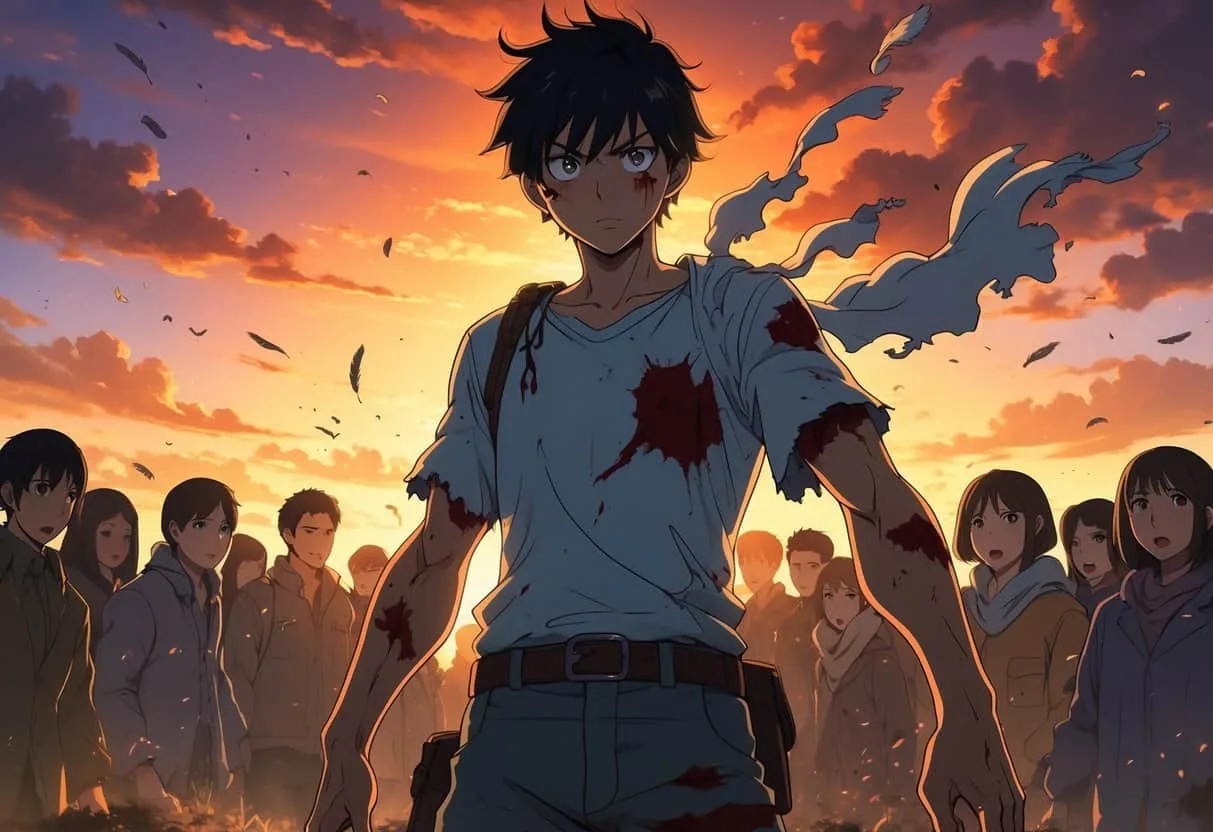
Color also plays a critical role. A hero’s blood on a white uniform, a sudden shift to monochrome, or the glow of a final attack all signal the sacred nature of the moment. Music swells, time seems to slow, and the audience is pulled into a heightened state of awareness. This sensory convergence ensures that the sacrifice is not merely understood intellectually but felt viscerally, embedding it deep in memory. These symbolic languages are a core reason why anime sacrifice scenes achieve nearly mythological status in fan communities.
Iconic Examples Of Self-Sacrifice In Anime
Abstract analysis only goes so far. To truly grasp the prevalence and power of this theme, we need to look at how it materializes in specific series and characters. From legendary shonen staples to psychologically complex dramas, self-sacrifice takes many shapes.
Classic And Modern Heroes
The template was set early. In Sailor Moon, Usagi repeatedly throws herself into danger to shield her friends, her tears and terror making her courage all the more remarkable. Astro Boy, created by Osamu Tezuka, regularly saved humanity at the cost of his own robotic life, establishing a direct line to later cybernetic heroes. Dragon Ball Z turned sacrifice into a serial expectation: Goku’s death against Raditz, Vegeta’s self-detonation against Buu, and Gohan’s one-armed final stand exemplify a world where the ultimate technique is often the surrender of self. Dragon Ball’s history of sacrifice shows how a martial arts story can repeatedly mine profound emotion from the same premise.
Modern series have refined the trope. Demon Slayer builds its entire emotional core around the sacrifice of the Flame Hashira, Kyojuro Rengoku, whose indomitable will to protect the weak becomes the moral compass for the protagonist. Jujutsu Kaisen similarly presents characters who burn up their life force or gamble their futures in brutal exchange for power, highlighting that sacrifice is not just a final act but an ongoing state of being for those who fight curses. These works demonstrate that the classic hero’s sacrifice can still feel fresh when grounded in deeply personal motivations.
Role Of Love, Friendship, And Community
Love—romantic, platonic, and familial—is the most common catalyst for sacrifice. In Clannad: After Story, the sacrifices are quiet and domestic: a parent giving up dreams, a child sacrificing health for a wish. Yet these small gestures accumulate until they become as devastating as any battle death. Your Lie in April presents a subtler form: the heroine Kousei sacrifices her emotional armor to connect with Kaori, and Kaori’s hidden struggle redefines sacrifice as living fully for someone else’s sake while you still can.
Friendship and community often blur. One Piece is a monument to this idea; the entire saga of the Straw Hat Pirates is built on each crew member’s willingness to risk everything for the others. Portgas D. Ace’s death shielding Luffy becomes a generational trauma, but also a lesson in what it means to be truly loved. The series repeatedly insists that a sacrifice for your found family is the highest form of wealth in a world of pirates. This communal dimension taps into the Japanese cultural emphasis on group harmony, or wa, making the sacrifice feel less like a personal loss and more like a necessary contribution to the collective.
Antiheroes And Unconventional Figures
Self-sacrifice becomes even more fascinating when performed by characters who scarcely resemble traditional heroes. Death Note’s L, a socially awkward genius, knowingly walks into a trap that results in his death because solving the case matters more than his life. His sacrifice is cold, almost clinical, yet it underscores an unwavering commitment to justice. In Code Geass, Lelouch vi Britannia orchestrates his own assassination to unite the world against a common enemy, a Machiavellian sacrifice that is simultaneously noble and monstrous. You are left questioning whether his self-destruction was an act of atonement or the ultimate manipulation.
Neon Genesis Evangelion pushes the theme into psychological horror. Characters like Rei Ayanami are literally replaceable clones created to die. Her multiple “sacrifices” are stripped of heroism, exposing the dehumanizing machinery behind the idea of sacrifice. The series challenges the audience to see that not all self-sacrifice is empowering; sometimes it’s a symptom of broken systems. This critical lens adds a layer of moral complexity that keeps the theme alive and contentious even decades later.
Psychological And Social Impacts
Why do these moments affect us so profoundly? Beyond the narrative mechanics, self-sacrifice in anime touches on universal psychological truths about pain, meaning, and the human condition. It also holds up a mirror to societal values and fears.
Human Suffering And The Nature Of Sacrifice
Suffering is the currency of sacrifice, and anime does not shy away from its full cost. When you watch a character like Tokyo Ghoul’s Ken Kaneki endure torture and transform into a self-lacerating figure who sacrifices his own humanity to protect the few he loves, the pain is not glorified—it is searing and realistic. This depiction validates the truth that genuine sacrifice hurts, and that pain is what gives the act its meaning. It also allows viewers to process their own experiences of loss and altruism through a safe, fictional lens, providing catharsis.
On a social level, these narratives reinforce the idea that community survival often depends on individual cost. In a country like Japan, where communal responsibility and self-restraint are deeply embedded, anime becomes a mythological space to explore the tension between personal desire and social obligation. The hero who sacrifices himself becomes a cultural ideal, a reminder that the needs of the many can, and perhaps should, outweigh the needs of the one—but at a terrible price that should never be taken lightly.
Violence And The Value Of Life
Anime’s frequent use of violence is not gratuitous when tied to sacrifice; it becomes a philosophical probe. Each drop of blood, each broken body asks what life is worth. Berserk is a brutal case study: Guts’s entire existence is defined by the sacrifices he and others have made, often violently. The series suggests that life’s value is not inherent but is forged through the struggles and sacrifices one endures. By depicting violence as a medium of sacrifice, anime reframes it from mere spectacle to a meditation on the cost of ideals.
This challenges viewers to consider when violence is justified and whether a life given in battle is truly wasted or meaningfully exchanged. Modern series like 86 Eighty-Six explicitly tackle this, as child soldiers are sent to die in drone battles while a nation rationalizes their sacrifice as necessary. The show critiques the very concept of heroic sacrifice when it is enforced by an unjust society, blurring the line between heroism and exploitation.
Supernatural And Spiritual Dimensions
Many anime sacrifice scenes transcend the physical, entering a realm where the spirit persists. In Bleach, the Soul Reapers who fall in battle do not simply vanish; their spiritual energy returns to the cycle of souls. This reframes death as a transition rather than an end, softening the finality of sacrifice. Mob Psycho 100 presents a more esoteric view: Shigeo’s emotional breakdowns and subsequent sacrifices of his power to connect with others echo a Buddhist-like release of ego, turning each outburst into a step toward enlightenment.
Spiritual sacrifice often implies a covenant. In Noragami, the god Yato risks his existence to save his regalia, showing that divinity itself is bound by sacrificial laws. These supernatural frames suggest that sacrifice has a cosmic dimension—that it can balance spiritual debts, appease metaphysical forces, or even rewrite fate. For the viewer, this adds a comforting layer: the hero’s death is not an absence but a transformation, a continuing presence in the world they saved.
The Evolving Face Of Self-Sacrifice In Modern Anime
As anime storytelling matures, the trope of self-sacrifice is being interrogated and reinvented. No longer is it always presented as an unalloyed good. Series like Chainsaw Man depict a protagonist whose willingness to sacrifice everything for a normal life is exploited and hollowed out, raising questions about whether self-sacrifice can be a form of self-erasure. Ranking of Kings shows a deaf prince whose physical sacrifice of speech and strength is not a one-time act but a lifelong negotiation, and the story asks whether the community should expect such ongoing sacrifice from its most vulnerable members.
Isekai anime also twists the trope: protagonists who are resurrected in fantasy worlds often discover that their heroic sacrifice in the original world was meaningless, forcing them to redefine what it means to give up something for others. Re:Zero’s Subaru repeatedly dies in gruesome ways, but the series emphasizes that self-sacrifice without self-worth is a cycle of trauma, not a path to heroism. This evolution signals a cultural shift—anime is now challenging the very traditions that gave birth to its most sacred narrative ritual. The result is a richer, more critical conversation about what heroes owe to others and to themselves.
Self-sacrifice will likely remain a cornerstone of anime, but as creators continue to broaden the definition of heroism, the act will increasingly be measured not by the grandeur of the death, but by the wisdom and compassion that inform it. For you, the viewer, that means these stories will only grow more resonant, more emotionally complex, and more reflective of the multifaceted reality of what it means to give.