Table of Contents
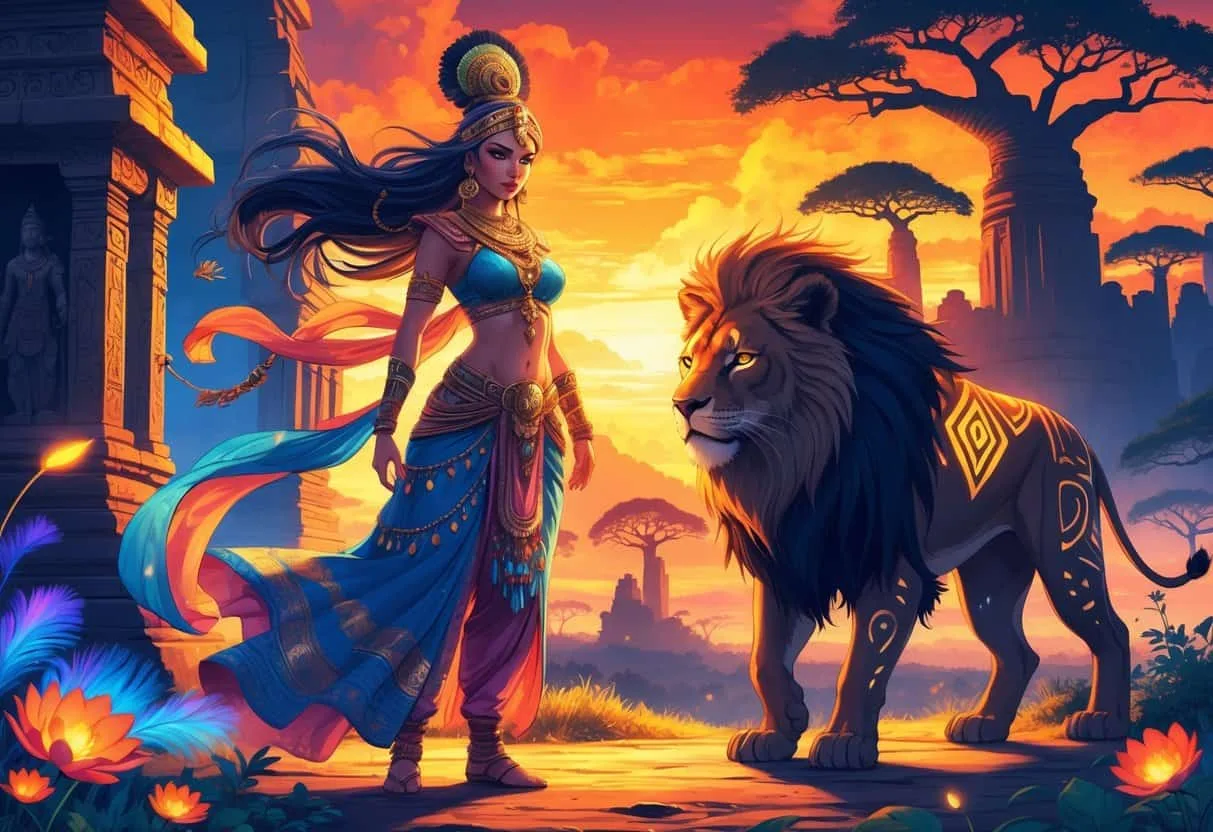
Anime has never shied away from borrowing myths. Japanese yokai, Greek gods, Norse legends, and Buddhist cosmology regularly fuel everything from shonen battlers to contemplative art films. Yet the well of inspiration remains far from dry. Two vast and largely untapped reservoirs sit waiting: Indian mythology, with its cosmic epics and intricate philosophy, and African folklore, steeped in community spirits, tricksters, and oral wisdom. When anime creators begin weaving these traditions into their narratives, they unlock fresh themes, character archetypes, and visual vocabularies that break decisively from the Eurocentric mythologies that dominate the industry today.
Indian and African storytelling do not simply offer alternative window dressing; they introduce fundamentally different relationships between mortals and the divine, the individual and the collective, fate and free will. This expansion has the power to attract global audiences hungry for cultural authenticity and to push the medium of anime into richer, more reflective territory. The medium's inherent flexibility—its willingness to blend genres and experiment with form—makes it the perfect vehicle for these mythic traditions to find new, global audiences.
The Cosmic Canvas of Indian Mythology
Indian mythology springs from a library of ancient texts—the Mahabharata, the Ramayana, the Puranas, and the Vedas—that together form one of the world's oldest continuous storytelling traditions. These are not simple tales of good versus evil. They operate on a cosmic scale, where gods and mortals grapple with dharma (moral duty), karma, and the cycle of rebirth. Time is not linear but a vast wheel of ages—the four yugas, each progressively darker—and heroes often face impossible choices that pit love against duty, personal desire against universal order. The concept of dharma itself is a narrative engine: every character must navigate their own moral obligations, which often conflict with others', creating layered tragedies and triumphs.
Anime has already dipped its toes into this river. Record of Ragnarok featured Shiva as a combatant, and Naruto borrowed the concept of chakras and the Rinnegan eye from Hindu and Buddhist cosmology. The Saint Seiya franchise is littered with Buddhist and Hindu references, and Dragon Ball's Son Goku takes his name from the Chinese Journey to the West but also echoes the monkey god Hanuman in his superhuman strength and devotion. Yet these borrowings remain mostly superficial—cool power systems and exotic names. A genuine engagement with Indian myth would mean embracing the moral complexity that defines it.
Imagine a protagonist modeled on Arjuna from the Mahabharata, paralyzed on the battlefield because righteous action means fighting his own kin. Such internal conflict, built into the hero's arc from the start, pushes anime beyond simple power scaling into philosophical depth.
The characters waiting to be adapted are staggering. Krishna, the divine charioteer who manipulates events with dazzling wit, could be an anime's mentor figure who is simultaneously a wise philosopher and a cosmic prankster—a combination of Yoda and Loki, but with the weight of cosmic purpose. Kali, the dark goddess of time and destruction, invites a female anti-hero whose rage is both terrifying and maternal, a figure who can annihilate demons and protect the innocent in the same breath. The concept of the avatar—a deity descending into mortal form (as in Vishnu's ten avatars)—aligns perfectly with isekai tropes, but with a spiritual gravity that the genre often lacks. A protagonist who incarnates with divine memory and cosmic duty would confront the classic isekai power fantasy with the burden of responsibility.
The Living Traditions of African Folklore
African folklore is not a monolith; it spans thousands of distinct cultures, each with its own oral traditions, pantheons, and story cycles. Unlike the scripture-based Indian myths, these stories live in performance, song, and communal memory. They feature animal tricksters, nature spirits, and ancestor figures who bridge the world of the living and the dead. The themes that emerge—community survival, harmony with the natural world, and the transformative power of story itself—offer a stark but invigorating contrast to anime's frequent focus on lone heroes and individual power growth.
Trickster figures like Anansi the Spider of West African lore would revolutionize anime's character dynamics. Anansi uses cunning, not brute force, to outwit gods and monsters, often learning humility in the process. An anime series built around such a protagonist could balance humor, moral lessons, and sharp social commentary, akin to a fusion of One Piece's cleverness and Kino's Journey's episodic wisdom. The water spirit Mami Wata, a pan-African figure of beauty, danger, and healing, could anchor narratives that weave environmental anxiety with supernatural romance—a genre for which anime already has a proven appetite, as seen in works like Nagi no Asukara or Mushishi.
African folklore also rethinks the relationship between the natural and the supernatural. In many traditions, forests speak, animals hold wisdom, and ancestral spirits demand accountability. This is not the sanitized "nature is magic" sentiment of Western fantasy; it is a worldview in which the spiritual and ecological are inseparable. The concept of ashe (Yoruba life-force) or the role of the griot as living archives invites narrative structures built around song, call-and-response, and communal storytelling. Anime like Mushishi or Mononoke have touched on similar ideas, but a dedicated exploration of African folk ecology could produce something entirely new: a setting where every river has a temperament, every mountain a history, and where the protagonist must negotiate with the landscape rather than conquer it.
Specific traditions offer rich veins. Yoruba mythology features the Orishas—deities like Ogun (god of war and iron), Oshun (goddess of love and rivers), and Shango (god of thunder and dance). Their relationships and domains mirror the pantheonic drama of Record of Ragnarok but with a distinctly West African aesthetic and moral framework. The Zulu myth of Unkulunkulu, the creator who emerged from the reeds, or the folk hero Mwindo from the Congo, who battles supernatural forces, provide ready-made epic arcs.
Where Worlds Converge: Archetypes and Divergences
When you lay Indian and African mythologies side by side, fascinating overlaps emerge. Both traditions center on the hero's journey, on temptation and redemption, and on the trickster who challenges authority. Both understand that power carries a cost and that wisdom is often won through suffering. The concept of a divine mother figure—Kali in India, Mami Wata or Oshun in Africa—appears across both, embodying creation, destruction, and nurturing. But the emphasis shifts dramatically.
Indian myths tend toward the cosmic and the cyclical; the battle between devas and asuras plays out across eons, and reincarnation means that even death is a temporary setback. African myths keep their eyes on the village, the family, and the immediate relationship between a person and the spirit world; ancestors remain active participants in daily life, and community obligations transcend individual ambition.
This divergence is creatively fertilizing. A series could, for example, borrow the Indian framework of a world-shaking war between ancient powers, but ground it in an African-inspired community where the stakes are not just the fate of the universe but the survival of a single lineage of storytellers. The interplay between the grand and the intimate would give anime a new emotional register, one that honors both the epic sweep of a Mahabharata and the grounded folk wisdom of an Anansi tale. The Indian concept of maya (illusion) and the African concept of nommo (the word as creative force) both emphasize that reality is shaped by narrative and ritual—a meta-commentary on storytelling itself that anime could exploit brilliantly.
Moreover, both mythologies place high value on non-physical conflict. Dialectics, riddles, debates between sages—these are as important as sword fights. An anime that dramatizes a verbal duel with the same visual intensity as a mecha battle would not only be innovative; it would be true to the source material that prizes wit and philosophical clarity over raw strength. Imagine an episode where a protagonist must out-argue a goddess in a debate competition, with the animation shifting to abstract, symbolic realms as arguments collide.
New Genres, New Visual Languages
Indian and African mythologies carry with them aesthetic toolkits that could reshape anime's visual identity. Indian art brings mandalas, vibrant color palettes, multi-limbed deities, and the kinetic grace of classical dance forms like Bharatanatyam and Kathakali. Imagine a fight sequence in which every strike maps to a mudra (symbolic hand gesture) and every movement is choreographed like a temple dance—anime already excels at turning action into visual poetry, and this would push that instinct to an ecstatic extreme. The use of color would change: think of the deep indigos and golds of Indian miniature paintings, the fiery reds of Holi, the calm greens of forest scenes inspired by Mughal gardens.
African visual culture offers its own distinct riches: bold geometric patterns, masks that evoke spiritual transformation, and textiles like kente and mudcloth that tell stories. An anime adopting these elements could move away from the clean, homogenous lines that dominate mainstream productions toward a more textured, expressive art style. Characters might shift visual registers when they enter the spirit world, their designs fracturing into patterns that echo specific cultural traditions—Adinkra symbols could replace standard magical runes, and Ndebele patterns could adorn armor and architecture.
Music and dance, too, would become integral to narrative rather than background. In many African traditions, a story is inseparable from its rhythm and call-and-response. An anime could structure episodes around drum cycles, with the tempo rising and falling to match emotional beats. Indian ragas, with their ability to evoke specific moods and times of day, could be woven into the score to create an aural landscape as rich as the visual one. The result would be a synesthetic experience—anime as something closer to opera than to television.
Studios like Studio Ghibli have long understood how music carries memory; a mythology-driven anime would elevate that principle.
Representation and the Global Audience
For decades, anime's global expansion has proven that fans everywhere hunger for narratives they haven't already seen a hundred times. Streaming platforms have demolished geographic barriers, and audiences are now actively seeking out stories with cultural specificity. The success of Castlevania, which leaned into Eastern European folklore, and the international buzz around African animated projects such as Kizazi Moto: Generation Fire (a Pan-African sci-fi anthology) signal that the market is primed for mythologies beyond the usual Greek-Norse-Japanese trifecta. Smithsonian Magazine's analysis of anime's global influence highlights how cross-cultural pollination has always been central to the medium's growth, from the influence of Disney on early Tezuka to the global fandom of Attack on Titan.
However, representation is a minefield if handled without care. Surface-level exoticism, where a culture's symbols are used as mere decoration, breeds resentment and backlash. Authenticity requires collaboration: hiring cultural consultants, co-producing with Indian and African animation studios, and involving artists who live these traditions. The goal is not to make anime "about" Indian or African cultures in a touristic sense, but to let the narrative logic of those mythologies genuinely shape plot, character, and theme. The Japanese co-production The Legend of Prince Rama (1992) set an early precedent—a direct adaptation of the Ramayana animated by Japanese studios with Indian consultants—but more ambitious partnerships, like the collaboration between Studio 4°C and Kenyan artists on Mazingira, or the Japanese-Beninese co-production Bino and Fino, suggest the next wave will be far more integrated.
Anime historians have traced Hindu mythology's quiet impact on everything from Dragon Ball to Berserk, yet the acknowledgment has rarely translated into full-throated exploration. That is beginning to change, with projects like the upcoming Ramayana: The Legend of Prince Rama remaster and new Indian-Japanese anime co-productions in the pipeline.
Accurate, respectful representation also carries a deeper social value. It combats the erasure of non-Western cultures from global pop culture and offers audiences—especially audiences of Indian and African descent—heroes and worlds that resonate with their own heritage. This is representation not as checkbox but as storytelling empowerment: the chance for a child in Mumbai to see her grandmother's bedtime stories animated with the same love as a Miyazaki film, or for a child in Lagos to recognize the Anansi tales his uncle told him given epic, serialized life.
Challenges Creators Must Navigate
Integrating these traditions into anime is not a simple act of borrowing. Indian mythology is intertwined with living religious practice for millions of people; the careless depiction of a deity can cause deep offense. Hanuman is worshipped as a living god; Shiva's third eye is not just a cool design element. Sensitivity and intentionality are non-negotiable. African folklore, often passed down orally, resists convenient codification and demands sensitivity to the specific community from which a story originates—one cannot simply mix Akan, Yoruba, and Zulu traditions without understanding their distinct contexts.
Creators must invest in deep research, avoiding the trap of treating a continent of 54 countries as a single flavor.
Censorship poses another hurdle. Some Indian myths contain erotic, violent, or politically charged elements—the Mahabharata includes polyandry, explicit sexual encounters, and brutal war scenes—that distributors in certain markets might balk at. Similarly, African traditions that address taboo subjects like witchcraft, colonial trauma, or critique of authority with sharp edges might test the comfort zones of global platforms. Yet anime has a history of pushing boundaries, from the body horror of Akira to the political satire of Psycho-Pass. These very frictions could generate the kind of groundbreaking work that defines eras—as long as the creators are willing to stand by their artistic vision and navigate local sensitivities with respect.
Economic logic is the final wall. Studio executives often bet on familiar properties, and greenlighting a series built on an unfamiliar mythology represents financial risk. The way forward likely runs through independent and mid-sized studios, international crowdfunding, and co-productions that spread risk and pool cultural knowledge. The recent wave of webtoon adaptations (e.g., The God of High School, Tower of God) proves that audiences are ready for unconventional premises; a well-executed pilot or short film could ignite demand just as One-Punch Man's humble beginnings rewired expectations. Initiatives like the Japanese government's Cool Japan Fund, which has financed cross-cultural projects, show that institutional support exists.
Towards a More Global Mythology
Anime's future lies in its ability to absorb and reinterpret human stories from every corner of the earth. Indian mythology and African folklore are not merely new content libraries; they are alternative epistemologies—different ways of understanding time, duty, community, and the sacred. When anime embraces them fully, it can move beyond the hero's journey template that has grown thin through overuse and begin to tell stories that feel genuinely unpredictable—where the protagonist's growth might come not from defeating a villain but from restoring balance to a village, or where the central conflict is not a battle but a philosophical inquiry into the nature of reality.
Concrete steps are already visible. Workshops between Japanese animators and African concept artists have yielded stunning pitch materials. Indian graphic novelists, already blending myth with modern manga aesthetics, are courting anime adaptation deals. Meanwhile, platforms like Bakka Magazine's coverage of African folklore in animation reflect a growing critical mass of interest. The rise of African animation studios like Naija Anime and Kugali Media, which are already producing content inspired by Yoruba and other traditions, signals a groundswell of talent ready to collaborate.
The reward for getting this right is not just artistic novelty. It is a richer, more empathetic global culture in which anime becomes a meeting ground—not where differences are smoothed over, but where they are given full, vibrant expression. A world where a viewer in Mumbai sees her grandmother's bedtime stories animated with the same love as a Miyazaki film, and a viewer in Lagos recognizes the Anansi tales his uncle told him given epic, serialized life. That is the future this mythology-forward anime could build—a future that honors the past while forging new visual and narrative languages for generations to come.