Table of Contents
What Defines a Sports Anime?
Sports anime is a subgenre of Japanese animation that places athletic competition at the center of its narrative. Unlike action series where combat or adventure drives the plot, sports anime zeroes in on real-world or near-future sports—volleyball, basketball, figure skating, distance running, and even mechanically enhanced boxing. These series capture the rigorous training, tactical ingenuity, and emotional highs and lows that athletes endure on their journey toward a championship, a personal record, or simply the self-respect that comes from pushing beyond perceived limits.
At their core, such shows are character-driven dramas. They map the protagonist's growth from an inexperienced or flawed player into someone capable of inspiring teammates and challenging elite opponents. The court, field, or rink becomes a stage for inner conflict, resilience, and the bonds forged under pressure. Whether it’s the perfectly animated spike of a volleyball or the silent tension before a free throw, the genre transforms athletic motion into emotional expression. The result is a medium that appeals not only to sports enthusiasts but to anyone who appreciates a well-told story about ambition, failure, and redemption.
Key Differences Between Sports Anime and Sports Manga
Although sports anime and sports manga explore identical themes of perseverance and rivalry, the experience they offer differs sharply. Manga relies on static panels and the reader's own pacing, often using intricate linework and internal monologues to convey the intensity of a match. Anime, by contrast, adds motion, color, voice acting, and a synchronized soundtrack that can heighten the thrill of a last-second goal or the gravity of a defeat.
| Sports Anime | Sports Manga |
|---|---|
| Animated series that use fluid motion, camera angles, and sound to bring athletic competition to life. | Printed graphic novels where action is suggested through sequential art and the reader’s imagination fills the gaps. |
| Music, voice performances, and pacing guide the emotional rhythm, often making pivotal moments feel cinematic. | Intricate panel layouts and detailed close-ups force the reader to linger on a single expression or a subtle shift in stance. |
| Studios can reimagine the original character designs and add original scenes, making the adaptation a distinct creative work. | The original work, unfiltered by budget or broadcast constraints, often contains side stories and deeper internal conflict. |
| Examples: Slam Dunk, The Prince of Tennis, Ping Pong the Animation. | Examples: The King’s Avatar (manhua), Ao Ashi, Chihayafuru. |
Both forms share a commitment to authentic sport psychology, but anime's ability to make a serve feel explosive or a runner’s breath sound labored creates an immersive sensory experience that manga trusts the reader to construct alone.
The Evolution of Sports Anime: From 1928 to a Global Phenomenon
The first known sports anime was produced in 1928 by Yasuji Murata. The silent short, Animal Olympic Games, featured anthropomorphic creatures competing in track and field events, blending whimsy with the Olympic spirit. It was a modest debut that hinted at animation’s potential to depict athletic motion decades before television made the genre a household staple.
In the 1960s and 70s, baseball and boxing came to dominate the landscape. Star of the Giants (1968) dramatized the grueling path of a pitcher, while Ashita no Joe (1970) set a new standard for grit and character study in a boxing ring. By the 1980s, Captain Tsubasa not only popularized soccer across Japan but also ignited a real-world football boom. The 1990s saw the arrival of Slam Dunk, a basketball series that shattered sales records and proved sports anime could carry dramatic weight beyond the game itself. Creator Mitsuru Adachi further elevated the genre with works like Touch and H2, weaving romance and slice-of-life elements seamlessly into the competitive framework.
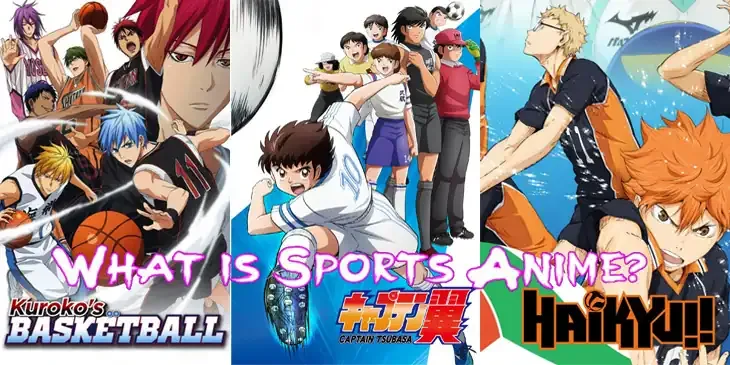
The 2010s and 2020s brought a renaissance, fueled by high-definition animation and global streaming. Haikyuu!!, Kuroko no Basket, Yuri!!! on Ice, and Run with the Wind each attracted enormous international followings, proving that sports anime could transcend cultural and linguistic barriers. Today, the genre continues to diversify, exploring everything from badminton (Hanebado!) to dance sport (Welcome to the Ballroom), reflecting an ever-growing appetite for stories where the body becomes the primary instrument of expression.
Why Sports Anime Captivates Audiences Worldwide
On the surface, a show about high school volleyball may seem niche. Yet the best sports anime achieve a universal resonance by tapping into fundamental human experiences: the hunger to improve, the pain of a loss, and the euphoria of a hard-won victory. The matches function as metaphors. A blocked spike represents rejection; a missed pass becomes self-doubt; a comeback rally signifies hope. Because the stakes are personal rather than apocalyptic, viewers can connect more intimately with the characters.
The genre also excels at building ensemble casts. Each teammate carries a distinct personality and backstory, and the friction and support among them mirror real relationships. A setter and a spiker who cannot communicate, a captain who shoulders too much pressure, a prodigy struggling with burnout—these archetypes feel authentic because they are rooted in observable human dynamics. Even rivals are rarely villains; they are simply athletes with their own dreams, raising the level of competition and empathy.
Production quality plays an equally important role. Modern sports anime rely on dynamic camera work that mimics live sports broadcasts: slow-motion replays, first-person perspectives, and sweeping aerial shots of the arena. Combined with pulsing soundtracks, these techniques turn every match into a visceral event. The result is an emotional workout that leaves audiences cheering, crying, and marathoning episode after episode. Notably, you do not need to understand the sport to be moved by it; the narrative does the teaching.
Top 5 Best Sports Anime to Watch (and Why They Shine)
1. Haikyuu!!
Shoyo Hinata is a short-statured junior high student who becomes obsessed with volleyball after witnessing a national tournament match on television. Despite lacking height and a proper team, he models himself after the “Little Giant” and eventually enrolls at Karasuno High School, where he encounters the genius setter Tobio Kageyama—a former rival. Their fiery, at-times dysfunctional partnership becomes the engine that powers Karasuno’s improbable climb toward the spring national championship.
Produced by Production I.G, Haikyuu!! is widely praised for its realistic depiction of volleyball mechanics and its layered character writing. Each opponent team is treated with respect, giving every match the weight of a final. The series balances breathless rallies with quiet moments of doubt, camaraderie, and tactical adjustment. It not only revitalized interest in high school volleyball in Japan but also attracted a massive global audience, consistently ranking among the top-rated anime on platforms like MyAnimeList. IMDb: 8.7/10.
2. Kuroko no Basket
Five prodigies once formed the legendary “Generation of Miracles” at Teiko Middle School, crushing all opposition with superhuman talent. After graduation they scatter to different high schools, each seeking to prove that individual brilliance can still dominate the sport. Standing in their way is a phantom sixth player, Tetsuya Kuroko, who partners with the explosive but raw Taiga Kagami. Together at Seirin High, they challenge the Miracles one by one, advocating for a style of basketball built on trust, passing, and selfless teamwork.
The series amplifies real basketball concepts into near-fantastical special abilities—an area of contention for some purists, yet undeniably effective at generating spectacle. Behind the flashy crossovers and zone-triggered auras lies a story about redefining strength and rediscovering the joy of playing with others. Kuroko no Basket became a cultural juggernaut, spawning films, stage plays, and a lasting imprint on global fandom. Its pacing and climactic matches keep viewers glued, and the emotional payoff when the Generation of Miracles confronts its fractured past is immense. IMDb: 8.1/10.
You can find it on Crunchyroll.
3. Yuri!!! on Ice
Japanese figure skater Yuri Katsuki suffers a crushing defeat at the Grand Prix Final and retreats to his hometown, contemplating retirement. When a video of him perfectly replicating a routine by five-time world champion Victor Nikiforov goes viral, Victor himself appears at his doorstep, offering to become his coach. What follows is a season of rediscovery, as Yuri learns to balance the pressure of elite competition with a blossoming romantic connection that quietly normalizes a same-sex relationship without ever sensationalizing it.
The show won acclaim for its detailed, accurately choreographed skating sequences—supervised by real-life skaters—and for the emotional authenticity of its characters. Two Yuris (Katsuki and the fierce Russian skater Yuri Plisetsky) duel not just for medals but for artistic identity. The intimate dynamic between Yuri and Victor redefined what a sports anime could be, proving that vulnerability and love are no less compelling than a last-second goal. The series generated a massive international following, and its original soundtrack soared on music charts. IMDb: 8.3/10.
4. Run with the Wind
When Haiji Kiyose, a fourth-year university student, recruits ten residents of the dilapidated Chikusei-so dormitory to form a long-distance relay team, barely any of them have running experience. His ambition is audacious: qualify for the Hakone Ekiden, Japan’s most prestigious collegiate marathon relay. The protagonist, Kakeru Kurahara, is a former elite runner running from his past. As the months of training wear on, each member confronts personal demons—fear of inadequacy, parental expectations, chronic injury—and together they discover that running is not about speed alone but about trust, sacrifice, and the literal passing of the sash from one soul to another.
Adapted from Shion Miura’s novel, Run with the Wind emphasizes character psychology over flashy athleticism. The Hakone Ekiden itself becomes a breathtaking 23-episode arc where every kilometer feels earned. The series is a quiet masterpiece that speaks to anyone who has ever doubted their own worth, and its persistent message—that the journey matters more than the podium—lingers long after the finish line. IMDb: 8.4/10.
5. Megalo Box
In a dystopian future where boxers compete with mechanical exoskeletons called “gear,” a nameless fighter known only as Junk Dog scrapes by in underground fixed matches. After a chance encounter with Yukiko Shirato, the head of the corporation that governs the sport, and a brutal challenge from the reigning champion Yūri, Junk Dog adopts the ring name “Joe” and enters the brutal Megalonia tournament. He has three months to obtain a citizen ID and climb the official rankings, all while fighting without any gear—a disadvantage that becomes a defiant statement of raw human will.
A spiritual homage to Ashita no Joe, the series captures the same gritty, sun-bleached atmosphere of 1960s manga but updates it with hip-hop-infused sound design and fluid fight choreography. Joe’s journey from nameless dog to folk hero resonates because the stakes are always intimately personal: identity, freedom, and the right to exist in a system designed to discard the weak. The second season, Nomad, deepens the tragedy and redemption, cementing Megalo Box as one of the most emotionally honest sports anime of its decade. IMDb: 7.8/10.
The Lasting Impact of Sports Anime on Real-World Athletics
The influence of sports anime now extends far beyond the screen. After the release of Haikyuu!!, the Japan Volleyball Association reported a noticeable spike in youth enrollment. Similarly, Yuri!!! on Ice drove a surge of interest in figure skating, with many young viewers citing the show as their reason for stepping onto the ice. Professional athletes themselves have acknowledged the genre’s motivational pull: NBA players have referenced Kuroko no Basket, and Olympic-level runners have shared their affinity for Run with the Wind.
These series succeed because they treat sport with sincerity. The training montages may be compressed, but the underlying principles—discipline, nutrition, mental fortitude—are depicted with enough accuracy to function as a gateway drug for curious beginners. Leagues and federations increasingly partner with anime productions for promotional campaigns, recognizing that fictional narratives can cultivate lifelong fans and participants in ways traditional advertising cannot. In this sense, sports anime has evolved into a cultural ambassador that blurs the line between entertainment and genuine athletic inspiration.
Conclusion
Sports anime is far more than animated matches. It is a storytelling engine that transforms physical effort into emotional catharsis. From the silent Animal Olympic Games of 1928 to today’s streaming juggernauts watched by millions in real time, the genre has consistently proven its power to move audiences, spark athletic dreams, and reflect the depth of human perseverance. Whether you come for the adrenaline of a spike or the silence of a figure eight, the best sports anime leave you with a renewed belief in the beauty of striving—and that is a victory worth sharing.