Table of Contents
There is a reason school festivals feel like an inevitable turning point in so many anime series. Beyond the bright lanterns, the chaotic food stalls, and the last-minute costume disasters, these events mirror something profoundly real. In Japan, the bunkasai—the school cultural festival—is not a fictional invention; it is a cornerstore of the academic year, and for millions of students, it represents weeks of preparation, collaboration, and raw self-expression. Anime simply amplifies that energy and uses it as a narrative engine.
Understanding why school festivals appear with such frequency requires looking at both the storytelling possibilities they unlock and the cultural bedrock they rest on. The festival episode is rarely just filler. It is a versatile backdrop that can test friendships, force confessions, reveal hidden talents, or simply let characters exist outside the rigid rhythm of lessons and exams.
The Cultural Backbone of the School Festival
Before anime turned the school festival into a dramatic device, it was—and remains—a genuine pillar of Japanese student life. Every autumn, schools across the country open their gates to families, alumni, and the local community for a day or two of performances, exhibitions, and food. The event is so deeply ingrained that its absence would feel as strange to a Japanese viewer as a prom-free American high school drama.
Understanding Bunkasai – More Than Just a Fun Day
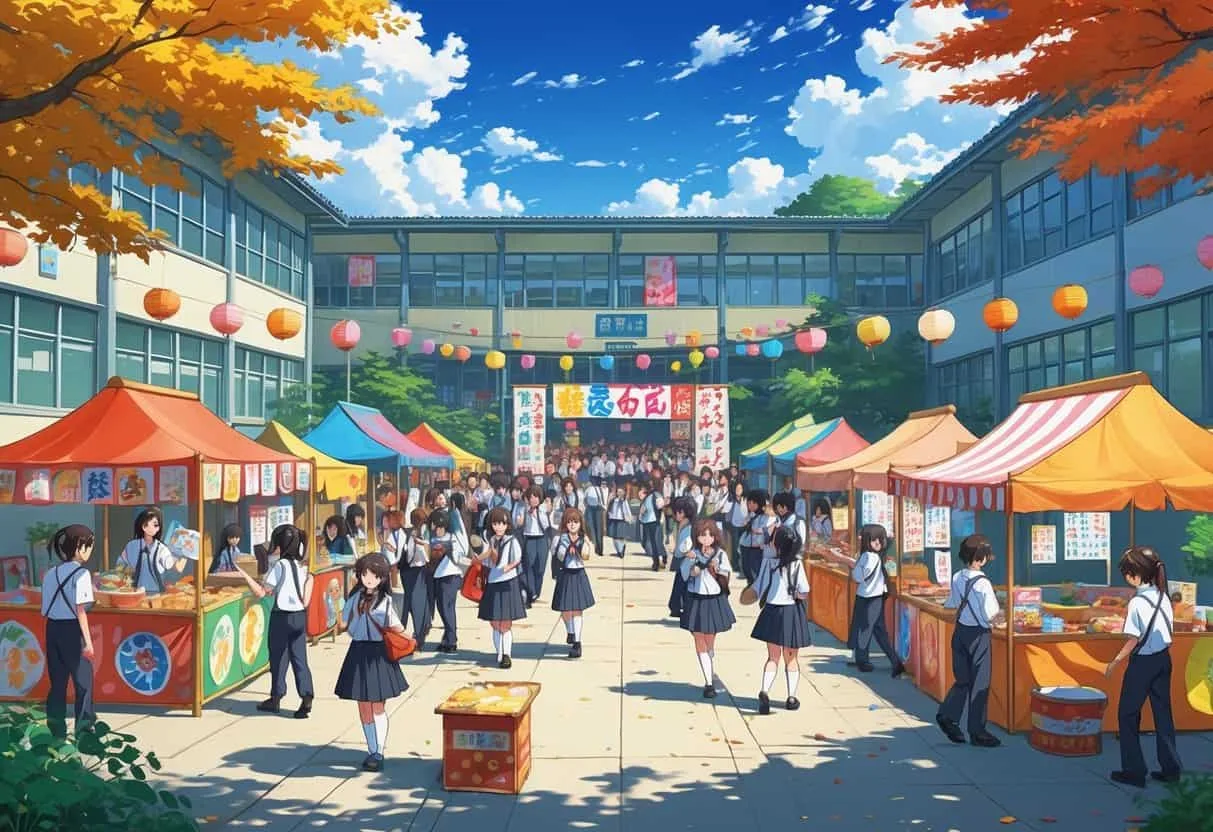
The term bunkasai (文化祭) translates directly to “culture festival,” but that clinical label undersells the experience. Classes transform into themed cafés, haunted houses, art galleries, or interactive science demonstrations. The gymnasium becomes a stage for bands, dance troupes, and plays. Hallways hum with the smell of takoyaki and yakisoba, cooked by students who have spent days arguing over ingredient budgets. For a visitor, it looks like a joyful carnival; for the students, it is a high-stakes project management exercise wrapped in crepe paper.
Organisation begins weeks in advance. Homeroom classes vote on what attraction they will run, and the majority decision often sparks the first wave of comradely tension. A class that wanted a cosplay café may end up with a traditional tea room, forcing compromises that test relationships—exactly the kind of raw material anime writers thrive on. The event is simultaneously an academic obligation and an emotional pressure cooker, which makes it irresistible for character-driven storytelling.
Roots in Japanese Matsuri Traditions
The school festival did not emerge from nowhere. It borrows heavily from the broader tapestry of Japanese matsuri, the community celebrations that punctuate the calendar. Many local festivals originally honoured Shinto deities or marked agricultural milestones. Over time, the focus shifted toward collective enjoyment and civic pride. When schools adopted the framework, they kept the communal spirit but replaced religious ritual with student creativity.
This lineage is why the school festival in anime often carries a faintly sacred weight. Lanterns, festival drums, and yukata-clad characters roaming the corridors evoke the atmosphere of a summer matsuri, even when the calendar is set in November. It is a deliberate visual shorthand that signals to the audience: what happens here matters. Bonds forged under the soft glow of paper lanterns feel more permanent than those created in a classroom.
Why Anime Creators Love School Festivals
From a writing perspective, the school festival is a Swiss Army knife. It can slice into any genre—slice-of-life, romance, supernatural thriller, or sports drama—and provide instant conflict, colour, and catharsis.
A Natural Stage for Character Development
Classroom scenes are inherently static. Desks, chalkboards, uniforms—they flatten personality into a single student role. A festival, by contrast, lets characters occupy new identities. The shy bookworm might turn into a commanding stage director. The aloof honour student might be forced to wear a ridiculous apron and serve customers with a smile.
These role reversals are not just comic relief; they reveal layers that ordinary school life obscures.
The pressure of public performance also strips away pretense. When a character’s carefully planned café crumbles ten minutes before opening, or when the gymnasium sound system fails during the band’s big number, you see who panics, who steps up, and who quietly fixes the problem without needing credit. In a medium that relies on visual and situational storytelling, no other school scenario offers this density of revealing moments in such a short span.
The Perfect Catalyst for Romantic and Dramatic Moments
Seasoned anime fans know that the school festival episode often houses the confession. There is a logical reason: the festival creates pockets of privacy in a shared space. A rooftop overlooking the courtyard, a deserted classroom turned into a fortune-telling booth after closing time, or the legendary “courtyard tree” where a rumour claims love will bloom. These locations offer the intimacy a classroom cannot.
Dramatic stakes also heighten naturally. A botched performance can feel like a public humiliation that scars a character for an arc. A rival class’s triumph can spark a competitive fire that fuels the next several episodes. Romance, rivalry, and redemption all feel elevated when witnessed by the whole school—characters are not just acting for themselves; they are performing for a crowd of peers whose judgement matters. That external gaze amplifies every emotion.
Escaping the Classroom Routine
Anime that lean heavily on day-to-day school life need disruption to avoid stagnation. The festival serves as a controlled explosion of normalcy. The rigid timetable dissolves, uniforms are often swapped for costumes, and teachers retreat to the background. This temporary freedom lets writers experiment with tone, inserting surreal sight gags or gentle melancholy without breaking the show’s internal logic. For the viewer, the festival is a reward—a burst of visual splendour and emotional payoff after episodes of setup.
It also democratises screen time. A series with a large supporting cast can scatter characters across half a dozen stalls, giving each one a brief spotlight. The audience checks in on multiple story threads in a way that feels organic, not fragmented. That structural efficiency is part of why the trope persists.
Inside a Typical Anime School Festival
While every series puts its own spin on the event, certain elements appear so frequently they have become a visual language in their own right. Recognising them not only deepens appreciation of the anime but also reveals how closely many depictions cleave to reality.
The Iconic Stalls and Classroom Attractions
The classroom café is ubiquitous. Most often it is a maid café or a themed cosplay café, where the comedy writes itself. Classmates who barely speak during homeroom suddenly have to coordinate orders, deal with overbearing customers, and manage a cash box. The menu usually features simple snacks—popcorn, crepes, juice—but the real product is the atmosphere. Haunted houses, too, are a staple.
They require minimal budget and maximum enthusiasm, and they generate exactly the kind of startled shrieks and accidental hand-holding that romance writers adore.
Other common fixtures include the art club exhibition, the science club’s experimental display, and the fortune-telling booth run by a character who may or may not possess genuine supernatural insight. These attractions do more than decorate the background; they reflect the personality of the students who built them and often become the site of minor character arcs.
Sports Day and Other Companion Events
Though often conflated with the cultural festival in casual conversation, taiikusai (体育祭) or sports day is a separate institution. Anime sometimes runs the two back-to-back or merges them into a single story arc. Relay races, cavalry battles, and tug-of-war give physically gifted characters a chance to dominate, while the less athletic protagonists provide comic relief or unexpected heroics. The sports day arc can inject physical tension and team rivalry in a way that complements the creative efforts of the cultural festival.
School trips also frequently orbit the festival season. A class might travel to Kyoto or Okinawa in the summer, and memories of that trip resurface during the autumn festival preparations. These interwoven experiences create a dense web of shared history that makes character relationships feel lived-in rather than scripted.
Festivals with a Twist – Supernatural and Competitive Genres
Not every school festival stays grounded. In series where magic or science fiction elements exist, the festival becomes a canvas for the extraordinary. An alchemy class might sell potions that work a little too well. A psychic character might turn a fortune-telling booth into a genuine portal of revelation. These twists use the familiar framework of the bunkasai to lower the audience’s guard before introducing the fantastical, making the unreal feel credible by association.
Competitive genres, from cooking anime to academic battle series, treat the festival as a tournament stage. A class’s food stall can become a proxy battlefield, with reputations—and sometimes scholarships—on the line. The public nature of the judging raises the tension, and the crowd’s reaction provides immediate validation or heartbreak. In these narratives, the festival is not just a backdrop; it is the arena where the story’s core conflict plays out.
Real Japanese School Festivals vs. Their Anime Counterparts
Anime stylises the bunkasai, but it rarely invents from whole cloth. Many of the most emotional or absurd moments have a basis in how actual students experience the event.
How Faithfully Do Bunkasai Portrayals Reflect Reality?
In a typical Japanese high school, the cultural festival is an all-consuming project that can dominate homeroom time for a month. Students form committees, draft floor plans, and submit health and safety checks to the faculty. The budget is real and often partially funded by the school, with additional earnings from previous festivals reinvested. Profits might go toward class trips or charity. The sense of financial and moral responsibility is genuine.
Anime condenses this timeline. The weeks of preparation are often compressed into a montage set to a catchy insert song. The paperwork and adult oversight dissolve, leaving only the emotional and social dynamics. This compression is not inaccuracy; it is narrative economy. The core truth—that students pour their energy into creating something together—survives intact.
According to Japan-Guide.com, the cultural festival is one of the most anticipated school events, and student-led planning is a defining characteristic.
One difference worth noting is scale. Anime frequently depicts festivals that sprawl over several days with thousands of visitors and elaborate stage productions that would require professional logistics. Real bunkasai are typically one- or two-day affairs, open to families and local residents but not usually the entire city. The hyperbole serves the drama, but the emotional core—the pride, the exhaustion, the camaraderie—is entirely faithful.
Regional Variations and the Influence of Community
Japan is not a monolith, and school festivals outside Tokyo often carry a distinct identity. In rural areas, festivals might incorporate traditional performing arts like kagura or local folk songs passed down through generations. Community involvement is stronger; farmers might donate produce for food stalls, and retired residents might volunteer to teach students a traditional dance. This intergenerational aspect rarely surfaces in anime set in anonymous urban high schools, but when a story ventures into the countryside—as with Non Non Biyori or Barakamon-adjacent settings—the festival becomes a bridge between the school and the wider world.
Even within a single city, differences emerge. High-profile academic schools may emphasise exhibitions of student research, while arts-focused schools stage full-scale theatre productions. This diversity gives anime a deep well of possibilities: the type of festival a show chooses to portray often says something intentional about the kind of school it wants to depict.
School Festivals in Other Media – Movies, Games, and Beyond
The anime school festival did not stay confined to television. It migrated into film, interactive entertainment, and even tourism, becoming a shorthand for youth, nostalgia, and Japanese identity.
The Festival as a Cross-Media Storytelling Device
Live-action Japanese films set in high schools rely on the bunkasai almost as heavily as anime do. Movies like Waterboys or the numerous live-action adaptations of shoujo manga use the festival as both a climax and a communal celebration. The visual language—the lanterns, the flickering light, the crowd shots—transfers seamlessly from animation to film because the aesthetics are rooted in physical reality.
Video games, too, have embraced the trope. In the Persona series, the school festival is a key narrative beat where relationships deepen and the player’s choices carry lasting weight. Other titles, such as Blue Archive or Doki Doki Literature Club!, use the school festival setting to subvert expectations, either by building a wholesome atmosphere and then twisting it, or by letting players manage the chaos as core gameplay. The festival works interactively because players understand the stakes: their decisions determine whether the event succeeds or implodes. This agency mirrors the real-life pressure students feel, making the digital experience surprisingly empathetic.
Bringing Japanese Youth Culture to a Global Audience
For international viewers, the anime school festival functions as a cultural ambassador. It introduces concepts like the maid café, the haunted house, and the class competition without requiring a lecture. Over time, audiences absorb the rhythm of the Japanese school year and the values of group harmony and effort embedded in the bunkasai. The festival becomes a point of entry into a broader appreciation of Japanese culture. Websites such as Tofugu have noted that foreign fans often express surprise upon learning that the events they watched in anime are not exaggerated fantasies but near-documentary depictions.
This authentic foundation is part of why the trope endures. It feels truthful, even when it veers into melodrama. The sweaty chaos behind the scenes, the sudden quiet when the last visitor leaves, the mixture of pride and exhaustion when students finally sit down to clean up—these are not anime inventions. They are memories that real people carry.
The Enduring Appeal: Nostalgia, Connection, and Universality
Ultimately, the school festival persists in anime because it captures something fleeting and precious. High school is a narrow window of time when a person can devote themselves wholeheartedly to a project with friends, without the weight of adult obligations. The bunkasai represents a final burst of collective creativity before graduation scatters the group. For characters, it is a memory in the making; for the audience, it is a mirror of their own youth—whether that youth was spent in a Japanese high school or somewhere else entirely.
The specific details may change, but the emotions are universal. The anxiety of public failure, the thrill of a surprise compliment, the quiet satisfaction of teamwork well done—these resonate across cultures. The school festival is not just a set piece. It is a reminder that adolescence, for all its awkwardness, offers rare moments of wholehearted community. And that might be the truest answer to why they appear again and again.
The anime school festival, then, is a dialogue between reality and storytelling. It takes a genuine cultural institution and heightens it just enough to make the unspoken audible. It turns a crowded corridor into a confessional, a flour-dusted apron into a symbol of care, and a paper lantern’s glow into the light of possibility. That is a narrative tool too powerful to abandon—and audiences, it seems, will never tire of walking through those gates one more time.