Table of Contents
In the grand narrative of One Piece, few debates ignite as much passion as the comparison between Roronoa Zoro and Vinsmoke Sanji. Both serve as the right and left hands of the future Pirate King, yet their journeys toward personal fulfillment and inner growth unfold in radically different ways. While Zoro embodies the stoic pursuit of absolute strength, Sanji’s path is riddled with emotional complexity, family trauma, and the struggle to reconcile compassion with conviction. This analysis examines their character development across multiple arcs, their core philosophies, and the ways their relationships shape not only themselves but the entire Straw Hat crew. By breaking down their defining moments, we can appreciate why Sanji’s evolution often resonates as the more layered and psychologically rich of the two.
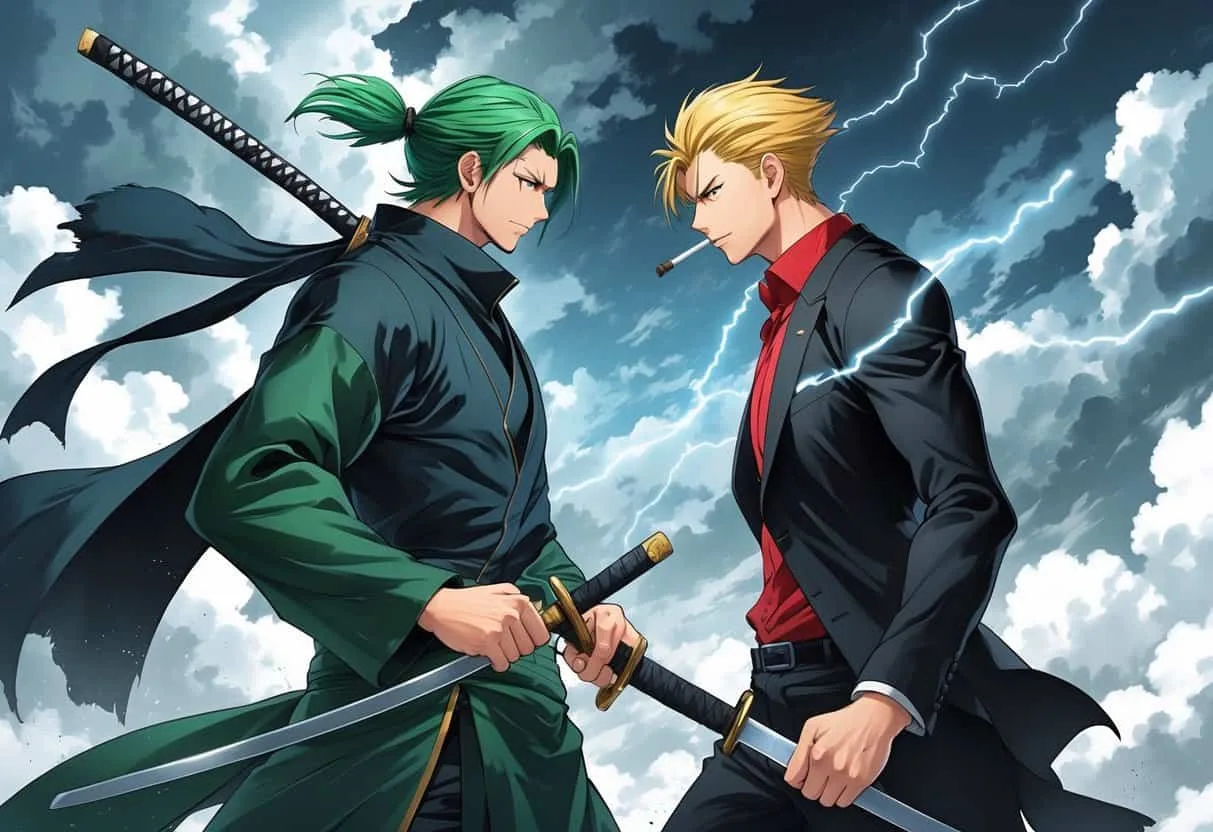
Foundations of Identity: Childhoods Shaped by Loss and Vows
To understand the divergence in their development, one must first look at the bedrock of their personalities—the childhoods that forged their dreams and the promises that drive them.
Zoro’s Oath to a Fallen Rival
Roronoa Zoro grew up in Shimotsuki Village, where his ambition to become the world’s greatest swordsman ignited after repeated defeats at the hands of Kuina. Her untimely death transformed his competitive spirit into a solemn vow: he would carry her legacy and his own ambition to a pinnacle no one else could reach. This backstory, as documented on Zoro’s One Piece Wiki page, is foundational to his character. His goal is singular and external: to surpass Dracule Mihawk. That singularity gives Zoro a clarity of purpose that rarely wavers.
He does not question his path; he simply trains, fights, and endures. This lack of internal conflict is a strength in terms of narrative reliability, but it also limits the range of emotional transformation he undergoes. Zoro’s growth is linear and measurable—he acquires new techniques, hones his Haki, and collects scars. His past, though tragic, becomes a catalyst for relentless forward motion, not a source of ongoing psychological tension.
Sanji’s Split Identity: Germa’s Reject and Zeff’s Heir
Vinsmoke Sanji’s childhood is a study in duality. Born into the genetically enhanced Germa 66 kingdom, he was deemed a failure by his father Judge for retaining human emotions. His escape, aided by his sister Reiju, led him to the Baratie and the gruff mentorship of “Red Leg” Zeff. The comprehensive Sanji page on the One Piece Wiki details how his profound empathy and refusal to waste food are direct responses to his early trauma. Unlike Zoro, Sanji’s core identity is built on a contradiction: he is both the compassionate cook who dreams of the All Blue and the heir to a biological family of ruthless soldiers.
This split plants seeds of internal conflict that would not fully bloom until the Whole Cake Island arc. Even before that reveal, Sanji’s chivalry—a defining trait—was a self-imposed code he crafted to differentiate himself from his violent upbringing. His development is not a straight line; it is a series of confrontations with his own past, his worth, and the limits of his kindness.
The Philosophy of Strength: Loyalty as Identity vs. Conviction as Growth
Both Zoro and Sanji are fiercely loyal to Monkey D. Luffy, but they express that loyalty through fundamentally different philosophical lenses. These lenses dictate how they process failure, sacrifice, and personal growth.
Zoro’s Unshakeable Anchor: Strength Through Suffering
Zoro’s loyalty is often portrayed as a silent, immovable force. In the celebrated “Nothing Happened” moment on Thriller Bark, he absorbs all of Luffy’s pain from Kuma without a word, later brushing off inquiries with stoic indifference. This act cements his role as the crew’s shield, willing to die not just for Luffy but for the dream Luffy carries. Zoro’s development focuses on the physical and mental capacity to endure. His training under Mihawk during the two-year timeskip sharpened his Armament Haki and sword skills, but his worldview remained largely unchanged.
He emerges stronger, but not necessarily emotionally evolved. For Zoro, growth means becoming a more reliable weapon. The purity of this approach is admirable, yet it means his arcs rarely peel back layers of vulnerability. When he kneels to Mihawk and begs for training, it is a moment of profound humility, but it still serves the external goal of surpassing his teacher. Zoro’s internal state is a fortress; few walls ever come down.
Sanji’s Fractured Code: Kindness as Rebellion
Sanji’s loyalty is active, nurturing, and frequently tested by his own insecurities. He does not merely protect the crew; he feeds them, frets over Nami and Robin, and serves as a tactical wildcard who often operates away from the main fight. The Whole Cake Island arc forces Sanji to confront his deepest fears: that his Germa blood makes him a monster, and that his absence will destroy the crew he loves. His decision to sacrifice his own happiness by agreeing to marry Pudding, and later his heartbreaking discovery that his family never truly changed, catalyze a developmental leap that is unique among the Straw Hats. Sanji finally accepts that he is both a Vinsmoke and a Baratie cook—and that neither label fully defines him.
This reconciliation of his dual heritage marks a genuine psychological transformation. Where Zoro’s post-timeskip growth plateaus in the realm of combat, Sanji’s expands to encompass self-acceptance, forgiveness, and a more mature application of his chivalrous code. He learns that kindness isn’t weakness, even in a world of pirates.
Pivotal Storylines That Defined Them
A direct comparison of specific arcs reveals how Oda designed their growth trajectories. While both characters shine in battle, the narrative weight behind their personal stories creates a stark contrast in developmental texture.
Enies Lobby: Sacrifice and the Birth of a Monster
The Enies Lobby saga is a crucible for the entire crew, but Zoro and Sanji showcase their philosophies of sacrifice differently. Zoro’s physical ordeal against Kaku and his contribution to bringing down the CP9 agents highlight his relentless combat evolution. His new Ashura technique is a visual spectacle of his will manifesting as power. Yet the true emotional core of Zoro’s journey in this arc lies in his unwavering belief in Luffy’s order to shoot down the World Government flag. He doesn’t question; he executes.
This is a testament to his trust, but not a source of internal character change.
Sanji, meanwhile, operates in the shadows, disabling the Gates of Justice and later facing Jabra with a mix of tactical brilliance and raw emotion. His chivalry is directly tested when Kalifa refuses to fight, and Sanji’s refusal to strike a woman, even at the cost of his own safety, shows that his principles are not situational. The arc also teases the layers of his past that would only be unpacked much later. Sanji’s growth here is subtle—he learns to trust the crew to handle threats without him, a step toward shedding his lone-wolf tendencies. The emotional stakes for Sanji in Enies Lobby, while not as overt as his later arcs, start to crack the facade of the unflappable cook.
Thriller Bark to Sabaody: The Limits of Sacrificial Thinking
Thriller Bark gives Zoro the iconic moment that fans still hail as his finest hour. By taking Luffy’s accumulated pain and fatigue, Zoro literally shoulders the captain’s burden. This act does not change who Zoro is; it demonstrates the absolute peak of who he has always been. In contrast, Sanji’s own attempt to sacrifice himself for Luffy and Zoro, intercepted by Zoro’s knockout blow, reveals a competitive altruism. Sanji’s willingness to die is just as strong, but he is deprived of the martyr’s moment.
This narrative choice preserves the uniqueness of Zoro’s sacrifice while highlighting Sanji’s own selflessness—yet it also begins to underscore a pattern: Sanji’s personal growth often involves being denied the dramatic, solitary redemption he craves, forcing him to find worth through interdependence rather than solitary martyrdom.
Whole Cake Island: Sanji’s Emotional Crucible
No arc in One Piece has so profoundly reshaped a Straw Hat’s emotional landscape as Whole Cake Island did for Sanji. The revelations about his Vinsmoke lineage, the arranged marriage to Charlotte Pudding, and the cruel mockery of his cooking by his own brothers shatter his self-image. Sanji’s internal monologues—crying alone in the rain, admitting to his sister that he cannot hate his abusive family—provide a level of psychological depth unprecedented for any Straw Hat, including Zoro. His defeat of the notion that he must bear everything alone culminates in his plea to Luffy for help, a moment of vulnerability that stands in stark contrast to Zoro’s solitary absorption of pain in Thriller Bark. Where Zoro’s response to crisis is to isolate and endure, Sanji’s is to finally reach out.
This arc transforms Sanji from a character defined by his cooking and chivalry into a man who has faced his worst fears and chosen the family that earned his love.
Even Sanji’s combat abilities evolve through this emotional growth. The Raid Suit, a relic of his hated past, becomes a tool he reluctantly accepts and later modifies to preserve his identity (eventually discarding its invisibility for a transparent version that symbolizes his renunciation of Germa’s underhandedness). No equivalent internal struggle propels Zoro’s power-ups; his training is always a clear route to a defined goal. Sanji’s strength is reforged in the furnace of identity crisis.
Wano and Beyond: Parallel Contributions, Separate Journeys
The Wano arc places both warriors in monumental battles—Zoro against King, Sanji against Queen. Zoro’s confrontation with his own lineage as a descendant of Wano’s Shimotsuki clan is touched upon, but it doesn’t fundamentally alter his personality or motivations. He gains Enma, a blade that forces him to control his Haki output, which is a technical challenge, not an existential one. Sanji, however, faces Queen while grappling with the fear that the raid suit has awakened his latent Germa modifications, including a hardened exoskeleton and enhanced strength. His terror of becoming a soulless weapon like his siblings forces him to destroy the raid suit and consciously reject the cold, emotionless power his father valued.
He embraces his fire-based Diable Jambe as a manifestation of his burning passion—the exact opposite of Germa science. This choice crystallizes his entire developmental arc: he will be strong, but only on his own terms, as a cook who feels deeply. The post-Wano updates continue to show Sanji refining this identity, while Zoro’s growth remains largely confined to the realm of swordsmanship milestones.
Interpersonal Dynamics: The Bonds That Forged Growth
Growth rarely occurs in isolation; it is reflected through relationships. Zoro and Sanji’s interactions with the crew, their mentors, and each other reveal the distinct engines driving their development.
Influence of Luffy and the Straw Hat Crew
Luffy’s leadership is a catalyst for both characters, but the nature of that influence differs. Zoro sees Luffy as the man he has chosen to follow—a captain whose dream is worth dying for. Their bond is built on unspoken trust and mutual recognition of strength. Zoro’s loyalty is an extension of his samurai-like code, and Luffy’s unwavering belief in Zoro’s ability reinforces the first mate’s sense of purpose. There is little need for conversation; actions suffice.
Sanji’s relationship with Luffy is more overtly emotional. Luffy’s simple declaration at Whole Cake Island—“I can’t become the Pirate King without you!”—shatters Sanji’s isolation and grants him permission to be wanted for who he is, not for his utility. The crewmates also serve different functions. Nami’s intelligence and Robin’s scholarly calm often draw out Sanji’s protective instincts in ways that force him to confront the limits of his chivalry. His interactions with Chopper and Usopp show a nurturing side that contrasts with Zoro’s brusque, big-brother sternness.
While Zoro’s role is to be the unshakeable vice-captain, Sanji’s is the crew’s emotional glue, and that position requires far more interpersonal adaptation.
Mentors: Mihawk’s Blade and Zeff’s Kitchen
The mentor figures they carry within them speak volumes. Zoro’s relationship with Dracule Mihawk is defined by rivalry and respect. Mihawk embodies the peak Zoro seeks, and Zoro’s growth is a constant effort to close that gap. This mentorship is transactional in the best sense—training in exchange for the promise of a future duel that will determine the world’s greatest swordsman.
Sanji’s mentor, Zeff, gave him far more than combat technique; he gave him a moral compass. The infamous story of Zeff eating his own leg to ensure Sanji survived is the ultimate lesson in sacrifice and the sanctity of food. The Baratie chefs shaped Sanji into a man who would rather feed an enemy than see them starve. This foundational training is not about surpassing Zeff; it’s about honoring a legacy of compassion. Every time Sanji refuses to kick a woman or feeds a hungry stranger, he is actively reinforcing a choice that defies his Germa blood.
That constant, conscious choice is ongoing character development, whereas Zoro’s training under Mihawk was a means to an already fixed end.
The Zoro-Sanji Dynamic: Rivalry as a Mirror
Their constant bickering and one-upmanship are more than comic relief; they are a mechanism for mutual refinement. Zoro’s cool-headed directness often directly criticizes Sanji’s emotional outbursts, while Sanji’s tactical, protective style exposes the rigidity in Zoro’s lone-wolf approach. The fan nickname “Zosan” has inspired extensive creative work, as readers recognize that the two are mirrors—each driving the other to prove their worth. Yet in terms of who changed because of this rivalry, Sanji’s character has shown more visible adaptation. Zoro remains largely the same sarcastic, sake-loving swordsman, while Sanji’s worldview—from his initial hot-headed cruelty toward Zoro to a more grudging, respectful partnership—has gradually softened and matured.
The Davy Back Fight, Skypeia, and later arcs show that Sanji is capable of learning from Zoro’s steadfastness, even as he mocks it.
Emotional Depth vs. Unwavering Resolve: Who Wins in Development?
Evaluating “better” character development requires a metric. If one defines it as psychological transformation, Sanji clearly takes the lead. His journey from a self-sacrificing, overly emotional cook to a man who has reconciled his dual heritage, accepted his own weaknesses, and redefined his strength on his own terms is a classic coming-of-self arc. The emotional register of his story—shame, longing, compassion, and righteous fury—is broader and more vividly drawn. His flaws are more visible, making his victories more cathartic.
If, however, development is defined by the unwavering pursuit of a dream against all odds, Zoro is the exemplar. His simple, relentless climb toward the title of World’s Strongest Swordsman is a pure distillation of ambition. He does not need to change because he represents an ideal already achieved in spirit. His occasional moments of strategic brilliance (like warning Luffy about Usopp’s return during Water 7) show depth, but they are flashes of a stable personality, not signs of ongoing evolution. Zoro is a complete character from early on, while Sanji is a work in progress that the narrative continually builds and rebuilds.
Impact on the Fandom and the One Piece Legacy
Both characters have left indelible marks on the series and its global community. Zoro’s “Nothing Happened” scene and his constant, badass one-liners have cemented him as a fan-favorite for those who admire stoic strength. The official One Piece anime available on Crunchyroll showcases his epic battles with cinematic weight. Sanji, however, has become a touchstone for discussions about emotional trauma, toxic masculinity, and the heroism of caregiving. His refusal to hit women, often debated among fans, is a deliberately uncomfortable stance that Oda uses to challenge readers’ notions of strength.
The Whole Cake Island arc, in particular, is frequently cited in critical analyses as one of the best character-driven stretches of the entire series.
In fandom spaces, the Zoro vs. Sanji debate thrives precisely because each represents a different flavor of heroism. Zoro is the blade that never bends; Sanji is the flame that adapts and reignites. But when measuring who had the better character development—meaning who underwent the most meaningful, layered, and transformative arc—Sanji’s journey stands as a richer, more complex narrative. He is a testament to the idea that true strength lies not in being unbreakable, but in having the courage to break and choose to rebuild.
In the end, both characters are essential to the Straw Hats’ voyage, and their combined presence elevates the story. Yet it is Sanji, with his countless internal battles and hard-won self-acceptance, who delivers the most deeply human narrative of growth—one that mirrors the messy, beautiful process of becoming who you’re truly meant to be.