Table of Contents
Few anime rivalries carry the weight and nuance of the clash between Yugi Muto and Seto Kaiba. It’s a conflict etched into the DNA of Yu-Gi-Oh!, stretching from the earliest episodes to the climactic cinematic battles. Kaiba steps onto the field with a single-minded obsession—victory as proof of his own worth. Yugi duels from a different place entirely, anchored by friendship, the mysterious power of the Millennium Puzzle, and a genuine love for the game itself. That fundamental divide transforms every match they play into something far more layered than a simple contest of cards.
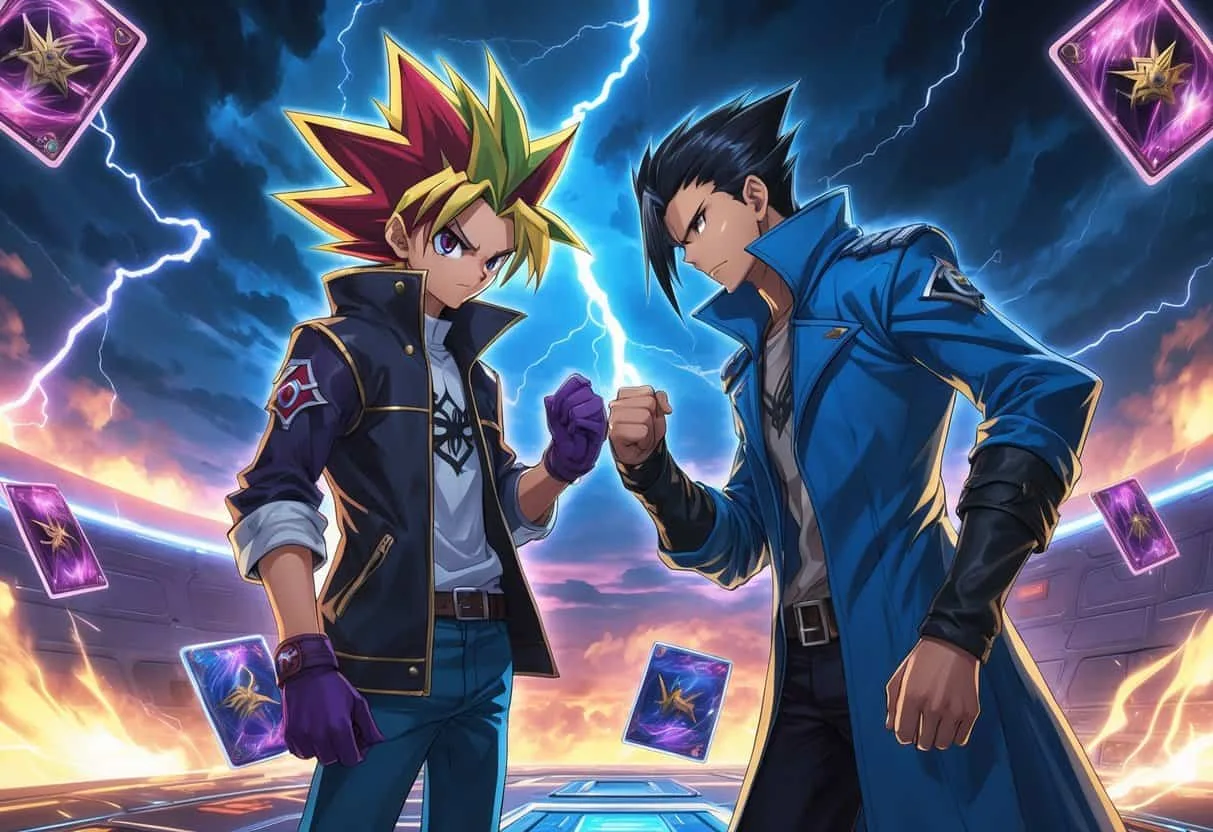
To understand the rivalry is to understand the engine of the entire series. It’s not merely a question of who claims the win. Their relationship ignites the moment Kaiba recognizes that Yugi poses the only genuine threat to his carefully constructed ego and empire. Over time, their duels became cultural touchstones—moments that forced audiences to care deeply about both competitors. Every draw of the cards pulls back layers of pride, trauma, destiny, and a strange, unspoken bond that neither would ever comfortably admit.
Key Takeaways
- The Yugi-Kaiba dynamic is the emotional and philosophical core of Yu-Gi-Oh!, driving the narrative across multiple arcs.
- Their duels consistently expose the raw motivations behind each player: ego and self-validation versus protection and personal growth.
- This rivalry not only elevates both characters but also shapes the development of those around them, from Mokuba to Joey Wheeler.
The Origins and Evolution of Yugi and Kaiba's Rivalry

The rivalry didn’t bloom from a simple misunderstanding. It emerged from a collision of two completely different worldviews, each powered by deep-seated personal history. From their first confrontation, the battle lines were drawn not just in cards, but in the very reasons they held a deck.
The First Encounter
You witness the ignition point when a brash, tech-billionaire prodigy dismisses a seemingly ordinary high school student. Kaiba, armed with unmatched resources and a belief in his own superiority, views the game as a tool for dominance. Yugi, far less experienced in competitive circuit play, carries the Millennium Puzzle, an artifact that houses the spirit of an ancient pharaoh. That first duel is a masterclass in contrast: Kaiba’s cold, calculated aggression versus a playing style rooted in adaptability and an almost spiritual trust in the draw. It’s where Kaiba’s entire identity gets rocked, and from that moment, the rivalry becomes an unshakable obsession.
Personal Motivations and Rivalry Dynamics
Kaiba’s drive is not a cartoonish desire for power. It traces back to a harsh childhood and the crushing weight of being orphaned, then adopted into a family that valued ruthless ambition. Dueling becomes his vehicle for total control—a way to build a legacy that no one can take from him. He needs to be undefeated because losing would unravel the identity he’s pieced together. Yugi’s motivations sit on the opposite end.
He duels to shield those he cares about and to honor the enigmatic bond he shares with the spirit of the Millennium Puzzle. There’s no empire to protect, only promises and people. This asymmetry fuels a unique dynamic: Kaiba pursues victory like air, while Yugi chases understanding. The result is a rivalry where one party never stops returning for more, not because he’s evil, but because Yugi is the only mirror that reflects his own unfinished self.
Character Development Across the Series
Stretching from Duelist Kingdom to the Dark Side of Dimensions film, the rivalry works as a dual character study. Early Kaiba is laser-focused and emotionally isolated, yet repeated exposure to Yugi—and his own failures—forces him to evolve. He broadens his horizons, caring more about his younger brother Mokuba and the future of KaibaCorp. Yugi’s growth is just as significant. Beginning as a quiet, uncertain boy, he matures into a confident leader who can stand on his own even without the Pharaoh’s direct intervention.
Each duel acts as a catalyst, pushing them further into self-discovery. The conflict is never static; it’s a conduit for genuine transformation.
Iconic Duels and Rivalry Highlights
No other pair in the franchise produces the same electric tension when their duel disks activate. Across multiple tournaments and alternate dimensions, certain matches stand as definitive moments—each escalating stakes and revealing new layers of their complex relationship. Signature monsters like the Blue-Eyes White Dragon and the Egyptian God Cards become extensions of their wills.
Duelist Kingdom Face-Offs
Duelist Kingdom serves as the proving ground. Here, the rivalry transitions from a personal grudge into a public spectacle. Kaiba arrives with an arsenal built around overwhelming force, most notably his trio of Blue-Eyes White Dragons. Yugi, supported by the alter ego of Pharaoh Atem, relies on strategic foresight and an almost poetic sense of timing. Their match on Pegasus’s island is a collision of raw power and clever adaptability.
It sets the tone for everything that follows: Kaiba throws everything he has at his opponent, only to be met by a resolve that brute strength can’t break. It’s a foreshadowing that the scoreboard isn’t all that matters.
Battle City Tournament Showdowns
Battle City ramps up the intensity dramatically. The introduction of the Egyptian God Cards—especially Obelisk the Tormentor, which Kaiba aggressively pursues—transforms duels into mythological clashes. Kaiba believes the God Card will grant him invincibility, but Yugi counters with a deeper understanding of the cards’ spiritual weight and his unshakeable bond with the Pharaoh. These matches evolve into intricate psychological warfare. Each player learns to anticipate the other’s strategies, leading to sequences that feel less like a card game and more like a cerebral chess match between two minds that know each other’s weaknesses intimately.
The tension stems from Kaiba’s fear of being outclassed permanently, a dread that forces him to constantly innovate his approach.
Ceremonial Duel and Final Battles
The Ceremonial Duel abandons external stakes for something far heavier: emotional release and ancestral duty. It’s not merely a match to determine a winner; it’s a ritual to allow the spirit of Atem to pass on. Yugi fights here not with the Pharaoh taking over, but as himself, proving his own growth. Kaiba, while not a direct participant in the ceremony in the same way, is inextricably tied to this arc through his unrelenting desire to duel the Pharaoh one last time. The atmosphere is thick with mutual recognition—after years of conflict, there’s a silent acknowledgment that this rivalry has given both of them purpose beyond victory.
The Dark Side of Dimensions Confrontation
In The Dark Side of Dimensions, technology collides with ancient magic in spectacular fashion. KaibaCorp’s advancements, including the Solid Vision system that renders duels with terrifying realism, are pushed to their limits. Kaiba’s obsession reaches its apex as he literally builds a device to transcend dimensions, driven solely by the need to stand across from the Pharaoh again. Yugi, now fully his own duelist, carries the legacy of the Millennium Puzzle without the spirit that once defined him. The duel features unprecedented power, including the upgraded Neo Blue-Eyes Ultimate Dragon, and demonstrates that the rivalry has outgrown its origins.
It’s no longer about titles; it’s about a fundamental human connection that neither can sever.
Core Themes, Key Cards, and Supporting Influences
The Yugi-Kaiba dynamic reaches far beyond the duel disk. Signature cards become psychological profiles. Friends and family ground each competitor in reality. And beneath every draw lies a web of themes—trust, destiny, technology, and an ancient Egyptian legacy—that elevates the conflict.
Signature Cards and Strategic Divergence
Kaiba’s entire philosophy is contained within the Blue-Eyes White Dragon. It’s a card of immense power, rare elegance, and a destruction-oriented design. He favors fusion plays, combining monsters with Polymerization to command the field with entities like the Blue-Eyes Ultimate Dragon. His strategy is overwhelmingly offensive: establish a dominant board presence and crush resistance with relentless force. Yugi’s deck, anchored by the Dark Magician, operates differently.
It thrives on synergy, trap cards, and tactical pivots. The Millennium Puzzle deepens this style, as it connects Yugi to a reservoir of ancient instinct. While Kaiba leans on technological precision and linear power curves, Yugi’s play is notably organic—his greatest strength is turning an opponent’s aggression into a fatal flaw.
Supporting Cast and Their Ripple Effect
No rivalry exists in isolation. Mokuba Kaiba offers the single most important window into Seto’s humanity, consistently reminding the audience that behind the cold exterior is an older brother willing to sacrifice everything. On Yugi’s side, Joey Wheeler, Téa Gardner, and Tristan Taylor provide unwavering emotional support, reinforcing the theme that dueling is a shared experience rather than a solitary climb. Antagonists like Malik and Yami Bakura push both rivals into territory that tests their moral codes and resilience. This wider cast doesn’t dilute the central conflict; it enriches it, providing stakes that resonate beyond the battlefield.
Trust, Respect, and the Unspoken Bond
In the earliest episodes, every interaction crackles with disdain. Kaiba’s every action is a declaration of superiority, and Yugi’s victories are a direct affront to his worldview. Over time, though, the edges soften. Moments of grudging respect emerge—Kaiba acknowledges, even if silently, that Yugi is the only duelist who has ever pushed him to the brink. The dynamic transforms from pure antagonism into something akin to a challenging friendship built not on affection but on the profound recognition of another’s strength.
There’s a stubbornness in both that, paradoxically, creates a bond. Neither would label the other a friend, but their actions betray a connection that goes far beyond casual competition.
Ancient Egypt, Destiny, and Technological Ambition
Yugi’s story is steeped in the mysticism of ancient Egypt, all funneled through the Millennium Puzzle. The artifact houses Atem, a pharaoh’s spirit, and ties Yugi’s every duel to concepts of fate, memory, and identity. This ancient backdrop grants his journey a mythic scale, with themes of balance between light and dark. Kaiba stands in stark opposition, representing the future: a world built by innovation, corporate might, and self-determination. There’s no mystical legacy backing him, only the sheer force of his will.
This thematic clash—destiny versus self-made ambition—runs parallel to the card duels, making every face-off a conversation between two philosophies about what it means to be powerful.
| Element | Yugi’s Side | Kaiba’s Side |
|---|---|---|
| Signature Card | Dark Magician | Blue-Eyes White Dragon |
| Strategy | Adaptability, combos | Power, fusion, aggression |
| Core Motivation | Protect friends, destiny | Obsession to be the best |
| Key Relationships | Allies like Joey, Téa | Mokuba, business rivals |
| Overarching Theme | Ancient Egypt, mysticism | Technology, ambition |
The Psychology of Obsession and Connection
Peeling back the surface reveals a rivalry defined by two contrasting psychological drives. Kaiba’s obsession is not a simple flaw; it’s a survival mechanism. From the moment he was orphaned, he learned that vulnerability equals loss. Dueling became the arena where he could rewrite that script—if he wins, he sets the terms of his own existence. Losing to Yugi, then, is not just a mark on a record; it is an existential earthquake that threatens the foundation of his self-worth.
That’s why he never stops coming back, constructing increasingly elaborate plans to secure a victory that will finally bring him peace.
Yugi’s connection to dueling operates on an entirely different frequency. He plays to understand, to reach out, and to fulfill a role he never asked for. The presence of the Pharaoh within the Millennium Puzzle gives him access to ancient wisdom, but it also burdens him with a destiny that often conflicts with his gentle nature. His victories are rarely about domination; they are about restoring balance or protecting the people standing behind him. This psychological gap—obsession versus connection—is what makes every duel unpredictable.
Kaiba brings ferocity; Yugi brings resilience. Neither can fully comprehend the other’s engine, and that incomprehension keeps the rivalry alive and raw.
Legacy, Cultural Impact, and Modern Reflections
Few rivalries in anime have shaped a franchise’s identity as completely as this one. The Yugi-Kaiba dynamic is often cited as a gold standard for how to construct a long-term competitive relationship that fuels character growth instead of stalling it. The structure of the original Yu-Gi-Oh! series essentially revolves around their clashes, with each arc building toward the next inevitable confrontation. Merchandise, from the legendary Dark Magician Girl to the ever-iconic Blue-Eyes White Dragon statues, continues to sell specifically because these characters represent more than a deck archetype—they symbolize opposing worldviews that resonate with fans.
Furthermore, the rivalry’s influence persists in the modern game. Many competitive players cite the anime’s depiction of the Kaiba-versus-Yugi mindset as a formative influence on how they approach deck building: the tension between relentless consistency (Kaiba’s style) and adaptable, reactive play (Yugi’s style) remains a real strategic debate. The release of new support cards for both Dark Magician and Blue-Eyes decks in the actual trading card game speaks to the enduring marketability and emotional pull of the rivalry. For a thorough analysis of how the anime shaped competitive play, resources like the Yugipedia community wiki offer deep dives into deck evolutions tied to the anime arcs.
In the broader context of pop culture, the rivalry has been referenced in discussions about character design and narrative structure. Critics often point to the Battle City arc as a turning point where the duels transcended simple good-versus-evil, embedding complex personal stakes. The Dark Side of Dimensions film, in particular, drew praise for its willingness to explore Kaiba’s almost tragic inability to move on from the past, cementing his status as a character far more layered than a typical “rich rival” archetype. The legacy is one of balance: a rivalry that never truly ends, leaving room for interpretation and keeping the flame alive for future generations of duelists.