Table of Contents
Understanding Yami Yugi: Origins and Duality
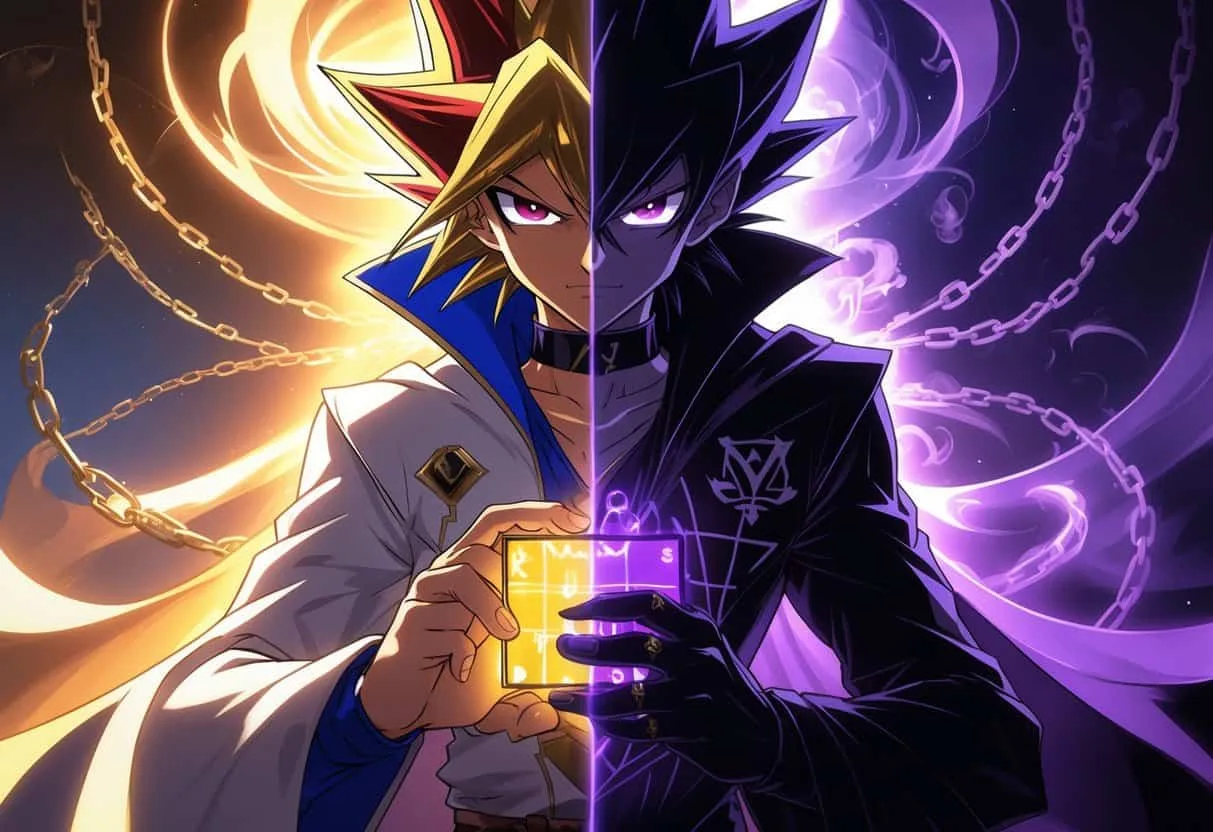
To fully understand Yami Yugi’s moral complexity, you have to examine his formation. The spirit bound to the Millennium Puzzle, the shared consciousness with Yugi Muto, and a personality shaped by ancient traditions all contribute to a figure who defies simple categorization. His ethical framework draws from sources that are inherently conflicted, blending protector instincts with the severity of an old-world ruler.
The Spirit of the Millennium Puzzle
Yami Yugi’s existence begins with a profound dislocation. For over three thousand years, his soul remained anchored inside the Millennium Puzzle, a relic crafted through forbidden Egyptian alchemy and immense sacrifice. This spirit is the incomplete memory of Pharaoh Atem, a king who sealed his own identity to safeguard dark forces. When Yugi Muto assembled the puzzle, it didn’t just release a ghost—it fused a fractured psyche with a modern host. The puzzle itself operates as a conduit for ancient energy, granting Yami Yugi dominion over Shadow Games and occult penalties that mirror the rituals of judgment from his era.
This background is critical because it means his approach to conflict isn’t whimsical; it’s a continuation of a kingly mandate where games were literal life-or-death trials for the soul.
The Dual Nature of Yami Yugi and Yugi Muto
The juxtaposition of Yami Yugi and Yugi Muto creates a dynamic psychological tension. Yugi is empathetic, soft-spoken, and often hesitant to escalate conflict. Yami, by contrast, materializes with a steely resolve, an unyielding gaze, and a willingness to impose harsh sanctions. Their body-sharing arrangement means that actions are filtered through two distinct value systems. When Yami takes control during a duel, he isn’t merely playing a card game; he is executing a verdict.
This duality forces you to confront whether his authoritarian methods stem from genuine protection or a cold, punitive nature. He uses intimidation not as cruelty for its own sake, but as an instrument to dismantle opponents’ malice—yet the line between tool and tyranny remains perilously thin.
Historic Influences on Character Morality
Pharaoh Atem’s mindset was forged in an epoch where sovereignty was synonymous with divine judgment. Ancient Egyptian kingship carried the dual duty of shepherding the people and annihilating chaos, often through severe measures. Yami Yugi inherits this moral legacy, interpreting perceived threats through the lens of a ruler who regards leniency as potential catastrophe. This historical context illuminates why his decisions rarely feel purely benevolent. He mirrors figures like the mythological Osiris, who offered resurrection but also presided over judgment of the unworthy.
The resultant ethic is a pragmatic, sometimes brutal calculus focused on cosmic order rather than personal sentiment. This perspective makes him neither a simple savior nor a straightforward despot; he operates in a gray zone where the preservation of good demands the crushing of evil, without tidy democratic oversight.
Savior or Menace: Yami Yugi’s Moral Judgments
Yami Yugi’s sense of justice is a complete puzzle. He tries to protect the innocent, but his punishments can get intense. Shadow Games aren’t just some flashy trick—they’re tied to his own ideas about what’s right and wrong.
Motivations Behind Shadow Games
When Yami Yugi initiates a Shadow Game, you’re seeing more than a strategy to win a duel. These confrontations are his primary mechanism for facing down corruption. He targets individuals who exploit the vulnerable or defile the sacred bonds of friendship. The games impose a psychic mirror, forcing antagonists to internalize their misdeeds through visceral, often terrifying illusions. His motivation isn’t fame or conquest; it’s an ancient, almost instinctual drive to excise evil from the world he now occupies.
However, this drive is laced with a personal code that doesn’t always accommodate modern sensibilities about rehabilitation. He believes that true remorse must be beaten into the soul through a trial of suffering, which raises persistent doubts about whether his ends justify his means.
Justice Versus Vengeance
No debate about Yami Yugi is more central than the distinction between justice and vengeance. In episodes like the “Mind Crush” penalty against Seto Kaiba, you see him systematically dismantle a rival’s psyche to cure a corrupted heart. Was this a therapeutic excision of malice, or a vengeful act of psychological destruction? The evidence cuts both ways. Critics in-series, like Katsuya Jonouchi, sometimes react with horror at the darkness of these penalties.
Yet Yami rarely acts out of pure spite; his targets are almost always active tormentors of others. This liminal space between retribution and prevention is where his true moral ambiguity resides. He doesn’t merely punish past actions; he attempts to forcibly reshape the perpetrator’s future, which can feel both redemptive and despotic depending entirely on your tolerance for authoritarian benevolence.
Consequences for Villains and Bystanders
The fallout from Yami Yugi’s Shadow Games resonates far beyond the immediate loser. Villains like the player killer “The Murderer” at the Duellist Kingdom or the crooked broadcaster at Domino City do face severe, life-altering punishments including temporary madness or spiritual collapse. But the effect on bystanders is equally profound. Yugi’s normal friends witness the terrifying darkness radiating from their protector, creating a persistent undercurrent of fear. The collateral psychological cost is rarely quantified in the narrative.
Imagine being Anzu Mazaki, cheering for a friend while glimpsing the capacity for immense cruelty behind his eyes. This dissonance strains the social fabric of the group and forces characters—and you—to continuously reassess whether the safety he provides is worth the moral damage inflicted on everyone’s sense of security.
Evolution of Yami Yugi’s Ethics Throughout the Series
The trajectory from merciless enforcer to a more tempered guardian is one of the most scrutinized arcs in the franchise. You can map this ethical growth across distinct story phases, where external relationships and personal discoveries progressively soften his judgment without eliminating his fundamental sternness.
Early Ruthlessness in Shadow Games
During the initial chapters and the first season, Yami Yugi operates with an almost mechanical severity. He challenges a bullying hall monitor to a game where the man loses his sanity, forces a escaped convict into feeling his own arson as real flames, and subjects a rival model to a skin-crawling illusion of decay. Each penalty is a zero-tolerance message. There’s no space for dialogue, no incremental warning system—just sudden, total psychological condemnation. This period reveals a Pharaoh who hasn’t yet grappled with the nuance of living human relationships.
His ego is colossal; the concept of losing a game equates to a failure of divine justice, so he channels every ounce of his power into absolutely certainty of outcome, making him appear chillingly tyrannical to anyone who values procedural fairness.
Changing Views on Mercy and Redemption
The Battle City tournament marks a turning point in Yami’s philosophy. Facing a repentant opponent, or recognizing genuine courage in an enemy, begins to mellow his judgment. He spares the life and dignity of the duelist Pandora, whose earlier suicide threat suggested profound mental instability, and he shows restraint with Strings, an animated puppet of Marik’s manipulation. Rather than obliterating the tool, he targets the master, displaying a new capacity for differentiated judgment. This shift doesn’t make him weak; it makes him accurate.
He learns that some minds are salvageable and that excessive punishment can create more darkness than it erases. His decisions become less about satisfying a personal code of retribution and more about genuinely neutralizing threats while preserving the possibility of reform.
Influence of Companions on His Decisions
The weight of his friendships—especially the bond with Yugi Mutou—functions as an ethical anchor. Yugi’s quiet bravery and insistence on seeking the good in others directly challenge Yami’s default harshness. In critical moments, such as the duel against Kaiba atop the Duel Tower, Yami’s comrades verbally intervene to stop him from launching a revenge-driven fatal attack. They remind him that their fight isn’t for dominance but for peace and protection. This emotional scaffolding allows Yami to evolve from a solitary king into a member of a community.
The consistent voice of Tea Gardner’s compassion and Joey Wheeler’s rough-hewn loyalty collectively teach him that strength doesn’t exist in a vacuum—it becomes aristocratic tyranny without the humility to listen to others.
The Ceremonial Duel and Final Moral Reckoning
The ultimate test of Yami Yugi’s character arrives in the final arc, where he must confront not an external villain but the embodiment of his own journey. The face-off against Yugi Muto in the ceremonial battle serves as a ritualized audit of his entire existence.
This duel isn’t about winning or losing; it’s a metaphorical trial where Yugi proves to Yami that his methods of leadership and protection have successfully fostered a strong, independent partner. For the first time, Yami faces an opponent he fully trusts and loves. You can see the evolution in his posture and dialogue. The cold, detached aura melts away into something more vulnerable. He still plays with fierce intelligence, but the predatory darkness is absent because he has nothing to punish.
This moment concretizes his journey from a spirit who believed in punishment as power, to a man who understands that the greatest strength is empowering others to stand without fear.
Legacy and Debate: Lasting Impact on Fans and Media
The conversation around Yami Yugi continues to pulse through fan communities and critical analyses, ensuring his moral complexity remains a hot text for discussion across generations of viewers.
Cultural Reception of Yami Yugi’s Actions
Online forums, from Reddit to dedicated fan boards on sites like MyAnimeList, are saturated with debates about whether Yami is a protagonist or a necessary antihero. Some audiences celebrate his decisiveness as a refreshing break from conflicted heroes, arguing that the harsh penalties are perfectly scaled to the fantasy world’s extreme villains. Others recoil, pointing to the Mind Crush and early Penalty Games as clear violations of ethical boundaries that betray a sadistic streak. Cosplayers and fan artists often emphasize his dual aspect, splitting their portrayals between the stoic savior in latex pants and the narrowed-eye punisher wielding shadows. This polarized reception proves that the character refuses to be comfortably canonized as purely good.
Morality in Franchise Continuations and Adaptations
Later Yu-Gi-Oh! media, including Dark Side of Dimensions and various video games like Duel Links, retroactively enrich the debate. In the movie, Yami’s legacy is felt through the palpable grief and strength of his friends, reframing his harshness as a temporary necessity for growth rather than an inherent flaw. Interactive adaptations allow players to make choices that simulate his judgment calls, forcing a personal engagement with the “savior vs. tyrant” dilemma. Critical essays on platforms like Anime News Network have analyzed his character through the lens of ancient kingship ethics, noting how later series like VRAINS echo his themes of digital punishment. Even the official Konami card game strategy site sometimes leans into his lore, framing powerful trap cards as extensions of his punitive style.
This multi-platform reflection embeds him permanently into the discourse on justice in animation.
Philosophical Interpretations of the Shadow Tyrant
Digging deeper, you can situate Yami Yugi within broader philosophical constructs of power. His approach mirrors the “noble lie” concept where a ruler withholds or manipulates truth for social order, except his weapon is existential terror. Some commentators have linked his early behavior to the ideal of the Platonic guardian—a figure who imposes order because they possess knowledge and strength others lack. However, his later evolution repudiates this elitism by surrendering control to Yugi’s moral conscience. This narrative arc suggests a maturation from an absolutist ethical system into a more democratic, relational model of protection.
Looking at resources like the scholarly breakdown on ResearchGate for papers on anime morality, you find that Yami often serves as a case study in how pop culture figures personify the dangerous allure of benevolent dictatorship. The fact that he ultimately passes the final test by trusting his partner suggests a core message: any authority, no matter how well-intentioned, must eventually relinquish absolute power to become truly good.
Ultimately, Yami Yugi’s moral character exists as a coiled tension between his Pharaonic duty and his emergent humanity. He never becomes a soft, merciful figure in the traditional sense. Instead, his growth lies in learning when to lift his enormous weight of judgment and allow others to bear their own burdens. You can call him a savior because he saves souls from eternal darkness, or you can call him a tyrant for dictating the terms of salvation. The truth is that he is both, and that unresolved contradiction keeps the ancient spirit vital, challenging every generation of duelists to define justice for themselves.