Table of Contents
In the world of anime, few disappointments sting like the sudden news that a beloved series won’t be returning. One season ends on a jarring cliffhanger, a new arc is teased, and then… silence. The reasons behind these unfinished tales are often more tangled than fans realize, touching on brutal economics, strained production pipelines, and creative dead ends. While streaming has brought Japanese animation to more screens than ever before, the industry still operates on razor-thin margins and a patchwork of fragile assumptions that can collapse at any moment.
At the heart of many abandoned series lies a simple truth: most anime are produced by temporary coalitions of investors, known as production committees. These groups pool money from publishers, record labels, merchandise companies, and TV stations, each hoping the show will boost their own product. If the returns don’t materialize quickly—whether from disc sales, character goods, or music tie-ins—the committee has little incentive to fund another season. Even a passionate fanbase can’t always bridge the gap when the revenue numbers come up short.
The Economic Reality of Anime Production
Anime isn’t cheap. A single 12-episode cour can cost anywhere from $1.5 million to over $3 million, depending on the studio’s reputation and the complexity of the animation. Those costs are split among production committee members, but each expects a return on their specific investment. For a manga publisher, the anime is essentially a long-form commercial designed to sell more volumes. A music label eyes soundtrack sales and concert tie-ins.
A toymaker or figure manufacturer hopes the show generates new merchandise lines.
If the first season does its job—boosting manga sales, moving CDs, filling gacha machines—the committee might greenlight a sequel. But if the boost is modest or the initial production ran over budget, the calculus changes overnight. Streaming revenue, while increasingly important, rarely covers the full cost: a typical licensing deal from an overseas platform might amount to a few hundred thousand dollars, not enough to fund a whole season on its own. This is why even internationally popular shows can stall when domestic Blu-ray and DVD sales—the traditional profit engine—disappoint.
The disc sales threshold for a sequel varies by franchise, but it’s common to see a series fall short by just a few thousand units. A show that sells 3,000 discs per volume might be deemed a commercial failure, while 5,000 could sustain it. Those narrow margins mean executives often pull the plug rather than risk further losses. The result is a graveyard of anime that debuted to fanfare and vanished after 12 episodes, never to be heard from again.
Source Material Shortfalls
A huge slice of anime comes from manga, light novels, or video games. When the source material stalls, the adaptation typically stalls with it. Many ongoing manga are serialized for a decade or more, with authors taking planned breaks or facing health crises. If an anime catches up to the printed material, the studio faces a choice: invent an original ending (which can anger purists), pad the story with filler arcs, or simply stop and hope the manga finishes eventually. All three paths have resulted in series that feel incomplete.
Consider the case of Nana, Ai Yazawa’s iconic josei manga. The 2006 anime adaptation covered 12 volumes of a story that later went on indefinite hiatus in 2009 when the author fell seriously ill. The anime stopped at a natural break point, but the larger narrative remains unresolved to this day. Fans still discuss what might have happened, but without new chapters, a continuation is effectively impossible. Another example is Highschool of the Dead, whose creator died in 2017, leaving both the manga and anime permanently unfinished.
Similarly, Kentaro Miura’s Berserk saw multiple anime adaptations, but the original manga’s slow, meticulous release schedule—and Miura’s untimely passing in 2021—left every adaptation at a different cliffhanger. Although the manga is now being continued by Miura’s assistants, the anime landscape remains fractured, with no single complete run. In all these cases, the source material’s fragility transforms into an unbreakable wall for animation studios.
Scheduling Pressures and Studio Overload
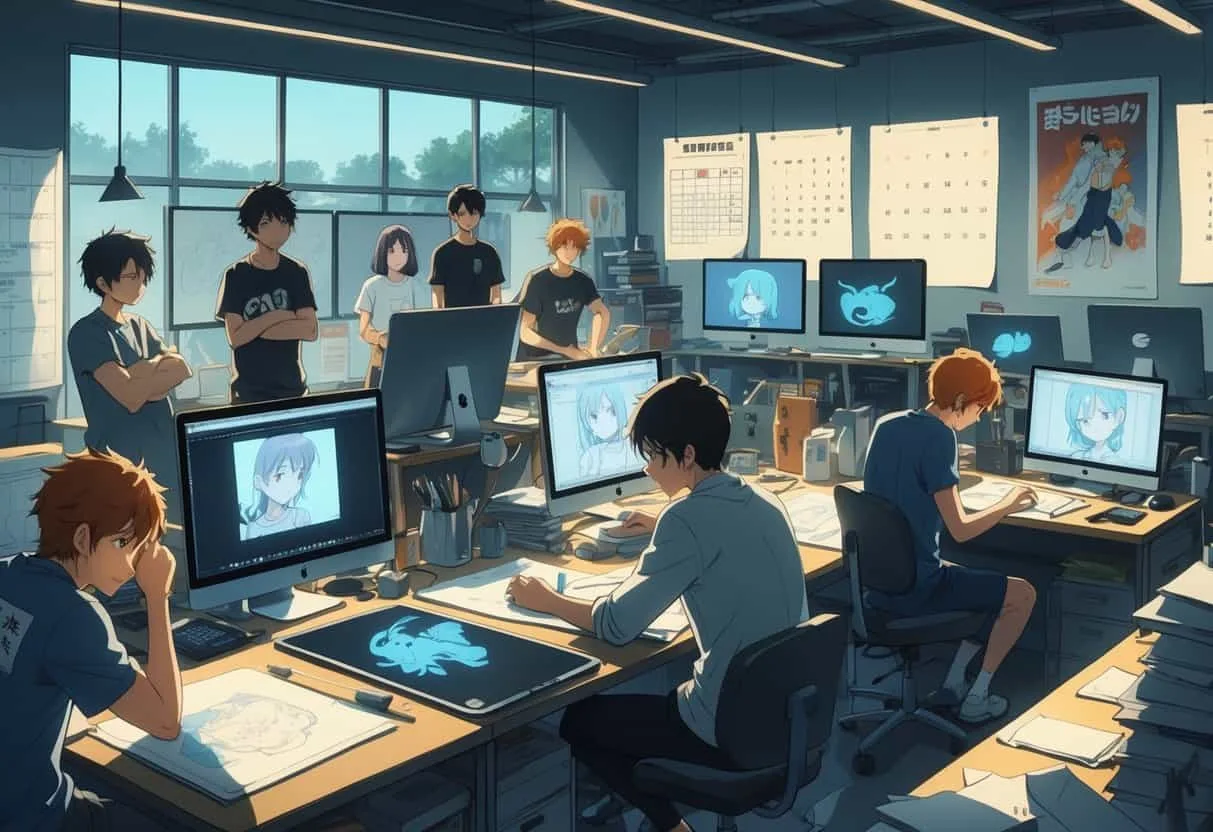
Japanese animation studios operate under immense time pressure. A typical spring or fall season demands a show be completed week to week, with episodes often finished just hours before broadcast. This “just in time” model leaves almost no margin for error. When key animators fall ill, a director quits mid-production, or a subcontractor misses a deadline, the entire schedule can cascade into chaos. Quality dips, recap episodes get rushed out, and sometimes the final episode is delayed or never produced.
Staffing shortages compound the problem. Japan’s animation industry is notorious for low wages, especially at the entry levels where in-between animators earn a pittance. Studios rely heavily on freelancers, and if a hotly anticipated movie or a higher-paying project poaches the available talent, smaller series can be left with skeleton crews. This happened with Gangsta., a 2015 anime from the small studio Manglobe. The studio filed for bankruptcy while the show was airing, and the remaining episodes were completed with great difficulty.
The story, far from over, never got a second season.
Even larger studios aren’t immune. MAPPA’s ambitious lineup in 2021–2022 saw multiple series in production simultaneously, leading to public complaints from animators about unsustainable working conditions. While shows like Jujutsu Kaisen survived, fans of other MAPPA projects worried that overload might cause cancellations or indefinite delays. The reality is that when every studio is running at full capacity, anything that falls behind risks being quietly abandoned.
Creative Differences and Legal Landmines
Sometimes an anime’s fate is decided not by money or material, but by disagreement. A director might part ways with the production committee over creative direction. A manga author could refuse to license further adaptations if they dislike how the first season handled their story. Voice actors might become unavailable or embroiled in contract disputes that stall dubbing and international releases. Even something as mundane as a music rights expiration can force a series out of circulation or prevent a sequel.
International licensing adds another layer of complexity. A show might be a hit on Crunchyroll but unwatchable in its home country due to regional streaming exclusivity deals that anger local broadcasters. If those partnerships sour, the financial foundation for future seasons can crumble. Legal issues have fully derailed multiple projects, with rights holders sometimes choosing to shelve a franchise entirely rather than navigate a protracted dispute.
An infamous example is the Macross franchise, which spent decades tangled in international legal battles over the rights to the “Macross” name and designs outside Japan. As a result, sequels and spin-offs were blocked from overseas release for years, making it impossible for a global audience to support the series financially. While that particular dispute was recently resolved, similar conflicts still simmer around lesser-known properties, keeping them in limbo.
Ratings, Reception, and the “Filler Death Spiral”
Television ratings in Japan still matter, especially for shows airing in prime-time slots. But more nuanced metrics now drive cancellation decisions: social media engagement, streaming watch hours, and the all-important “disc multiplier” (the ratio of Blu-ray sales to TV ratings). A show that trends weekly on Twitter might still be considered a failure if it doesn’t move physical media, because merchandise and disc sales are what directly fund sequels.
Audience reception can turn on a dime if a show deviates from its source material. An original ending that betrays character arcs, or a filler arc that drags on too long, can shatter the fanbase’s trust. Recovery is rare. Tokyo Ghoul √A and the later seasons of The Promised Neverland are textbook cases where anime-original changes alienated viewers so severely that enthusiasm for future installments evaporated. Even if a studio wanted to continue, the commercial damage was already done.
The “filler death spiral” is a unique danger for long-running adaptations of weekly manga. When a show like Bleach caught up to the manga mid-arc, it inserted entire filler seasons that stretched the patience of viewers. Ratings dropped, merchandise sales waned, and the anime was eventually cancelled before adapting the final manga arc. (That arc is now being animated years later, a rare resurrection made possible only by sustained, vocal fan demand and a shift in the streaming landscape.)
Fans Fight Back: Campaigns, Crowdfunding, and Resilience
Fans rarely accept a cancellation quietly. Online petitions, hashtag campaigns, and fan art blitzes have become standard responses to unfinished stories. Some of these efforts even succeed. A sustained global campaign helped convince Netflix to fund more episodes of Lucifer (a live-action show, but the dynamic applies to anime too). In the anime realm, dedicated crowdfunding has revived dormant projects, such as the Yuri on Ice movie, which was announced but then stalled for years, with fans keeping the conversation alive through social media and merchandise purchases.
Crowdfunding platforms like Kickstarter and Campfire have allowed creators to bypass traditional committees entirely. Nekopara, Under the Dog, and a number of short film projects found second lives through direct fan funding. However, these efforts rely on enormous reach and often deliver only a fraction of a full season’s budget. Without deep corporate backing, a fan-funded continuation often ends up as a single OVA or a short film rather than a true sequel.
Even when a series never returns, the community’s love doesn’t die. Fanfiction, doujinshi, and exhaustive wiki pages keep the world alive. The scarcity of official content only deepens the sense of shared ownership. In some cases, the incomplete state becomes a defining trait, sparking endless speculation and debate that a neat resolution would have extinguished. The legacy of a cancelled anime can be as enduring as that of a finished one.
Why Some Shows Can’t Just “Finish”
A common fan sentiment is, “Why can’t they just make one more season to wrap it up?” The answer lies in how anime is structured. Unlike Western TV series that film entire seasons before airing, Japanese productions are often still being drawn while the first episode hits screens. There is no completed vault of episodes waiting years for release. The creative team disbands after production ends; reassembling them for a finale years later is logistically nightmarish.
Contracts expire, staff move on to other projects, and the original production materials may not even exist in a usable form.
Additionally, producing a “wrap-up” season for a niche title means accepting a near-certain financial loss. No production committee will fund a project solely to satisfy a small group of fans unless there’s a clear path to profit. The short-form nature of most anime—12 episodes that adapt only a fraction of a longer manga—means that even two seasons feel like a luxury, and the storytelling often stops at a point that is, by design, a commercial hook rather than a narrative full stop.
How Streaming Is Changing the Game—But Not Always for the Better
Streaming platforms like Crunchyroll, Netflix, and Amazon Prime have become major financiers of new anime, sometimes commissioning entire series without a traditional production committee. This model gives studios more upfront cash and can insulate a show from the fickle disc market. Netflix’s strategy of releasing entire seasons at once removes the week-to-week ratings anxiety and lets creators focus on a complete story. This has led to fully realized projects like Devilman Crybaby and Cyberpunk: Edgerunners.
However, the streaming era introduces new risks. A platform’s internal metrics are opaque; a show might be wildly popular with subscribers but still get axed if it doesn’t drive new sign-ups or meet a specific cost-per-hour-watched threshold. Anime that are exclusive to one service can also miss out on the broader buzz that comes from being simulcast everywhere, leaving them invisible to potential new fans. And if a streaming service decides to pivot away from anime—as has happened with some platforms—the shows tied to that service can be left permanently in limbo, with no physical release and no path to a sequel.
For fans, the most frustrating scenario is the “Netflix jail” phenomenon: a series is aired in Japan but locked behind a streaming delay overseas, killing word-of-mouth and making it harder to demonstrate international support. Until the industry settles on transparent success metrics that align with how modern audiences watch anime, the gap between what feels popular and what gets renewed will remain.
A Hard Truth but a Creative One
The reality of unfinished anime is neither romantic nor satisfying. It’s a reflection of an industry that operates as a high-risk business, where art and commerce collide in unpredictable ways. Every cancelled series represents dozens of creators who poured months of their lives into a project, only to see it come to an abrupt halt. Yet the same fragility is what pushes studios, directors, and writers to take bold creative swings, telling stories that might never have been attempted in a safer environment.
For the audience, loving an unfinished series means learning to appreciate what exists, rather than mourning what doesn’t. It means supporting official releases, engaging with the source material, and understanding that every episode costs far more than a streaming subscription can cover. The next time a favorite show goes dark after 12 episodes, remember the web of forces behind that silence—and maybe check if the manga is still running. Sometimes, the story continues; it just does so on a page instead of a screen.