Table of Contents
The Enigma of Itachi Uchiha
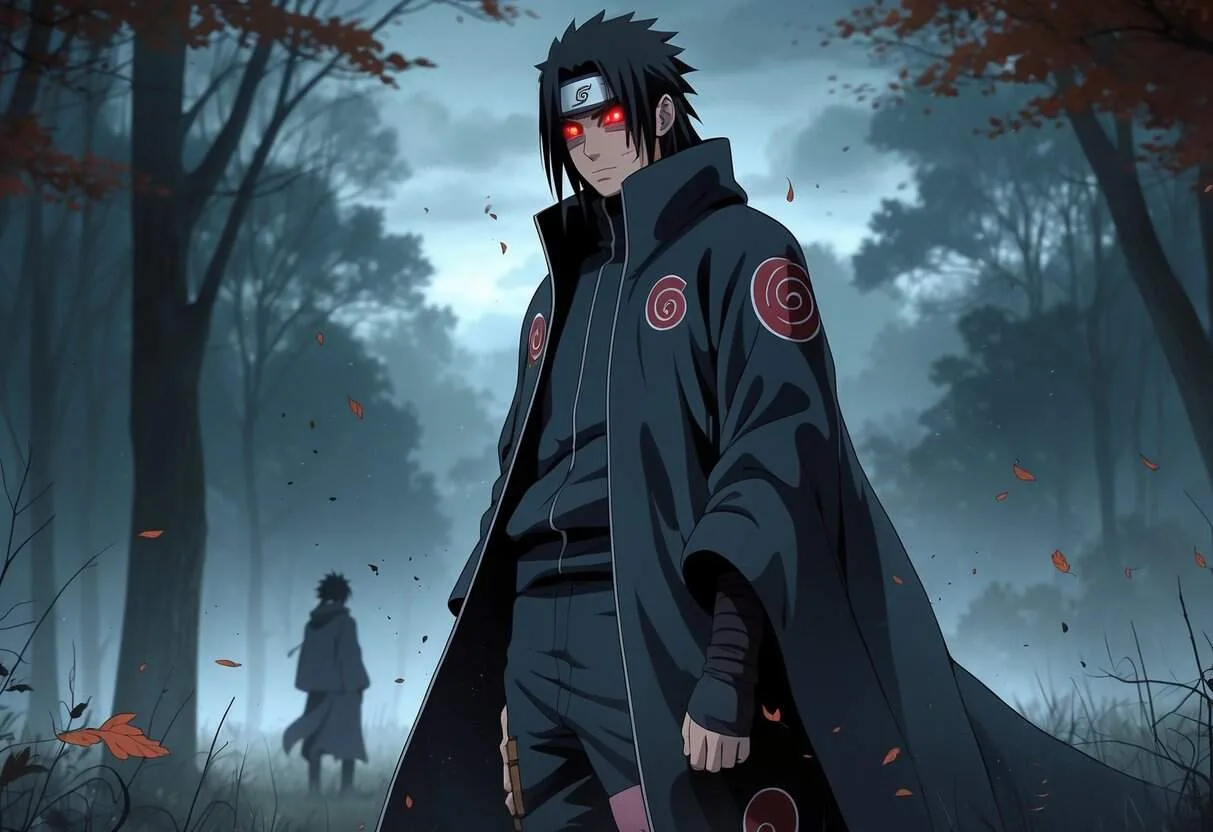
Itachi Uchiha resists easy labels. He is neither a straightforward villain nor a conventional hero, yet his presence in Naruto reshapes the entire narrative. From his first appearance as a cold-blooded kinslayer to the posthumous revelation of his true motives, he forces viewers to confront uncomfortable questions about loyalty, love, and the price of peace. Few characters in anime carry a burden as heavy, and even fewer manage to inspire both revulsion and profound sympathy in equal measure.
On the surface, Itachi is defined by his prodigious talent and unnerving calm. He graduates the Academy at age seven, masters the Sharingan at eight, becomes an Anbu captain at thirteen, and slaughters his entire clan shortly after. These facts alone paint a picture of a ruthless genius. But when the hidden Konoha orders and his own internal torment come to light long after his death, a radically different figure emerges: a young man who destroyed his family to prevent a war, willingly accepted a lifetime of infamy, and carved a lonely path so that his little brother could one day surpass him. He trades every chance at joy for the village’s survival, and in doing so, becomes one of anime’s most meticulously crafted tragic heroes.
This article explores the layers of Itachi’s character—his traumatic origins, his monstrous choices, his paradoxical love for Sasuke, the philosophical weight of his sacrifice, and the lasting mark he leaves on anime storytelling. Rather than a simple case of right and wrong, Itachi’s legacy is a tangled web of duty, pain, and incomprehensible selflessness that continues to resonate with fans across the world.
The Roots of Tragedy: Itachi’s Early Life and the Uchiha Conflict
Itachi’s story begins not with violence, but with a deep sensitivity rare among shinobi. As a child he witnesses the carnage of the Third Great Ninja War, an experience that sparks a lifelong obsession with peace. He becomes a pacifist trapped in a clan that measures worth through power. His father Fugaku, head of the Uchiha, sees Itachi’s genius and grooms him as the clan’s future, while the boy’s heart drifts toward a larger, village-wide perspective.
The founding of Konoha left a fissure between the Uchiha and the Senju-led administration. Generations later, the Uchiha are marginalized, isolated to a compound on the village outskirts, and kept away from the governing center. The resentment hardens into an organized coup d’état. Itachi, as a double agent inside the Anbu, reports the Uchiha’s plans to the Third Hokage and the village elders. His hope is a diplomatic resolution; instead, the elders entrap him in an impossible ultimatum.
Danzo Shimura, leader of the Root organization, sees Itachi as a tool. If Itachi refuses to eliminate the Uchiha, civil war will erupt, destabilizing the Land of Fire and inviting invasion. If Itachi complies, he can spare only one person: his younger brother Sasuke. The choice is grotesque, yet Itachi makes it—not out of malice, but from a deeply warped sense of love and duty. As the Naruto databooks clarify, Itachi’s decision was never about hatred; it was about preserving a fragile peace at the lowest possible cost in lives.
The tragedy is that the cost is his own soul.
The Night of the Massacre: A Brother’s Impossible Choice
The massacre itself is depicted with brutal efficiency. Itachi, assisted by the masked Obito, cuts down every member of his clan, sparing only Sasuke. When Sasuke returns home to find their parents dead, Itachi stands over them like a demon. He uses his Mangekyo Sharingan to force Sasuke to relive the horror over and over, all while telling him to hate him, to cling to life, and to become strong enough to kill him one day.
From the outside, this act is monstrous. Itachi appears to revel in cruelty, goading a child into a life of vengeance. Yet every word he speaks is calculated. He wants Sasuke to survive, to grow so powerful that no one—not even the remnants of the Uchiha or Konoha’s darker elements—can harm him. He deliberately frames himself as the ultimate villain so that Sasuke’s hatred never softens, never turns to despair, and never catches the attention of those who would use the boy as a pawn.
In the cruelest irony, Itachi’s most sadistic moment becomes his deepest expression of love.
The massacre also reveals Itachi’s mindset regarding collective versus individual morality. He accepts that he will be damned, that his name will be cursed forever, because he sees no alternative that does not result in vastly more death. The trauma he inflicts on Sasuke is catastrophic, yet he considers it a necessary component for his brother’s eventual strength. This willingness to become an absolute villain for a greater good places Itachi in a moral category far removed from typical shonen antagonists.
The Burden of Secrecy: Itachi’s Path as a Rogue Ninja
After the massacre, Itachi flees Konoha and joins the Akatsuki, the criminal organization that serves as the series’ central antagonistic force. His role within the group is ambiguous; he follows orders yet consistently avoids actions that would catastrophically harm the Hidden Leaf. He even feeds intelligence back to the village through covert channels, though this is never publicly acknowledged.
Living among killers like Kisame Hoshigaki, Itachi maintains a façade of detachment. His health deteriorates due to an unspecified illness, which he masks with sheer willpower and medication. He knows his lifespan is shortening and adjusts his plans accordingly. Every encounter with Sasuke is a step in a long con designed to mold his brother into a hero. First, he humiliates Sasuke during their reunion in Part I, reinforcing the thirst for power.
Later, he pushes Sasuke to the breaking point during their final battle, draining him of the curse mark’s influence and purging Orochimaru from his system. Itachi dies smiling, poking Sasuke’s forehead one last time—an unconscious callback to the affection he could never openly express.
This elaborate scheme is only fully understood posthumously when Tobi (Obito) reveals the truth to Sasuke. The revelation shatters Sasuke’s worldview, transforming his lifelong hatred into overwhelming grief and a new, darker desire for vengeance against Konoha. Itachi’s secrecy, meant to protect, inadvertently plunges Sasuke into a vortex of confusion and rage. The tragedy expands outward, proving that even the best-intentioned deceptions have unpredictable consequences.
The Complexity of Love: Itachi and Sasuke’s Relationship
There is no relationship in Naruto more psychologically intricate than the one between Itachi and Sasuke. At its core, it is a bond built on a lie—the lie that Itachi is a heartless murderer. Sasuke’s entire identity coalesces around that falsehood. His drive, his training, his defection to Orochimaru, his obsession with strength—all are reactions to the trauma Itachi engineered.
Yet Itachi’s love, though buried under layers of violence, is evident in retrospect. He refuses to kill his brother when he has the chance. He programs a final Mangekyo trap to activate in Sasuke’s eyes if Tobi ever reveals the truth, aiming to protect his brother’s future even from beyond the grave. During the Fourth Great Ninja War, when reanimated by the Impure World Reincarnation jutsu, Itachi finally speaks openly to Sasuke. He admits his mistakes, says he will love Sasuke no matter what path his brother chooses, and for the first time, offers honesty without manipulation.
This moment reframes their entire history. Itachi’s damaging acts were not a denial of love but a distorted expression of it, shaped by a childhood spent in the shadow of war and an adulthood crushed under state-sanctioned atrocity. The tragedy does not disappear; it deepens. Itachi acknowledges that he should have trusted Sasuke with the truth, that perhaps together they could have found a different way. His confession underscores the tragic hero’s central flaw: isolation carried to its extreme.
The Duality of Monster and Savior
A tragic hero often occupies a liminal zone between villainy and virtue. Itachi embodies this duality more starkly than most. To the world he is a traitor who murdered his own kin. To the select few who know the truth, he is a savior who prevented a bloody civil war. He is simultaneously a monster and a saint, and neither label fits comfortably.
This tension is what makes his character so enduring.
The concept of the “shadowed hero” appears elsewhere in anime—Lelouch vi Britannia from Code Geass similarly dons the mask of a tyrant to bring about peace—but Itachi’s iteration is uniquely tragic because he seeks no redemption in his lifetime. He doesn’t design a final spectacle to clear his name. He expects to die hated and forgotten. His only reward is the survival of Konoha and Sasuke’s growth into a shinobi strong enough to defend himself. The lack of any personal benediction distinguishes him from anti-heroes who eventually claim recognition.
This duality extends to his fighting style. Itachi’s genjutsu prowess with Tsukuyomi allows him to inflict psychological devastation, yet he frequently uses non-lethal methods when possible. In his encounters with Kakashi, Kurenai, and even Naruto, he neutralizes threats without unnecessary death. His actions within the Akatsuki—delaying the capture of the Nine-Tails, avoiding direct conflict with Konoha forces—reveal a strategic restraint that contradicts his fearsome reputation. The monster and the savior coexist in every battle, every choice.
Moral Ambiguity and the Anti-Hero Archetype
Itachi forces audiences to confront the limits of conventional morality. He commits an act that is, by any everyday standard, irredeemable. Yet the narrative does not demand forgiveness; it demands understanding. The massacre is not framed as “right,” but as an outcome of broken political systems, ingrained clan loyalties, and a child soldier’s impossible burden. By placing Itachi in this moral gray zone, Masashi Kishimoto challenges the simplicity of the hero-villain binary that often defines shonen manga.
When placed alongside other morally complex figures—a topic frequently explored in articles on anime anti-heroes—Itachi stands out for his complete lack of self-justification. Light Yagami of Death Note adopts a god complex; Eren Yeager of Attack on Titan believes his genocidal path is the only way; Lelouch orchestrates his downfall for a global reset. Itachi simply endures. He carries his sin quietly, never pleading his case, never expecting sympathy. This stoicism, more than anything, earns him the audience’s compassion after the truth emerges.
Moral ambiguity also flavors his philosophy of peace. Itachi understands that peace is delicate, often maintained by acts that civilized societies condemn. His willingness to stain his own hands so that others remain clean mirrors real-world ethical paradoxes about war, sacrifice, and statecraft. It’s no surprise that analysts compare him to tragic figures in classical literature who are forced to choose between public duty and private devotion.
Itachi’s Powers and Tactical Genius
Beyond his psychological complexity, Itachi is a shinobi of terrifying capability. His intellect and combat prowess are inseparable from his tragic trajectory. The Sharingan, evolved into the Mangekyo Sharingan, grants him three signature techniques: Tsukuyomi, an unbreakable illusion that tortures the mind for what feels like days in a single second; Amaterasu, black flames that burn anything to ash; and Susanoo, a spectral warrior equipped with the Totsuka Blade and Yata Mirror.
Tsukuyomi stands as perhaps the most psychologically invasive jutsu in the series. Itachi uses it to incapacitate opponents without physical damage, as seen when he dismantles Kakashi during their first encounter. The trauma it inflicts is mental, leaving victims bedridden for weeks. Yet Itachi rarely deploys it lethally. His restraint underlines a crucial point: he possesses the means to kill without effort but chooses not to unless absolutely necessary.
This careful application of overwhelming power distinguishes him from chaotic antagonists like Hidan or Deidara.
His tactical acumen is equally impressive. During his fight with Sasuke, Itachi orchestrates an extremely elaborate sequence that draws out Orochimaru from Sasuke’s cursed seal, seals the serpent away with the Totsuka Blade, and finally collapses only after ensuring Sasuke’s survival. He anticipates the moves of multiple S-rank opponents simultaneously, a skill that allows him to stalemate the entire Team 7 reunion without harming Konoha’s ninja. Itachi’s battles are won through foresight as much as strength, cementing his reputation as a once-in-a-generation genius.
Comparisons with Other Tragic Figures in Anime
Tragic heroes populate the landscape of anime, but Itachi’s specific blend of concealment, sacrifice, and fraternal love sets him apart. Characters like Portgas D. Ace from One Piece and Gaara from Naruto undergo profound suffering and transformation, yet their arcs move toward open connection and public acknowledgment. Ace finds solace in the Whitebeard Pirates and dies with a smile, loved by many. Gaara sheds his monstrous past to become a beloved Kazekage. Itachi receives no such release while alive.
Levi Ackerman of Attack on Titan parallels Itachi in his stoicism and willingness to make ruthless choices. Both lose nearly everyone they care about and continue fighting for a cause larger than themselves. However, Levi’s actions are transparent to his comrades; his tragedies are shared. Itachi’s isolation is absolute. Even his sole confidant, the Third Hokage, dies without ever exonerating him publicly.
Itachi’s loneliness is a defining feature of his tragedy.
In the realm of Naruto itself, the closest parallel might be Nagato, who also takes extreme measures for peace. But Nagato wields pain as a weapon to force the world into submission; Itachi absorbs pain to prevent conflict from escalating. This contrast highlights the philosophical divide within the series about how peace should be pursued. Itachi’s way is self-destructive, arguably unhealthy, but deeply principled. It resonates because it feels human—flawed, burdened, and heartbreakingly earnest.
Itachi’s Enduring Influence on Naruto’s World and Beyond
Itachi’s choices echo throughout the entire Naruto timeline. Without him, Sasuke would not have become the vengeful avenger who eventually reunites with Naruto to reshape the ninja world. The truth about the Uchiha massacre, once exposed, forces the village to confront its own dirty hands in the cycle of hatred—a reckoning that influences Naruto’s own philosophy of peace. Itachi’s quiet manipulation from the shadows secures critical moments: he programs the crow with Shisui’s eye to break the cycle of the Reanimation Jutsu, and this very contingency later saves the Allied Shinobi Forces from total defeat.
Outside the narrative, Itachi’s popularity statistics speak to his impact. He consistently ranks at the top of Naruto character polls worldwide, a feat for a figure who spends most of the series as a supposed antagonist. Fan communities dissect his every action, debating whether he could have found an alternative to genocide, whether his love for Sasuke excuses his methods, and what his story says about the nature of heroism. Academic-flavored essays on platforms like Geek Culture and Screen Rant analyze his enduring appeal, often placing him in the pantheon of fiction’s great tragic figures alongside characters from Greek drama.
His symbolism extends beyond the series itself. Itachi becomes an archetype for the sacrificial shinobi—the shadow operative who ensures peace from the darkness, unattached to glory. This archetype influences later anime and manga, where hidden protectors and double agents grapple with similar dilemmas. The idea that true heroism might require becoming a villain in the eyes of the world is a narrative hook that resonates deeply, and Itachi remains its most poignant example.
Legacy and Philosophical Reflections
What makes Itachi a tragic hero rather than merely a sad one is the alignment of his demise with his own choices and inherent flaws. His flaw is not ambition or pride; it is the conviction that he must bear everything alone. He trusts no one with his burden, not even Hiruzen Sarutobi to the extent needed. This self-imposed isolation accelerates his suffering and leaves Sasuke psychologically shattered. The tragedy is that his love, while real, is delivered through trauma, and the scars it leaves shape Sasuke’s darkness as much as his eventual redemption.
Some argue that Itachi’s story contains a critique of blind loyalty to the state. He obeys an order that annihilates his family, and while he does so to avert war, the systemic failures that led to that ultimatum are never fully resolved until much later. The tragedy is thus twofold: a personal one of a young man forced into monstrosity, and a political one of a village that relies on such sacrifices to function. The Hidden Leaf’s peace is built, in part, on the bones of the Uchiha and the lies told to their last survivor.
Itachi’s philosophical outlook, expressed in his final words, is one of unconditional acceptance. “You don’t ever have to forgive me,” he tells Sasuke. “But no matter what you do from now on, know this: I will love you always.” That statement encapsulates the entire arc. It asks nothing, demands nothing, offers only the truth at last.
It is the closest thing to absolution he can give, and in that moment, the audience understands the full weight of his twenty-one years of hidden agony.
Ultimately, Itachi Uchiha endures because he refuses to be simplified. He is a genius who makes a catastrophic miscalculation in how to protect his brother. He is a pacifist who becomes a mass murderer. He is a villain who is secretly the series’ greatest unsung hero. By holding these contradictions together, Naruto gifts its audience a figure who transcends genre conventions and invites us to sit with uncomfortable truths about sacrifice, love, and the high cost of peace.
Itachi’s legacy is not one of easy answers, but of profound, lingering questions—the mark of a truly great tragic hero.