Table of Contents
The Emotional Engine: Why Viewers Gravitate Toward Chosen Kinship
The concept of found family resonates so powerfully because it bypasses the biological lottery and taps directly into the affirmation of choice. In real life, not everyone wins the birth family jackpot. Many individuals face estrangement, geographical distance, or a fundamental lack of understanding from their relatives. Anime doesn't shy away from this reality; instead, it builds entire narratives around the radical idea that intimacy is constructed, not inherited. This places the power of belonging squarely in the hands of the characters—and by extension, the viewer.
The psychological appeal is rooted in the human need for acceptance without preconditions. When a ragtag crew of misfits decides to protect each other, it sends a powerful message: you are worthy of love not because you are perfect, but because you are present. Unlike biological ties that can sometimes feel obligatory, these chosen bonds are actively maintained. The characters want to be together, and that active consent forms a deeper narrative satisfaction. It allows audiences to imagine a life where they, too, can find their "people," regardless of their past mistakes or social awkwardness.
Emotionally, these stories serve as a corrective to real-world alienation. In highly connected but socially isolating times, watching a group share meals, argue over trivial things, and risk their lives for one another fulfills a deep-seated craving for community. It dismantles the myth that adulthood requires solitary stoicism. Instead, it champions the idea that maturity is found in interdependence, a theme that resonates particularly well with younger demographics navigating the transition from familial dependence to self-sufficiency.
Narrative Alchemy: Transforming Strangers into Soulmates
From a structural standpoint, found family is a masterclass in narrative efficiency. It allows writers to bring together disparate archetypes—the hothead, the strategist, the healer, the comic relief—and force them to cohere. This forced proximity generates immediate conflict, sparking the friction that makes relationships dynamic. The journey from "unwilling allies" to "unbreakable family" provides a built-in arc that sustains serialized storytelling, which is essential for long-running manga adaptations.
This narrative device also acts as a crucible for trauma bonding. In many series, the characters aren't just hanging out; they are collectively surviving apocalyptic events, systemic oppression, or deeply personal vendettas. Shared trauma accelerates intimacy in a way that casual friendships cannot. When two characters have saved each other’s lives, the depth of their unspoken understanding transcends traditional dialogue. This intensity creates a unique flavor of loyalty that feels more extreme and, therefore, more compelling than standard friendship plots.
Moreover, found family complicates moral frameworks in fascinating ways. A biological family might disown a criminal, but a found family built on "ride-or-die" loyalty might pull off a heist to save them. This tension between societal good and familial protection creates morally gray storytelling. It challenges the viewer to ask what they would do for their own tribe. The boundaries of right and wrong blur when the safety of one’s chosen kin is on the line, making the narrative far more gripping than a simple black-and-white morality tale.
Reciprocal Healing and Collective Growth
Beyond the adventure, the core function of the found family is therapeutic. You'll rarely find an anime found family that leaves a member unchanged. The mechanism is reciprocal rescue: Character A provides the emotional stability that Character B lacks, while Character B provides the physical protection or levity that Character A desperately needs. It’s an ecosystem of care. This mirrors the reality that no single person can fulfill all our needs, but a curated collective just might.
The beauty of this dynamic lies in its rejection of the "lone wolf" trope. Even the strongest characters in these narratives are often broken in specific, hidden ways. The family unit serves as a mirror, reflecting back the potential the character cannot see in themselves. It’s a psychological patchwork where the group's combined strength covers the individual's blind spots. This makes the growth feel earned; they heal because they are exposed to constant, stubborn affection they can’t easily dismiss.
From Bloodlines to Bondlines: A Cultural Disconnect
The saturation of found family themes also points to a subtle, shifting commentary on the traditional Japanese household structure. While the "ie" (家) or family system historically emphasized vertical lineage and ancestral duty, modern anime often pivots to horizontal bonds of camaraderie. Many protagonists are orphaned, estranged, or fundamentally detached from their lineage, clearing the stage for a new type of household to form—one based on shared ideals rather than shared names. This shift reflects a broader global reassessment of what "home" actually means.
In contrast to the rigid social obligations often seen in historical dramas, contemporary found family stories prioritize emotional authenticity over social performance. Characters don't wear masks around each other; they are accepted at their worst. This vulnerability is a luxury not always afforded within the confines of a traditional filial piety structure, where "saving face" can sometimes suppress genuine emotional expression. As a result, these anime families become a fantasy not just of adventure, but of radical emotional honesty.
The erosion of the traditional safety net in real-world economies also plays a role. As job security and lifelong employment become less guaranteed, the concept of relying solely on a nuclear family has weakened. Anime found families often operate as economic units—mercenary groups, restaurant staff, or ship crews—where collective survival is practical as well as emotional. This aligns with the modern reality of roommates and work friends often becoming the primary support network in dense urban environments like Tokyo, making the fantasy feel pragmatically grounded.
Tropes and Variations: The Architecture of Unlikely Belonging
Not all found families are built the same way. The genre has developed a rich set of tropes that define how these units coalesce. One popular structure is the "Adoption by Proximity" trope, where a powerful, often stoic mentor figure simply refuses to leave a younger, vulnerable character alone. This "I’m not your dad, but I’m definitely acting like it" dynamic creates a soft power structure within the unit. It bypasses explicit declarations of love for a gruff but unmistakable protection.
Another variation is the "Sink-or-Swim" collective, where the family forms through shared incarceration, survival quests, or institutionalization. Here, the bond is forged in resistance against an external authority. The family's identity is built on being outcasts, and their unity is an act of defiance. This is particularly potent in dystopian settings where the state or a villainous entity has failed them. Their loyalty to each other is a direct repudiation of the broken system that discarded them.
For further insight into how creators build these trusted networks, the resources at Psychology Today offer a real-world psychological counterpart to these fictional bonds.
The Domestic Fluff Interlude
Intense action is not the sole domain of these bonds. A crucial subset of the found family theme is the "domestic fluff" arc, often found in winter seasons or slice-of-life segments. These are chapters or episodes dedicated entirely to grocery shopping, cooking, or cleaning the shared living space. While seemingly mundane, these moments are the load-bearing walls of found family believability. They show the characters functioning in tranquility, not just crisis.
The intimacy of a shared meal or the argument over who takes out the trash often feels more poignant than the grand battle speeches.
This grounding in mundane reality is what transforms a narrative squad into a perceived family. It signals that the relationship has a future beyond the closing credits. Viewers love seeing their favorite warriors struggle with a clogged drain because it bridges the gap between fantasy and reality. It suggests that belonging exists in the quiet, unheroic moments where characters simply coexist.
Genre Fluidity: How Found Family Conquers Every Format
While shounen and isekai provide the most obvious scaffolding, the found family theme demonstrates incredible genre fluidity. In sports anime, the team becomes the family, and the club room replaces the living room. The hierarchy of senpai and kouhai mimics sibling dynamics, creating a surrogate lineage built on mentorship rather than blood. The pressure of competition accelerates trust, turning teammates into irreplaceable anchors who understand the specific agony of defeat and the ecstasy of victory in a way no parent ever could.
In the slice-of-life and "cute girls doing cute things" genres, found family operates through micro-communities. A camping club or a student council can become a vital emotional core. These narratives remove the high-stakes life-or-death battle and replace it with the high-stakes battle of social anxiety and personal growth. The delicate handling of introverts being gently pulled into a noisy, warm collective provides a soft, comforting version of the theme. For a deep dive into the archival significance of these narratives, resources like the Anime News Network often trace how these subtle themes have evolved over decades of serialized releases.
Even darker psychological thrillers utilize a corrupted version of the trope. A toxic found family—a cult, a gang, or a manipulative unit—feels scarier precisely because the emotional payoffs mimic genuine bonding. The horror comes from recognizing that the need for belonging can lead a character to cling to a group that is destroying them. This inversion proves the strength of the trope; it is so foundational to the human psyche that its perversion creates the most effective trap a villain can set.
Iconic Roster Analysis: Mechanics of a Memorable Crew
To understand the mechanics, dissecting a successful archetype is essential. Take the Straw Hat Pirates from One Piece. Their longevity stems from a central unspoken rule: individual dreams are sacred and non-negotiable, yet pursuing them never excludes the group. Luffy doesn't demand that anyone sacrifice their goal for the "family"; instead, the family exists to protect the right to dream. This lack of possessive jealousy creates a healthy attachment style that is incredibly satisfying to watch.
It’s a masterclass in how a leader dismantles co-dependency while fostering ironclad loyalty.
Contrast this with a unit like the Survey Corps in Attack on Titan. Here, the found family is built on collective trauma and a morbidly specific shared goal: a suicidal charge for freedom. The bonds are intense but tragically mortal. The family exists not to endure forever, but to pass the torch. This highlights a different facet of the theme—generativity.
The family's purpose is to ensure the survival of the idea, even if the individuals perish. It reflects a military-style brotherhood where love is expressed through the defense of a comrade’s flank, not through words.
On the softer end of the spectrum, Spy x Family brilliantly deconstructs the theme entirely. The Forger family begins as a transactional lie; they are a found family built on mutual utility and deception. The comedy and tension emerge from watching these actors accidentally stumble into genuine affection. It externalizes the "fake it till you make it" philosophy of belonging. They choose each other repeatedly, not out of a heroic moment, but through the accumulation of small, daily defenses of their shared domestic bubble.
To explore viewing patterns of such genre-defining series, platforms like Crunchyroll provide comprehensive libraries where these character dynamics play out across hundreds of episodes, solidifying the core viewership’s loyalty.
Visual Language and Symbolism of the Pack
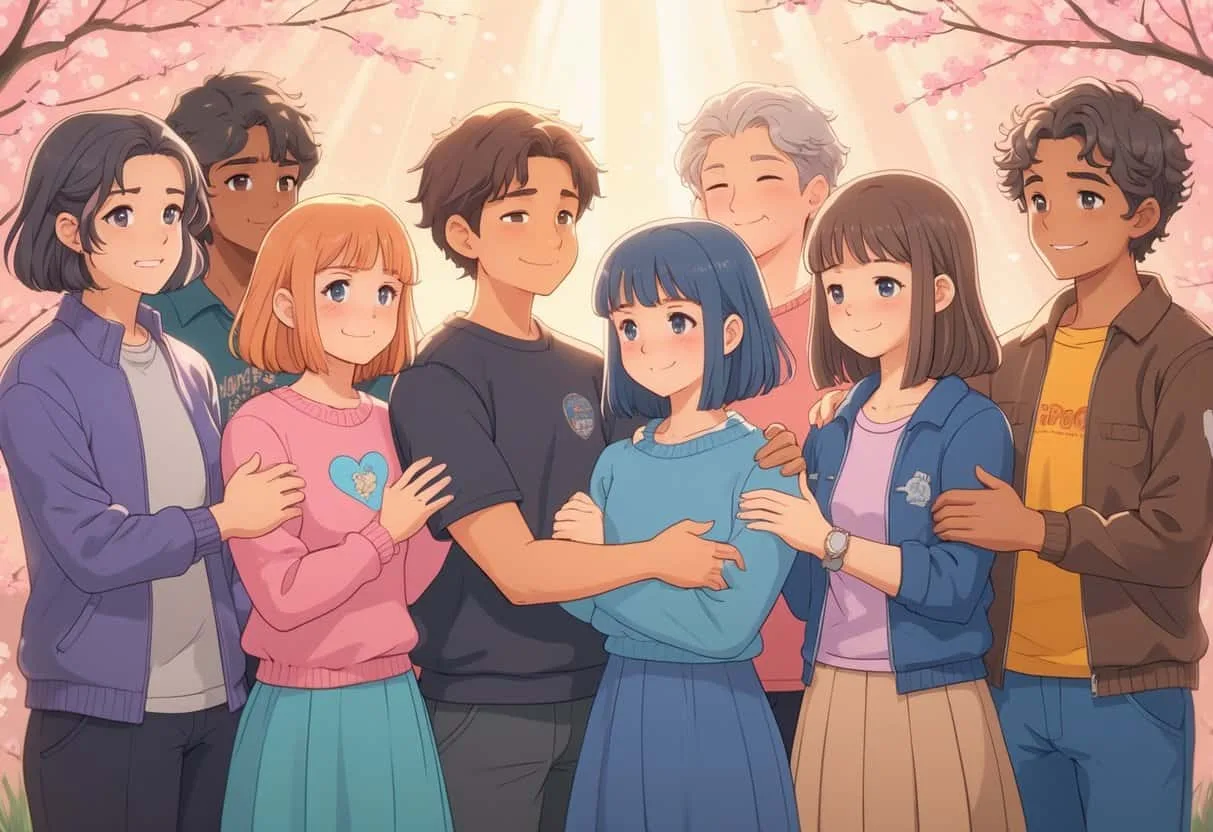
The found family doesn't just live in the script; it’s visualized in the animation. Directors often use specific framing techniques to signify the shift from a group to a family unit. Early in a series, characters might be framed individually or in isolated shots. But as the bond solidifies, group shots become compact, with limbs overlapping and heads leaning together in the frame. This visual compression signifies a loss of physical boundaries that mirrors emotional intimacy.
Color palettes also play a subconscious role. A found family will often have a designated "home base" with a warm, saturated color palette—glowing lanterns, rich wood tones, or a shared sunset. In contrast, their external enemies or the outside world are rendered in colder, harsher blues and grays. This visual coding trains the viewer to associate the group's aggregate physical space with safety and warmth. Furthermore, the use of shared meals as a recurring visual motif cannot be overstated; the communal bowl of rice or the passing of a bento box acts as a secular communion, a symbolic breaking of bread that cements their status as a household.
The character design itself often evolves to show belonging. A lone-wolf character might initially be drawn with sharp, jagged lines and dark, concealing clothing. As they integrate into the found family, their design softens. They might shed a cape, roll up their sleeves, or gain a shared accessory—a team jacket, a tattoo, or a specific ring—that visually unites them. These talismans are the visual shorthand for the contract they’ve signed in blood and spirit.
Audience Symbiosis: How Fans Sustain the Fantasy
The relationship between found family narratives and fan communities is deeply symbiotic. The audience doesn't just consume these stories; they extend them. The fandom models itself on the very structures it admires. Online fan spaces often adopt the lingo of kinship, referring to creators as "big siblings" or fellow fans as "part of the crew." This mimicry blurs the line between fiction and social reality, creating a recursive loop where the anime validates the fan’s loneliness, and the fandom validates the anime’s message.
Fan fiction and fan art are primary vehicles for this extension. These works often fill the "blank spaces" that canon leaves behind—the quiet morning after the battle, the conversations that happen off-screen. By fleshing out the domestic interiors of these violent worlds, fans reinforce the illusion that the family exists independently of the main plot. This type of secondary creation focuses almost entirely on the emotional interiority that the breakneck pace of an action series might skip.
This phenomenon also provides a unique safe harbor for identity exploration. Since found families in anime often normalize flexible roles, they attract fans who exist outside rigid social norms. A fan might project onto an android, a demon, or a non-human sidekick and find a model for acceptance. The digital community built around a series like Fullmetal Alchemist, for instance, becomes a gathering point for discussing not just alchemy, but the ethics of sacrifice and the definition of humanity. These forums function as the extended family of the extended family, a massive, sprawling web of connection sparked by a fictional core, a phenomenon extensively documented in media studies across platforms like ResearchGate.
Global Resonance: Belonging Without Borders
The international explosion of anime has proven that the found family theme has zero cultural localization barriers. Whether you are in Rio, Berlin, or Jakarta, the desire to be seen and accepted by a self-created tribe translates instantly. For viewers in cultures with strong individualistic streaks, the theme offers a corrective fantasy of deep, unshakeable communalism. For viewers in collectivist cultures that might feel burdened by biological family pressure, it offers a fantasy of agency—the right to choose which collective receives your loyalty.
Streaming giants have recognized this global salve for loneliness. Algorithms that push "wholesome crew" or "power of friendship" content aren't just tracking a genre; they are tracking an emotional need state. The cross-pollination of international audiences has also influenced production. Creators are now more aware that their story of a Japanese high school club or a gang of Edo-period swordsmen is speaking to a universal human condition. This has led to more intentional and nuanced writing, ensuring the emotional payoffs are robust enough to survive translation and cultural translation.
Ultimately, the modern prevalence of found family in anime is a direct mirror of its audience's search for utopian connection. It is a rejection of the accidental circumstances of birth in favor of the deliberate construction of support. It teaches that blood is not an entry fee for loyalty, and that a home is not a place where you were born, but a space where you are kept safe. As long as people feel isolated in a crowded world, these narratives will remain one of the most powerful exports of the animation industry—a blueprint for building love in the wreckage of the nuclear family.