Table of Contents
Anime has become a primary cultural export of Japan, introducing global audiences to everything from the country’s culinary delights to its nuanced social codes. Among the most visually striking and emotionally resonant scenes are those depicting Japanese holidays. Whether it’s a lantern-lit summer festival, a solemn temple visit at midnight on New Year’s Eve, or a snowy Christmas Eve rendezvous, these holiday episodes serve as more than scenic backdrops. They anchor character arcs, drive plot twists, and offer a window into the nation’s rituals. But how much of what you see on screen reflects genuine tradition, and how much is a fanciful invention designed for maximum dramatic effect?
This cultural analysis unpacks the layers, exploring what anime gets right, what it distorts, and why the blend matters.
Key Takeaways
- Anime faithfully reproduces many holiday aesthetics—clothing, food, and shrine etiquette—while often injecting supernatural twists or heightened emotions.
- Family and community rituals such as hatsumode (first shrine visit) or Obon ancestor reverence are usually presented with sincere accuracy, but the scale of drama is frequently amplified.
- Western holidays like Christmas and Valentine’s Day appear in anime as commercial or romantic celebrations, not as religious observances, which mirrors real Japanese practice more than many viewers assume.
- Fantasy anime sometimes invents wholly original festivals, yet the underlying values—gratitude, remembrance, togetherness—remain recognizably Japanese.
- Recognizing the line between cultural fact and narrative fiction enriches both your appreciation of the medium and your understanding of Japan.
How Anime Portrays Japanese Holidays
At their best, anime depictions of holidays function like a vibrant travelogue, capturing the sensory overload of a summer matsuri or the quiet intimacy of a family sitting around a kotatsu during New Year’s. Series ranging from slice-of-life classics to supernatural epics rely heavily on seasonal celebrations to frame pivotal moments, and they often go to considerable lengths to get the visual details right. The patterns that emerge fall into three broad categories: festival traditions, family and community gatherings, and the distinctly modern interpretation of Christmas.
Festival Traditions in Anime
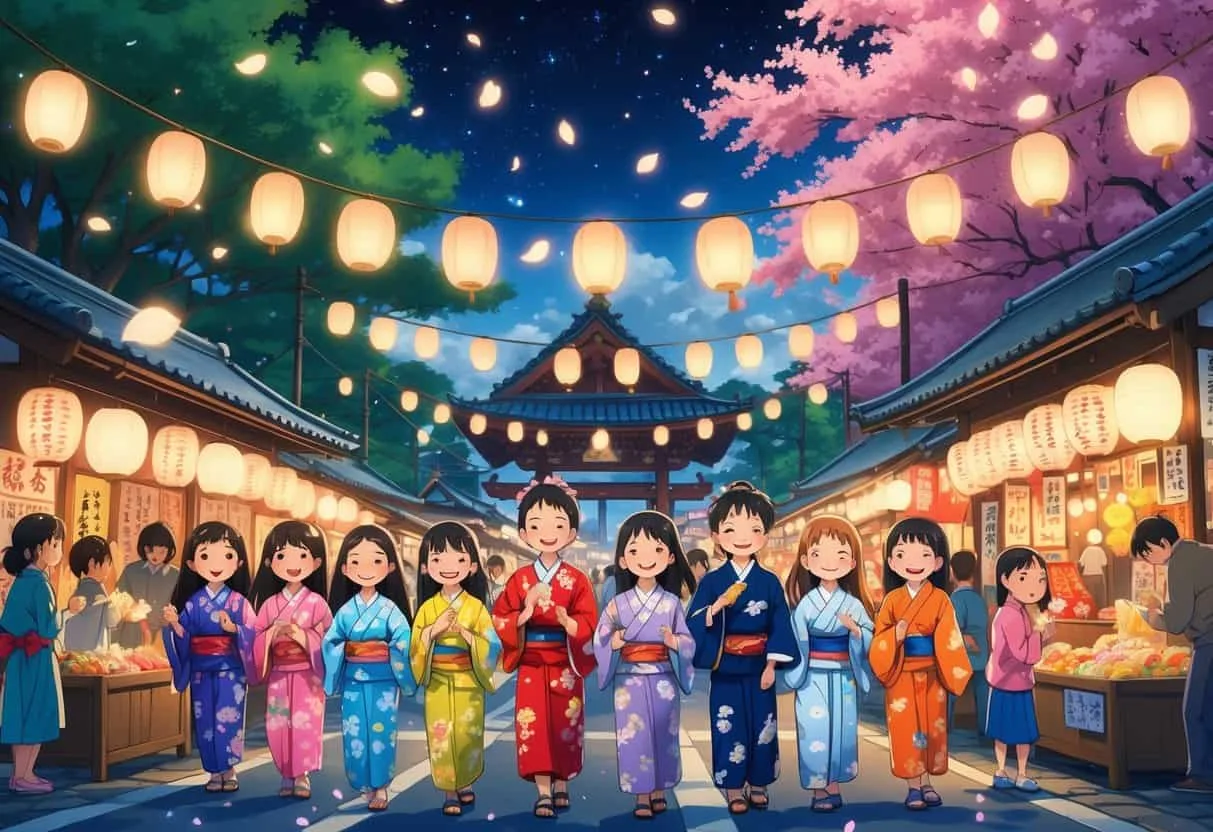
When a character dons a cotton yukata and strolls past rows of street stalls selling grilled squid, candied apples, and goldfish scooping games, you are seeing a highly faithful rendering of a Japanese summer festival. Series like Anohana: The Flower We Saw That Day, My Teen Romantic Comedy SNAFU, and K-On! treat the festival episode almost as a rite of passage, using the fireworks finale to force confessions or bittersweet farewells. The bon odori dance, food-lined yatai carts, and the hum of taiko drums appear just as they would in a real neighborhood celebration.
Anime also dedicates screen time to more solemn observances. Cherry blossom viewing, or hanami, is a recurring spring motif: groups spread blue tarps under blooming trees, share homemade bento, and drink saké while petals drift down like snow. Your Lie in April uses the ephemeral cherry blossom season to mirror the fragility of its characters’ dreams, a thematic choice that resonates because hanami itself is a meditation on impermanence. Similarly, the Tanabata star festival appears frequently, with characters hanging paper wishes on bamboo branches—an accurate depiction of the legend of Orihime and Hikoboshi, though anime might add a ghostly encounter or a time-loop to heighten the drama.
What anime gets right: the visual atmosphere, the specific foods, and the communal rhythm are spot-on. What it often exaggerates: the emotional stakes. A simple night of food and firecrackers rarely leads to life-altering revelations in real life, but in fiction, the pressure cooker of the matsuri is too useful a storytelling tool to pass up.
To explore real-world festival calendars, the Japan National Tourism Organization offers a detailed guide to major Japanese festivals.
Representation of Family and Community
Perhaps the most authentic area of anime holiday portrayal is the depiction of family duty and neighborhood ties during seasonal milestones. The New Year’s holiday, or shōgatsu, routinely appears as a time of multigenerational gathering. Characters travel back to their rural hometowns, help prepare osechi ryōri (the beautifully arranged New Year’s dishes), and visit a local shrine for hatsumode. Wolf Children captures this beautifully: the family’s quiet shrine visit underscores the themes of continuity and adaptation. March Comes in Like a Lion devotes an entire arc to the protagonist being welcomed into a warm, food-focused household, where the preparation of soba noodles and the clinking of otoso cups cement his belonging.
The concept of Obon, a Buddhist custom honoring ancestral spirits, receives similarly respectful treatment. In real Japan, families clean graves, offer food at household altars, and sometimes light lanterns to guide spirits back to the other world. Anohana structures its entire narrative around the arrival of a ghost during Obon, which is a supernatural leap, but the underlying rituals—the paper lanterns, the incense, the family altar—are meticulously researched. In Summer Wars, the extended family’s Obon reunion is the emotional core, showing how clan loyalty and shared history become a fortress against external chaos.
Anime may occasionally amplify family conflicts to create narrative tension, but the bedrock values of on (reciprocal obligation) and wa (harmony) remain intact. You learn that holidays are not just a break from routine but a reaffirmation of interpersonal bonds. This portrayal is so accurate that many Japanese viewers see themselves in these scenes, while overseas fans receive an unintentional cultural primer.
Christmas Episodes and Their Cultural Impact
Unlike traditional Shintō or Buddhist festivals, Christmas in anime mirrors a real Japanese cultural phenomenon: it is a secular, commercial, and deeply romantic event. You will rarely see a church service or nativity scene; instead, the screen fills with illuminated streets, elaborate cake displays, and couples exchanging gifts. Toradora! famously centers its climactic emotional arc on Christmas Eve, using the holiday as a catalyst for long-suppressed feelings. Rent-a-Girlfriend, Kaguya-sama: Love Is War, and countless others treat Christmas as the ultimate date night, where loneliness is a plot point and confessions carry extra weight.
This mirrors reality with surprising fidelity. In Japan, Christmas is not a public holiday, and its celebration is driven by marketing and youth culture. Fried chicken from KFC—thanks to a wildly successful 1970s campaign—became a de facto Christmas meal, and strawberry shortcake is the dessert of choice. Anime often includes these elements; you might notice characters lining up for buckets of chicken or sharing a cake topped with whipped cream and a single, symbolic strawberry. For a breakdown of how this tradition took root, the Japan Guide’s Christmas overview is an eye-opening read.
The cultural takeaway is that anime’s Christmas episodes are not “wrong” about Japan; they accurately depict a holiday that has been repurposed to fit local social needs. The disconnect arises for Western viewers who assume Christmas carries the same religious and familial weight worldwide. By understanding this local adaptation, you can appreciate the episodes without misinterpreting Japanese values.
Common Misconceptions in Anime About Japanese Holidays
While anime can be a gateway to cultural literacy, it is also a factory of dramatic license. Two major areas where the line between fact and fiction blurs are the inflation of ritual scale and the blending of domestic and Western customs into a seamless, sometimes confusing, whole.
Exaggeration of Rituals and Celebrations
In the animated world, a simple mamemaki bean-throwing ceremony during Setsubun might trigger a demon invasion, and a serene hatsumode can devolve into a battlefield between rival spirit clans. Series such as Noragami or Tokyo Ravens layer elaborate, high-stakes lore onto holidays that are, in reality, modest and family-oriented. While these creative flourishes make for compelling entertainment, they can implant a skewed impression that Japanese holidays are inherently magical or perilous.
Even without overt fantasy, anime often amplifies the scale. High school festivals in anime frequently boast professional-level stage productions, massive haunted houses, and inter-class competitions that absorb the entire student body for weeks. Real-life school culture festivals are genuinely a big deal, but the anime version tends to blur into a heightened reality where every class president is a logistical genius and every introverted protagonist finds themselves thrust into a maid café or band performance against their will. This is exaggerated, but the spirit of collective effort—kyōdō sagyō—remains authentic.
Another subtle misrepresentation involves regional specificity. Anime might present a custom, like the Namahage demon costumes of Akita Prefecture, as if it were a nationwide practice. A viewer unfamiliar with Japan’s cultural geography could mistakenly believe all Japanese children hide from oni-like figures on New Year’s Eve. Recognizing that many rituals are intensely local is key to untangling the anime-powered myth from the map of actual traditions.
Western Influences and Hybrid Customs
Modern Japanese holiday culture is an intricate weave of indigenous, Chinese, and Western threads, and anime reflects—and sometimes scrambles—this blend. Valentine’s Day is a prime example of a Western import that Japan transformed into a unique social ritual: on February 14, women give chocolates to men, not the other way around. A month later, on White Day, men who received chocolates reciprocate with white-themed gifts. Anime series such as Monthly Girls’ Nozaki-kun and Gekkan Shoujo play this exchange for comedy and romantic tension, accurately capturing the commercial-driven practice but often ignoring its more mundane workplace giri-choco (obligation chocolate) reality.
Similarly, Halloween has gained traction in Japan, but not as a night of trick-or-treating. Instead, it has become a cosplay-friendly, street-party event, particularly in areas like Shibuya. Anime occasionally shows characters in elaborate costumes heading to a Halloween gathering, but often the focus remains on the aesthetic rather than the tradition’s origins. The resulting “hybrid customs” can confuse international viewers who expect Western logic to apply. The table below contrasts typical anime portrayals with actual Japanese practice for three widely depicted holidays.
| Holiday | Typical Anime Portrayal | Real Japanese Practice |
|---|---|---|
| New Year’s | Dramatic shrine encounters, spirits, grand reunions | Quiet family meals, hatsumode, watching Kōhaku music show |
| Christmas | Romantic dates, lavish gifts, fried chicken feasts | Couples’ night out, KFC buckets, Christmas cake; not a family or religious holiday |
| Valentine’s Day | Girls confessing with handmade chocolates | Women give honmei-choco (true feeling) to partners and giri-choco to coworkers; White Day response in March |
By understanding these differences, you can appreciate anime’s creative liberties without internalizing them as anthropological fact. A quick look at Nippon.com’s article on modern Japanese holidays can further solidify the distinction.
Supernatural Elements and Holiday Themes
One of anime’s most distinctive storytelling strengths is its willingness to invite spirits, demons, and gods into the most ordinary of holiday settings. This fusion of the mundane and the mythological draws on a rich vein of Japanese folklore where the boundary between worlds grows thin during particular times of the year—most notably Obon and the solstices.
Angels, Demons, and Vampires in Holiday Storylines
In shows like Inuyasha or Natsume’s Book of Friends, traditional festivals become occasions for yōkai (supernatural creatures) to interact with humans. During Obon episodes, you might see a lonely spirit seeking one last glimpse of a loved one, or a malevolent entity exploiting the weakened veil. This isn’t pure fabrication; Japanese folk belief holds that ancestral spirits return during Obon, and many communities perform dances to welcome them. Anime takes that perceived vulnerability and weaponizes it for drama, turning a solemn family observance into a narrative crucible.
Vampires and angels, though less rooted in Shintō-Buddhist lore, appear frequently in holiday-themed arcs of series like Seraph of the End or Dance in the Vampire Bund. Here, the holiday functions as a thematic stage: a Christmas Eve vampire attack juxtaposes a symbol of salvation with one of predation, while a moon-viewing festival (tsukimi) can serve as the backdrop for a celestial being’s descent. The result is a powerful merger of cultural calendar and genre fiction that often preserves the emotional truth of the holiday even while discarding its literal accuracy.
These supernatural hijackings can actually deepen a viewer’s understanding of a holiday’s essence. When a demon is eventually pacified through an offering of rice cakes or a boundary talisman, the audience internalizes the idea that certain rituals hold protective power. You learn that Shintō cleansing rites and Buddhist memorial services are not just pageantry but acts of emotional and spiritual balance, a concept that resonates beyond the screen.
Fantasy Worlds and Their Holiday Depictions
Isekai and high-fantasy anime often invent entirely new celebrations, yet they rarely stray far from Japanese seasonal sensibilities. In Mushoku Tensei, the Millis religious festival involves costumes, lanterns, and communal feasting that echo a Japanese summer matsuri. That Time I Got Reincarnated as a Slime features a harvest festival with magical beasts pulling floats, a clear parallel to the ornate floats of Kyoto’s Gion Matsuri. Even when the gods worshipped are fictional, the human impulse to gather, offer thanks, and mark the passage of time remains universal and distinctly Japanese-coded.
These imagined holidays allow creators to explore cultural concepts without being shackled to factual precision. A village might celebrate the “Day of the Returning Wing” to honor a dragon that protects the valley; the ritual includes elements of Shintō purification and Buddhist merit-making, blended so seamlessly that you absorb the cultural logic without needing a textbook. The authenticity lies not in the names or the mythical beings but in the community ethics and the humility before nature’s power.
For non-Japanese viewers, these fantasy festivals serve as a gentle introduction to the rhythms of a real Japanese year—planting, harvest, ancestor remembrance, and renewal. The packaging may be fantastic, but the core sentiment is recognizably rooted in the same soil that nurtures the actual holidays.
Thematic Influence of Holidays on Anime Narratives
Beyond aesthetics and cultural exposition, holidays in anime are structural pillars. They mark narrative time, force character evolution, and often act as catalysts for the story’s most memorable turning points.
Character Development Through Holiday Events
A New Year’s sunrise episode almost guarantees introspection. Characters like Hachiman Hikigaya in SNAFU or Rei Kiriyama in March Comes in Like a Lion use the period between Christmas and New Year’s to wrestle with loneliness, regret, and the desire for change. The cultural expectation of greeting the new year with a clean slate becomes a mirror for the characters’ internal arcs. You see them set goals, mend broken relationships, or let go of past trauma—all under the narrative weight of a universally recognized temporal reset.
Tanabata episodes, with their star-crossed lovers theme, habitually push romantically dense protagonists toward a confession. The legend of Orihime and Hikoboshi, allowed to meet only once a year, amplifies the emotional stakes. A character who writes a heartfelt wish on a paper strip and ties it to bamboo is participating in a ritual that the audience already understands as a plea for connection. The holiday, therefore, does much of the narrative work; the writer merely needs to place the characters inside it and let the cultural subtext speak.
Even seemingly innocuous celebrations like Hinamatsuri (Doll’s Festival) carry thematic heft. A story might use the display of imperial dolls to comment on a character’s innocence, lost childhood, or the pressure of perfection. In Erased, the March 3 festival becomes intertwined with a tragic murder, and the date itself serves as an ominous countdown. The holiday’s symbolic meaning—praying for the health and happiness of girls—clashes violently with the plot, creating a sophisticated layer of irony that resonates with culturally aware viewers.
Holiday Mysteries and Plot Devices
Holidays are fertile ground for mystery because they come with built-in rules and expectations that can be subverted. A body discovered inside a locked shrine during New Year’s crowds, or a ghostly whisper heard only during a temple bell’s 108 rings, instantly raises tension precisely because the setting promises peace. Hyouka masterfully wields the school cultural festival as the background for a closed-circle puzzle, using the chaotic energy of the event to hide clues in plain sight. The festival itself becomes a character, its timetable and geography shaping the detective’s path.
The following table highlights how specific holidays commonly function as narrative devices in anime.
| Holiday | Common Plot Use | Effect on Story |
|---|---|---|
| New Year | Reflection, resolution, family reunions | Character growth, relational repair |
| Obon | Ghostly encounters, ancestral revelations | Suspense, emotional depth, cultural grounding |
| Tanabata | Wishing rituals, romantic confessions | Heightened emotional stakes, thematic clarity |
| School Culture Festival | Closed-circle mysteries, public confessions, class competitions | Plot turning points, character exposure, social dynamics |
| Christmas Eve | Romantic climax, dramatic irony, loneliness vs. togetherness | Turning point for relationships, character isolation highlighted |
By weaving thematic resonance with dramatic structure, anime transforms holidays into far more than pretty backdrops. They become engines of meaning, guiding viewers through the emotional and moral landscapes of the characters while offering a crash course in the cultural heartbeat of Japan. When you next watch a festival episode, you will not only notice the accuracy of the yukata pattern or the shape of the takoyaki but also understand why that particular ritual was chosen for that particular moment—and that is the real gift of this cross-cultural storytelling.