Table of Contents
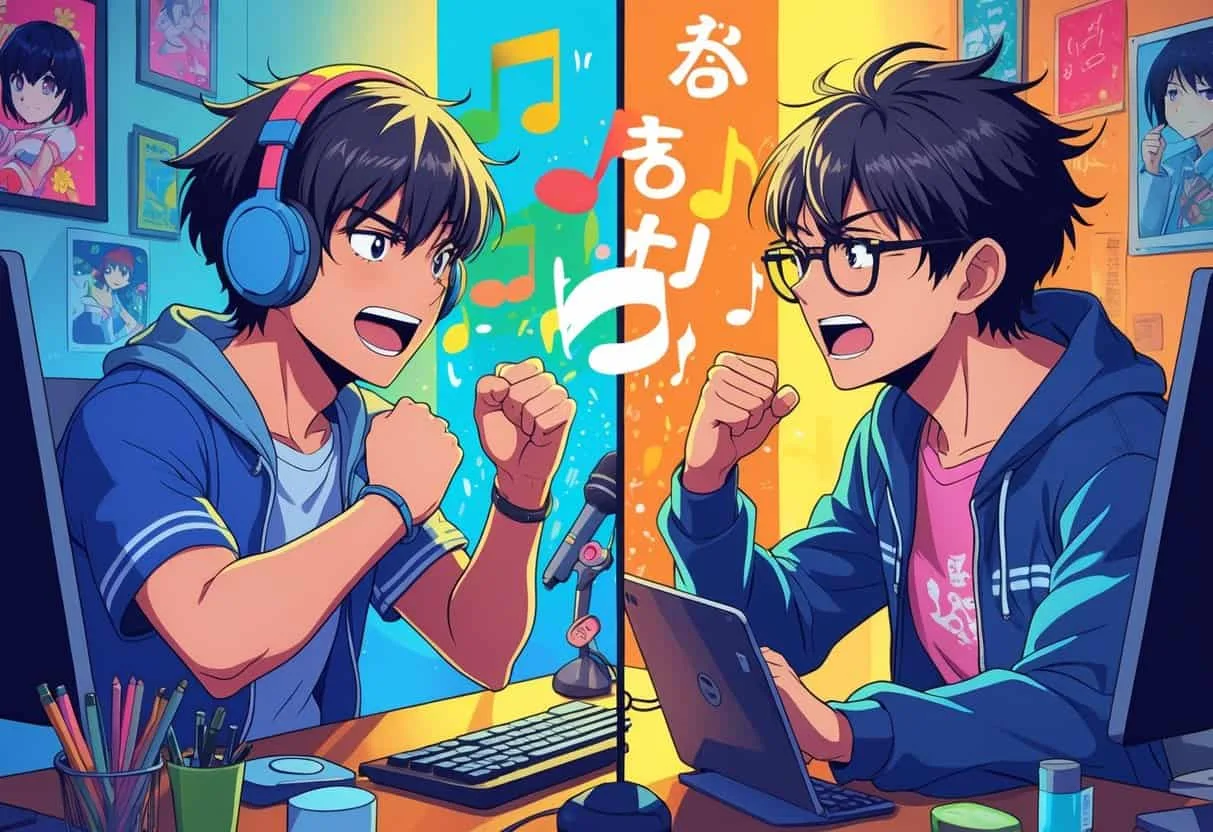
The debate over watching anime with subtitles (subs) or listening to an English voice cast (dubs) has been a cornerstone of fandom culture for decades. This conversation isn’t just about language; it touches on topics like artistic authenticity, accessibility, and the very way stories connect with global audiences. As the anime industry has evolved from late-night Japanese broadcasts to a worldwide streaming phenomenon, the way fans consume content has diversified, yet the fundamental question remains: which experience offers the truest, most powerful connection to a series?
 What makes this discussion so enduring? Anime isn’t a monolith.
A sprawling shonen adventure like One Piece presents entirely different challenges for localization than a quiet slice-of-life drama like March Comes in Like a Lion. Your personal preference often shifts depending on the genre, the quality of a specific production, and even the viewing environment. Understanding the core arguments that fuel these battles helps every fan appreciate the craft on both sides of the sub/dub divide, making you a more informed viewer regardless of which team you’re on.
Understanding Sub vs. Dub: The Foundational Differences
To truly understand the controversy, you have to look at the mechanical and artistic choices that separate a subtitled experience from a dubbed one. These aren’t just parallel tracks; they are fundamentally different forms of media translation that engage your brain in distinct ways.
The Translation Tug-of-War: Localization vs. Direct Translation
At the heart of the debate lies the tension between strict translation and cultural localization. Subtitled anime typically relies on a more direct translation of the original Japanese script. This approach preserves honorifics like "-san" and "-kun," specific cultural idioms, and the original sentence structure, giving you a window into the culture as intended by the creators. However, this can sometimes require heavy reading speed to parse complex ideas while keeping up with fast-paced action.
Dubs, conversely, engage in localization.
The goal is not just to translate words but to adapt them for the ear of an English-speaking audience. A Japanese pun might be replaced with an English equivalent, and cultural references to Japanese New Year’s games might become a joke about Thanksgiving. This practice sparks the most vitriolic debates. When a dub script changes a line to better fit the lip flaps or to make a character sound more sarcastic, purists argue that the original creative intent is being erased, while dub advocates maintain that this is necessary to make the dialogue feel natural and immediate for a native speaker.
Voice Acting: Capturing the Soul of a Character
The audio track is where the emotional argument peaks.
When you watch a sub, you hear the seiyuu (Japanese voice actor) delivering a performance that was often directed by the anime’s original creative team. In many cases, the animation is literally drawn to match the actor's vocal inflections and breathing. This creates a seamless fusion of sound and visual movement that many argue cannot be replicated.
Dubs, recorded in post-production, often on a tight schedule, must adhere to "lip-flap matching," where English words are contorted to roughly match the mouth movements already drawn for the Japanese dialogue. This technical constraint can sometimes lead to stilted or unnatural line deliveries.
However, modern English voice actors have become legends in their own right. Performances like Steve Blum as Spike Spiegel in Cowboy Bebop or Johnny Yong Bosch as Lelouch vi Britannia in Code Geass are not just seen as passable alternatives; they are often considered the definitive version of those characters by a large segment of the fandom. The argument isn't about one language being better, but about which specific performance captures the emotional truth of the character for you, the individual viewer.
Accessibility and the Modern Viewing Experience
The sub vs. dub conversation cannot be separated from the topic of accessibility, which expands the debate beyond mere preference.
For viewers who are dyslexic, visually impaired, or simply have a slower reading pace, dubs are an essential gateway to enjoying anime.
A show like Tatami Galaxy, famous for its rapid-fire monologues that fly across the screen at breakneck speed, is a nightmare to watch with subtitles unless you are an exceptionally fast reader. Conversely, for Deaf and hard-of-hearing viewers, subtitles are not an aesthetic choice but a fundamental necessity. The global anime community’s insistence on gatekeeping one format over the other can sometimes alienate disabled fans who rely on a specific viewing method. The healthiest fan spaces today acknowledge that a truly inclusive community celebrates both formats, recognizing that switching between them can be a necessary accommodation, not a betrayal of art.
Notorious Anime Debates: The Series That Keep the Fire Burning
Every long-time fan can point to a specific show where the sub/dub war reaches a fever pitch.
These key examples highlight why no single answer ever satisfies everyone.
Dragon Ball Z: The Goku Divide
Perhaps no other series embodies the schism as perfectly as Dragon Ball Z. The character of Goku in the original Japanese is voiced by Masako Nozawa, a legendary actress who has played the role since Goku was a child, delivering a high-pitched, hick-ish, and deeply naive performance that frames Goku as a pure-hearted, battle-obsessed bumpkin. The English dub, led by Sean Schemmel, famously turned Goku into a more traditional superhero, giving him a deeper, more heroic voice. To this day, fans argue over which version is "real"—the original innocent hick or the Western superman savior. This isn't just a voice swap; it's a complete reinterpretation of the protagonist's moral core.
Panty & Stocking with Garterbelt: A Case for the Dub
On the opposite end of the spectrum, Gainax’s raunchy comedy Panty & Stocking with Garterbelt is widely cited as a show where the English dub is not just superior, but essential. Modeled heavily after American cartoons like Drawn Together and South Park, the show’s humor relies on rapid-fire profanity and Western pop-culture references that simply do not land with the same impact in a direct Japanese-to-English subtitle translation. The dub script, heavily rewritten by the localization team at Funimation, was blessed by the original Japanese creators, proving that in rare cases, a localized script can capture the intended viewing experience more accurately than a direct translation ever could.
Cowboy Bebop: The Gold Standard
Cowboy Bebop is the series often used to declare a truce. Its English dub, considered a masterpiece of voice direction, is so highly regarded that even Japanese director Shinichiro Watanabe has praised it.
Meanwhile, the original Japanese cast, featuring Koichi Yamadera as Spike, is equally iconic. This show proves that when a production receives an extraordinary budget and talent on both fronts, the debate dissolves; the viewer has two flawless masterpieces to choose from, and switching between the two simply offers a richer appreciation of the narrative’s depth.
Attack on Titan: Screaming and Emotional Weight
In the 2010s, Attack on Titan reignited the war. The sheer emotional agony required to voice Eren Yeager—a character who spends a significant portion of the series screaming in rage, pain, and desperation—became a benchmark for voice acting. Japanese actor Yuki Kaji’s guttural, primal screams are so intense they reportedly caused him to damage his throat during recording sessions.
The English voice actor, Bryce Papenbrook, has received both immense praise for matching this sheer intensity and criticism from purists who claim the dubbed screams lack the same visceral texture. This debate highlights how subjective the perception of “raw emotion” can be when filtered through cultural expectations of acting.
Streaming, Simuldubs, and the Speed of Consumption
The technological landscape has fundamentally altered the power dynamics of the sub/dub debate. In the 1990s, dubbed VHS tapes were often the only way to watch anime. Today, you have a wealth of options at your fingertips, and that instant access has reshaped fan loyalty.
Crunchyroll and other platforms now offer simuldubs—English-dubbed episodes that drop mere weeks, and sometimes on the same day, as the Japanese broadcast. This has drastically reduced the "patience gap" that used to exist, where you’d have to wait years for an official dub. As a result, new fans entering the anime space no longer have to "learn to read" anime to keep up with weekly discussions on social media. They can dive directly into a dub and participate in the cultural conversation immediately. This has softened the elitism historically associated with the sub-only crowd, though not entirely erased it.
The instant availability of both tracks has turned the choice into a more fluid, per-show decision rather than an ideological identity.
The Role of the Fan Community and Gatekeeping
Online platforms like MyAnimeList forums, Reddit, and TikTok are the primary battlegrounds where sub vs. dub wars are fought daily. You’ll find a wide variety of takes, often flavored by the concept of "original intent." Gatekeeping—the act of policing who is a "true fan"—often uses the sub/dub choice as a litmus test. A new fan saying they liked the My Hero Academia dub might be bombarded with comments about how the Japanese voice for All Might is more impactful.
However, this same space also produces brilliant fan content that bridges the gap. YouTube is filled with comparison videos that objectively break down a scene, comparing the animation, the audio mixing, and the script choices side-by-side. These deep dives, such as the work by channels like Mother's Basement, elevate the conversation from a shouting match to a genuine appreciation of media localization. What was once a tribal war is slowly transforming, in many circles, into a form of audio-visual scholarship that makes everyone a more critical viewer.
Cross-Media Influence: When Dubs Define the Character in Games
The debate doesn't stop when the anime episode ends.
It bleeds heavily into anime-adjacent video game culture. When you boot up a game like Genshin Impact or any Dragon Ball fighter, you’re asked to choose an audio track. Interestingly, the legacy of anime dubs often dictates these choices. A gamer might be emotionally attached to the English voice of Vegeta because that’s the voice they grew up playing with in video games, even if they watch the Dragon Ball Super series in Japanese. The voice becomes attached to the interactive experience of controlling the character, demonstrating that the "better" track is often the one tied to your personal nostalgia and immersion, not an objective standard of quality.
The Academic Lens: How Reading Subs Affects Your Brain
Cognitive science also enters the ring. Studies on media processing suggest that watching subtitled content actually engages your brain differently. Reading while watching divides your attention, which can cause you to miss subtle background animation details or visual storytelling elements the director painstakingly crafted. On the flip side, this dual-channel processing can lead to a deeper cognitive encoding of the narrative because your brain is working harder to keep up, sometimes resulting in a more memorable viewing experience. Dubbed content, by removing the reading barrier, frees up your full visual attention, allowing you to fully absorb the sakuga (high-quality animation) and complex fight choreography without interruption.
Neither is objectively superior; they simply optimize for different aspects of the audiovisual experience.
How to Navigate the Debate as a Modern Fan
With so much content coming out every season, adopting a rigid stance is only limiting yourself. A practical approach is to treat your preference as situational. For a visually stunning movie like a Makoto Shinkai film, where you want to soak in every frame of artistic detail, a dub might be the perfect choice. For a dialogue-heavy, culturally dense period piece like Showa Genroku Rakugo Shinju, which revolves around Japanese storytelling traditions, the subtitled version is essential to hear the cadences of the original art form.
The most respected opinion in the modern fandom is a hybrid one. The goal isn’t to win an argument on a forum; it’s to experience the story in whatever way moves you the most. Whether you’re listening to the triumphant cries of a hero in English or reading the whispered secrets of a villain in Japanese, your connection to anime is yours alone. The debate will rage on, not because one side is right, but because anime is such a viscerally powerful medium that how we ingest it feels incredibly personal.