Table of Contents
Introduction: Why Studio Ghibli Captivates Audiences Worldwide
Studio Ghibli occupies a singular place in the history of film. For decades, the Japanese animation studio has produced some of the most visually stunning and emotionally resonant movies ever made. Unlike much of modern animation, which often prioritizes rapid-fire jokes or spectacle, Ghibli films invite viewers into immersive worlds where the smallest gesture can carry enormous weight. They celebrate quiet moments—wind rustling through grass, a train gliding across a still lake, a character simply tying their shoes—and turn them into something transcendent.
If you’re looking for a reliable ranking of the top Studio Ghibli movies, this guide sorts through the studio’s entire filmography to highlight the must-watch masterpieces, the beloved classics, and a handful of underappreciated gems. The ranking draws from decades of critical acclaim, audience adoration, and the films’ lasting cultural footprint. Whether you’re new to Ghibli or a seasoned fan, this list will help you discover or revisit the very best.
The Pillars of Ghibli’s Excellence
Before diving into the ranking, it helps to understand what sets Studio Ghibli apart. The studio’s magic rests on three pillars: visionary founders, a commitment to hand-drawn artistry, and storytelling that never talks down to its audience.
Founders Who Changed Animation Forever
Hayao Miyazaki and Isao Takahata founded Studio Ghibli in 1985, but their creative partnership stretched back decades. Miyazaki, a former Toei Animation director, brought a boundless imagination and a fierce dedication to pacifist, environmental, and feminist themes. His films often feature young heroines who defy convention and discover their inner strength—sometimes in worlds filled with ancient gods, witches, or floating islands. Takahata, by contrast, gravitated toward quieter, more realistic narratives that explored memory, loss, and the everyday struggles of ordinary people. Together, they built a studio that rejected the assembly-line ethos of commercial animation in favor of deeply personal, artist-driven projects.
Their insistence on hand-drawn animation, long after computer-generated imagery became the industry standard, is not mere nostalgia. It gives Ghibli’s films a warm, organic texture that digital tools still struggle to replicate. Every watercolor background and expressive pencil line feels touched by human hands, anchoring the fantastical plots in a recognizable physical world. That tactile quality is a large part of why a film like My Neighbor Totoro still feels fresh nearly four decades after its release.
Hand-Drawn Magic: The Ghibli Art Style
Ghibli’s visual language is instantly recognizable. Background paintings are lush and meticulously detailed, often drawn from real-world locations that animators visited and sketched on research trips. European townscapes, Japanese rural villages, and imaginary mechanical cities all receive the same reverent treatment. Water, in particular, is a recurring motif—rain, rivers, oceans—and Ghibli artists render it with a fluidity that has become a signature. The studio’s extensive use of color scripts ensures that each sequence has a distinct emotional palette: soft greens and golds for peaceful moments, stormy grays for conflict, and radiant pastels for moments of joy.
Character design, meanwhile, favors simplicity. Protagonists are often children or young adults with round features, expressive eyes, and relatable proportions. They don’t need exaggerated facial contortions to convey complex feelings; a slight downturn of the mouth or a hesitant glance does the job. This restraint makes the emotional beats hit harder. When Chihiro cries in Spirited Away, you feel it because the movie has earned that release through quiet, accumulated tension rather than melodrama.
Stories That Respect Their Audience
Ghibli’s narratives refuse to condescend. They address grief, war, environmental collapse, and the ache of growing up with a sincerity that children and adults alike can appreciate. Villains are often sympathetic or ambiguous. In Princess Mononoke, the ironworks leader Lady Eboshi is both a destroyer of forests and a compassionate shelter for lepers and former prostitutes. Moral clarity is rare; instead, the films ask viewers to sit with complexity.
Protagonists don’t always “win” in the traditional sense—they grow, they understand, they find a form of peace.
Japanese folklore and Shinto beliefs infuse many of the plots, but the themes are universal. A deep reverence for nature threads through films like Nausicaä of the Valley of the Wind and Spirited Away, while the quiet rhythms of rural life ground My Neighbor Totoro and Only Yesterday. War’s scars appear in Grave of the Fireflies and The Wind Rises, not as propaganda but as haunting meditations on loss. This willingness to confront difficult subjects without providing easy answers is what elevates Ghibli’s work beyond entertainment.
How We Ranked the Films
Ranking Studio Ghibli movies is an inherently subjective exercise—every fan has a personal favorite that defies consensus. To build this list, we considered a blend of critical reception (including international awards and retrospective reviews), cultural impact, box office performance, and rewatchability. We also factored in aggregation scores from major review platforms, such as Rotten Tomatoes and Metacritic, alongside community polls from anime and film forums. The goal isn’t to declare one film objectively “better” than another, but to provide a reliable starting point for anyone looking to explore the studio’s catalogue. What follows is a tiered journey through Ghibli’s finest achievements, from the monumental to the hidden.
The Top Tier: Essential Ghibli Masterpieces
These films appear at the summit of virtually every reputable ranking. They represent the studio at the peak of its powers and are essential viewing for any film lover.
Spirited Away (2001)
Hayao Miyazaki’s Spirited Away is the definitive Ghibli film for many. The story of ten-year-old Chihiro, who stumbles into a bathhouse for spirits after her parents are turned into pigs, is a modern fairy tale of staggering creativity. Every frame bursts with invention: soot sprites carrying coal, a radish spirit crossing a bridge, a stink spirit that turns out to be a polluted river god. The film won the Academy Award for Best Animated Feature—the only hand-drawn, non-English language film ever to do so—and shattered box office records in Japan.
Beyond its visual splendor, Spirited Away resonates because Chihiro’s journey is one of quiet empowerment. She doesn’t wield a weapon or discover magical powers; she survives through compassion, diligence, and the courage to remember her own name. The film is also a sharp critique of modern consumerism and environmental neglect, themes woven so seamlessly into the narrative that they never feel like lectures. It remains the perfect entry point into Ghibli’s world.
Princess Mononoke (1997)
Princess Mononoke is Miyazaki’s epic, a sweeping historical fantasy that pits industrial progress against the sacred forces of nature. Set during Japan’s Muromachi period, the story follows Ashitaka, a young prince cursed by a demon boar, as he ventures into a conflict between the iron-mining settlement of Irontown and the wolf goddess Moro’s forest domain. San, the human girl raised by wolves, becomes the emotional centerpiece—a fierce, conflicted warrior caught between two worlds.
The film refuses to offer easy heroes or villains. Lady Eboshi, who runs Irontown, provides refuge for marginalized people while simultaneously devastating the ecosystem. The forest gods are awe-inspiring but also terrifying and vengeful. The violence is visceral, the stakes immense, and the environmental message unflinching. It’s a film about hatred, co-existence, and the heavy responsibility of choosing a path when none are clean.
The animation, particularly in the fluidity of the forest spirits and the spectral Night Walker, represents some of Ghibli’s finest hand-drawn work. For those who think animation is just for kids, Princess Mononoke is the rebuttal.
My Neighbor Totoro (1988)
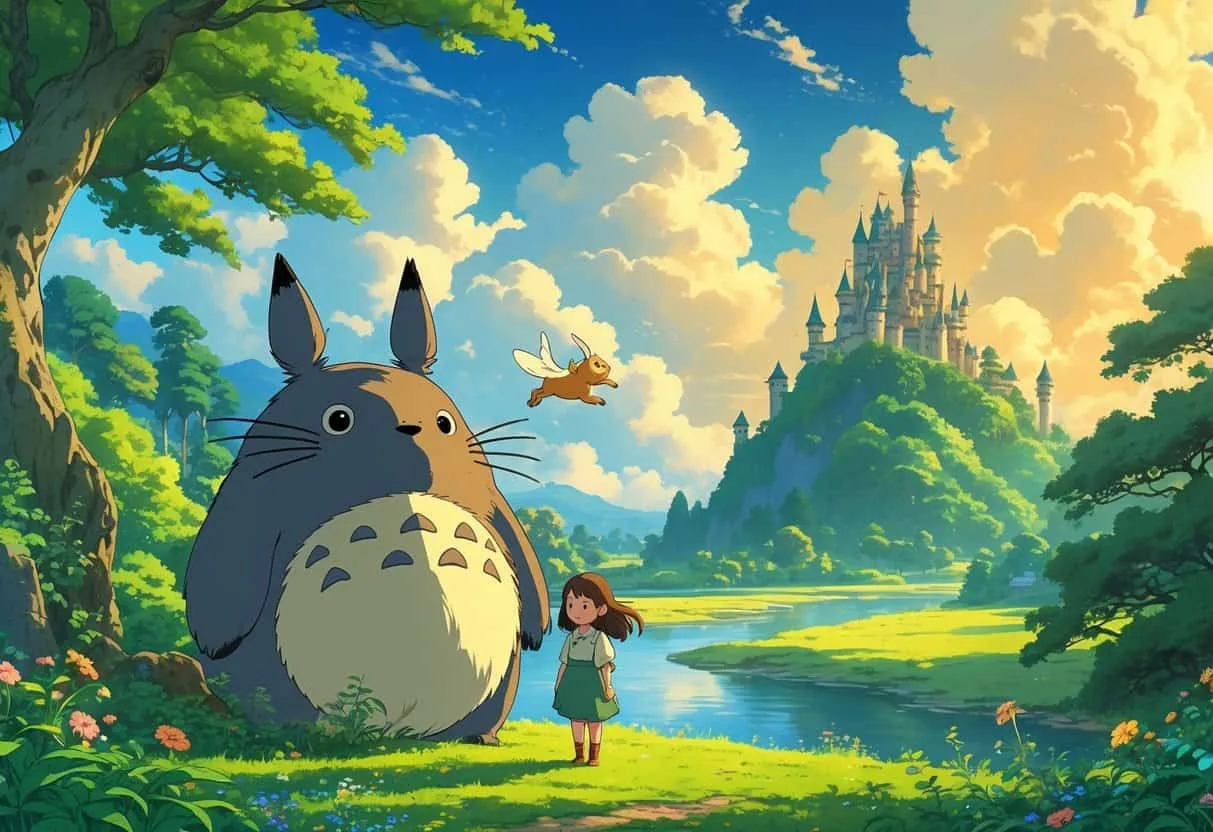
While Princess Mononoke thunders, My Neighbor Totoro whispers. It’s a film about two young sisters, Satsuki and Mei, who move to the countryside with their father while their mother recovers from an illness in a nearby hospital. There, they discover a family of forest spirits, led by the giant, fuzzy, and unmistakably iconic Totoro. There is no villain, no grand quest—just the gentle rhythm of rural life, punctuated by moments of quiet magic: a Catbus ride through the night, a seed planting that sprouts into a towering tree.
The film’s power lies in its ability to replicate the feeling of childhood, when the boundary between imagination and reality is porous. Totoro himself is a masterpiece of design: silent, benign, and expressive through the subtlest movements. His presence has become so beloved that the character serves as Studio Ghibli’s logo. My Neighbor Totoro is proof that a story doesn’t need high stakes to matter deeply. Sometimes, watching a gentle giant greet you at a bus stop in the rain is enough.
Powerful Classics and Fan Favorites
Just below the top tier sits a collection of films that are stellar in their own right, often narrowly missing the absolute summit due to slight inconsistencies or more niche appeal.
Howl’s Moving Castle (2004)
Adapted from Diana Wynne Jones’s novel, Howl’s Moving Castle is a fever dream of anti-war sentiment, cursed transformations, and eccentric romance. Sophie, a quiet hatmaker, is turned into an old woman by a witch’s spell and seeks refuge in the walking castle of the vain, magical wizard Howl. The castle itself—a clanking, chimerical behemoth—is one of Ghibli’s most imaginative set pieces. The film weaves a subplot about a pointless war that devastates the surrounding country, reflecting Miyazaki’s pacifist convictions in the wake of the Iraq War. The love story between Sophie and Howl is tender and unconventional, built on mutual recognition rather than grand gestures.
While the plot can feel denser and more chaotic than other Ghibli works, the emotional payoff and visual spectacle are undeniable.
Kiki’s Delivery Service (1989)
This coming-of-age tale about a young witch who starts her own delivery business in a coastal town is one of the studio’s coziest offerings. Kiki faces setbacks—self-doubt, creative burnout, loneliness—that feel disarmingly real despite the flying broomsticks. The film is a metaphor for the transition into adulthood, where talents can flicker and the world seems both inviting and indifferent. The European-inspired town, with its cobblestone streets and bustling bakery, is rendered in exquisite watercolor detail. Joe Hisaishi’s score, full of warm strings and woodwinds, reinforces the movie’s gentle optimism.
It’s a film about finding your rhythm, and it remains a comfort watch for generations.
Castle in the Sky (1986)
Officially Studio Ghibli’s first film, Castle in the Sky is an adventure through and through. Sheeta, a girl with a mysterious crystal pendant, and Pazu, a boy from a mining town, flee from sky pirates and government agents while searching for the legendary floating city of Laputa. The film establishes many hallmarks that would define the studio: lush aerial sequences, awe-inspiring technology, a blend of slapstick humor and real threat, and a profound respect for ancient nature. The climax, which reveals Laputa’s peaceful, tree-encrusted core, is a potent reminder that real treasure isn’t weaponry but life. The film’s influence can be seen in everything from steampunk aesthetics to modern video games.
Nausicaä of the Valley of the Wind (1984)
Technically released before Ghibli’s official founding, Nausicaä is often counted as the studio’s spiritual firstborn. Set a thousand years after an apocalyptic war, the film follows Princess Nausicaä as she navigates a world poisoned by a toxic forest and the aggressive kingdoms that still bicker over resources. It’s Miyazaki’s most thorough meditation on environmental stewardship, and Nausicaä herself is a paragon of empathy—her ability to communicate with the giant insects of the jungle is not a superpower but an extension of her deep respect for all life. The film’s design work, from the insect-like airships to the fungal forests, remains breathtaking. It’s a heavy, philosophically dense film that rewards repeat viewings.
Deep Cuts and Hidden Gems
Ghibli’s catalogue extends far beyond the globally famous titles. Some of the studio’s most affecting work has remained in the shadow of the blockbusters, but they are well worth seeking out.
The Wind Rises (2013)
Miyazaki’s (supposedly) final film is a fictionalized biopic of Jiro Horikoshi, the engineer who designed the Mitsubishi A6M Zero fighter plane used by Japan in World War II. It’s a somber, reflective work about the collision of artistic passion and moral consequence. Jiro dreams of beautiful flying machines, but his creations are ultimately deployed as instruments of destruction. The film is also a tender romance, as Jiro marries a young woman dying of tuberculosis. The wind itself—unseen but ever-present—becomes a metaphor for history, fate, and inspiration.
The Wind Rises is adult-oriented, quiet, and devastating, marking a mature endpoint for Miyazaki’s career.
Ponyo (2008)
A complete tonal shift, Ponyo is a vibrant, joyous riff on Hans Christian Andersen’s “The Little Mermaid.” A goldfish-girl falls in love with a boy and, through a chain of magical events, becomes human—unleashing a tsunami in the process. The film is a celebration of childhood, drawn in a loose, almost pastel crayon style that emphasizes the untamed energy of the sea. There’s a pure, anarchic delight to Ponyo’s transformation and the flood that follows; it’s a film that feels like a five-year-old’s imagination unleashed, but with Miyazaki’s seasoned hand guiding every frame. It’s simpler than many of the director’s other works, but its charm is overwhelming.
Whisper of the Heart (1995)
Directed by Yoshifumi Kondō, Whisper of the Heart is a slice-of-life romance set in a sleepy Tokyo suburb. Shizuku, a bookish teenager, discovers that all the library books she checks out were previously read by the same boy, Seiji. This leads to a tentative, beautifully awkward friendship and a shared pursuit of their creative dreams—Seiji as a violin maker, Shizuku as a writer. The film is remarkable for its groundedness; it treats the emotional lives of teenagers with the same seriousness that other Ghibli films give to gods and spirits. Its centerpiece, a fantasy sequence set to John Denver’s “Take Me Home, Country Roads,” is one of the most unexpected and moving moments in the studio’s history.
Tragically, Kondō died shortly after, making this his only directorial feature.
Only Yesterday (1991)
Isao Takahata’s Only Yesterday is a masterpiece of memory and self-discovery aimed squarely at adults. Taeko, a 27-year-old office worker, takes a vacation to the countryside, and the trip triggers a flood of memories from her fifth-grade year. The film seamlessly weaves past and present, contrasting the structured social pressures of 1960s Japan with Taeko’s present quest for fulfillment. The animation style shifts subtly between timelines, with the memories rendered in softer, washed-out colors. It’s a film about the quiet decisions that shape a life, and its final scene is one of the most emotionally cathartic in animation.
Long unavailable in the West, it finally received an English dub and widespread release in 2016, revealing itself as one of the studio’s deepest treasures.
Unique Elements That Define Ghibli Movies
The films are more than their stories. Several recurring elements contribute to the unmistakable Ghibli texture.
Joe Hisaishi’s Music and Masterful Sound Design
No discussion of Studio Ghibli is complete without Joe Hisaishi, the composer behind nearly all of Miyazaki’s films. Hisaishi’s scores are characters in their own right, using orchestral richness to evoke wonder (“One Summer’s Day” from Spirited Away), whimsy (“A Town with an Ocean View” from Kiki’s Delivery Service), or epic sorrow (“The Legend of Ashitaka” from Princess Mononoke). The music never panders; it respects the intelligence of its audience. Sound design, too, is meticulous—characters often pause to listen to wind, water, and insects, reinforcing the connection between inner and outer worlds. You can explore more about Hisaishi’s extensive work at the official Joe Hisaishi website.
Voice Acting with Naturalistic Warmth
Ghibli’s approach to voice acting, both in the original Japanese and in the carefully produced English dubs, prioritizes authenticity over theatricality. The actors deliver lines with the hesitations, breaths, and imperfections of real speech. This naturalism makes the fantastical settings feel inhabited by genuine people rather than cartoon characters. For The Boy and the Heron (2023), Miyazaki cast performers who could convey deep interiority with minimal dialogue, letting silence speak as loudly as words.
Character Depth and the Coming-of-Age Arc
Ghibli treats growth as a messy, non-linear process. Characters don’t suddenly become brave; they take small steps, often backsliding before moving forward. Whether it’s Chihiro learning to navigate the spirit world, Kiki recovering her flying ability after a crisis of confidence, or Taeko confronting childhood disappointments, the arcs feel earned. The studio respects adolescence as a time of profound upheaval, and its films validate the intense emotions that accompany it.
Romance Grounded in Realism
Love in Ghibli films is rarely about sweeping passion. It’s built through shared work, quiet conversations, and mutual respect. Howl and Sophie’s bond solidifies not through a dramatic confession but through the daily routines of maintaining the castle and watching the warplanes pass. Shizuku and Seiji connect over library books. These relationships feel honest because they are rooted in character rather than plot mechanics.
They reflect the studio’s broader humanism—a belief that people are fundamentally worth caring about, in all their complicated ordinariness.
Navigating the Lesser-Known Corners of the Ghibli Catalogue
Some Ghibli films remain divisive or overlooked, but they offer unique rewards for curious viewers.
Ocean Waves (1993) is a made-for-TV drama about teenage friendship and unspoken love, marked by its subdued realism and nostalgic tone. It lacks the fantasy of the studio’s blockbusters but captures the awkwardness of youth with painful accuracy. My Neighbors the Yamadas (1999), Isao Takahata’s watercolor-styled comedy, eschews a linear plot for a series of vignettes about a quirky family; its minimalist art direction was a bold experiment. Tales from Earthsea (2006), directed by Miyazaki’s son Gorō, adapts Ursula K. Le Guin’s fantasy novels with mixed results—ambitious but uneven, it remains the studio’s most contested work. And Earwig and the Witch (2020), Ghibli’s first fully 3D computer-animated feature, divided fans sharply with its departure from hand-drawn traditions.
These titles may not rank among the greats, but they demonstrate the studio’s willingness to take risks that no other animation house would dare.
Where to Start and How to Continue
If you’re new to Studio Ghibli, begin with Spirited Away to experience the full force of Miyazaki’s imagination, then pivot to My Neighbor Totoro for its soothing simplicity. From there, branch out based on what spoke to you: the epic scale of Princess Mononoke, the warm romance of Howl’s Moving Castle, or the quiet profundity of Only Yesterday. The beauty of Ghibli’s filmography is that it never rewards a single viewing; these stories deepen and change as you do. For more background on the studio’s history and filmography, the official Studio Ghibli site offers detailed production notes and glimpses into the art process.
This ranking is a roadmap, not a courtroom verdict. The film that lingers with you most might be the one critics often forget. That’s the quiet magic of Studio Ghibli: its stories are so rich, so personal, that everyone’s ranking will look slightly different—and that’s exactly how it should be.