Table of Contents
When you’re settling in for a late-night horror anime binge, picking the right show really matters. The best horror anime blends psychological fear, supernatural weirdness, and intense stories that’ll have you checking over your shoulder. These series are perfect for building a spooky atmosphere that lingers long after you’ve turned off the screen. Whether you’re drawn to slow-burning unease or sudden jolts of terror, streaming platforms now give you access to an impressive range of titles that span classic ghost stories, body-horror experiments, and mind-bending psychological thrillers. Many viewers prefer to watch these shows at night because darkness naturally amplifies the suspense, making even subtle sound design and shadowy scenes feel more immediate.
The variety is honestly remarkable: some nights you want pure adrenaline, other times you’re in the mood for horror that creeps up on you quietly, and there are anime for every shade of fear.
There are the famous classics, sure, but also plenty of hidden gems with their own brand of scares. What makes horror anime so effective is how it can visualize the uncanny in ways live-action rarely can, from distorted faces and impossible landscapes to eerie transformations that feel both beautiful and wrong. In this guide, we’ll explore top-tier picks, offbeat rarities, and the psychological depth that can keep you awake long past midnight.
Key Takeaways
- The best horror anime mix psychological and supernatural elements to create layered fear.
- Both popular and lesser-known horror anime can hit the spot, each with a unique approach to dread.
- You’ll find everything from nerve-wracking thrills to that slow, creeping horror that seeps into your thoughts.
Top Picks for Horror Anime to Watch at Night
These anime are loaded with suspense, monsters, and those moments that make you want to leave the lights on. Each one has its own flavor of horror, whether it’s psychological tension, overt gore, or philosophical questions wrapped in terror. If you’re starting a late-night marathon, these are the essential titles that consistently deliver scares.
Parasyte: The Maxim
Parasyte: The Maxim throws you into a world where alien parasites invade people’s bodies and assimilate into society. Shinichi, a regular teen, has his right hand taken over by one of these bizarre creatures, which forces him into a tense coexistence. The show delivers action and science-fiction horror, but its true power lies in the body horror that makes you squirm—limbs morphing into blades, heads splitting open, and an ever-present sense that humans are no longer at the top of the food chain. Behind the monster fights, Parasyte asks surprisingly deep questions about humanity, ecology, and what it means to be a person. The monsters are disturbing, yet it’s the uneasy alliance between Shinichi and his parasite that keeps things emotionally raw.
Watch this one with the volume up; the sound design during transformations is deliberately unnerving.
Tokyo Ghoul
Tokyo Ghoul is set in a world where ghouls—creatures that must eat human flesh to survive—live among us, often hiding in plain sight. Kaneki, a gentle college student, gets violently dragged into their reality after an accident leaves him half-ghoul, and his entire worldview shatters. The series is awash in blood, but the horror runs deeper: Kaneki’s struggle to hang onto his humanity while his body craves the unthinkable is brutal and emotionally exhausting to watch. The fights are visceral and beautifully animated, yet it’s the psychological disintegration that sticks with you. Each arc peels back another layer of moral ambiguity, and by the time Kaneki’s black-and-white thinking collapses into shades of gray, you’ll find yourself questioning who the real monsters are.
Shiki
Shiki drops you into a tiny, isolated village where residents start dying from a mysterious epidemic. As the body count rises, it becomes clear that the cause isn’t a disease—it’s vampires, and they are turning the villagers one by one. The series is a slow burn, deliberately building a claustrophobic atmosphere of paranoia where you can’t trust anyone. It plays with the viewer’s sympathies, showing the vampires’ own desperation and the brutality the humans resort to in self-defense. The horror is cumulative: quiet nights punctuated by the sound of digging, shadows that move when they shouldn’t, and the visceral unraveling of a community.
If you want chills that sneak up on you rather than punch you in the face, Shiki is perfect for winding down a long night with a creeping sense of dread.
Hellsing Ultimate
Hellsing Ultimate is all about vampires, ghouls, and Nazi-vampire conspiracies threatening humanity. The Hellsing Organization, led by the unflappable Integra Hellsing, fights back with firepower and their ultimate weapon: Alucard, a vampire of unimaginable power who relishes violence. The OVA series is unapologetically gory, with battles that escalate into operatic spectacles of destruction. Its animation style leans into the blood and shadows, making each confrontation feel like a dark painting come to life. If you want relentless horror paired with over-the-top action, this one is hard to beat.
It’s the kind of anime that’s ideally watched with the room completely dark, letting the gothic atmosphere and booming soundtrack pull you all the way in.
Underrated and Unique Horror Anime Gems
Some horror anime stand out by embracing the weird, the ritualistic, or the deeply personal fears that don’t rely on jump scares. These shows dig into Japanese folklore, urban legends, and psychological fractures, offering a different kind of fear that lingers in the back of your mind. You’ll find stories about mysterious medicine sellers, psychic investigators, and anthologies of ghost tales that feel like they’re being whispered in the dark.
Mononoke and the Medicine Seller
Mononoke follows a wandering Medicine Seller who travels across edo-era Japan exorcising malevolent spirits. To banish a mononoke, he must first understand its Form, Truth, and Reason, turning each episode into a Gothic detective story steeped in Japanese myth. The art is wildly inventive—colorful and textured like a woodblock print come to life, but with a dark, surreal edge that makes even calm scenes feel threatening. The stories are rooted in classic ghost tales and folkloric traditions, so the horror often springs from human cruelty as much as from the supernatural. It’s more thoughtful and deliberate than many horror series, asking you to pay attention to every symbolic detail.
If you enjoy horror that rewards patience and rewards a second viewing under the covers, Mononoke is an unforgettable trip.
Paranoia Agent
Paranoia Agent is a psychological horror set in modern Shibuya that begins with a strange kid on golden rollerblades—Lil’ Slugger—attacking random people with a bent baseball bat. What starts as a series of seemingly unconnected assaults spirals into a profound exploration of mass hysteria, guilt, and the lies people tell themselves. The series jumps between victims, detectives, and even the media, showing how fear and anxiety ripple outward and contaminate the collective psyche. Reality and imagination blur until you’re not sure what’s an actual event and what’s a shared delusion. It’s weird, mysterious, and demands your full attention, but the pay-off is a deep dive into the way fear can mutate into a social contagion.
Watching this at night, alone, makes its commentary on isolation and paranoia hit much harder.
Yamishibai: Japanese Ghost Stories
Yamishibai is an anthology of short, creepy tales based on Japanese urban legends and rural myths. The animation deliberately mimics old kamishibai (paper theater) storytelling, with paper-cutout characters that move in jerky, unnatural ways against drab, shadowy backgrounds. Every episode runs only a few minutes and usually ends with a twist, a warning, or an image that’s hard to shake. The stripped-down style forces your imagination to fill in the gaps, which makes the horror feel personal and intrusive. If you enjoy quick, bite-sized scares that tap into traditional ghost-story vibes, Yamishibai is a fantastic pick for a late-night short break between longer shows.
Ghost Hunt
Ghost Hunt follows a small team of paranormal investigators led by the teenage Shibuya Psychic Research group. Mai Taniyama, a high schooler, gets caught up in their cases and soon finds herself confronting tangled hauntings, poltergeists, and curses. The series blends suspense, supernatural occurrences, and a good dose of detective work, using both old-school spiritual techniques and modern ghost-hunting technology. Each arc explores a different type of paranormal phenomenon—from malevolent spirits born of trauma to dangerous psychic experiments—giving you a detailed, almost procedural look at how hauntings might be untangled. The slow-build tension and attention to ghost-story logic make Ghost Hunt especially effective when watched in the dark, where every creak in your own home suddenly sounds suspicious.
Psychological and Supernatural Horror in Anime
These anime mess with your head, using mind games, moral decay, and eerie vibes that blur the line between the real and the unreal. Here, the horror often comes from human nature itself, magnified by supernatural circumstances. Real-world anxieties get twisted into nightmarish scenarios that stick with you long after the credits roll, making them ideal for those long, quiet hours when introspection can turn unsettling.
Death Note
Death Note centers on Light Yagami, a brilliant student who finds a notebook that lets him kill anyone whose name he writes in it. He faces off against the world’s greatest detective, L, in a high-stakes intellectual battle that quickly leaves morality behind. The series isn’t full of ghosts or monsters, but the psychological horror of watching Light descend from vigilante justice to cold-blooded megalomania is deeply unsettling. The cat-and-mouse game is relentless, and the tension ramps up with each strategic move. You might find yourself questioning your own sense of right and wrong, or wondering what you’d do with such power.
It’s a different kind of fear—the horror of watching a human soul unravel—and it’s perfectly paced for a night-long binge.
Perfect Blue
Perfect Blue is a psychological thriller that gets under your skin like few films can. Mima, a pop idol who leaves her music career to become an actress, starts to experience a terrifying collapse of her identity as an obsessed stalker, a double, and the demands of her new role fracture her sense of self. You’re never entirely sure what’s real and what’s a hallucination, and the film uses rapid scene transitions, echoing voices, and distorted reflections to pull you into her unraveling mind. It dives headfirst into anxiety, exploitation, and the ugly side of fame. Intense and sometimes deeply uncomfortable, Perfect Blue is the kind of movie that’s best watched late at night when there’s no one to interrupt the spiral.
Serial Experiments Lain
Serial Experiments Lain is a trip through the intersection of technology, consciousness, and the supernatural. Lain Iwakura, a quiet middle-school girl, discovers that a classmate who committed suicide is sending her emails from a digital afterlife, pulling her deeper into a mysterious network called the Wired. The pacing is deliberate and the atmosphere is thick with quiet menace—buzzing power lines, stark empty rooms, and glitchy reality. As Lain loses her grip on the physical world, you’re left questioning what identity even means when the boundaries between the self and the network dissolve. It’s strange, cryptic, and not for everyone, but if you enjoy horror that feels like a philosophical puzzle wrapped in static and silence, Serial Experiments Lain rewards the late-night viewer with a sense of profound unease about the very screens we stare at.
Classic and Influential Horror Anime and Films
Some horror anime and films have shaped the entire genre with their unique style and willingness to push boundaries. They’re the ones that have stuck with audiences for decades, whether for their gothic visuals, relentless action, or sheer unpredictability. These titles are perfect for a night when you want something that feels like a cornerstone of horror, not just a passing scare.
Vampire Hunter D: Bloodlust
Vampire Hunter D: Bloodlust is a classic that drips gothic atmosphere and features some of the most stunning animation of its era. You follow D, a stoic half-vampire, as he hunts a noble vampire who has abducted a young woman—only to find the situation far more complicated than a simple rescue mission. The post-apocalyptic world is filled with mutant monsters, ancient technology, and tragic figures. The style melds vampire lore with spaghetti-western aesthetics and dark fantasy, creating an image-rich horror adventure. Plenty of violence and mature themes run through it, but the somber score and painterly visuals give the horror a melancholic beauty.
If you’re into vampires and dark journeys, do not skip this one on a moonlit night.
Hellsing (TV Series)
The original Hellsing TV series focuses on the Hellsing Organization fighting off supernatural threats, with a special emphasis on Alucard’s battles against artificial vampires and ghouls. While it diverges from the manga, the show creates its own grimy, noir-infused atmosphere full of conspiracies and creepy set-pieces. The tone is relentlessly dark, the gunshots echo through empty churches, and the soundtrack oozes menace. It’s a solid pick when you want something that feels like a Halloween night stretched across thirteen episodes—bloody, atmospheric, and fully committed to its horror roots.
High School of the Dead
High School of the Dead mixes zombie horror with high school survival drama, creating a breakneck thrill ride as a group of students and a school nurse fight across a collapsing city. The series doesn’t shy away from gore, and the undead attacks are chaotic and tense. There’s fan service woven in, yes, but the core of the show is about maintaining hope and humanity amid the apocalypse. The sound of moaning hordes and the grim desperation of the characters are amplified when you’re watching in a pitch-black room, making even familiar zombie tropes feel fresh and immediate.
Uzumaki and Junji Ito Horror
Uzumaki adapts Junji Ito’s legendary horror manga about a town cursed by the shape of the spiral. The anime captures Ito’s meticulous linework and his gift for taking an ordinary pattern and making it the source of unbearable madness. You’ll see people twist into grotesque forms, obsess over spirals until their minds break, and confront phenomena that defy all logic. The horror is slow, atmospheric, and deeply unsettling—much like Ito’s broader body of work, which you can explore through collections of his stories. Junji Ito’s manga are a masterclass in psychological and body horror that rely on eerie visuals and existential dread.
Watching Uzumaki or other adaptations like The Junji Ito Collection offers a kind of disturbing horror that’s completely different from the usual zombie or vampire fare. It’s weird, unnerving, and some nights you might wonder why you’re still watching—but you probably won’t stop, because the imagery it plants in your brain demands you see it through to the end.
Setting Up Your Late-Night Horror Anime Marathon
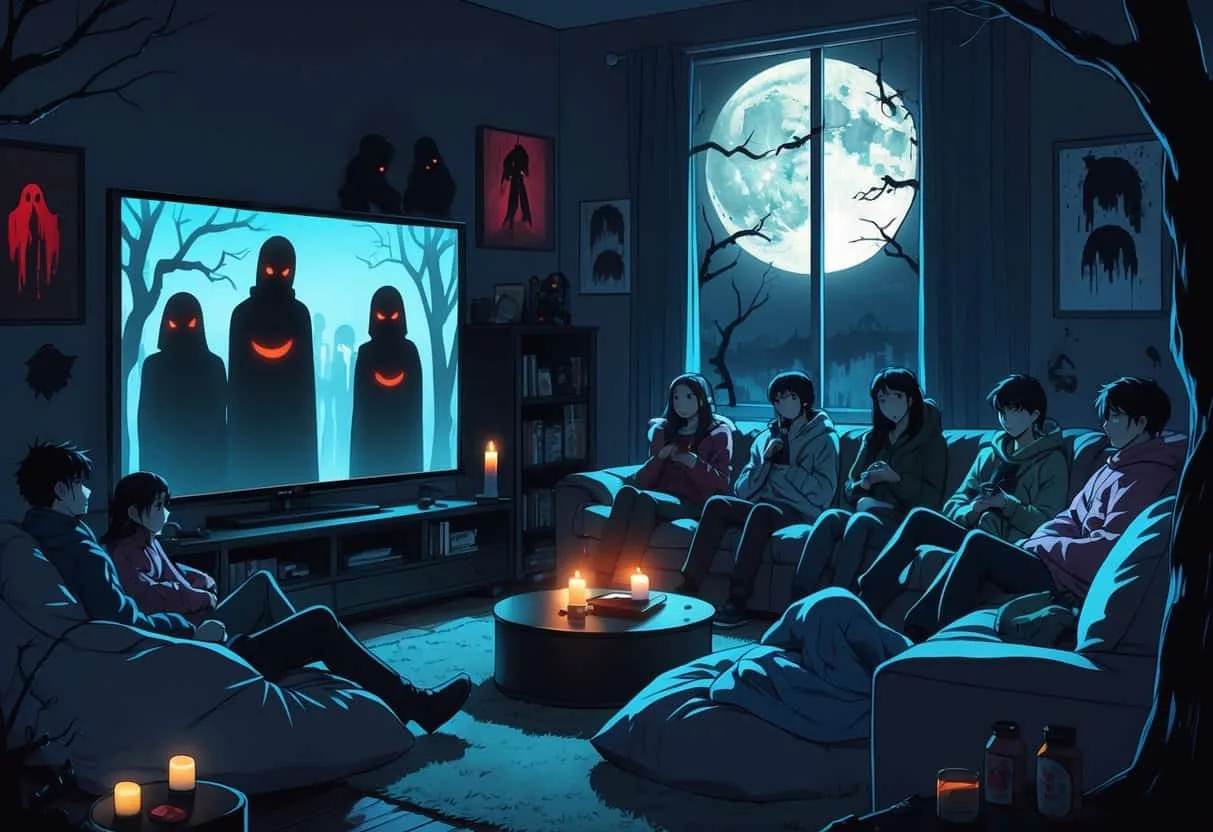
To get the most out of these shows, the environment you create matters almost as much as the titles you pick. A few simple adjustments can transform a casual viewing into an immersive scare session. Start by dimming or turning off all lights except the screen—darkness makes jump scares land harder and lets atmospheric horror seep into your periphery. Use headphones if possible; many horror anime, like Perfect Blue and Shiki, use subtle sound design to build tension that speakers might not catch. Keep a comfortable blanket nearby not just for warmth but as a psychological shield you can pull up when things get too intense.
For a varied night, alternate high-energy gorefests with slow-burning psychological series: start with something visceral like Hellsing Ultimate, then shift to a creeping dread series like Shiki, and cap the night with an anthology like Yamishibai to leave you with a final flicker of unease. Finally, have a palette cleanser ready—a funny episode of something light—because some of these titles will linger long after the screen goes dark, and you’ll want a way to bring yourself back to the mundane world before trying to sleep.