Table of Contents
Anime isn’t just explosions and over-the-top battles. A rich vein of series exists that deliberately weaves real historical events, cultural traditions, and hard science into compelling narratives. These shows do more than entertain—they open doors to understanding complex topics in a way that textbooks often struggle to match. Educational anime transform passive viewing into an active learning experience, making it easier to remember key facts, grasp intricate concepts, and develop a deeper curiosity about the world.
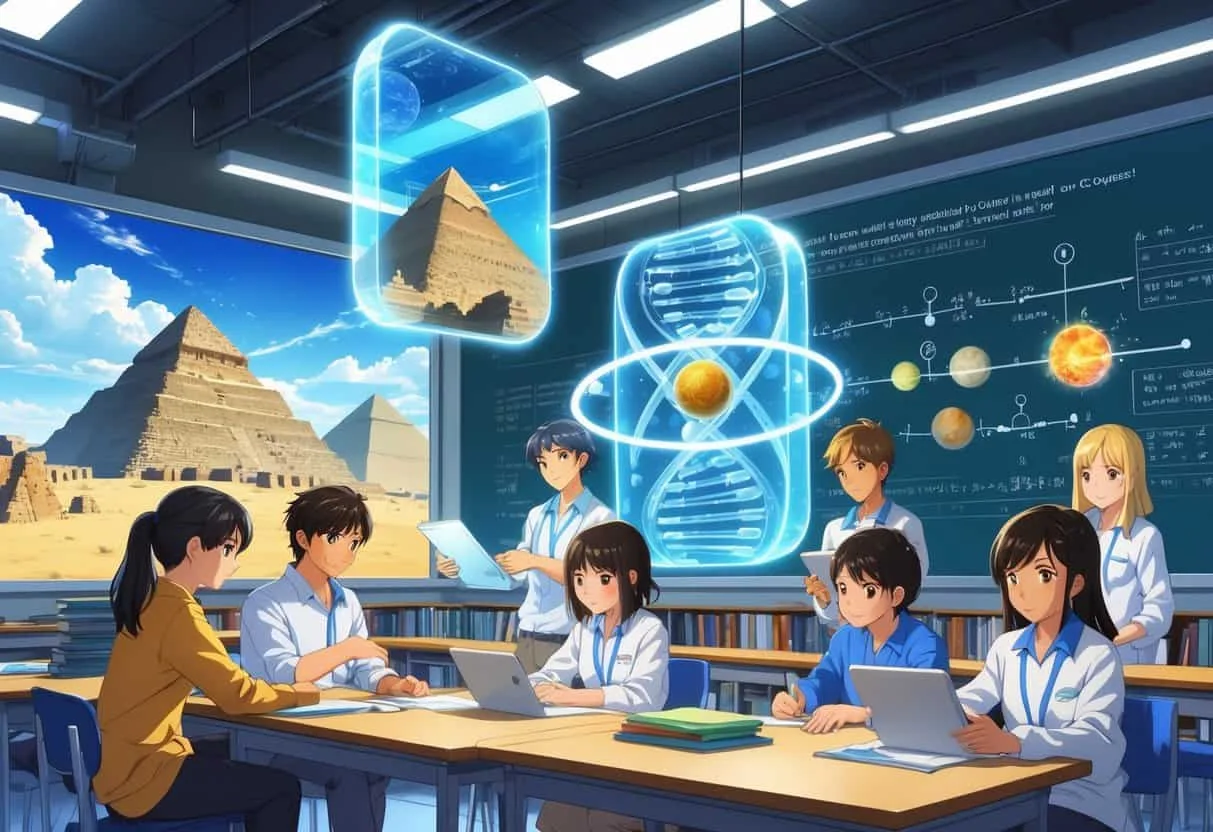
By blending meticulous research with memorable characters and dramatic arcs, these series invite you to explore everything from samurai-era politics to cutting-edge biochemistry without ever feeling like you’re being lectured. You absorb details about historical figures, scientific methods, and ethical dilemmas almost by accident, because you’re invested in the story. Whether you’re a student looking for a new angle on a subject or simply a curious viewer, these anime reward your attention with knowledge that sticks.
Key Takeaways
- Educational anime fuse factual accuracy with storytelling to make learning engaging.
- History-focused series bring authentic eras and events to life, while science shows break down complex theories through plot and character.
- Watching these shows can spark independent research, improve cross-cultural understanding, and reinforce social and emotional skills.
Why Watch Educational Anime: Bridging Entertainment and Learning
When a lesson hides inside a gripping story, your brain processes it differently. Emotional connection, visual stimulation, and narrative payoff all work together to deepen memory retention. Educational anime leverages this by turning historical periods into backdrops for personal journeys and scientific principles into puzzle-solving quests. Instead of memorizing dates or formulas in isolation, you witness how they shaped lives and drove entire societies forward.
Advantages of Anime for Teaching History and Science
Anime’s visual language is uniquely suited to unpacking dense material. Detailed background art recreates Edo-period streets, industrial-era factories, or the inner workings of a cell with a precision that still images can’t match. Motion and sound immerse you in the environment, while character reactions highlight the human stakes behind historical conflicts or scientific breakthroughs.
For history, shows like Rurouni Kenshin depict the uneasy transition from feudalism to modernity, while Kingdom turns ancient Chinese warfare into a sprawling epic that teaches military formations and political philosophy. Science series like Dr. Stone or Cells at Work! go a step further by embedding actual experimental processes and biological mechanisms directly into the plot. This marriage of factual content and narrative drive transforms abstract concepts into something tangible.
Unique Storytelling Techniques in Japanese Animation
Japanese animation often employs non-linear timelines, internal monologues, and symbolic imagery to layer meaning. These techniques mirror the way we actually learn—by connecting ideas, revisiting events from different angles, and discovering patterns over time. A flashback in a history anime doesn’t just deliver exposition; it can illustrate cause and effect, showing how a single decision altered the course of a nation.
Science anime use similar tools. Steins;Gate explains theoretical physics through character dialogue that gradually builds a coherent model of time travel, while Fullmetal Alchemist: Brotherhood uses the law of equivalent exchange as a recurring motif to teach conservation of mass and ethical responsibility. The narrative structure itself becomes a pedagogical device, guiding you from simple observations to complex conclusions without ever front-loading a lecture.
Cultural Perspectives and Real-World Connections
One of the greatest gifts of educational anime is the window it provides into Japanese perspectives on global history and science. Watching Gosick’s take on interwar Europe or The Rose of Versailles’s dramatization of the French Revolution reveals how historical narratives are interpreted across cultures. This encourages critical thinking about whose stories get told and how cultural context shapes understanding.
Modern shows also build bridges to contemporary issues. A Place Further than the Universe follows a group of girls on a research expedition to Antarctica, weaving in real-world logistics, climate science, and the emotional resilience required for exploration. Such stories remind you that science and history aren’t dusty relics—they are forces that shape current events and personal growth alike.
Must-Watch Historical Anime Series That Get It Right
A well-researched historical anime doesn’t just drop famous names; it recreates the sights, sounds, and social tensions of an era so you feel you’ve traveled there. The following series excel at accuracy and storytelling, making them powerful entry points into world history.
Best Depictions of Real Historical Events
Rurouni Kenshin remains a benchmark for Meiji Restoration storytelling. It follows a former assassin navigating a Japan rapidly shedding its samurai past. The series illustrates the clash between tradition and westernization, showcasing real political movements like the Satsuma Rebellion and figures such as Okubo Toshimichi. Its attention to period detail—from clothing to weaponry—grounds the drama in authenticity.
Kingdom takes you to the Warring States period of China, drawing heavily from the Shiji (Records of the Grand Historian). You watch the rise of Ying Zheng (Qin Shi Huang) through the eyes of a fictional soldier, absorbing the brutal realities of ancient warfare, the strategies of generals, and the philosophical underpinnings of unification. The show’s massive battle scenes are anchored in actual historical campaigns, making the spectacle educational.
Vinland Saga offers a meticulously researched look at the Viking Age, tracking the revenge quest of Thorfinn Karlsefni. Beyond the visceral combat, the series explores Norse society, the economics of slavery, and the slow creep of Christianity into pagan lands. Its later arcs, focused on a settlement in Vinland, examine pre-Columbian contact and the idealism of non-violent colonization.
Anime Influenced by Japanese and Global History
Golden Kamuy is a treasure trove of early 20th-century history, set in Hokkaido and Sakhalin just after the Russo-Japanese War. The series meticulously portrays Ainu culture, including their language, hunting practices, and spiritual beliefs, while weaving in real historical figures like Hijikata Toshizo. It doubles as a cultural anthropology lesson wrapped in a high-stakes treasure hunt.
The Rose of Versailles (or Lady Oscar) immerses you in the French Revolution through the fictional guard Oscar François de Jarjayes. Court intrigue, class struggle, and the fall of the monarchy are rendered with intense emotional weight, and the anime has been praised for inspiring viewers to study the actual revolution. It shows how fiction can ignite a genuine passion for history.
Gosick uses a fictional European country between the world wars to bottle the era’s anxiety, occult fascination, and rising nationalism. The mystery-of-the-week format frequently touches on real historical phenomena, such as the tulip mania or early 20th-century scientific hoaxes, encouraging you to investigate the facts behind the fiction.
Character Development Through History-Based Stories
Educational anime shine when they root personal transformation in historical upheaval. In Rurouni Kenshin, the protagonist’s vow never to kill again mirrors Japan’s own struggle to forge a peaceful identity after civil war. In Vinland Saga, Thorfinn’s evolution from a rage-driven warrior to a pacifist colonist parallels philosophical shifts about the meaning of a good life.
Arte follows a noblewoman determined to become a painter in 16th-century Florence. Her battles against gender expectations and guild restrictions offer a lens on the Renaissance beyond the masterpieces. Similarly, House of Five Leaves uses its melancholy ronin protagonist to explore the quiet desperation of Edo-period commoners, the feudal system’s rigid social hierarchy, and the precarious nature of honor in a time of peace. These character-driven arcs make historical context feel immediate and personal.
| Anime Title | Historical Period | Key Focus |
|---|---|---|
| Rurouni Kenshin | Meiji Japan | Samurai, political reform, identity |
| Kingdom | Warring States China | Military strategy, unification |
| Vinland Saga | Viking Age | Norse culture, revenge, pacifism |
| Golden Kamuy | Russo-Japanese War era | Ainu culture, military history, treasure hunt |
| The Rose of Versailles | French Revolution | Class conflict, court life, gender roles |
| Arte | Renaissance Florence | Art, gender barriers, patronage |
Science Anime That Teach and Inspire
Science anime come in many flavors—some celebrate the joy of experimentation, others dive into biotech ethics or the sheer beauty of space. The common thread is a respect for the scientific method and a desire to make complex ideas accessible through narrative.
Accurate Science in Modern Anime
Few shows have done as much for science communication as Dr. Stone. After a mysterious event petrifies humanity, one genius teenager sets out to rebuild civilization from scratch using chemistry, physics, and engineering. The series walks you through the step-by-step recreation of soap, glass, antibiotics, and even a cell phone, all backed by real scientific principles. Explore the science behind Dr. Stone to see just how much research went into every invention.
Cells at Work! personifies red blood cells, white blood cells, and platelets as hardworking citizens running the body’s internal city. When a pathogen invades, you witness the entire immune response choreographed like an action sequence. The anime faithfully represents cell functions, allergic reactions, and even cancer, making it a favorite in biology classrooms. Dive into the world of Cells at Work! to see how it turns immunology into an adventure.
Other series, like Space Brothers, ground their stories in the rigors of astronaut training and NASA’s selection process. The anime explores orbital mechanics, life-support systems, and the psychological toll of isolation with an eye toward realism that space enthusiasts appreciate.
From Alchemy to Engineering: Exploring Complex Scientific Concepts
Anime often uses alchemy as a bridge to modern chemistry. In Fullmetal Alchemist: Brotherhood, the law of equivalent exchange isn’t just a magical rule—it’s a direct analogy for the conservation of matter and energy. The series pushes its characters to confront the limits of this law, effectively teaching thermodynamics and ethical boundaries in a single, emotionally charged package.
Engineering takes center stage in Mobile Suit Gundam and Neon Genesis Evangelion. While the giant robots are fictional, the shows delve into the logistics of power sources, the physics of piloting a humanoid machine, and the iterative process of technological design. They also highlight how breakthroughs in engineering depend on collaborative teams, not lone geniuses.
For a gentler introduction to scientific curiosity, Moyashimon follows a college freshman who can see microbes. It blends agricultural science, fermentation, and microbiology into a campus comedy that explains how bacteria and fungi shape our food—and our world. The show’s light-hearted tone masks a deep respect for the unseen organisms that make civilization possible.
Mecha Anime and Technological Imagination
Mecha anime like Gundam and Evangelion extrapolate current engineering trends to envision future warfare and social structures. They ask what happens when humans merge with machines, how societies manage access to advanced weaponry, and what it means to pilot a machine that amplifies your will. These narratives serve as thought experiments, letting you explore technological ethics from the safety of a fictional world.
The teamwork required to maintain and operate mecha is a subtle but persistent theme. Pilots depend on mechanics, engineers, and strategists, mirroring real-world aerospace operations. By watching these dynamics, you gain an intuitive understanding of the collaborative nature of large-scale scientific and engineering projects.
Social Themes and Ethical Questions in Science Anime
Science doesn’t exist in a vacuum, and anime that tackle it seriously often confront its moral dimensions. Fullmetal Alchemist: Brotherhood presents human transmutation as a literal taboo, prompting reflection on the limits of experimentation. Attack on Titan explores how scientific discovery can be weaponized for control, and whether free inquiry is always a virtue.
Heaven’s Design Team offers a playful but informative take on evolutionary biology by depicting a celestial bureau that designs animals to meet absurd client requests. Each episode explains real biological features—like a giraffe’s long neck or a platypus’s venom—and why they evolved, subtly reinforcing the principles of natural selection. Such shows encourage you to consider not just the “how” of science, but the “why” and “should we” that accompany it.
How Educational Anime Impacts Viewers and Popular Culture
The ripple effects of educational anime extend far beyond the screen. Fans often report diving into historical texts or science articles after finishing a series, and classrooms are increasingly incorporating clips to spark discussion.
Influence on Audiences and Academic Interest
Research on edutainment suggests that narrative-based learning can improve recall and foster deeper engagement with material. Anime, with its serialized format and emotional arcs, is particularly effective at encouraging independent research. After watching Dr. Stone, viewers might look up how to make charcoal or the chemistry behind sulfa drugs. History anime prompt trips to Wikipedia to verify the life of a real samurai or the details of a 19th-century treaty. This self-directed exploration cements knowledge far more effectively than passive memorization.
Teachers have taken note. In Japan and abroad, anime is being used in classrooms to introduce topics like feudal history, cellular biology, and even ethics. The medium’s ability to hook students who might otherwise disengage makes it a valuable supplement to traditional curricula.
Educational Anime in Manga Adaptations
Many educational anime began as manga, and reading the source material often deepens the learning experience. Manga allow for a slower, more self-paced exploration, with panels packed with additional diagrams, author notes, and historical sidebars. Golden Kamuy’s manga, for example, includes extensive notes on Ainu recipes and hunting techniques that the anime only glosses over.
For science titles like Cells at Work! or Heaven’s Design Team, the manga format permits even more detailed explanations of biological processes, sometimes including mini-lectures at the end of chapters. This dual-media ecosystem means you can watch the anime for the big-picture story and then turn to the manga to quench your deeper curiosity.
Themes of Teamwork and Friendship
One of the most underrated educational aspects of anime is how it models collaboration. In Space Brothers, the protagonist’s dream of becoming an astronaut is impossible without the support of his crewmates and family. Dr. Stone constantly emphasizes that science is a collective endeavor—the inventions would stall without the diverse skills of the entire community.
These themes translate directly to real-world learning. When you watch characters pool their knowledge to overcome a crisis, you absorb the idea that complex problems require interdisciplinary teamwork. The social and emotional learning embedded in these narratives—perseverance through failure, empathy for different perspectives, the courage to challenge dogma—are lessons that stick just as firmly as the historical dates or scientific formulas. Ultimately, educational anime succeed because they treat learning not as a solitary grind but as a shared human adventure.
The Enduring Value of Learning Through Anime
Educational anime proves that entertainment and enlightenment aren’t opposites—they’re allies. By grounding fantastical stories in real-world facts, these series create a feedback loop where curiosity fuels enjoyment and enjoyment fuels retention. They lower the barrier to complex subjects, offering a welcoming on-ramp for anyone intimidated by dense textbooks or dry documentaries.
Whether you’re tracing the smoke-filled battlefields of the Warring States, peering into the microscopic warfare of the immune system, or crunching the numbers behind a rocket launch, you’re doing more than just watching. You’re building a mental framework that connects characters and conflicts to actual events and principles. And because the learning is so seamlessly integrated, you carry it with you long after the credits roll.
So the next time you pick out a series, consider one that’s as rich in facts as it is in feeling. You might discover that the best stories don’t just transport you to another world—they help you understand this one a little better.