Table of Contents
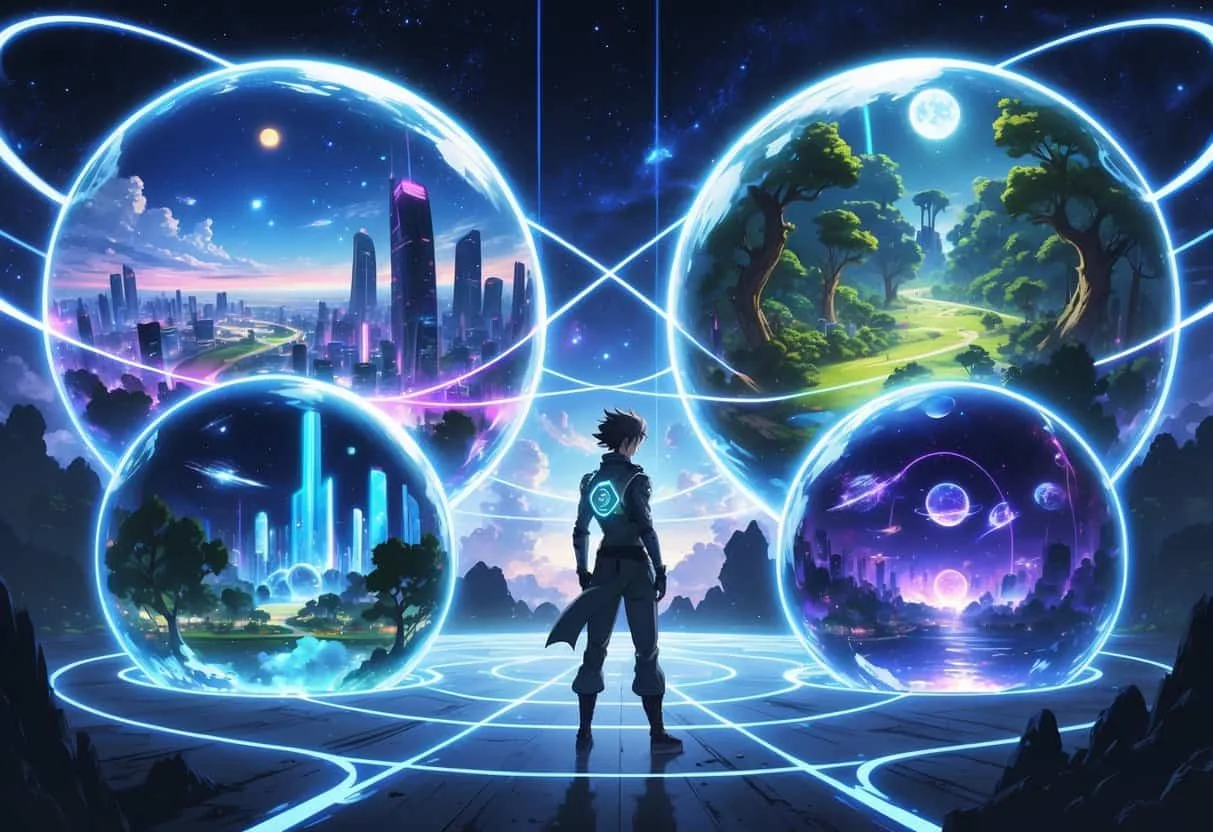
Anime that juggle multiple timelines or parallel universes tap into something elemental – the nagging thought that a single different decision might have reshaped everything. These shows don’t just tell a story; they build a labyrinth of what-ifs, alternate selves, and branching realities. Watching them feels like holding a fractured mirror up to the characters and, sometimes, to ourselves.
What makes the best of this breed stand out isn’t just clever plotting. It’s the emotional heft that comes from seeing a beloved character make an impossible choice in one world while a version of them lives a completely different life two dimensions over. The genre blends tense thriller mechanics, sci-fi speculation, and raw drama into something that stays with you long after the credits roll.
What Defines Multiverse and Timelines in Anime?
Understanding why these stories resonate begins with a quick look at the concepts they lean on. The terminology often gets muddled, but the distinctions matter for how a series builds its rules.
Timeline, Universe, and Multiverse: A Simple Breakdown
A timeline is a linear sequence of events. When a character travels back and changes something, a new timeline branches off from that point. Think of it as a tree where each decision is a fork. An alternate universe, on the other hand, is often a completely separate reality that may not share any origin point with the main story – it just exists, with its own history and physical laws. The multiverse is the overarching container that holds all of these timelines and universes together.
Shows that cling tightly to a “single timeline that gets rewritten” approach (like Erased) feel very different from those where characters leap between fully independent worlds (think Tsubasa Chronicle). Getting a grip on that framework upfront helps you appreciate the narrative gymnastics the writers are pulling.
How Anime Uses These Structures
Anime rarely uses multiple realities as a throwaway gimmick. The best series embed the concept into the protagonist's internal struggle. They push characters to confront literal other versions of their lives – the road not taken made flesh. A shy student might meet their confident, battle-hardened counterpart; a hero might discover they become the villain in another world.
This narrative tool naturally builds suspense because the rules can change. One episode you’re following a linear path, the next the floor drops out and you’re seeing events from a different angle that recontextualizes everything. It encourages active viewing; missing a single line of dialogue can mean missing the clue that ties two realities together.
Top 10 Anime With Multiple Timelines or Universes, Ranked
Ranking these series isn’t just about animation quality or popularity. It’s about how thoughtfully they integrate their multiverse mechanics, the emotional weight they assign to alternate outcomes, and the lasting impression they leave. Here are ten of the finest, counted down.
10. Dragon Ball Super
Few mainstream shonen jump into the multiverse pool with as much gusto as Dragon Ball Super. The Tournament of Power arc explicitly pits eight universes against each other, each with its own Goku-like warriors, divine hierarchies, and competing survival stakes. It’s a straightforward fight-centric take on the concept, but seeing familiar Saiyan traits twisted into new personalities (like Universe 6’s Cabba or the legendary assassin Hit) is undeniably fun. The series uses the grand scale of multiple universes to raise power ceilings while injecting a sense of cosmic peril that the original Dragon Ball Z rarely touched.
While it lacks the psychological depth of entries higher on this list, Dragon Ball Super deserves credit for making the multiverse accessible to a massive audience. It turned parallel existence into a stadium for explosive battles and gave fans exactly what they love: endless what-if warriors.
9. Noein: To Your Other Self
This early 2000s gem often flies under the radar, but it’s a visually daring exploration of quantum mechanics and parallel dimensions. A conflict erupts between two possible futures of the same universe – one where the fabric of spacetime has been catastrophically damaged, and another that still fights to prevent that outcome. The characters, particularly the young Haruka, become the pivot point for a war fought across dimensional planes.
Noein stands out for its raw, hand-drawn animation style that shifts to reflect the instability of merging realities. It’s a show that doesn’t spell everything out; you’re left to puzzle over the nature of identity when multiple versions of the same person exist simultaneously. The emotional core – seeing a child grapple with a future version of a friend turned desperate – is quietly devastating.
8. The Tatami Galaxy
Masaaki Yuasa’s surreal masterpiece tackles timelines through a deceptively simple lens: a college student relives his university years over and over, each time choosing a different club to join, hoping to land the “rose-colored campus life” he craves. Each episode resets the clock, dropping him into a new social circle that brings its own absurd misadventures.
Unlike action-driven series, The Tatami Galaxy uses its repeating structure to hammer home a philosophical point about regret and contentment. The rapid-fire dialogue, inventive visual metaphors, and final episode revelation tie every parallel experience into one cohesive, uplifting whole. It’s proof that timeline loops don’t need a sci-fi crisis to feel profound; sometimes the biggest stakes are internal.
7. Higurashi no Naku Koro ni (When They Cry)
The genius lies in how the series drip-feeds clues across fragments. You become the detective, assembling a jigsaw puzzle across timelines. The characters don’t remember the previous arcs, but the viewer does, watching helplessly as small shifts in trust or chance lead to dramatically different horrors. It remains one of the most gripping executions of the time-loop mystery format, inspiring endless fan theories and discussion threads on anime communities.
6. Re:Zero – Starting Life in Another World
Subaru Natsuki’s “Return by Death” ability is a cruel twist on timeline resets. He can’t willfully jump between points; he dies painfully, and his consciousness loops back to a fixed checkpoint. The narrative never lets you forget the trauma this inflicts, turning an isekai premise into a psychological horror showcase. Subaru must navigate politics, monstrous creatures, and his own breaking psyche by leveraging knowledge from previous failed timelines.
What elevates Re:Zero beyond a gimmick is its unwavering focus on consequences. Relationships are rebuilt from scratch in each loop; trust earned in one life vanishes in the next, forcing Subaru to carry an impossible emotional burden. The series regularly confronts the idea that saving everyone might itself be a damaging obsession, making it a provocative entry in the timeline sub-genre.
5. Puella Magi Madoka Magica
It starts as a seemingly innocent magical girl show, but within a few episodes, Madoka Magica reveals a harrowing time-loop mechanism at its heart. Homura Akemi’s desperate, repeated returns to the past to save her friend Madoka transform the story into a tragedy of accumulated trauma. Each loop worsens the situation, tangling the fabric of causality until a cosmic-scale resolution becomes necessary.
The tight, 12-episode structure is a clinic on how to introduce and pay off timeline manipulation. Homura’s cold, distant demeanor makes devastating sense once her cycled suffering is understood. The show’s willingness to blend existential dread with beautiful, surreal witch labyrinths cements its place as a modern classic that is endlessly discussed on platforms like Anime News Network.
4. Fate/Stay Night: Unlimited Blade Works (and the greater Nasuverse)
The Fate franchise is built entirely around branching timelines and parallel worlds, officially termed the Nasuverse. Each visual novel route – Fate, Unlimited Blade Works, Heaven’s Feel – is a distinct timeline where the Holy Grail War proceeds with radically different outcomes and character arcs. Shirou Emiya’s ideals lead him to heroism, self-destruction, or grim compromise depending on the path taken.
What’s remarkable is how the anime adaptations, particularly Unlimited Blade Works, treat these routes not as retcons but as equally valid realities that inform each other. The series expands further with Fate/Grand Order’s entire multiverse of singularities and Lostbelts, where entire histories are culled or saved. The Nasuverse rewards deep investment, with concepts like the “Kaleidoscope” (operation of parallel worlds) underpinning dozens of stories. It’s a meta narrative as rich as any singular plotline.
3. The Melancholy of Haruhi Suzumiya (Endless Eight Arc)
This entry earns its spot not for a sprawling multiverse but for the audacity of its “Endless Eight” arc. Over the course of eight nearly identical episodes, the SOS Brigade relives the last two weeks of summer vacation 15,532 times without realizing it. Only Nagato Yuki, an alien interface, is aware of the loop, and her accumulating fatigue becomes the arc’s quiet, heartbreaking core.
The bold choice to animate the same scenario with subtle differences in cinematography, clothing, and dialogue turned a simple time-loop concept into a divisive artistic statement. It forces the audience to feel the weight of eternity on Nagato, making it one of the most immersive and experiential uses of timeline repetition ever attempted. The emotional payoff is enormous precisely because of the repetitive structure.
2. Steins;Gate
Okabe Rintaro’s transformation from self-styled mad scientist to a man desperately trying to undo the changes he’s caused is the gold standard for time-travel storytelling. Steins;Gate meticulously builds a system of worldlines where each shift via D-Mail seems minor until the cumulative damage spirals into tragedy. The series grounds its sci-fi logic in real-world concepts like attractor field convergence, making the impossible feel unnervingly plausible.
The first half’s slow-burn character development pays off explosively in the second half as Okabe jumps between worldlines, sacrificing his sanity and emotional attachments to save the ones he loves. Few shows capture the agony of knowing multiple possible futures and being unable to tell anyone. The original visual novel and anime remain widely celebrated on Steam and MyAnimeList, and it’s the definitive gateway for anyone serious about timeline fiction.
1. Puella Magi Madoka Magica: Rebellion (and the broader film series)
While the original series is already a masterpiece, the film Rebellion pushes the concept of universe manipulation to its logical extreme. Without spoiling specifics, the movie explores what happens when a character gains the power to reshape the fabric of existence itself, effectively creating a pocket universe born from grief and love. The boundaries between reality and illusion, savior and oppressor, dissolve entirely.
It takes the recursive tragedy of Homura’s timeline loops and metamorphoses it into something new: a universe where the will of a single girl rewrites cosmic law. The visual storytelling, haunting musical score, and morally ambiguous climax elevate it beyond a typical sequel. Rebellion argues that even in a multiverse, some bonds defy the natural order – for better or worse. That raw, uncomfortable truth is why it ranks at the top.
Common Themes That Bind Worlds Together
Despite their wide variance in setting, these shows share thematic DNA. Looking at the common threads helps decode why we find them so gripping.
Regret, Redemption, and the Weight of Choice
Over and over, multiverse anime asks: “What would you change if you could?” Okabe’s desperate reversals, Subaru’s blood-soaked resets, Homura’s lonely war – they all pivot on regret and the search for an outcome where suffering is minimized. These stories treat choice as a burden, not a liberation, because every new timeline represents a version of people you’ve left behind.
The most resonant moments come when characters accept that there is no perfect worldline, just the one they choose to protect. It’s a surprisingly mature message wrapped in supernatural trappings.
Identity Across Worlds
Seeing alternate selves forces a question: what makes you you? When Shirou Emiya faces the possible end of his ideals in Archer, or when the Higurashi cast becomes both victim and perpetrator depending on the fragment, the series are digging into identity as a fluid, context-dependent thing. Even comedic properties like The Tatami Galaxy underline that core personality persists despite wildly different life paths – but it takes the multiverse to make that visible.
Memory as a Connective Tissue
A recurring motif is the character who remembers across resets. Nagato in Haruhi, Rika in Higurashi, and Subaru all carry the psychological burden of accumulated timelines. Memory becomes both a source of power (knowing what’s coming) and profound isolation (being the only one who knows). The tension between using that knowledge and cracking under its weight forms the backbone of many of these stories.
Why Fans Keep Coming Back to Multiverse Stories
The anime community’s deep engagement with these series isn’t accidental. Forums, Reddit threads, and fan wikis explode with timeline charts and alternate reality theories because the shows demand that level of participation.
Part of the draw is the intellectual satisfaction of solving a narrative puzzle. When Steins;Gate or Higurashi drip-feeds clues across loops, fans treat it like a detective game, piecing together the master timeline. But the emotional hook is just as strong: we become attached to characters across multiple versions, grieving the loss of timelines where relationships vanish. The rewatch value is enormous; the first viewing is about the shock of the twist, the second is about seeing the subtle foreshadowing in a new light.
This genre also lets fans engage with “what if” scenarios in their own headcanon. The Nasuverse explicitly encourages this with its official parallel routes, spawning endless fan fiction and discussion about “which route is best.” It’s a storytelling mode that extends beyond the screen.
Potential Pitfalls of Timeline-Heavy Writing
For all their brilliance, these shows walk a tightrope. Inconsistent rules can break immersion instantly. If a series sets up that each jump creates a new branch, then suddenly treats it as a single overwritten timeline without explanation, attentive viewers will feel cheated. The best entries – like Steins;Gate – establish their mechanics early and follow them with iron logic.
Another risk is emotional fatigue. Too many resets can numb the audience to death and tragedy. Re:Zero skirts this edge but deliberately uses the trauma to wear down Subaru; the viewer’s exhaustion mirrors his. The “Endless Eight” arc, while conceptually brilliant, famously tested viewer patience. A creator must know when repetition serves the story and when it becomes just repetition.
The Lasting Pull of Alternate Realities
Anime that tackle multiple timelines or universes do more than entertain – they reframe how we think about consequence and selfhood. The best of them fuse clever architecture with bleeding heart emotion, creating something that’s both a puzzle box and a punch to the gut. From epic battles spanning universes in Dragon Ball Super to the quiet, lonely loops of Haruhi, this storytelling mode shows no sign of losing steam.
Whether you’re here for the theoretical mechanics, the desperate time jumps, or the simple thrill of seeing your favorite hero’s dark counterpart, there’s a timeline out there for you. If you find yourself rewinding to catch a missed clue or drawing your own diagram of parallel worlds, you’re in good company. These are stories meant to be lived in more than once.