Table of Contents
What Makes an Anime Plot Twist Truly Great
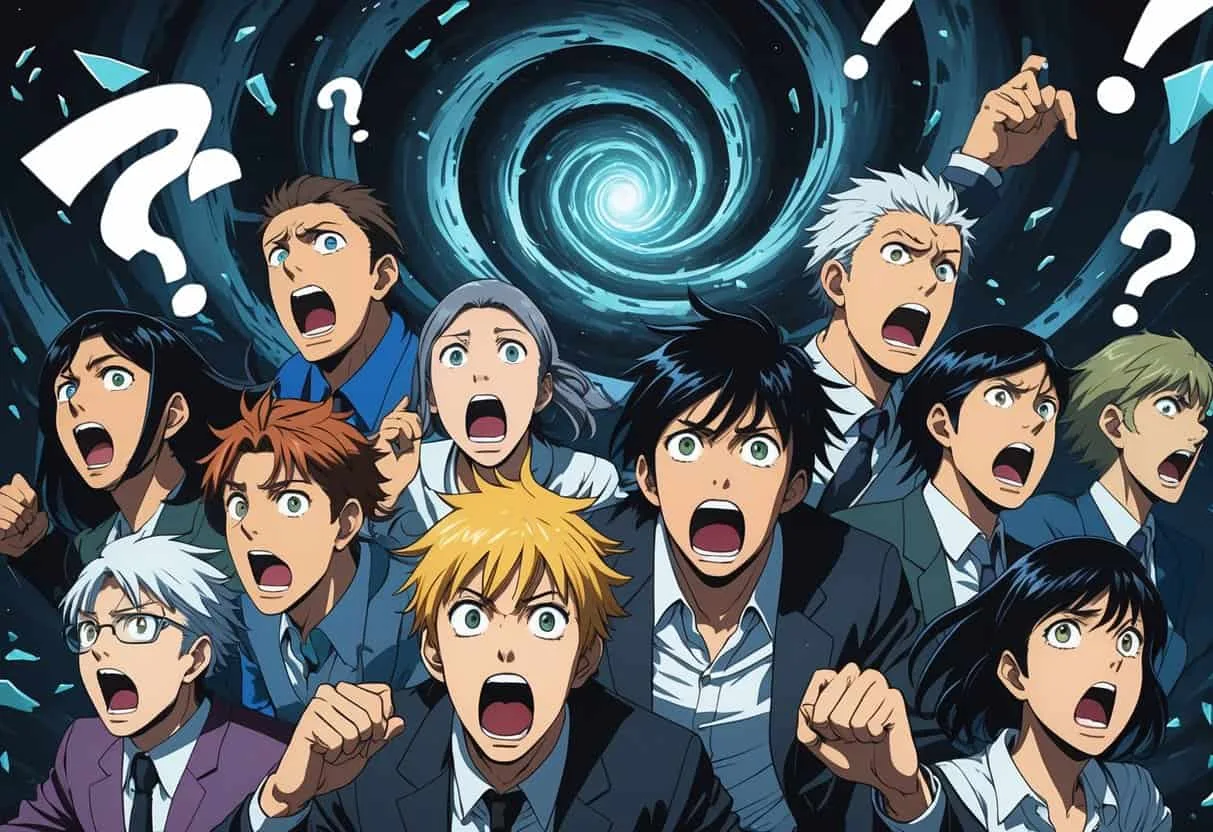
Shocking moments in anime are not accidents. The series that leave fans gasping have carefully built a foundation where every character decision, background detail, and even musical cue works in service of a single revelation. A twist that lands perfectly does more than surprise—it recontextualizes everything you thought you knew. Suddenly, earlier conversations carry new weight, and seemingly throwaway lines become crucial forecasters of the chaos to come. That second viewing often becomes the one where you truly appreciate the craft.
Great anime twists share a few unmistakable qualities: they are logically consistent within the established world, they lean on clever foreshadowing you can identify in hindsight, and they fundamentally alter the emotional stakes. A betrayal isn't just a plot mechanism; it's a rupture in the trust you placed in a character. An identity reveal doesn't just change a name—it flips the moral compass of the entire narrative. When done right, a twist feels simultaneously shocking and inevitable.
Timing is everything. The best reveals often arrive when the audience has settled into a sense of security. You've just cracked a smile at a comedic exchange, or you're convinced you understand the villain's endgame, and then the floor drops out. That contrast between calm and upheaval is what turns a surprise into a lasting memory. Shows that understand pacing will let tension simmer for episodes before detonating the truth in a single, devastating scene.
Compare that to twists thrown in purely for shock value, which fizzle because they lack emotional grounding. It’s the earned shock that resonates.
Animation and sound design function as silent partners in the twist's delivery. A sudden shift in the color palette, a drop into dead silence, or a discordant note in the soundtrack can amplify the narrative jolt tenfold. In Death Note, dramatic internal monologues escalate against a backdrop of orchestral crescendos that make Light’s machinations feel biblical in scale. In The End of Evangelion, the disorienting blend of live-action footage, rough line art, and haunting choral music turns the entire finale into a prolonged, shocking subversion of your expectations. The production team knows that what you see and hear in the seconds around the twist is what etches it into your psyche.
Unforgettable Twists That Changed Everything
Certain revelations have become cultural touchstones, discussed endlessly in forums and referenced in countless reaction videos. These moments don’t just define their respective series—they reshape how audiences talk about anime storytelling itself. Each one arrives with the force of a tidal wave, washing away the safe predictions you’d been clinging to.
The Revelation of Kira’s Identity in Death Note
From the opening episode of Death Note, you’re inside Light Yagami’s head. You know he’s Kira, the god-like figure dispensing lethal justice via an otherworldly notebook. What then becomes the twist isn’t the audience learning who Kira is, but the moment the brilliant detective L corners Light with enough evidence to make his secret identity collapse in on itself. When Light is forced to abandon his careful charade, the entire dynamic of the series pivots. No longer is it a cat-and-mouse game where the cat is blind—it’s two predators locked in the same cage, each fully aware of the other’s threat.
This structural twist reframes every previous interaction. Conversations that seemed like friendly tactical discussions become veiled death warrants. The reveal doesn’t just shock you—it weaponizes your knowledge. Now you anticipate the fallout, and each subsequent episode amplifies the psychological torment. The true revelation is not just that Light is Kira, but how quickly he discards any remaining morality to protect that identity, turning a high-stakes thriller into a bleak examination of power and corruption.
The Basement Revelation in Attack on Titan
For multiple seasons, Eren Yeager’s quest hinged on one seemingly simple goal: reach the basement of his childhood home to uncover the secrets his father left behind. When that moment finally arrives in Attack on Titan, the story doesn’t just answer a question—it detonates the entire premise. The basement reveals that the world outside the Walls is not a desolate wasteland but a thriving, technologically advanced civilization that has condemned the island’s inhabitants to a living prison. The truth transforms the series from a survival horror about monstrous Titans into a morally ambiguous war drama about race, history, and cyclical hatred.
What makes this twist so potent is the way it recontextualizes every act of heroism you’ve witnessed. The sacrifices of the Survey Corps suddenly sit in a harsh new light, and the motivations of supposed villains become tragically understandable. You can directly trace the show’s shift in tone and scale back to that single moment in the basement. It’s a masterclass in how a well-kept secret can expand an anime’s thematic scope without violating its own internal logic.
The True Nature of Wishes in Puella Magi Madoka Magica
At first glance, Puella Magi Madoka Magica presents itself as a pastel-toned magical girl story—until the truth about the contract system crashes down in one of anime’s most chilling third-act reversals. The cute mascot Kyubey is not a benevolent guide but an alien manipulator harvesting emotional energy from the despair of young girls. The moment you learn that every magical girl is destined to become a Witch—the very monsters they fight—the narrative transforms into a full-blown tragedy.
This twist gains its power from how thoroughly it undermines the genre’s conventions. Hope becomes a weapon used against the protagonists. The act of selflessly wishing for someone else’s happiness directly leads to personal annihilation. The show’s earlier, lighter scenes are recast as cruel dramatic irony. When you rewatch the series, every cheerful pact and sparkling transformation carries a dreadful aftertaste.
It’s the kind of revelation that doesn’t just change the plot; it redefines the emotional contract between the creators and the audience.
The Final Moments in The End of Evangelion
The End of Evangelion is less a single twist and more a sustained assault on narrative normality. Yet within its chaos, the revelation that Seele’s Human Instrumentality Project is a forced merger of all human souls into a singular consciousness stands as a mind-bending pivot. The movie takes the psychological fractures built up over the series and turns them into literal, world-ending consequences. Shinji’s climactic choice—to reject instrumentality and accept the pain of individual existence—redefines the entire saga not as a mecha action epic but as an intimate, terrifying character study.
This ending refuses to give you clean clarity. Live-action footage of a theater audience and hauntingly silent scenes pierce the animation, forcing you to confront your own role as a passive viewer. The twist is not a tidy puzzle piece but a philosophical sledgehammer that makes you question the nature of connection, identity, and suffering. For years, debates have raged online about what truly happens in those final frames, and that very ambiguity ensures the film’s enduring significance.
How Psychological and Supernatural Twists Rewire Your Brain
When anime ventures into the psychological or the supernatural, twists become more than narrative turns—they become explorations of the mind’s fragility and the unknown’s terrifying potential. These reveals often operate on a different frequency, aiming to unsettle your deepest assumptions about the characters and the world they inhabit.
Unexpected Betrayals and Double Agents
Few things sting like a trusted ally turning a blade in your back. In shows like Elfen Lied, characters you’ve built empathy for reveal hidden agendas that reconfigure the entire moral landscape. The shock doesn’t just come from the act of betrayal; it comes from realizing how thoroughly you were manipulated. Double agents force you to revisit every conversation, searching for the lie hidden behind a sympathetic gaze. The best betrayals are not out-of-character but rather the tragic culmination of a fully realized inner conflict that suddenly tips into darkness.
These twists work because they exploit a fundamental human fear: that we can never truly know another person’s heart. In a medium built on intense emotional investment, having that investment weaponized against you creates an almost physical jolt. It’s the same phenomenon Crunchyroll highlights when cataloging iconic turns—they disrupt the social contract between viewer and character, making you acutely aware of your own gullibility. That discomfort is precisely what elevates a simple plot device into an unforgettable experience.
Supernatural Elements That Change Everything
Introducing or revealing supernatural elements can instantly shatter a story’s established rules. Maybe a seemingly normal school setting conceals a hidden war between psychic factions, or a character’s mysterious illness is actually the manifestation of a world-ending curse. When these revelations hit, they don’t just add cool powers—they upend the genre. A slice-of-life drama morphs into a survival horror; a historical tale gains cosmic stakes. The best supernatural twists feel like discovering a hidden door in a room you thought you’d mapped completely.
Consider Akira, where the truth about the government’s psychic experiments on children explodes the story’s initial framework. Tetsuo’s spiraling powers are not random mutations but the direct result of a failed attempt to harness godlike energy. That twist reframes the entire chaotic cityscape of Neo-Tokyo as a monument to scientific hubris. Suddenly, every explosion and psychic outburst carries a weight of tragic intention, and the narrative becomes a cautionary tale about control and transcendence.
Psychological Thriller Dynamics
Psychological thrillers like Death Note or Monster thrive on a special kind of twist: the one that reveals the true architecture of a character’s mind. It’s not about what they did, but why they did it—and the reveal often uncovers a deeply buried trauma or a chillingly rational worldview. These moments force you to sit in uncomfortable proximity to darkness. When you learn the full scope of Light’s god complex or the origin of Johan Liebert’s nihilism, you’re not just surprised—you’re unnerved by how close those motivations brush against recognizable human impulses.
The effect is cumulative. Each twist in a psychological thriller tightens the noose of tension, narrowing the gap between what you thought you understood and what is actually true. The shows become an exercise in paranoia, daring you to trust anyone, including your own perceptions. That immersive stress is why these anime linger in your mind long after the credits roll, making you second-guess the nature of evil and compassion long into the night.
The Lasting Influence of Anime Plot Twists
Influence on Contemporary Action Anime
Modern action series have absorbed the lesson that a well-placed twist can transform a straightforward fight into a watershed moment. Current titles like Jujutsu Kaisen or Chainsaw Man deploy revelations about hidden techniques, secret pacts, or character origins to flip the power balance in an instant, keeping viewers perpetually off-balance. The influence traces directly back to the innovators: Attack on Titan proved that the world itself could be a twist, dispensed in drips across seasons. Death Note demonstrated that intellectual combat could be as gripping as any physical brawl, provided the audience’s own knowledge became the prize.
Without a culture of impactful twists, action scenes risk becoming hollow spectacle. The uncertainty about who might switch sides or what hidden ability could surface is what keeps the adrenaline pumping. Creators now seed clues throughout animation, background details, and dialogue, knowing a hyper-observant fanbase will dissect every frame. The result is a more interactive viewing experience where the twist is both a payoff for the attentive and a staggering surprise for the casual observer.
The Role of Soundtracks and Art Styles in Delivering the Shock
A twist’s emotional payload is as much an audiovisual feat as a narrative one. Soundtracks act as unspoken narrators, guiding your emotional state into a false sense of security before tearing it away. Hiroyuki Sawano’s bombastic, choir-backed tracks in Attack on Titan elevate revelations to near-mythic status, while Yoko Kanno’s hauntingly quiet piano pieces in Terror in Resonance make a sudden betrayal feel like a personal wound. The music doesn’t just accompany the twist—it encodes the feeling you’ll associate with that moment forever.
Art styles can shift on a dime. A sequence that has been smoothly animated might suddenly dissolve into rough, expressive linework or stark color inversions when reality cracks open. Madoka Magica famously uses its collage-like Witch labyrinths to visually separate the girls’ hopeful surface world from the horrifying truth underneath. These visual ruptures act as a sensory shorthand for the story’s internal collapse, ensuring that the twist registers not just intellectually but physically. When sound and image synchronize with the narrative reveal, the moment becomes an indelible flashbulb memory.
Why Tokyo-Based Stories Amplify the Power of Twists
There is something uniquely volatile about setting a catastrophic twist in Tokyo. The city’s dense population, labyrinthine alleyways, and glittering neon surfaces create the perfect backdrop for a revelation that shatters normalcy. In a place where millions of anonymous lives intersect daily, the idea that a single hidden truth could unravel the metropolis feels both terrifying and plausible. Characters weave through Shibuya’s scramble crossing or navigate the quiet underbelly of Sumida, and the contrast between public order and personal chaos magnifies every betrayal.
Tokyo’s dual identity—ultra-modern yet steeped in ancient temples and traditions—mirrors the kind of split revelations often found in anime. A character might be a regular high school student by day and a clandestine operative by night, their secret life mirrored by the city’s own layered reality. The urban landscape becomes a character in its own right; when a twist lands, the familiar skyline of Shinjuku or the trains of the Yamanote Line feel suddenly alien and menacing. That disorientation deepens the impact, rooting the shock in a place that feels recognizable enough to be truly unsettling. Series like Tokyo Ghoul and Durarara!! masterfully exploit this interplay, making the city itself a silent conspirator in the narrative’s upheavals.
Why We Keep Chasing That Twist
We return to anime full of shocking reveals because those moments satisfy a deep craving for stories that can still surprise us. In a media landscape saturated with predictable formulas, the promise of a genuinely transformative twist is a rare and valuable commodity. When a show like Steins;Gate takes its time building character bonds, only to yank the emotional rug out from under you with a time-loop tragedy, it rewards your emotional investment with something profound: the sense that the story respects your intelligence enough to challenge it. That feeling is addictive.
A well-crafted twist doesn't just entertain—it invites you to become an active participant in the narrative, sifting through clues and debating interpretations with a global community of fans. The discussions, the video analyses, the fan theories that sprout in the aftermath—these are all part of the twist's extended life cycle. The most enduring anime twists become part of the cultural lexicon, referenced in other media and held up as examples of what the medium can achieve. They demonstrate that anime is not just moving pictures but a storytelling laboratory where emotional and intellectual shock can be calibrated to perfection.