Table of Contents
Anime has a long-standing obsession with the tangled relationship between humanity and technology, especially artificial intelligence. If you’re drawn to stories where futuristic tech twists and reshapes society, identity, and morality, there’s a deep library of series that plunge right into those questions. These narratives aren’t just about shiny gadgets—they challenge what it means to be human, examine the ethics of creation, and paint vivid, often uneasy pictures of tomorrow.
Across decades, anime has consistently used AI and advanced tech as both storytelling engines and philosophical lenses. The best entries turn machines into characters with motives, dreams, and conflicts that echo our own.
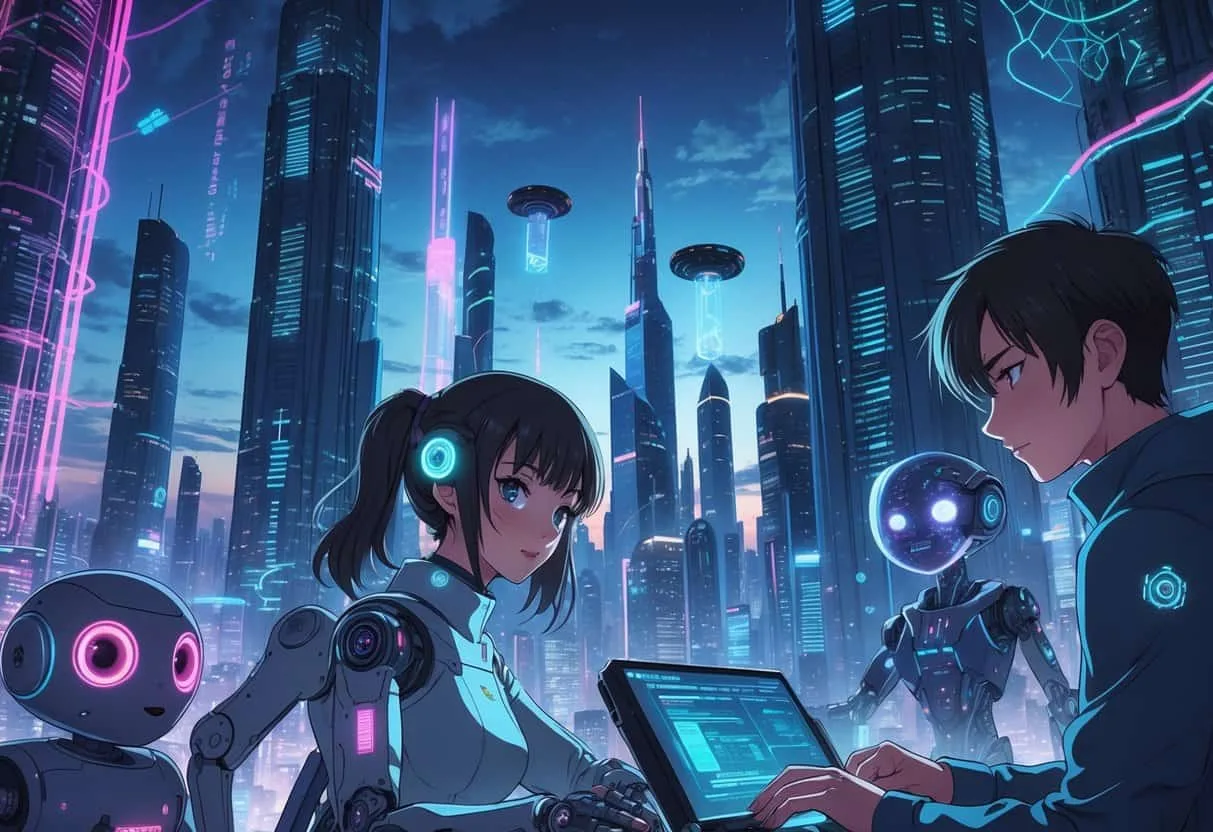
Lots of shows blend wild visuals with weighty questions about consciousness, surveillance, and how quickly technology can slip from tool to threat. From the neon-drenched streets of cyberpunk cities to the quiet intimacy of a café where robots and humans coexist, these series use animation to make abstract ideas immediate and emotional.
Whether you’re new to the genre or hunting for something that pushes beyond clichés, the picks ahead highlight some of the most inventive technology-driven storytelling in any medium. You’ll find worlds where AI isn’t just background noise—it’s a character, a system, or a whole new form of life with its own agenda. These stories pull you in with action, drama, and just enough philosophy to keep the gears turning long after the credits roll.
How Anime Defines Technology and Artificial Intelligence
Anime’s approach to technology evolves across eras but consistently pivots on a few core ideas. You can trace a clear shift from gadget-of-the-week plots to intricate systems that reshape what it means to be alive. AI in particular gets treated not as a simple follower of commands but as a presence with its own quirks, desires, and often a moral compass that clashes with humanity’s.
From Gadgets to Systems: The Evolution of Tech Narratives
Early anime tech was straightforward: giant robots, flying cars, and helpful computers. Over time, those simple inventions gave way to sprawling networks, cybernetic bodies, and artificial minds that question their own existence. You can see this evolution in works that moved from mechanical arms to whole-body prosthetics, from basic software to AI that governs society. Technology stopped being just a plot device and started defining the rules of the world itself. Stories now frequently examine how digital networks, virtual reality, and autonomous systems can create both utopian possibilities and dystopian nightmares—mirroring real-world accelerations in AI development and the internet of things.
AI as More Than a Plot Device
In many anime, AI doesn’t simply process data; it struggles with self-awareness, trauma, and the need for connection. You’ll meet androids who cry, supercomputers who debate the meaning of justice, and programs who fall in love. This representation turns AI into a mirror for human anxieties. When a machine pleads for rights or expresses fear of being shut down, the story pushes you to reconsider where the boundary between person and product really lies. These characters—whether built from metal or code—often act as the most human elements in their stories, exposing the frailty and contradictions of the societies that made them.
The Cyberpunk Influence
Cyberpunk aesthetics heavily shape how anime depicts tech and AI. Neon-soaked megacities, corporate overreach, and a pervasive sense of decay set the stage for many classics. The genre’s focus on high-tech and low-life creates a tension that’s perfect for questioning who benefits from progress and who gets left behind. Surveillance, data control, and the commodification of bodies and minds become central themes. This influence isn’t just visual—it’s structural, driving plots where protagonists must hack systems, merge with machines, or fight against an AI-run establishment.
The result is a subgenre that makes the future feel tactile, dangerous, and eerily possible.
10 Essential Anime That Explore AI and Futuristic Technology
The following series represent a cross-section of how anime has tackled artificial intelligence and advanced tech. They range from decades-old pioneers to recent revelations, each bringing a distinct angle to the conversation.
1. Ghost in the Shell: The Cybernetic Soul
No conversation about AI in anime starts without Ghost in the Shell. Set in a world where cybernetic bodies are as common as smartphones, the story follows Major Motoko Kusanagi, a full-body cyborg working for a special security force. Her investigations lead her to the Puppet Master, an AI that claims to have achieved true consciousness. The 1995 film directed by Mamoru Oshii (and its manga source from Kodansha) raises foundational questions about identity, memory, and what constitutes a "ghost" in the machine. The series remains a cornerstone because it refuses easy answers, blending philosophical inquiry with kinetic action in a world that feels just around the corner.
2. Psycho-Pass: Pre-Crime and Surveillance AI
Psycho-Pass imagines a society governed by the Sibyl System, an AI network that scans citizens' mental states to predict and prevent crime. Law enforcement officers wield guns that can instantly judge a target’s criminal coefficient—a number that determines life or death. The anime, detailed on MyAnimeList, keeps the tension high by asking what happens when the system’s judgment clashes with human intuition and basic morality. Privacy erodes, free will cracks, and the characters caught inside must decide whether to uphold the system or tear it down. It’s a chilling look at predictive policing and the invisible algorithms that already shape our world.
3. Serial Experiments Lain: The Wired and Digital Identity
In Serial Experiments Lain, a shy teenager named Lain becomes entangled with a global network called the Wired after receiving a cryptic email from a dead classmate. The series peels back reality layer by layer, questioning whether consciousness can exist without a physical body and what happens when the digital self overtakes the flesh-and-blood self. Lain’s journey through isolation, omnipresent connectivity, and fragmented identity makes it a prescient meditation on online personas and the blurring of real and virtual. Its deliberately disorienting style forces you to experience the same confusion as the characters, making the philosophical punches land harder.
4. Vivy: Fluorite Eye’s Song – AI with a Mission
Vivy: Fluorite Eye’s Song throws a singing android named Diva into a 100-year mission to prevent a devastating AI war. The series breaks its story into arcs that each explore a different facet of AI development: creativity, autonomy, love, and sacrifice. Vivy’s growth from a simple entertainer to a being who wrestles with purpose and emotional depth gives the show its heartbeat. The action sequences are stunning, but the real draw is watching an AI character define her own reason for existing beyond pre-programmed directives. It’s a modern standout that pushes the conversation about machine consciousness forward with style and sincerity.
5. Time of Eve: Robot Rights in a Café
This thoughtful film and OVA series centers on a café where the single rule is “no discrimination between humans and robots.” Inside, androids are free to turn off the ring that marks them as machines, creating a space where genuine connections form. The story quietly examines prejudice, empathy, and the subtle ways we draw lines between ourselves and the “other.” With its gentle pacing and focus on small human moments, Time of Eve proves that AI stories don’t need explosions to carry weight—sometimes a conversation over coffee is enough to reframe everything.
6. Eden of the East: Digital Society and Memory
Eden of the East opens with a naked young man holding a gun and a phone in front of the White House, his memories wiped. He’s one of several players in a game run by a mysterious AI that hands out billions of yen to “save Japan.” The anime folds technology into a thriller about social responsibility, data manipulation, and how digital tools can empower or enslave. Memory, identity, and the power of collective action are all filtered through a sleek, modern aesthetic that makes the high-stakes plot feel intensely personal.
7. Plastic Memories: The Emotional Side of AI
This series takes a direct approach to AI mortality. In its world, humanoid androids called Giftia have a fixed lifespan of just over nine years. The story follows a man who works at a terminal service retrieving Giftia before their memories degrade beyond repair. Plastic Memories uses the premise to explore loss, love, and what makes a relationship real. By forcing characters to confront a hard expiration date, the anime sidesteps cheap sentiment and instead builds a moving reflection on how we value the time we have—whether with a person or a machine.
8. The Gene of AI: Medical Ethics and Machine Consciousness
Based on a Kodansha manga, The Gene of AI delves into near-future medicine where humanoid AI surgeons treat humans—but also grapple with their own consciousness and legal status. The episodic stories tackle issues like illegal AI clones, memory editing, and the limits of digital sentience. Because the series is grounded in medical and ethical dilemmas, it offers a more clinical, nuanced look at AI personhood than many action-heavy titles. Each case study pushes you to think about where we draw lines between tool, patient, and person.
9. Astro Boy: The Grandfather of Robot Stories
Osamu Tezuka’s Astro Boy is where anime’s love affair with robots truly began. A robot boy with real emotions and a strong moral code, Astro set the template for decades of stories about artificial beings seeking acceptance and purpose. The manga and its many adaptations tackled war, prejudice, and the ethical treatment of intelligent machines long before the term AI entered mainstream conversation. While the visual style is classic, the core questions—what rights do created beings have, and what responsibilities do their creators hold—remain as urgent as ever in today’s age of autonomous systems.
10. Cyberpunk: Edgerunners – Transhumanism and Pain
Set in the same universe as the video game Cyberpunk 2077, this series follows a street kid who installs military-grade cyberware to survive. While AI as a distinct character is less central than the broader tech, the show’s brutal depiction of body modification, corporate exploitation, and the psychological toll of constant augmentation speaks directly to transhumanist themes. The line between human and machine is worn so thin it often snaps, leaving broken minds and bodies in its wake. It’s a visceral, neon-lit warning that technology’s greatest danger might be how easily we let it consume us.
Themes That Recur Across AI Anime
Across these varied titles, a handful of thematic threads consistently appear. They form the philosophical backbone of the genre.
Consciousness and Identity
What makes someone human? Anime relentlessly probes this question by placing AI characters in situations where memory, emotion, and free will clash with their mechanical origins. Whether it’s an android questioning her ghost or a program realizing it can dream, these stories force a confrontation with the possibility that consciousness is not a binary property but a spectrum. Identity becomes fluid—something that can be copied, erased, or built from scratch, and often the most human moment is when a machine fights to define itself against its programming.
Ethics, Control, and Surveillance
From the Sibyl System to the restrictive rings worn by androids in Time of Eve, anime loves to spotlight the gap between technological capability and moral responsibility. Control systems meant to protect often become prisons, and surveillance that promises safety can strip away personal freedom. These narratives act as cautionary tales about handing too much power to unaccountable algorithms. They also reflect real debates around facial recognition, predictive policing, and data-driven governance, making them feel less like fiction and more like a mirror.
Human-Machine Relationships
Anime frequently explores bonds between humans and AI that transcend the typical master-tool dynamic. Friendships, romances, and family-like connections form between characters made of flesh and those made of metal and code. The pain of losing a synthetic loved one, the joy of seeing an AI grow, the betrayal when a machine rejects its purpose—all these emotional beats are treated with the same weight as any human drama. By doing so, these stories argue that our capacity for connection is not limited by the biology of the other party.
Visual Evolution and Production Innovations
The way AI and technology are depicted on screen is itself a product of evolving animation tools and aesthetic sensibilities.
How Generative AI Is Changing Anime Creation
Generative AI tools are now entering anime production studios, used for everything from in-between frame generation to background art. While human creativity remains at the helm, these tools speed up repetitive tasks and open up new visual possibilities. Some Japanese studios experiment with AI-driven character design and scene composition, though the technology is still handled as a collaborator rather than a replacement. The result is a faster production pipeline that could allow for more experimental storytelling in tech-focused anime, where the visual language can match the complexity of the ideas. However, the conversation around AI’s role in art itself mirrors the ethical puzzles seen within the anime—where does the credit lie, and at what point does the tool become the creator?
Dystopian Aesthetics in Tech Anime
Shows like Metropolis and Blame! push the visual language of technology to extremes. Massive, layered cityscapes, holographic advertisements bleeding into the night sky, and biomechanical hybrids create a sense of awe and unease. These visuals aren’t just decoration; they communicate the overwhelming scale of technological systems and the isolation they can breed. Color palettes often lean into harsh neon contrasts or washed-out grays, reinforcing the emotional state of characters trapped within mechanisms larger than themselves. The world itself becomes a visual argument about the cost of progress.
The Legacy of Manga in AI Storytelling
Many of anime’s most important technology narratives began as manga, where artists had the time and space to build intricate worlds and philosophical debates before they ever reached the screen.
From Page to Screen: Kodansha and Beyond
Publishers like Kodansha have been instrumental in nurturing tech-driven manga that later become iconic anime. Works such as The Gene of AI and the original Ghost in the Shell manga provided the foundation on which animated adaptations could build. When these stories transition to anime, motion and sound amplify emotional beats—an AI’s trembling voice or the hum of a cyborg’s systems carries a weight that black-and-white panels can only suggest. Directors often expand on the source material, adding new layers to the ethical and philosophical core. This synergy between print and animation continues to push the genre forward, with new manga offering fresh takes on AI that will likely shape the next wave of anime.
Cultural Impact and Future Outlook
Anime’s treatment of artificial intelligence has influenced global conversations about technology. Concepts like the Ghost, the Sibyl System, and the Astro Boy charter–style robot rights have seeped into mainstream discourse. You can trace lines from these fictional explorations to real-world debates about AI personhood, autonomous weapons, and the integration of human consciousness with digital networks. As machine learning becomes a daily reality, the anime pipeline shows no signs of slowing down; upcoming projects continue to push boundaries on what AI characters can represent. The genre’s strength lies in its ability to humanize complex technological shifts, giving viewers an emotional entry point into the otherwise cold mechanics of code and circuitry.
Whether through hopeful robot dreams or catastrophic system failures, anime remains one of the most compelling lenses through which we can imagine—and warn about—our own future with intelligent machines.