Table of Contents
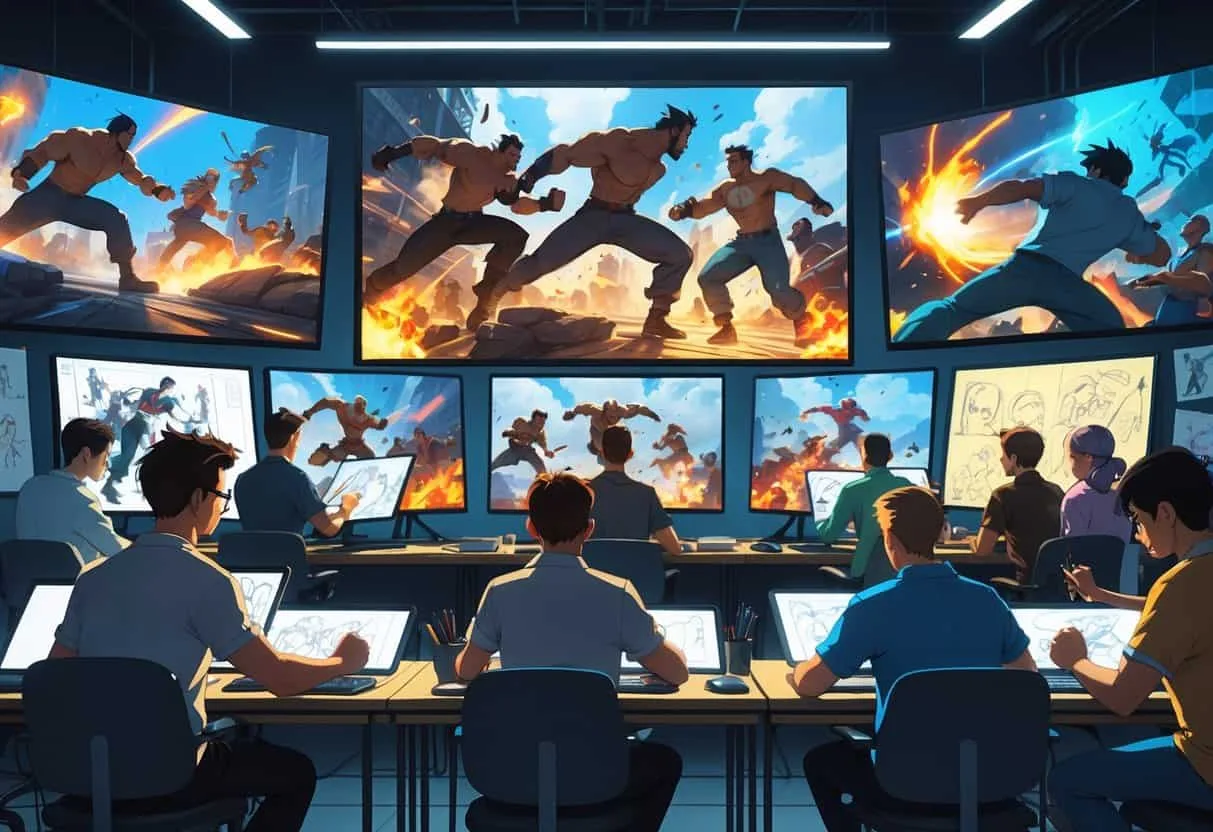
You feel your pulse quicken when an animated character throws a punch that seems to shatter the screen. The most jaw-dropping fight sequences don’t happen by accident—they are built, frame by frame, by animators who treat motion like a language. The craziest fight scenes in animation today come from a blend of technical precision, wild imagination, and a deep understanding of when to break the rules of physics for pure emotional impact. These artists have turned action into a storytelling engine, where every strike advances character, every stagger reveals vulnerability, and every explosion earns its place on your rewatch list.
Behind those viral clips and late-night fan discussions stand creators like Yutaka Nakamura, whose lightning-fast choreography in anime defines a generation, and rising talents like Weilun Zhang, who shocked the industry with his work on Boruto. Their fingerprints shape the visual language of modern animated combat, influencing everything from high-budget studio films to indie shorts. This article profiles the animators behind the craziest animated brawls, explores the techniques that make their work unforgettable, and breaks down case studies that show exactly why some fights become instant classics.
Key Takeaways
- Motion storytelling separates great fight animators from capable ones, using timing, weight, and spacing to make every hit feel authentic.
- A handful of legendary studios and solo artists have defined entire eras of fight animation, from the Golden Age cartoons to today's digital hybrids.
- Character design and narrative stakes amplify action; a well-motivated fight lands harder than any spectacle alone.
- Emerging voices are redefining the medium by fusing 2D fundamentals with 3D tools and experimental frame rates.
- You can trace the evolution of action animation through specific key scenes—from slapstick chases to emotionally devastating duels.
The World of Animation’s Craziest Fight Scenes
You know a crazy animated fight when you see one: the screen blurs with speed, sound design rattles your speakers, and the choreography makes you forget you’re watching drawings or rigs. But what separates a good brawl from a legendary one is rarely about how much destruction gets drawn. It’s about how the animator controls your eye, plays with rhythm, and builds anticipation until the release feels like a deep exhale. Modern action animation mixes decades of evolving tradition with real-time digital feedback, letting creators iterate faster while preserving the hand-crafted feel that makes you lean in.
What Makes an Animated Fight Scene Stand Out?
A standout fight scene operates on clarity first. You should never wonder where a character is in space, who is winning, or what a hit costs. Animators use exaggerated anticipation—a wind-up that stretches time—so that even a fast snap of movement feels weighty. Color theory often gets ignored in this conversation: silent shifts to monochrome for a flashback impact, or a saturated splash to mark a critical strike, guide your emotional reading of the action. The best fights also treat pacing like music.
They alternate between rapid-fire exchanges and moments of stillness, letting you absorb the damage before the next wave. If you look closely at a sequence from Sakugabooru, a massive animation reference site, you’ll see how one animator can own a scene’s entire rhythm while keeping each character’s fighting style distinct—languid versus staccato, beastly versus technical.
Influence of Animation Styles on Action Sequences
Style dictates the rules of engagement. Traditional hand-drawn fights, like those in Cowboy Bebop, rely on smear frames and exaggerated arcs to sell speed without losing form. 3D CGI, as seen in Land of the Lustrous, allows dynamic camera sweeps that weave through limbs at impossible angles, giving you a sense of three-dimensional chaos. Some creators purposefully blend the two. In Spider-Man: Into the Spider-Verse, the mix of 2D comic book accents over rigged characters—impact bursts, onomatopoeia, offset timing—creates a visual language that feels energetic and chaotic while staying readable. The animation style also affects how injuries register.
Stop-motion gives you tangible weight, where every frame of a puppet’s stumble screams pain to your brain. Anime frequently uses stylistic “impact frames”—single, high-contrast drawings inserted for a fraction of a second to punctuate a blow. These choices aren’t just aesthetic; they control your nervous system response to danger on screen.
Impact on Animated Shows’ Popularity
It’s no secret that viral fight clips drive subscriptions and merch sales. A show like Jujutsu Kaisen exploded internationally off the back of sequences so clean and brutal that fans dissected them in thousands of reaction videos. Google Trends spikes whenever a major battle episode drops, and platforms like Crunchyroll and Netflix track retention specifically around action showcases. High-octane fights become gateway drugs: a casual viewer stumbles onto a YouTube compilation of the best animated fights, then binges an entire season. For the industry, investing in a star animator’s sequence can deliver years of fan loyalty.
The trust you place in a show after seeing a perfectly constructed duel means you’ll return even for quieter episodes, curious about the next time the animation floors you again.
Top Animator Profiles: The Visionaries Behind Iconic Battles
Behind every staggering combat sequence is a person with a sketchbook, a tablet, or a stack of keyframes. These animators don’t simply move characters from pose to pose; they inject philosophy, personality, and anatomy into violence. Their names become shorthand among fans for a certain kind of thrill.
Pioneering Cartoonists and Their Contributions
Before there were anime sakuga superstars, there were cartoonists figuring out that movement could be funny, brutal, and meaningful all at once. Winsor McCay’s 1914 Gertie the Dinosaur proved that sequential drawings could convey playful aggression, with Gertie stomping and tossing objects with personality. Max Fleischer then pushed realism forward by patenting the rotoscope in 1915, tracing live-action footage to create fluid fight choreography in series like Superman (1941). That methodology gave weight to punches that felt physically credible, directly influencing how 2D fights approached anatomy. Tex Avery and Chuck Jones at Warner Bros. later weaponized exaggeration—think of Daffy Duck’s elastic body absorbing shotgun blasts or the Looney Tunes’ physics-defying brawls—where timing and comic violence turned fights into visual jokes that still influence stylized action today.
Their work taught generations that a fight scene could be as expressive as a dance and as structured as a musical piece.
Spotlight on Studio Legends
When you think of Disney’s Nine Old Men, you might picture singing princesses, but Milt Kahl’s animation for the final dragon fight in Sleeping Beauty (1959) remains a master class in clear silhouettes and powerful movement. The dragon’s massive form never becomes a muddy tangle because Kahl prioritized readable outlines even during rapid lunges. Across the Pacific, Studio Ghibli’s action sequences often ride a different current. Hayao Miyazaki’s boarding for the battle between Ashitaka and the samurai in Princess Mononoke uses long, unbroken tracking shots where the camera pushes through violence without a cut, making you feel the inexorable momentum of a cursed arm. The legendary Yasuo Ōtsuka, mentor to Miyazaki, stressed the importance of weight and balance; every jump and landing in a Ghibli fight feels grounded, even when magic is present.
These studio systems didn’t just produce movies—they codified principles like squash and stretch, anticipation, and follow-through that remain the grammar of all animated action.
Modern Masters of Animated Action
Today’s pantheon includes names that trigger immediate visual associations. Yutaka Nakamura, known to fans simply as “Yutapon,” has become synonymous with cubes—geometric debris that explodes from impacts—and a camera that spins around a character mid-flip. His cuts in My Hero Academia and One Punch Man use speed lines and extreme foreshortening to bend perspective until a fist seems to touch your nose. Genndy Tartakovsky, creator of Samurai Jack and Primal, champions silhouette-based choreography where you could remove all internal details and still read the story through body shapes. His fights are symphonies of silence, punctuated by raw sound that makes each slash feel like time halts.
Shinichiro Watanabe’s Samurai Champloo, blending hip-hop with chanbara swordplay, relied on animators like Kazuto Nakazawa to mix fluid breakdancing footwork with sudden lethal cuts—a mashup that still feels fresh. Kim Do-hee, a Korean veteran behind many stunning fights in Fire Force and Soul Eater, uses low-angle shots and smeared motion to make fire and fists look equally alive. These modern masters all understand that action is a conversation, and they speak in sentences of impact, reaction, and recovery.
For a deeper look at Yutaka Nakamura’s signature style, Crunchyroll’s feature breaks down his cube motif and how he constructs speed.
Rising Stars in the Animation Industry
The next wave of fight animators is already leaving scorch marks on the industry. Weilun Zhang’s jaw-dropping sequence in Boruto: Naruto Next Generations episode 65 became an overnight legend, showcasing a fluid hand-to-hand fight with dynamic camera rotation and martial arts accuracy that convinced many to give the series a second look. Shingo Yamashita’s work on Naruto Shippuden and Jujutsu Kaisen mixes grainy, almost VHS-like textures with ultra-sharp impact frames, creating a gritty texture that feels visceral and raw. Kai Ikarashi has refined digital smears to a point where a character’s limbs warp across the screen, yet your eye never loses the focal point of the strike. In the West, animators like Lauren Montgomery, whose boarding on Avatar: The Last Airbender and Voltron: Legendary Defender emphasized martial arts stances and cooperative team combat, continue to push thoughtful action that prioritizes character arc over spectacle alone.
These rising stars are embracing remote collaboration tools and hybrid 2D/3D workflows, proving that a small team with a clear vision can rival the output of a massive studio. They’re the reason you’ll keep finding new favorites on anime streaming sites and YouTube animation showcases for years to come.
Case Studies: Legendary Fight Scenes Across Cartoons and Anime
To understand what makes fight animation tick, you have to jump inside specific scenes. Each era and region brings its own priorities: laughter, shock, technical brilliance, or emotional release. Here’s how different animations approach the same core problem of making violence compelling.
Classic Cartoons: Evolution of Animated Combat
Warner Bros. shorts from the 1940s and 1950s turned combat into a rhythm of anticipation and absurd payoff. Bugs Bunny’s duels with Yosemite Sam live or die on the timing of a beat before a cartoon explosion. The humor derived from knowing exactly what would happen—a frying pan to the face, a detonating TNT plunger—and still laughing when the physics broke hilariously. Hanna-Barbera’s Tom and Jerry simplified the formula: clear character roles, brutal gags, and music that acted as punctuation. Even later, The Simpsons’ Itchy & Scratchy segments distilled animated violence into a meta-commentary on how little logic matters when the gag is king.
These classic sequences taught every animator that clear staging and deliberate pacing could make a simple punch land harder than a hundred laser blasts.
Anime’s Most Unforgettable Showdowns
Anime’s fight memories often attach to specific cuts that redefined fan expectations. The final duel between Spike and Vicious in Cowboy Bebop uses minimalistic movement, long silences, and a single brilliant piece of motion—Spike’s do-or-die finger-gun gesture—to say more than epic beam struggles ever could. Demon Slayer: Kimetsu no Yaiba episode 19, directed by Haruo Sotozaki but anchored by key animator Nozomu Abe, merges digital effects with flowing water visuals to turn Tanjiro’s desperate slash into a moment of heartbreaking beauty. The clash between Levi and the Beast Titan in Attack on Titan is a clinic in momentum: Levi spins, slices, and never stops, the camera tracking his movement so smoothly you feel you’re riding his ODM gear. Animation Magazine’s breakdown of that scene reveals the storyboard tricks used to maintain breakneck speed without losing you in the chaos.
These fights don’t just showcase power; they define character, sharpen themes, and stay lodged in your memory like a favorite song.
Standout Fights in Modern Animated Shows
Moving beyond anime, Western television has delivered its own defining battles. Avatar: The Last Airbender’s Agni Kai between Zuko and Azula strips away music for raw, roaring fire and sobbing breaths, a choice that underlines the tragedy of the sibling war. Arcane on Netflix, produced by Fortiche, brought a painterly, almost impressionistic texture to 3D combat, blending hand-painted backgrounds with explosive particle effects that make Vi’s jail break and Jinx’s showdown feel like moving concept art. Invincible turned a subway fight into a horrifying, unflinching display of superpowered gore, relying on the contrast between clean character designs and brutal impacts to shock you out of complacency. Even comedic shows like Rick and Morty occasionally unleash beautifully storyboarded sequences—think Rick’s multi-dimensional brawl in the season 5 finale—that prove even absurdist comedies can respect action choreography.
The table below maps show, style, and focus.
| Show | Fight Style | Key Focus |
|---|---|---|
| Tom and Jerry | Slapstick, destructive gag-based | Musical timing, physical comedy |
| Attack on Titan | 3D maneuver gear, ODM action | Speed, spatial awareness, consequence |
| Avatar: The Last Airbender | Elemental martial arts | Character growth, strategic bending |
| Arcane | Painterly 3D hybrid | Emotional weight, texture, color |
| Invincible | Brutal, high-impact realism | Consequence of power, body horror |
Character Inspirations and Storytelling Innovations
Even the most technically brilliant fight feels hollow if you don’t care about the people swinging. The intersection of personality and combat design is where animators can make you cheer, cry, or shout at your screen. The following sections unpack how character design and narrative technique elevate a brawl into an icon.
Influential Characters in Animated Fight Scenes
Iconic fighters like Azula from Avatar and Madara Uchiha from Naruto redefine animation because their fighting styles emerge from who they are. Azula’s precise, almost dance-like firebending contrasts with Zuko’s raw, emotional bursts; an animator can show a whole arc in a single stream of blue flame. In comedic contexts, Bugs Bunny’s nonchalance during combat—dodging bullets while munching a carrot—turns a fight into a psychological game where personality wins over brawn. Mob from Mob Psycho 100 presents a different challenge: animating the build-up of emotional energy that triggers cataclysmic power without any physical tension. The character’s blank expression versus the distorted world around him forces you to feel the fight internally, a triumph of visual storytelling.
Even Jerry the mouse and Tom the cat demonstrate that character-driven gags—Jerry’s mischievous ingenuity, Tom’s indignant fury—turn every clash into a rivalry you’re invested in, despite the lack of dialogue.
Storytelling Techniques That Enhance Animated Action
Animators often borrow narrative tools from filmmaking to make you feel the stakes. Clear goals are non-negotiable: when Tanjiro fights Rui in Demon Slayer, you understand he’s trying to protect Nezuko, and every cut is filtered through that desperation. Foreshadowing a technique—like showing a character practice a move in a quiet moment—gives the eventual execution a cathartic pop. Pacing alternates between extremes; a long, quiet stare before a duel makes the sudden flurry of motion more shocking. Sound design, or the deliberate lack of it, can reshape your entire experience—the silent chunk of a severed limb in Samurai Jack haunts more than any orchestral swell.
Music can act as a counterpoint: a gentle lullaby played over a brutal fight disorients and deepens the tragedy. Visual clarity remains the bedrock, and directors like ufotable’s Haruo Sotozaki prioritize clean posing and depth-of-field tricks even amidst swirling CG backgrounds so you never lose the focus point. The table below highlights these techniques with clear examples.
| Technique | Purpose | Example |
|---|---|---|
| Goal clarity | Roots action in character need | Protecting a sibling in Demon Slayer |
| Foreshadowing | Creates delayed payoff | Luffy’s Gear training montages |
| Pacing contrast | Amplifies impact of sudden violence | Silence before a sword draw |
| Sound design | Engages visceral response | No music during Primal kills |
| Visual clarity | Prevents disorientation | ufotable’s depth layering |
The Future of Fight Animation
As we look ahead, the tools and pipelines that shape fight scenes will continue to blur the line between traditional and digital. Animators are now using real-time game engines like Unreal to pre-visualize fights, allowing them to test camera moves and impact timing before a single keyframe is drawn. AI-assisted inbetweening is helping studios reduce the grind of manual frames, freeing artists to focus on the most expressive key poses. We’re also seeing a global collapse of geographic barriers: a fight scene for a Japanese anime might have its key animation done by a Korean studio, its effects by a French team, and its compositing done remotely across time zones, all while a singular vision holds it together. Festivals like Annecy and events on platforms like Sakugabooru continue to celebrate the individual animator’s signature, ensuring that even in massive productions, a name like “Yutapon” or “Weilin Zhang” gets recognized.
You can expect more hybrid styles that mix 2D hand-drawn character acting with 3D environment destruction, all built around the fundamental principle that you need to feel every hit in your gut.
At the same time, the rise of independent animators on YouTube and social media means the next great action sequence might come from a single creator in their bedroom, using digital brushes that simulate pencil on paper. The barrier to entry has dropped, but the need for strong storytelling and empathetic choreography hasn’t. As you continue to search for the craziest fight scenes, remember the faces behind the frames and the decades of craft that make a few seconds of animation stick with you forever.