Table of Contents
The Fire-and-Ice Dynamic
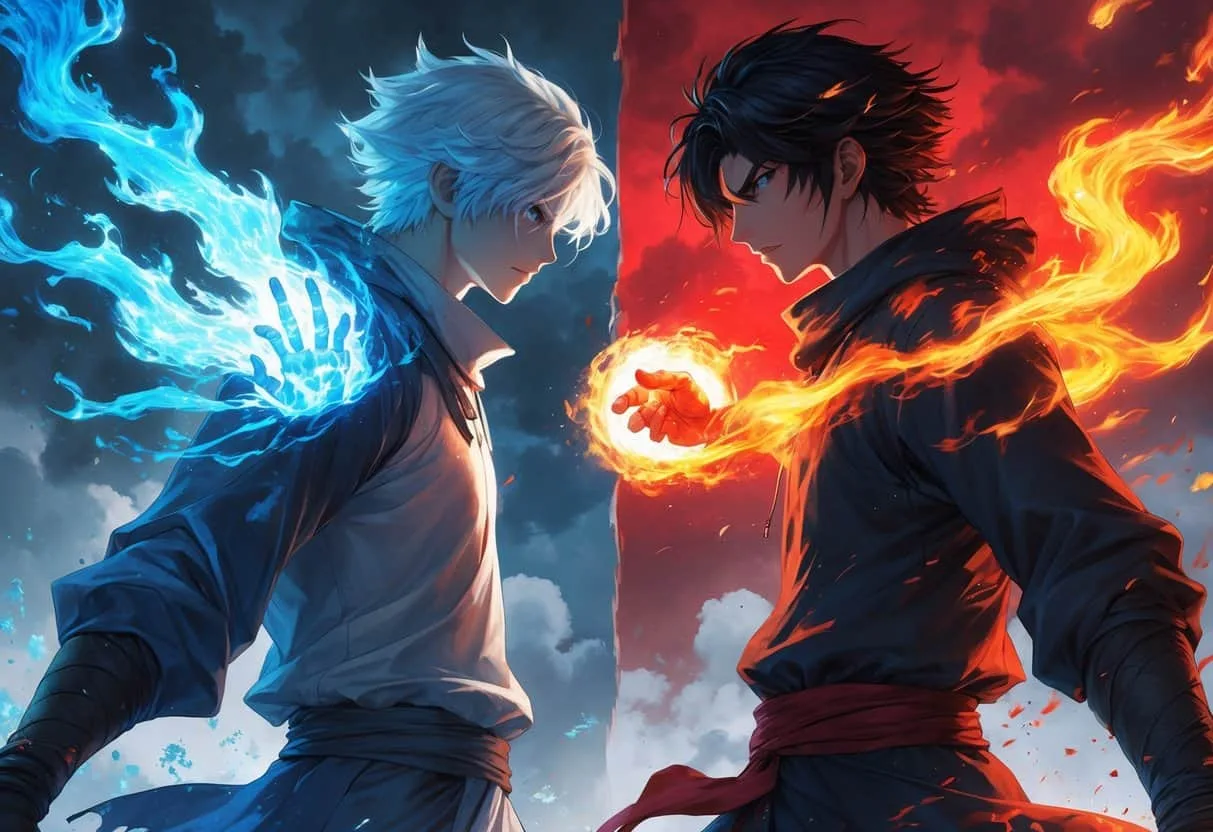
Few rivalries capture the imagination quite like the one between Shoto Todoroki and Prince Zuko. Both characters command elements of fire and ice—or, in Zuko’s case, fire channeled through a cold exterior—and both carry the scars of turbulent upbringings. Their arcs are not just about mastering supernatural abilities; they are about reclaiming identity, shaking off toxic expectations, and learning that true strength requires balance. Todoroki’s half‑cold, half‑hot Quirk literally splits him between two extremes, while Zuko’s firebending rages against a life of banishment and a desperate need for approval. Placing them side by side reveals two richly different flavors of the same struggle, and yet both remind us that healing is possible when you stop fighting yourself.
These two characters dominate conversations across anime forums, fan art communities, and pop culture analyses for a reason. Their stories tap into universal themes: the clash between authority and rebellion, the weight of parental legacy, and the messy, nonlinear path to becoming a better person. Todoroki and Zuko may exist in separate fictional universes, but their journeys echo each other so powerfully that fans can’t help but compare them—and the parallels only deepen the more you look.
Shoto Todoroki: A Hero Forged in Frost and Flame
Shoto Todoroki enters My Hero Academia as one of U.A. High School’s most promising students. His left side burns with the intense fire he inherited from his father, Endeavor, the current Number One Hero. His right side can generate glaciers of ice, a legacy from his mother. This genetic cocktail was no accident—Endeavor specifically married Rei, a woman with a powerful ice Quirk, through a Quirk marriage designed to create a child who could surpass All Might. The result is a prodigy, but also a boy who has been treated as a tool his entire life.
The Weight of the Number One Hero
Todoroki’s childhood was defined by emotional abuse and isolation. Endeavor subjected him to relentless training, forbidding him from playing with his siblings or having any semblance of a normal life. The pressure drove Rei to a psychological break, and she poured boiling water on Shoto’s left side, leaving the burn scar that now covers his eye. That moment cemented Todoroki’s vow to never use his fire—it belonged to his father, a man he despised. Instead, he leaned entirely on his ice, suppressing half of his identity out of spite and pain.
His enrollment at U.A. sets the stage for a gradual thaw. Todoroki initially appears cold and aloof, relying solely on raw power to coast through battles. But encounters with classmates like Izuku Midoriya and Katsuki Bakugou force him to confront the emotional walls he’s built. Midoriya, in particular, becomes a catalyst: during the Sports Festival, he screams at Todoroki that “it’s your power, not his,” shattering the mental dam that kept the fire locked away.
Half-Cold, Half-Hot: Mastering His Quirk
Todoroki’s Quirk is a fascinating study in duality. The left side can unleash devastating flames, but using it drains his stamina and risks overheating. The right side can flash‑freeze entire areas, but overuse can lead to frostbite. The two halves are designed to regulate each other—fire warms the body after ice has lowered its temperature, and ice cools the flames before they become uncontrollable. For years, Todoroki ignored this synergy, handicapping himself.
His growth depends on accepting that his power is not a curse but a complete system, one he can wield on his own terms.
Once he begins using both sides, his combat style transforms. He shifts from a one‑note glacier machine into a versatile tactician who can create steam screens, temperature barriers, and rapid‑fire combination attacks. More importantly, the internal struggle mirrors the external one: embracing his fire forces him to process the trauma tied to it, and that emotional work is just as demanding as any villain fight.
Todoroki’s Turning Points
Several moments stand out in Todoroki’s arc. The Sports Festival clash with Midoriya is the obvious pivot, but there are quieter breakthroughs too. Visiting his mother at the hospital and hearing her say she still loves him begins to mend a wound he thought permanent. Facing the villain Dabi—revealed to be his lost older brother Toya—forces him to reckon with Endeavor’s sins on an even larger scale. Each milestone chips away at the frigid shell he had constructed, revealing a hero who is compassionate, protective, and willing to forgive.
By the time the final arcs unfold in the manga, Todoroki has evolved into a leader who can stand alongside his classmates not just as a weapon, but as a fully realized person. His journey from rejecting his fire to harnessing it on his own terms is one of self‑acceptance, and it resonates with anyone who has ever tried to bury a painful part of their past.
Zuko: The Banished Prince’s Path to Honor
Zuko’s story in Avatar: The Last Airbender is widely regarded as one of the greatest redemption arcs in animated history. Introduced as an antagonist hell‑bent on capturing the Avatar to restore his honor, Zuko is a prince stripped of everything: his title, his homeland, and his father’s respect. For three seasons, viewers watch him stumble, rage, and slowly unlearn the indoctrination that convinced him cruelty was strength and mercy was weakness.
A Scar That Tells a Story
Zuko’s physical scar—the burnt tissue around his left eye—is a permanent reminder of his banishment. Ozai, the Fire Lord, burned his son in a cruel Agni Kai after Zuko spoke out against a plan to sacrifice a division of new recruits. Instead of recognizing his son’s compassion, Ozai saw weakness and branded it into Zuko’s face. That single act defined Zuko’s teenage years: he chased the Avatar obsessively, believing that only by completing that mission could he erase his shame and return home.
The scar also becomes a symbol of his internal conflict. He lashes out with anger and frustration, but those outbursts often mask deep sadness and confusion. Zuko’s entire Season 1 persona is a boy trying to be someone he isn’t, because the alternative—accepting that his father is a monster—is too terrifying to consider. That cognitive dissonance makes his eventual heel‑turn all the more satisfying.
Firebending as a Mirror of the Soul
Unlike Todoroki, Zuko does not possess ice powers. His firebending, however, evolves from a volatile, rage‑fueled flame into a cleaner, disciplined art. The shift comes after he learns the true origins of firebending from the dragons Ran and Shaw, who teach him that fire is not just destruction—it is life, energy, and light. This revelation aligns with his changing heart: as Zuko lets go of his anger and finds his own moral compass, his bending becomes stronger and more precise.
Zuko’s swordsmanship also reflects his character. When firebending fails him—either because his inner turmoil blocks it or because he’s disguised as the Blue Spirit—his dual dao swords carry the weight of his combat skill. That versatility mirrors his ability to adapt and survive, even when stripped of his elemental advantage. It’s a reminder that Zuko’s strength has always been more about willpower than raw power.
Uncle Iroh and the Journey to Redemption
No discussion of Zuko’s arc is complete without Uncle Iroh. The retired general, tea‑loving, and endlessly patient, Iroh is the moral center Zuko desperately needs. While others mock or fear the banished prince, Iroh sees a lost boy who just needs the space to figure things out. He never forces his wisdom; instead, he shares proverbs, plays Pai Sho, and lets Zuko make his own mistakes. That gentle guidance allows Zuko to eventually recognize that his real honor lies not in his father’s approval, but in aligning his actions with his conscience.
Zuko’s true redemption moment arrives when he confronts his father during the eclipse, declaring that he will join the Avatar and help end the war. It’s a choice made freely and with full understanding of the consequences. He then works to earn the trust of Aang, Katara, Sokka, and Toph—a process that takes time and humility. His arc completes when he faces Azula in the final Agni Kai, not to destroy her, but to protect Katara, and when he shields her from a lightning strike, taking the blow himself. That sacrifice crystallizes everything Zuko has become: selfless, brave, and profoundly changed.
Power and Personality: A Side-by-Side Comparison
Despite their different settings, Todoroki and Zuko share a striking number of traits. Both come from families where a powerful father viewed them as extensions of his own legacy. Both are initially defined by the sides they reject—fire for Todoroki, the Fire Nation’s cruelty for Zuko. And both need a compassionate outsider to help them see that their worth isn’t determined by their parent’s approval.
Control vs. Passion
Todoroki operates from a place of rigid control. His ice reflects emotional detachment, and even after he starts using his fire, he channels it with careful regulation. His demeanor is often described as “cool” or “stoic,” and he processes pain internally rather than exploding outward. Zuko, by contrast, is a hurricane of emotion. He yells, he broods, he punches walls.
His firebending feeds off passion, and his early episodes are marked by frustration and impulsiveness. As he matures, he learns to channel that passion into resolve, but the intensity never fully disappears.
This contrast makes the two of them compelling mirrors: Todoroki is ice that learns to stoke an inner flame, while Zuko is fire that learns temperance. Both arcs hinge on balance—Todoroki’s between two elements, Zuko’s between his emotions and his values.
Family as the Catalyst
Endeavor and Ozai are both monstrous fathers, though their methods differ. Endeavor’s abuse is rooted in a twisted desire to create the perfect hero; he sees Shoto as a project. Ozai’s cruelty is pure dominance, a reflex to crush any hint of defiance. The emotional damage they inflict is deep, but the paths to healing diverge. Todoroki eventually receives apologies and attempts at reconciliation from his father, and he is able to forge a fragile peace with his family.
Zuko, on the other hand, must fully reject Ozai—there is no reconciliation, only a clean severing. Both endings feel appropriate for the characters: Todoroki’s world allows for some measure of redemption for his abuser, while Avatar requires a complete dismantling of the imperial system Ozai represents.
Redemption or Self-Acceptance?
A key difference lies in the nature of their arcs. Zuko commits genuine wrongs: he hunts children, betrays allies, and aids a genocidal regime. His journey is a classic redemption arc, requiring him to atone for past harms. Todoroki, by contrast, hasn’t done anything villainous; his arc is one of self‑acceptance and breaking free from abuse. He doesn’t need to be redeemed so much as he needs to stop punishing himself.
The storytelling stakes are different—Zuko’s missteps raise the tension of whether he can ever be trusted, while Todoroki’s evoke sympathy for a hero who was never allowed to be whole. Despite that distinction, both arcs hit with tremendous force because they are about choosing your own identity instead of inheriting one.
Shared Themes in Their Stories
Look past the elemental powers and you’ll find a web of interconnected themes that make Todoroki and Zuko feel like spiritual siblings. Their creators tapped into deep emotional truths, and the result has left a lasting mark on how we think about character growth in animation.
Rejecting Destructive Legacies
Both young men are born into legacies that demand they become instruments of their fathers’ ambitions. Endeavor wanted a child who could surpass All Might; Ozai wanted an heir who would continue the Fire Nation’s conquest. By refusing to play those roles, Todoroki and Zuko assert that they are more than their bloodlines. This theme resonates with anyone who has ever felt pressure to follow a prescribed path—whether from family, culture, or society.
The Role of Mentors and Friends
Todoroki’s primary catalyst is Midoriya, a classmate who sees through the walls and challenges him to reclaim his fire. Zuko’s anchor is Iroh, a wise uncle who embodies unconditional love. In both cases, the breakthrough comes not from a dramatic fight but from someone stubbornly believing in them. These relationships underscore that healing often requires connection; you can’t walk out of the dark entirely on your own.
The Fire-and-Ice Duality in Their Growth
The interplay of fire and ice is more than aesthetic. Fire represents destruction, passion, and change; ice symbolizes preservation, stasis, and emotional control. Todoroki’s entire journey is about merging the two forces into a cohesive identity. Zuko’s arc mirrors this dichotomy symbolically: his firebending is his most volatile trait, but he must learn to apply it with the cold discipline of a true master. The lesson is the same: balance is strength, not suppression.
For a deep dive into how these archetypes echo across fiction, MasterClass’s guide to redemption arcs breaks down the structural elements that make these stories work.
Cultural Impact and Fandom
Todoroki and Zuko have transcended their source material to become icons of modern animation. Their popularity is not just about cool powers or striking character designs—it’s about how deeply people connect with their struggles. The cultural conversation around them continues to evolve, driven by fan creations, critical analysis, and the sheer volume of “who would win” debates.
Todoroki and Zuko as Shipping Icons
Both characters are magnets for shipping culture. Zuko’s intensity and ultimate kindness make him a favorite for pairings with Katara, Mai, Sokka, and even characters from entirely different franchises. Todoroki similarly inspires a wide array of fan pairings: with Midoriya, Momo Yaoyorozu, Bakugou, and countless others. The fascination isn’t just romantic; it’s about the emotional intimacy these characters rarely express. Shippers gravitate toward the idea of someone finally breaking through the ice and offering the warmth they were denied.
Inspiration Across Media
The DNA of these characters appears in numerous shows, games, and comics that followed. You can spot Todoroki’s influence in anime heroes who wield opposing elemental forces and struggle with parental expectations. Zuko’s redemption arc set a new standard for antagonists‑turned‑allies, influencing everything from She‑Ra’s Catra to video game narratives like Fire Emblem: Three Houses. The archetype of the conflicted fire user seeking honor is now a storytelling staple. For fans looking to revisit Zuko’s journey in depth, the Avatar Wiki entry on Zuko offers an exhaustive timeline of his evolution.
To understand the broader cultural footprint, the Wikipedia page for My Hero Academia contextualizes Todoroki’s role in the series’ success.
Why Both Arcs Matter
In an era of media saturated with antiheroes and morally grey protagonists, Todoroki and Zuko remind us that vulnerability can be just as captivating as grit. Their stories reject the idea that you must be defined by your worst moments or your family’s sins. Instead, they champion the slow, difficult work of introspection and change. Todoroki’s path shows that you can reclaim parts of yourself you’ve long hated; Zuko’s proves that it’s never too late to rewrite your story, even if you’ve already harmed others.
Their arcs also set a high bar for emotional realism in fantastical settings. The conflicts they face—parental rejection, identity crises, the crushing weight of expectation—are grounded in experiences that transcend genre. That’s why viewers from all walks of life see pieces of themselves in a hero with split‑colored hair and a scarred prince with a temper. The fire and ice are just metaphors; the real heat comes from the human heart beating beneath the surface.
Two Sides of the Same Coin
Debating whether Todoroki or Zuko has the better redemption arc often misses the point. Their journeys are not in competition; they illuminate different facets of the same universal truth: healing is messy, nonlinear, and deeply personal. Todoroki teaches us that you can be whole without forgiving the person who broke you, while Zuko demonstrates that true honor is found in the courage to change. Both characters wield fire and ice in their own ways, but the fire they ultimately master is the one within—and that’s a victory no scar or rival can take away.
As long as audiences crave stories about overcoming trauma and forging identity, the legacies of Shoto Todoroki and Prince Zuko will continue to burn bright. In a landscape full of fire‑and‑ice motifs, these two remain the standard‑bearers, not because of their powers, but because of their profoundly human hearts.