Table of Contents
The Akatsuki stands as one of the most compelling and morally complex antagonist groups in anime history. Their immediate objective is chillingly straightforward: capture the nine tailed beasts and use their collective power to reshape the world order. Yet behind that surface-level villainy lies a dense web of personal trauma, ideological conviction, and devastating sacrifice. The group functions less as a simple cabal of evil-doers and more as a fractured mirror reflecting the very conflicts they claim to want to end. War, peace, pain, and the cyclical nature of hatred pulse through every member’s story, making the Akatsuki simultaneously terrifying and deeply human.
Key Takeaways
- The Akatsuki’s primary mission is to seize all tailed beasts to forge a weapon capable of imposing a new world order, often through extreme violence.
- Every member carries a distinct personal motive, transforming the organization into a collision point for themes like nihilism, faith, art, and redemption.
- The group’s symbolism—the red cloud, the black robes, the ring positions—is deeply rooted in the trauma of war and a twisted desire for peace.
- The Akatsuki’s legacy reshaped the entire shinobi geopolitical landscape and continues to influence anime storytelling and fan culture worldwide.
Origins and Goals of the Akatsuki
The Akatsuki’s birth is inseparable from the blood-soaked rains of Amegakure and the idealism of three orphans who dared to dream of a world without pain. What began as a grassroots peace movement gradually mutated into a clandestine mercenary force and eventually into the most feared terrorist organization in the ninja world.
Formation and Founding Figures
During the chaos of the 3rd Shinobi World War, Yahiko, Nagato, and Konan formed a small group dedicated to ending the suffering that turned their home village into a perpetual battlefield. Trained by Jiraiya of the Legendary Sannin, they initially pursued peace through dialogue and collective action. Yahiko’s charisma and unwavering hope drew followers, and the original Akatsuki grew into a symbol of resistance against the warring great nations.
That fragile hope shattered when Hanzo the Salamander, in collusion with Danzo Shimura, betrayed the group. Yahiko was forced to commit suicide to save Konan, and the moment ignited Nagato’s transformation into Pain. From then on, the organization’s core philosophy shifted: peace could only be achieved by making the world understand true agony. The tragic irony is that the very desire for an end to conflict became the justification for mass destruction.
Central Ideologies and Ambitions
Nagato’s vision crystallized into the “cycle of hatred” theory. He believed that lasting peace could never be achieved through mutual understanding alone because vendettas and violence endlessly regenerated. His solution was a monopoly on the means of mass destruction: gather the tailed beasts, create a weapon of unimaginable power, and periodically unleash it so that nations would be too terrified to wage war. This idea of peace through pain echoed real-world critiques of deterrence and cold war logic.
As the Akatsuki expanded, individual ambitions grew more fragmented. Itachi Uchiha harbored a secret loyalty to Konoha, joining to spy and ultimately to protect his brother. Hidan sought only to serve Lord Jashin through ritualistic killing. Kakuzu treated it as a lucrative business venture. These disparate drives made the group unpredictable, but they all orbited the central gravitational pull of capturing the jinchuriki.
Underneath the bickering and personal dramas, each mission brought them closer to the Infinite Tsukuyomi that would later be orchestrated by their true shadow leader.
Leadership Structure and Key Members
Outwardly, Nagato (as Pain) served as the leader, his Six Paths of Pain technique allowing him to command multiple bodies simultaneously. This terrifying ability made the Akatsuki appear larger and more omnipresent than it actually was. Beside him, Konan remained the loyal confidante, paper-based jutsu granting her both lethal precision and a gentle aesthetic that belied her resolve.
Beneath this surface lurked the true mastermind: Tobi, later revealed to be Obito Uchiha operating under Madara’s name. His manipulation kept the other members on a need-to-know basis, all while he steered the group toward the Moon’s Eye Plan. Orochimaru briefly served before his ambitions clashed with Pain’s, leading to a spectacular defection. Other pivotal operatives like Kisame Hoshigaki, the monstrously loyal swordsman, and Zetsu, the plant-like spy, rounded out a roster that combined raw power with intricate intelligence networks. The resulting hierarchy was deliberately opaque, with real authority often hidden behind layers of deception and contingency plans.
Evolution of Objectives Over Time
After Nagato’s death during the Assault on Konoha, the Akatsuki’s mission was hijacked entirely by Obito. The original goal of a punitive peace weapon was swapped for the esoteric Eye of the Moon Plan: a global genjutsu that would trap all humanity in a blissful illusion, ending all conflict by erasing free will. This radical pivot required not only collecting the remaining tailed beasts but also reviving the Ten-Tails itself.
As the Fourth Shinobi World War erupted, the Akatsuki transformed into an existential threat to the entire shinobi alliance. What had started among three orphans yearning for rainy days of tranquility had become an apocalyptic mechanism that nearly extinguished hope itself. The group’s evolution charts a grim trajectory from idealism through terrorism to outright world domination—a cautionary arc about how righteous anger can be twisted into an engine of destruction.
Symbolism and Themes in the Akatsuki
Every visual element associated with the Akatsuki is steeped in meaning. The name, the emblem, the uniforms, and even the manner of their operations were designed to be a statement. They didn’t simply wear their identity; they projected it, forcing the world to confront the pain they embodied.
Name, Emblem, and Attire
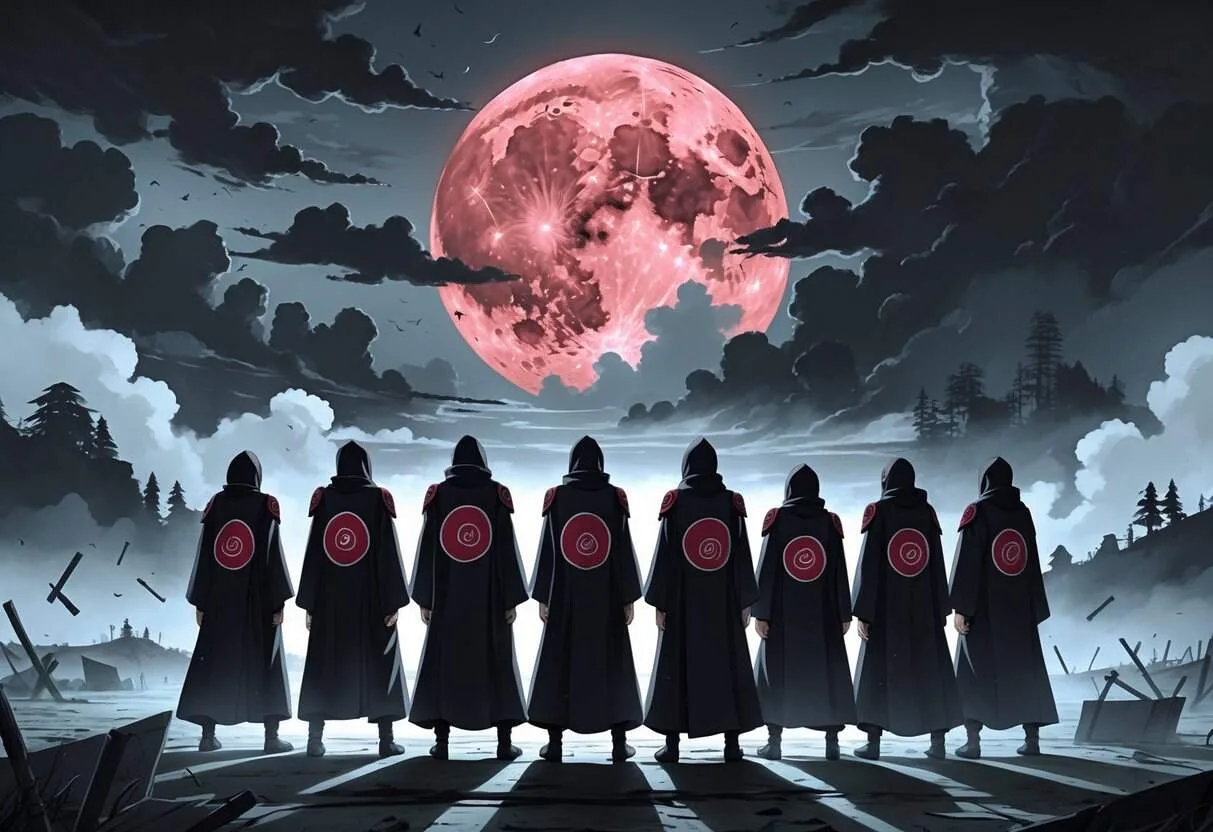
“Akatsuki” translates directly to “dawn” in Japanese, an evocative choice for a group that seeks to break the world into a new morning—whether through enlightenment or annihilation. It’s a word brimming with ambiguity, promising hope but arriving through darkness. The emblem embroidered on their cloaks is a stylized red cloud, a motif that recurs across every member’s back. Their long black robes with high collars create a silhouette that is at once monastic and menacing, uniting individuals as different as the artistic Deidara and the devout Hidan under a single, unmistakable banner.
The colors themselves carry heavy weight. Black has long been associated in Japanese tradition with mystery and formality, but also with mourning. Red, seared into the cloud design, is the color of lifeblood and sacrifice. Together, they hint at a congregation of mourners dressed for a funeral—perhaps for the world as it once was.
Red Clouds: Meaning and Significance
The red clouds are a direct visual reference to the blood that rained down upon Amegakure during the wars that orphaned the founders. Creator Masashi Kishimoto deliberately chose the emblem to evoke the tragedy of endless conflict, particularly the village’s perpetual storm that mixed rainwater with the lifeblood of countless shinobi. The clouds serve as a permanent reminder that the Akatsuki were born from agony and carry that agony with them like a shroud.
Yet the symbol also functions as a warning. For enemies who glimpsed those red clouds on the horizon, it signaled an inescapable confrontation with overwhelming power. The motif’s duality—a marker of personal suffering and a herald of impending doom—perfectly captures the organization’s central paradox: they are victims who became victimizers, convinced that only through greater violence can the cycle be broken.
Representation of Ambiguity and Morality
One of the series’ greatest achievements is that the Akatsuki rarely feel cartoonishly evil. Nagato’s Pain monologue about understanding true suffering resonates because it’s not entirely wrong. Itachi’s willingness to slaughter his entire clan to prevent a world war is a monstrous act born of profound love. Hidan’s religious fanaticism, while repellent, is a twisted expression of faith that forces audiences to consider where conviction ends and madness begins. Even Kakuzu’s raw greed can be read as a survival mechanism in a world that discards shinobi once their usefulness ends.
Kishimoto forces the reader into an uncomfortable space where the “villains” often have more compelling moral reasons than the heroes. The Akatsuki challenge the very concept of justice, asking whether peace imposed by force can ever truly be called peace. Their legacy in the narrative is a permanent stain of doubt that deepens the series’ philosophical undercurrents.
Notable Akatsuki Members and Individual Legacies
While the organization functioned as a collective, certain members’ personal sagas became cornerstones of the entire Naruto mythos. Their skills, motivations, and ultimate fates woven together form a tapestry of loss that underscores the human cost of the shinobi system.
Itachi Uchiha: Tragedy and Sacrifice
Few characters in anime command as much reverence and heartbreak as Itachi Uchiha. A prodigy who became an ANBU captain at thirteen, he was forced into an impossible choice: allow his clan’s coup d’état to plunge the village into civil war, or exterminate his own family and bear the stigma of a traitor to protect both Konoha and his younger brother Sasuke. He chose the latter, and then spent the rest of his short life inside the Akatsuki monitoring threats to the village he still loved in secret.
Itachi’s mastery of the Sharingan and his signature technique Tsukuyomi made him a feared opponent, but his legacy lies in the philosophy of self-sacrifice. Even after death, his actions shaped Sasuke’s path from vengeance to reluctant protector. His story is a masterclass in dramatic irony: the villain everyone hated was the ultimate hero, a truth that recontextualizes the entire early series. Itachi’s tale continues to inspire debates about the ethics of preemptive violence and the weight of love without acknowledgment.
Deidara: Art and Explosions
Deidara’s entire worldview revolved around the concept of the fleeting moment. To him, true art was not something static and eternal like Sasori’s puppets; it was the instant of destruction, the sublime flash of an explosion that could never be replicated. His Explosive Clay jutsu allowed him to sculpt living bombs, from tiny spiders to colossal dragons, each a performance meant to elicit awe.
His rivalry with Itachi—who subdued him with a mere glance from the Sharingan—fueled a deep-seated inferiority complex that eventually drove him to a final, suicidal “artistic” act against Sasuke. Deidara’s infamous proclamation, “Art is an explosion!”, has become one of anime’s most quoted lines, and his genuine passion for destruction forces a reconsideration of the boundaries between creation and annihilation. He left behind no moral lesson, only a scorched reminder that art and war can emerge from the same volatile heart.
Sasori: Manipulation and Puppetry
Where Deidara celebrated transience, Sasori sought permanence. Haunted by the death of his parents during wartime, he retreated into the art of puppetry, eventually hollowing out his own body to become an ageless, living weapon. His core philosophy was that true art endures forever, untouched by decay or emotion. Each of his hundred puppets was a preserved fragment of a life he had ended, collected like morbid souvenirs.
Sasori’s control extended beyond battle; it was a psychological armor against the grief that had fractured his childhood. His final confrontation with his grandmother Chiyo and Sakura Haruno became a meditation on generational pain and the possibility of healing. In the end, his death was hastened by the embrace of the “parent” puppets he created to simulate the love he never had, a potent symbol that even the most mechanical hearts still yearn for connection. More about his tragic story can be found in the Naruto fan archive.
Obito Uchiha: Deception and Redemption
If the Akatsuki were a play, Obito Uchiha—initially disguised as the goofy, swirling Tobi—would be both playwright and director. His fall from a compassionate, Naruto-like boy into a nihilistic manipulator was triggered by the trauma of Rin Nohara’s death, a loss that convinced him the real world was a hell not worth saving. Embracing Madara’s plan, he orchestrated the controlled chaos that drove the Akatsuki forward, all while hiding his true identity from even the closest members.
Obito’s Kamui ability granted him near-invulnerability and made him a terrifying ghost on the battlefield. Yet his arc ultimately becomes one of redemption, as Naruto’s relentless empathy reawakens the hope he’d buried. He sacrifices himself during the Kaguya confrontation, not to erase his sins but to buy the future a chance. Obito represents the series’ deepest argument: that even those who have caused the most suffering can rediscover who they once were and choose to protect what they once sought to destroy.
Impact and Enduring Legacy
The Akatsuki’s influence extends far beyond the fictional borders of the Elemental Nations. They reshaped the political landscape, forced unprecedented alliances, and left an indelible stamp on global anime culture that continues to thrive.
Influence on the Shinobi World and Major Villages
The mere existence of the Akatsuki forced the great nations to rethink their security paradigms. Sunagakure’s kidnapping of Gaara during the Kazekage Rescue Arc not only devastated an entire village emotionally but exposed critical shortcomings in its defense protocols. Similarly, the specter of the Akatsuki pushed the Hidden Cloud, Mist, and Stone to bolster their jinchuriki protections, reinforcing a panicked arms-race mentality that ironically mirrored real-world reactions to nuclear threats.
Konoha, in particular, was forced to grapple with the infiltration of Itachi and the subsequent Pain attack that reduced the village to a crater. The reconstruction that followed symbolized a shift in the series’ tone: the shinobi world could no longer ignore the dangers coming from within and without. The trauma of the Akatsuki became the catalyst for the unprecedented formation of the Shinobi Alliance, a union that ultimately saved the world.
Contribution to Major Conflicts
From the reanimation of chaos during the Chunin Exam aftermath to the apocalyptic scale of the Fourth Great Ninja War, the Akatsuki were lynchpins. Kakuzu and Hidan’s clash with Team Kakashi demonstrated the brutal cunning required to defeat a seemingly immortal duo. Sasori and Deidara’s attack on Sunagakure kicked off a narrative chain that led to Gaara’s captivity and Naruto’s desperate rescue mission. Pain’s devastating Shinra Tensei over Konoha remains one of anime’s most visually cataclysmic moments, and it forced Tsunade’s leadership to its absolute limit.
Their most profound contribution, however, was the resurrection of the Ten-Tails and the initiation of the Infinite Tsukuyomi. The alliance that stood against this threat represented every major village setting aside centuries of grievance, a direct consequence of the Akatsuki’s relentless pressure. Without the group’s provocations, the fragile peace that followed might never have been forged.
Cultural Impact in Anime and Manga
Outside the story, the Akatsuki have become a cultural phenomenon. The iconic red cloud cloak is one of the most cosplayed costumes worldwide, instantly recognizable even to casual anime fans. Acrylic keychains, collectible figurines, and streetwear collaborations continue to proliferate, cementing their aesthetic into the broader pop culture lexicon.
Critics and fans alike point to the Akatsuki as a benchmark for well-rounded antagonist ensembles. Each member’s philosophy—whether Pain’s utilitarian terror, Itachi’s sacrificial silence, or Hidan’s zealous devotion—supplies endless material for video essays and panel discussions. The group also inspired subsequent manga authors to craft villainous organizations with similarly layered motivations. In essence, the Akatsuki’s narrative reach has extended far beyond the pages of Naruto, influencing how modern shonen frames conflict, morality, and the painful path toward peace. For further reading on the group’s design and lore, the Akatsuki page offers a comprehensive breakdown.