Table of Contents
The Enduring Legacy of the Saiyan Race
Within the expansive Dragon Ball universe, few elements have proven as transformative or as relentlessly compelling as the Saiyan race. Originating as a simple narrative device to explain the protagonist Goku’s unnatural strength, the Saiyans have evolved into a complex mythic system that underpins over three decades of storytelling. Their influence extends beyond the screen, shaping the very definition of the “warrior archetype” in modern anime. To understand the Saiyans is to grasp the engine that drives Dragon Ball’s themes of transcendence, rivalry, and the unyielding pursuit of power.
This exploration goes beyond surface-level trivia. We will examine the historical foundations laid on the primordial Planet Sadala, dissect the biological anomalies like the Zenkai boost that make Saiyans so formidable, and trace the cultural and mythological ripples they have sent through global pop culture. Whether you're revisiting the series or diving deep for the first time, a thorough understanding of the Saiyan race will fundamentally change how you engage with the franchise’s most explosive moments.
Core Insights
- Saiyans personify a warrior culture where strength dictates social hierarchy and personal worth, creating a society built on perpetual conflict.
- Their unique physiology, including the near-death power surge known as the Zenkai boost, is a biological imperative that turns every defeat into a stepping stone for greater power.
- The mythology of the Super Saiyan transformation functions as both a narrative climax and a cultural legend that binds the entire series together.
- From Goku’s first Kamehameha to the divine forms of Dragon Ball Super, Saiyan evolution is the central pillar that supports every major story arc and character development.
Origins and Historical Evolution
The Primordial Saiyan Homeworld: Planet Sadala
The Saiyan saga begins not on the familiar Planet Vegeta, but on a distant, unforgiving world called Planet Sadala. Unlike the later industrialized Saiyan capital, Sadala was a primal landscape of extreme climates and hostile mega-fauna. This harsh environment is often cited as the crucible that forged the Saiyans’ inherent resilience. The species evolved not through intellect, but through a pressure-driven selection process that favored raw physical power and aggressive instinct. Archaeological hints within the Dragon Ball Super timeline suggest that Sadala was ultimately destroyed by internal conflict, forcing Saiyans to become nomadic conquerors.
This early period also gave rise to the myth of Yamoshi, the righteous Super Saiyan God, whose spirit later traveled through time to seek warriors pure of heart—a legend that directly shapes the divine transformations seen in modern arcs. For a detailed look at the earliest Saiyan myths, resources like the official Dragon Ball Wiki compile lore from various media.
The Conquest of Planet Plant and the Fall of the Tuffles
In their cosmic migration, the Saiyans discovered Planet Plant, a world rich in resources and already home to the technologically advanced Tuffle race. The ensuing conflict was not a fair fight but a prolonged campaign of annihilation. The Tuffles, masters of science and engineering, initially held a defensive advantage with energy weapons and city shields. However, the Saiyans’ ability to grow stronger after each battle, combined with the devastating power of the Oozaru transformation during the full moon, turned the tide irreversibly. The war culminated in a decisive Saiyan victory, with the entire Tuffle civilization being wiped out.
King Vegeta, the ruthless Saiyan monarch, formally claimed the planet and renamed it after himself. This act of colonial violence is a critical origin point for the Saiyans' imperial identity and sets the stage for their eventual cosmic reputation as brutal mercenaries, a period detailed in various Dragon Ball Z historical records.
Saiyan Society: A Strict Hierarchy of Power
Everything in Saiyan society was governed by a singular metric: the combat power level read by scouters. At birth, Saiyan infants were immediately classified. The strong—deemed elite warriors—were groomed for planetary conquest; the weak were often dispatched to fringe worlds, a practice known as “infiltration baby” deployment. The most prominent example is Kakarot (Goku), who was sent to Earth precisely because his low power level deemed him suitable only for purging a weak planet. This ruthless meritocracy shaped Saiyan psychology, forging individuals who were both fiercely independent and utterly bound to the warrior code.
Emotions like compassion or mercy were viewed as liabilities. Even among the highest ranks, loyalty was tenuous, with the king fearing any subordinate whose power threatened his throne. This internal pressure cooker of ambition and brutality ensured that Saiyans remained a dangerous but fractured race, always one charismatic tyrant away from collapsing inward.
The Cataclysm of Planet Vegeta
The Saiyans’ violent expansion inevitably drew the attention of the Cold Emperor Frieza, who had already absorbed the Saiyans into his Planet Trade Organization as attack dogs. Frieza, however, was deeply paranoid. The legends of the Super Saiyan and Super Saiyan God haunted him, and the Saiyans’ exponential growth through Zenkai boosts represented a fire that needed to be extinguished before it became an inferno. In a single, calculated strike, Frieza destroyed Planet Vegeta, obliterating nearly the entire Saiyan race in an instant. This genocide is the foundational trauma of the Dragon Ball Z narrative.
It transforms survivors like Goku, Vegeta, and the lower-ranked Raditz and Nappa from conquerors into relics of a dead world. The destruction of their homeworld also severs the Saiyans from their past, making their later cultural rediscovery and pursuit of myth—like the Super Saiyan—a deeply personal journey of reclamation. This event is comprehensively covered in the Toei Animation production notes for the Frieza Saga.
Biological Mechanics and Combat Capabilities
Physical Attributes and Ki Mastery
While outwardly humanoid, Saiyan physiology is a masterpiece of predatory evolution. Their muscular structure is denser, their skeletal resilience far greater, and their eyesight adapted for high-speed combat. A defining feature is their prehensile tail, which serves multiple functions: it’s the key to their Great Ape transformation, aids in kinetic balance during flight, and historically marked them as a distinct species. However, the tail is also a critical weak point, causing paralyzing pain when gripped. The central pillar of Saiyan ability, however, is their innate capacity to manipulate ki, or life energy.
Unlike many species that require years of rigorous training to sense and control ki, Saiyans seem to wield it intuitively, projecting it as concussive beams, defensive barriers, or thrust for superhuman flight. This natural affinity makes them prodigious learners who rapidly close the gap with more experienced fighters, a trait constantly demonstrated by Goku and Vegeta when facing gods and angels.
The Zenkai Boost: Evolutionary Adaptation Through Injury
No biological quirk defines a Saiyan more than the Zenkai boost. This phenomenon is an adaptive survival mechanism where, upon recovering from a near-fatal injury, a Saiyan experiences a dramatic and permanent surge in power. In evolutionary terms, it’s a brute-force adaptation: the body, having narrowly survived a threat, reconfigures itself to ensure that threat can never be fatal again. Akira Toriyama utilized this mechanic masterfully to explain how Goku could escalate from a power level of 8,000 to defeating the tyrant Frieza in a matter of weeks on Namek. The boost is not linear; it is highly reactive to the severity of the wound and the opponent’s strength, encouraging Saiyans to walk the razor’s edge between life and death.
This creates a dangerous feedback loop where the most aggressive, recklessly brave warriors are also the ones genetically rewarded with the greatest strength.
Transformations: The Pinnacle of Saiyan Power
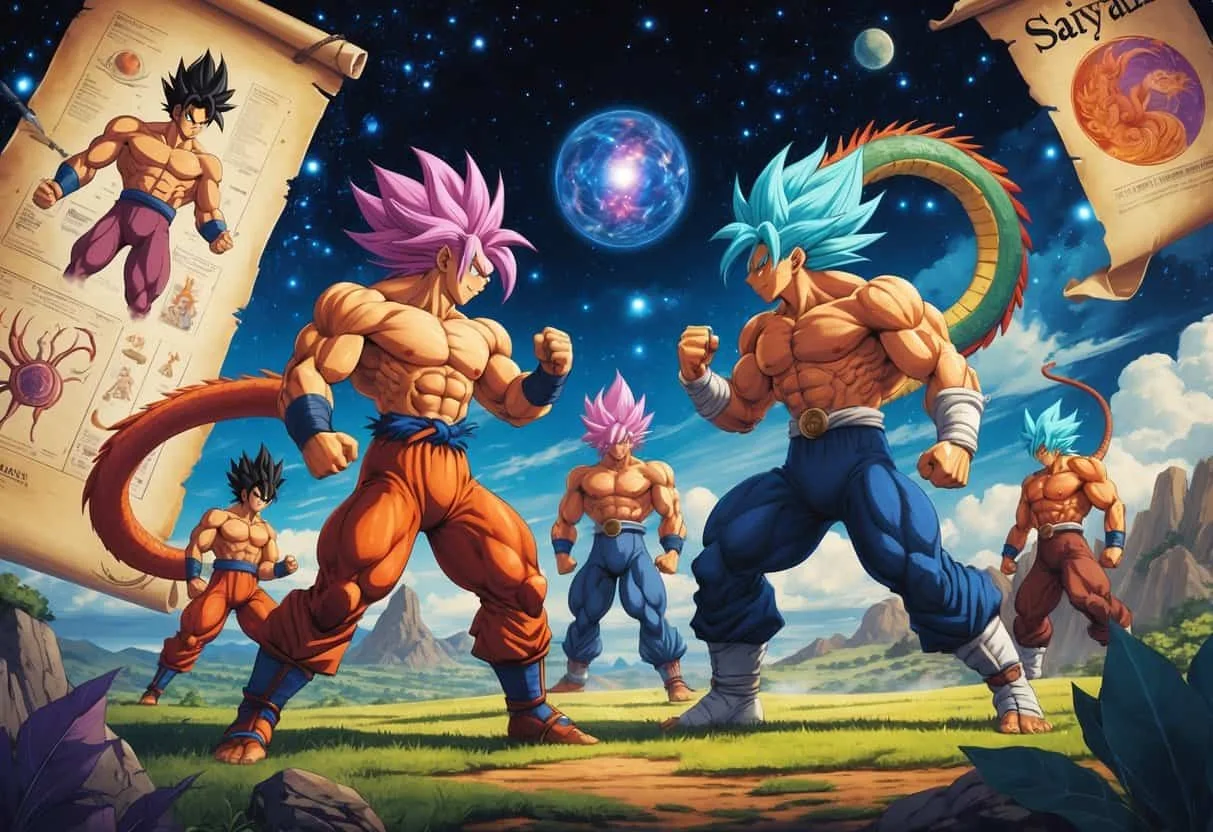
If the Zenkai boost is the engine, transformations are the supercharger. These multiplieative states allow a Saiyan to access a new tier of physical and energetic output, often altering their appearance and aura. The triggering mechanisms range from primal celestial events to intense emotional upheaval. The table below outlines the core transformation stages and their immediate effects.
| Transformation | Appearance | Power Multiplier | Primary Trigger |
|---|---|---|---|
| Oozaru (Great Ape) | Giant ape, red eyes | 10x base power | Full moon + tail |
| Super Saiyan 1 | Golden hair, green eyes | 50x base power | Intense rage or need |
| Super Saiyan 2 | Sharper hair, sparks | 2x Super Saiyan 1 | Stronger emotional trigger |
| Super Saiyan 3 | Long hair, no eyebrows | 4x Super Saiyan 2 | Intense training in Other World |
| Super Saiyan 4 | Red fur, black hair | High, natural stability | Blending Oozaru and Super Saiyan control |
| Super Saiyan God | Red hair, slim build | Divine ki surge | Ritual of five righteous Saiyans |
| Super Saiyan Blue | Blue hair, calm aura | Super Saiyan over divine ki | Mastery of Super Saiyan God’s power |
| Ultra Instinct | Silver hair, eyes | Divine autonomy | Breaking self-imposed mental shells |
The introduction of forms like Super Saiyan Blue and the angelic Ultra Instinct signal a shift from brute force emotional triggers to a deeper synchronization with divine energy and mental clarity. This evolution keeps the Saiyan race perpetually catching up to divine beings, reinforcing the series theme that there is no finite ceiling for a warrior with a pure, battling heart.
The Primal Oozaru: Unleashing the Beast Within
The Great Ape transformation is the most ancient of Saiyan powers, connecting modern warriors directly to their prehistoric roots on Sadala. When their eyes absorb Blutz waves from a full moon, a Saiyan’s body undergoes a horrific mass expansion, becoming a towering, mindless engine of destruction. In this state, a Saiyan’s power increases tenfold, but the trade-off is a loss of higher reasoning, turning them into instruments of raw chaos. The most skilled warriors, notably Vegeta, learned to control these Oozaru forms, retaining their tactical minds within the monsters. The removal of a Saiyan’s tail historically sealed this power away, but the essence of the Oozaru remained as the raw, atavistic energy that would later be refined into the stability of Super Saiyan 4, a form that beautifully marries the beast with the warrior.
Divine Saiyans: Super Saiyan God and Beyond
The pivot from physically tiered Super Saiyan forms to those involving divine ki represented a narrative recalibration. The Super Saiyan God ritual, discovered by Shenron from ancient lore, allowed Goku to temporarily access power that threatened the God of Destruction, Beerus. More importantly, it taught Goku and later Vegeta to internalize godly ki, leading to the Super Saiyan Blue state, which combines the explosive potential of a Super Saiyan with the calm control of divine energy. This arc fundamentally reframes the Saiyan race from interstellar conquerors to universal protectors, with Goku’s subsequent mastery of Ultra Instinct—a state of mind so clear that the body moves on its own—representing the philosophical peak of Saiyan potential: action without the weight of thought, drawing directly from the well of angelic training under Whis.
Pivotal Saiyan Characters and Narrative Arcs
Founding Bloodlines: From Bardock to Goku
The lineage of the series’ protagonist is a study in contrasts. Bardock, Goku’s father, was a low-class warrior but a fierce combatant who, in his final moments, perceived Frieza’s betrayal and fought vainly against the extinction of his race. His story, particularly as canonized in the Dragon Ball Super: Broly film, reveals a Saiyan capable of care, even if buried under layers of warrior rage. In sending Kakarot to Earth, Bardock inadvertently saved the galaxy. Goku’s adoption by the gentle Grandpa Gohan and his subsequent head injury erased his innate Saiyan bloodlust, replacing it with a pure-hearted love for martial arts.
This environmental reprogramming is arguably the most pivotal event in Saiyan history, creating a warrior who fights for self-improvement rather than conquest, and whose friendships fundamentally alter the universe’s destiny.
The Royal Line and Its Rivals: Vegeta’s Evolution
Vegeta’s arc is the most dramatic character study in the franchise. Introduced as a genocidal prince mourning a conquered throne, Vegeta’s identity was entirely wrapped in Saiyan pride—a hollow symbol of a dead monarchy. His rivalry with Goku, a lower-class warrior who consistently surpasses him, is a relentless humiliation that catalyzes his growth. Vegeta’s journey is not about raw power alone; it’s about learning to fight for something beyond himself, famously humbling himself before Beerus to protect his family and newly adopted Earth. This internal reconciliation between his Saiyan pride and his human attachments culminates in forms like Super Saiyan Blue Evolved, where his power literally cracks the limit through love and righteous fury.
His transformation from antagonist to deuteragonist is the series’ most resonant narrative achievement, showing that a Saiyan’s deepest strength comes not from isolation, but from bonds.
The New Generation: Hybrids and Prodigies
The arrival of Saiyan-human hybrids introduced a new dynamic. Gohan, the son of Goku, broke all power ceilings when, as a child, his latent emotional fury unlocked Super Saiyan 2, annihilating Cell. Gohan’s hidden potential was so vast that it required mystical unlocking by the Old Kai, resulting in the “Ultimate” form which draws on every drop of power without a transformation. Similarly, the fusion of Goten and Trunks into Gotenks introduced a younger, more chaotic, and creatively unpredictable application of Saiyan abilities, showcasing techniques like the Super Ghost Kamikaze Attack. These hybrids often exhibit faster growth rates and emotional depths that pure-blooded Saiyans struggle to access, proving that the race’s legacy is one of integration and evolution, not purity.
Even future timelines, with the battle-scarred Future Trunks, demonstrate a Saiyan lineage that thrives in trauma, creating the unique Super Saiyan Rage form from sheer despair. The influence of Saiyan blood on new generations is a topic of constant fan analysis on the official Dragon Ball site.
Legendary Saiyans Beyond Universe 7
The introduction of Universe 6 flips the Saiyan script, presenting a reality where Planet Sadala still exists and the race evolved as protectors, not conquerors. Cabba, Caulifla, and Kale represent a Saiyan society that uses power for justice. The most striking narrative twist is the reinvention of the Legendary Super Saiyan myth. Kale is the gentle, timid thrust of Universe 6’s legend, who loses control in a berserker rage similar to Broly’s. Her mentorship under Caulifla, an ambitious punk who craves the next transformation, leads to the creation of Kefla, a fusion whose staggering power pushes Goku to the brink of Ultra Instinct. This universe-hopping saga confirms that the Saiyan propensity for explosive growth is a universal constant, yet environmental context dictates whether that power manifests as destructive rage or disciplined protection.
Mythology and Enduring Influence in Pop Culture
The Oral Tradition of the Super Saiyan God
Saiyan mythology functions as a narrative director for the series, planting seeds that sprout into major plot points decades later. The story of Yamoshi, a pure-hearted Saiyan who achieved the Super Saiyan God form and led a rebellion against evil Saiyans, is the central myth. His failure to defeat his enemies, and his spirit’s subsequent wandering, directly motivates the hunt for the transformation in Dragon Ball Super. This legend turns the Saiyans from mere fighters into a race haunted by their own celestial potential. The narrative device of myth-as-blueprint is a powerful tool: it frames the superhuman feats of Goku and Vegeta not as random anomalies, but as the culmination of a species’ spiritual journey, validating the series’ themes through an ancient, almost biblical, oral tradition.
The Saiyan Archetype in Modern Media
The Saiyan model of the "limit-breaking warrior" has become a foundational trope in anime and beyond. The visual language of a transformation triggered by rage—hair changing color, an eruption of a visible aura, the ground shaking under a surge of power—is now a universal signifier of an impending power climb in media. Shows from Naruto (with its Jinchuriki cloaks) to Bleach (Bankai) borrow from the structural grammar established by Super Saiyan forms. On a thematic level, the Saiyan ideal of getting stronger after every defeat echoes the hero’s journey but strips it down to its most primitive, combat-driven core. This archetype appeals because it externalizes the human desire to overcome adversity, making every scar a badge of honor and every failure a power-up, a concept that resonates deeply in competitive sports and personal development spaces.
The global merchandising of this archetype has turned Saiyans into a billion-dollar brand, from Bandai Namco’s video game franchises to high-end collectible statues.
Global Fan Culture and the Saiyan Identity
The Saiyan race has transcended its origin as a plot device to become a cultural identity for fans. Cosplayers dedicate themselves to crafting the spiked hair and battle-worn armor, while fan artists endlessly reimagine hypothetical transformations and alternative universe Saiyans. The phrase “Saiyan pride” has entered fan vernacular as a shorthand for a self-respecting, combat-obsessed mentality. This culture is not merely passive consumption; it’s a participatory mythology. The constant theorizing about power scales, fusion techniques, and undiscovered forms keeps the Saiyan legend alive between official releases.
In video games like Dragon Ball FighterZ and Xenoverse 2, players literally inhabit a custom Saiyan, creating a personal avatar that inherits the race’s iconic powers. This interactive element solidifies the Saiyan myth as a modern, evolving legend—a warrior’s call that echoes through a global community, ensuring that even if the series ends, the Saiyan spirit of relentless self-improvement and thrilling battle will never fade.