Table of Contents
Orochimaru remains one of the most layered figures in Masashi Kishimoto’s entire Naruto saga. Longtime viewers know him as the serpentine threat who haunted the Chunin Exams, yet his presence extends far beyond a classic antagonist role. He defies easy labels, operating as a villain, a reluctant ally, and a brilliant mind driven by a fear of irrelevance. The series explores his obsessions with knowledge, identity, and immortality, crafting a character whose moral ambiguity still fuels debate among anime communities.
To understand how Orochimaru functions as a cultural touchstone, it helps to see him as a reflection of the ninja world’s darkest possibilities. He did not merely attack Konoha; he challenged its core beliefs about loyalty, sacrifice, and the value of a single life. His experiments on human subjects, his defection, and his eventual return as an uneasy ally raise uncomfortable questions: Can a person who committed atrocities ever be accepted? Is genius without conscience a form of evil or an evolutionary step? These tensions keep Orochimaru relevant, not just as a plot device, but as a mirror for the protagonists’ own journeys.
The Making of a Prodigy: Orochimaru’s Early Years
Orochimaru’s path began in the shadow of loss. Orphaned at a young age, he learned early that the world offered no guarantees. This absence of parental protection may have planted the seed for his lifelong fixation on rebirth and control. He quickly distinguished himself at the Academy, displaying a natural affinity for jutsu and a chilling composure that caught the eye of Hiruzen Sarutobi, the Third Hokage. Sarutobi recognized a once-in-a-generation talent and admitted him into a team alongside Jiraiya and Tsunade, hoping the bonds would temper the boy’s intensity.
Instead, the contrast between the three students sharpened Orochimaru’s sense of isolation. Jiraiya was loud, warm, and often a failure who grew through stubborness. Tsunade channeled her energy into medicine and grief. Orochimaru, by contrast, watched comrades die during wartime and internalized death not as a noble sacrifice but as a problem to be solved. According to detailed biographies on the Naruto Wiki, his curiosity morphed into an obsession after the death of his parents, then deepened further when he witnessed the mortal fragility of his own mentor.
His genius was never in question—even his enemies admitted that—but it came with a terrifying pragmatism. While other ninja sought to protect, Orochimaru sought to understand the mechanics of life itself. He became fascinated not by a single ideal, but by compiling every jutsu in existence, a goal that would require him to transcend a normal human lifespan. That ambition, often framed as a noble pursuit of knowledge, quickly crossed ethical borders.
From Lost Child to Forbidden Scientist
The shift from sorrowful orphan to ruthless experimenter happened over years, but it accelerated once Orochimaru began working in Konoha’s research facilities. He had access to rare scrolls, chakra manipulation theories, and a steady supply of war orphans and prisoners. His early studies into cellular regeneration and longevity gradually turned into forbidden human trials. His partnership with Akimichi clan members and other scientists initially seemed collaborative, but Orochimaru’s secrecy and cruelty isolated him.
His interest in immortality coalesced around the concept of body transfer—stealing a living vessel to host his soul and memories. This technique, later perfected as the Living Corpse Reincarnation, became his signature. To him, bodies were temporary shells; the mind was the true seat of power. That cold philosophy terrified his former teacher and colleagues. For insight into the folklore that inspired his snake-like transformations, Japanese yokai resources like Yokai.com detail the mythical eight-headed serpent that shares his name, symbolizing both danger and regeneration.
The Descent: How a Legendary Sannin Became a Pariah
Orochimaru’s defection from the Hidden Leaf was not a single dramatic moment but a slow burn. He had already been denied the position of Fourth Hokage; the elders saw his darkness and chose Minato Namikaze instead. Feeling spurned and misunderstood, Orochimaru retreated further into his laboratories until his atrocities came to light. When the Third Hokage caught him red-handed during a raid, the confrontation ended with Sarutobi letting his former student escape—a moment of compassion that would haunt the village for decades.
Free from the village’s oversight, Orochimaru established hidden bases and cultivated a network of followers willing to trade their bodies and loyalty for promises of power. He founded the Hidden Sound Village as a front, funneling resources into genetic experiments and the development of curse marks. The curse mark itself emerged as a twisted fusion of nature energy and his own chakra, a way to brand and control potential vessels like a serpent sinking its fangs into prey.
Curse Marks and the Hunt for Vessels
The Cursed Seal of Heaven, placed prominently on Sasuke Uchiha, epitomized Orochimaru’s methodology. He did not force total servitude; he offered seductive power. The seal amplified the user’s chakra at the cost of sanity and bodily corruption, creating a dependency that mirrored the snake sannin’s own desire to consume and assimilate strength. This predatory relationship turned young prodigies into extensions of his will. His obsession with the Sharingan—specifically, the Uchiha clan’s visual prowess—tied directly to his need for faster mastery of jutsu.
If he could inhabit a body with the eyes of Itachi or Sasuke, he believed he could crack the secrets of all ninjutsu in a single lifetime.
When the Chunin Exams invasion unfolded, Orochimaru revealed the scale of his ambition: he assassinated the Fourth Kazekage and impersonated him, manipulated Sunagakure, and unleashed a proxy war designed to crush Konoha and claim the Third Hokage’s life. The battle between Sarutobi and his former student on the rooftop became one of the series’ emotional peaks—a clash of ideologies as much as a fight of techniques. Sarutobi sacrificed himself to seal Orochimaru’s arms, crippling his ability to perform jutsu, but even that proved temporary.
Between Monster and Mentor: Orochimaru’s Shifting Role
After his defeat at the hands of Sasuke and later his reintegration during the Fourth Great Ninja War, Orochimaru’s narrative shifted. He did not have a sudden moral awakening; rather, his perspective expanded. Observing Kabuto Yakushi’s misguided attempt to become “the perfect being” taught Orochimaru that pure imitation was a hollow victory. Watching Sasuke carve his own path, independent of any master, forced him to reconsider his own methods. He began to see value in allowing others to grow without his direct interference, even if that meant letting go of a vessel he had coveted for years.
The change became undeniable when he resurrected the previous Hokage to assist the Allied Shinobi Forces. That act, while self-serving in part, also required a recognition that the world’s survival mattered more than his own private experiments. He joined the battlefield not as a hero, but as a curious observer of a new era. His motivations became less about conquering death and more about witnessing the infinite potential of human evolution—a subtle but profound pivot.
The Fourth Great Ninja War and A Qualified Redemption
Orochimaru’s role in the war arc remains divisive. He provided critical intelligence, summoned the legendary Hokage, and saved the Five Kage from certain death. Yet he never fully repented. The story did not grant him a tearful redemption; it offered a probationary acceptance. Konoha placed him under strict surveillance, but allowed him to continue research under the oversight of Yamato.
This outcome echoes the messy reality that some people never become good, but they can still contribute to a better future. As discussed in analytical pieces from CBR, his character challenges the black-and-white morality common in shounen anime.
His dynamic with his son Mitsuki—a synthetic human created to navigate the ninja world—adds another layer. Orochimaru’s detached parenting style and genuine curiosity about Mitsuki’s development suggest that he has learned from his failures with Sasuke. He no longer demands ownership; he watches, documents, and occasionally intervenes in ways that preserve his son’s autonomy. This evolution, explored further in Boruto, reframes Orochimaru not as a redeemed sinner, but as an unrepentant scientist trying to understand bonds without entirely sacrificing his nature.
Psychological Underpinnings: Fear, Loneliness, and the Desire to Transcend
To dismiss Orochimaru as purely evil overlooks the psychology driving him. He is defined by a profound terror of insignificance. He explicitly states that a life that does not endure has no meaning, which positions immortality as the only logical answer to the emptiness he felt as an orphan. His experiments, while monstrous, are also expressions of a deeply human refusal to accept cosmic indifference. He replaced philosophy with science, attempting to build a tangible ladder beyond the reach of death.
His loneliness runs parallel to Sasuke’s and Nagato’s, though he responded to it differently. Instead of seeking peace or revenge, he sought to become a self-contained system. He built villages, laboratories, and even his own body as his only trusted kingdom. That hyper-individualism made him incapable of genuine connection for most of his life, yet it also gave him a unique clarity about the fragility of the ninja system. He saw through the propaganda of “Will of Fire” while simultaneously becoming its greatest perversion.
Contrast with Other Antagonists
Unlike Madara, who wanted to impose a dream world, or Kaguya, who desired to reclaim chakra entirely, Orochimaru’s ambition was personal and ultimately smaller in scope. He did not wish to rule the world; he wanted to master it through knowledge. That makes him more relatable—and in some ways more sinister—because his evil was not born from grand ideology but from a fundamentally wounded ego. He represents what happens when a brilliant mind loses empathy and pursues curiosity without limit.
His influence on anime and manga beyond Naruto is evident in characters like Mayuri Kurotsuchi from Bleach or Shou Tucker from Fullmetal Alchemist, both of whom blur the line between scientific progress and cruelty. Orochimaru’s archetype endures because it forces audiences to confront uncomfortable questions about the ethics of research, the cost of longevity, and whether a monster can ever be trusted.
Cultural Roots and The Serpent Symbolism
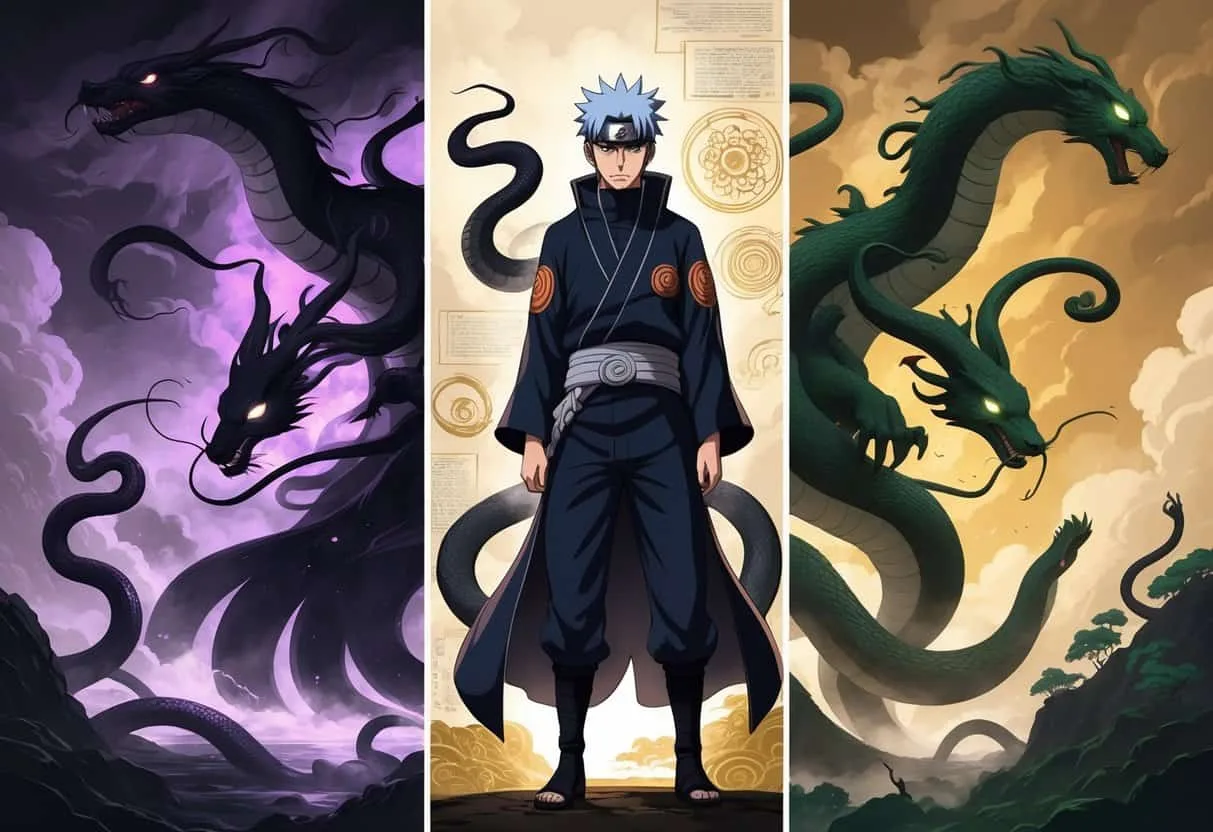
Kishimoto deliberately steeped Orochimaru in Japanese folklore. The Yamata-no-Orochi, an eight-headed serpent from Shinto myth, represents destruction and rebirth. The snake’s ability to shed its skin aligns perfectly with Orochimaru’s body-switching immortality jutsu. Additionally, snakes in many Eastern traditions guard hidden knowledge, and white snakes in particular carry associations with the divine and the occult. His pale skin, golden slit eyes, and elongated tongue evoke the imagery of a creature standing on the threshold between the living and the supernatural.
This mythological foundation deepens his character beyond a simple homage. It positions him as a force of nature, an inevitable consequence of a world that venerates violence and power. His ultimate form, the White Snake, strips away human pretense and reveals him as an entity that has consumed so much life that he barely resembles a person anymore. For further reading on the mythological tie-ins, Britannica’s entry on Yamata-no-Orochi provides historical context that enriches the viewing experience.
Enduring Legacy in Fandom and Media
Orochimaru’s mark on pop culture is far from fading. Cosplayers replicate his distinctively long tongue, pale makeup, and purple bow with a gleeful intensity, turning conventions into snake pits of admiration. His theme music, the eerie “Orochimaru no Theme,” instantly signals danger. Podcasts and YouTube analyses dissect his motives, debating whether his post-war compliance is authentic change or a long con. The ambiguity is the point; a straightforward villain would not command this level of sustained discussion.
Fanworks frequently explore his psychology, crafting alternate histories where he mentors Sasuke without the parasitic element or where he finds a genuine emotional connection. This creative engagement reveals a desire to humanize him without excusing his crimes. It also underscores the series’ success at creating a character who is simultaneously repellent and captivating.
Orochimaru’s Influence on Modern Storytelling
His character blueprint appears in modern shounen and seinen titles that favor morally grey antagonists. The idea that a former villain can operate on the same side as the heroes—not because they changed internally but because circumstances align—has become a more common narrative device. Orochimaru arguably paved the way for complex figures who outlive their roles as final bosses. His existence forces the protagonists to grow not just stronger but wiser, learning that the world cannot be cleansed of all darkness.
Academic discussions and fan analyses on platforms like MyAnimeList often rank him among the most memorable antagonists of all time. The character’s longevity—surviving the original series, Shippuden, and appearing prominently in Boruto—testifies to a narrative design that was never satisfied with a simple monster-of-the-arc template. He is a slow poison that the series keeps administered, reminding viewers that some threats never fully disappear.
The Misunderstood Genius Trope: A Critical Look
Calling Orochimaru a “misunderstood genius” risks romanticizing his atrocities. He understood exactly what he was doing when he abducted children, used them as lab rats, and discarded them. The “misunderstood” label feels inadequate when applied to someone who orchestrated a terrorist attack on a village that had raised him. Yet he is not a mindless beast either. His philosophy, while cold, has internal logic.
He represents an extreme version of the ninja world’s instrumentalism: if a shinobi is meant to be a tool, then why not refine the tool until it surpasses mortality?
This tension prevents easy categorization. He is villainous in his methods, anti-heroic in his later utility, and undeniably a genius in his scientific achievements. The series never fully reconciles these threads, leaving the audience to wrestle with their own conclusions. In that sense, Orochimaru functions as a narrative test: how much cruelty can a person commit before their intellect and later contributions become irrelevant? The answer shifts depending on which arc you’re watching.
Redefining the Anti-Hero in Shounen
Orochimaru’s character arc helped expand the definition of anti-hero in mainstream shounen. Traditionally, an anti-hero might be a gruff ally with a dark past. Orochimaru inverted that: he started as a monster and then slowly, over hundreds of chapters, became an asset without ever being fully trusted. This model later influenced characters like Aizen in Bleach’s final arc or even certain iterations of Dragon Ball’s villains-turned-allies, though Orochimaru’s partnership is far more conditional and uneasy. The audience never relaxes around him, and that sustained tension is a mark of excellent writing.
Conclusion: The Serpent That Refuses to Die
Orochimaru’s story arc embodies the series’ central theme that human beings are not static. He transformed from a victim of war into a perpetrator of horror, then into a guarded observer who still finds the world worth studying. He never achieves the conventional peace that Naruto or Gaara find, but he arrives at a kind of equilibrium—a state where his brilliance is no longer a direct threat to those he once terrorized. That uneasy coexistence may be the most realistic resolution a character like him could have.
In examining the rise and fall of Orochimaru, we see a villain who failed in his grandest schemes yet succeeded in redefining what a shinobi can become. He is simultaneously a cautionary tale, a cultural bridge to ancient myths, and a testament to the idea that even the most twisted path can round back toward something resembling purpose. The snake keeps shedding its skin, and each new layer reveals less of a monster and more of a question that refuses to be answered simply.