Table of Contents
The Quiet Shift: From Credits Roll Call to Emotional Payoff
Anime ending themes once felt like afterthoughts, brief musical palettes placed at the end of an episode to ease viewers back into a living room or a late-night screen. A soft melody accompanied by scrolling text, character art that rarely changed, and a sense that the chapter had simply been closed. Over decades, that function has been upended. The ending sequence in today’s anime often carries just as much narrative weight as the opening hook, and in some cases it becomes the primary vessel for emotional release, character interiority, or thematic summary.
The transformation didn’t happen in a single season or with one breakout hit. It was a slow burn that tracked shifts in music production, fan expectations, and the creative ambitions of studios. Ending themes are no longer simply the music that plays while names scroll past. They’ve become compact narrative tools capable of rearranging how an audience interprets what they just saw—and what they’ll see next week.
For many fans, the ending song is the emotional bookmark of an episode. It holds the residue of a shocking cliffhanger, the tenderness of a quiet goodbye, or the bittersweet ache of a character making a hard choice. That emotional residue often lingers longer than the spectacle of a battle scene because it arrives in a moment of deliberate stillness. The screen dims, the action stops, and the music offers permission to feel.
Key Takeaways
- Ending themes have moved well beyond extra tracks, becoming central to emotional pacing and thematic storytelling.
- They create space for reflection, often delivering narrative subtext that the episode itself only hints at.
- Ongoing stylistic innovation keeps ending sequences relevant, dynamically engaging, and culturally influential.
Historical Overview of Anime Ending Themes
Tracing the arc of anime ending themes from humble beginnings to their current narrative sophistication reveals a parallel story of the medium’s growth. It’s a chronicle of budget expansion, musical experimentation, and an increasing willingness to treat every second of screen time as storytelling real estate.
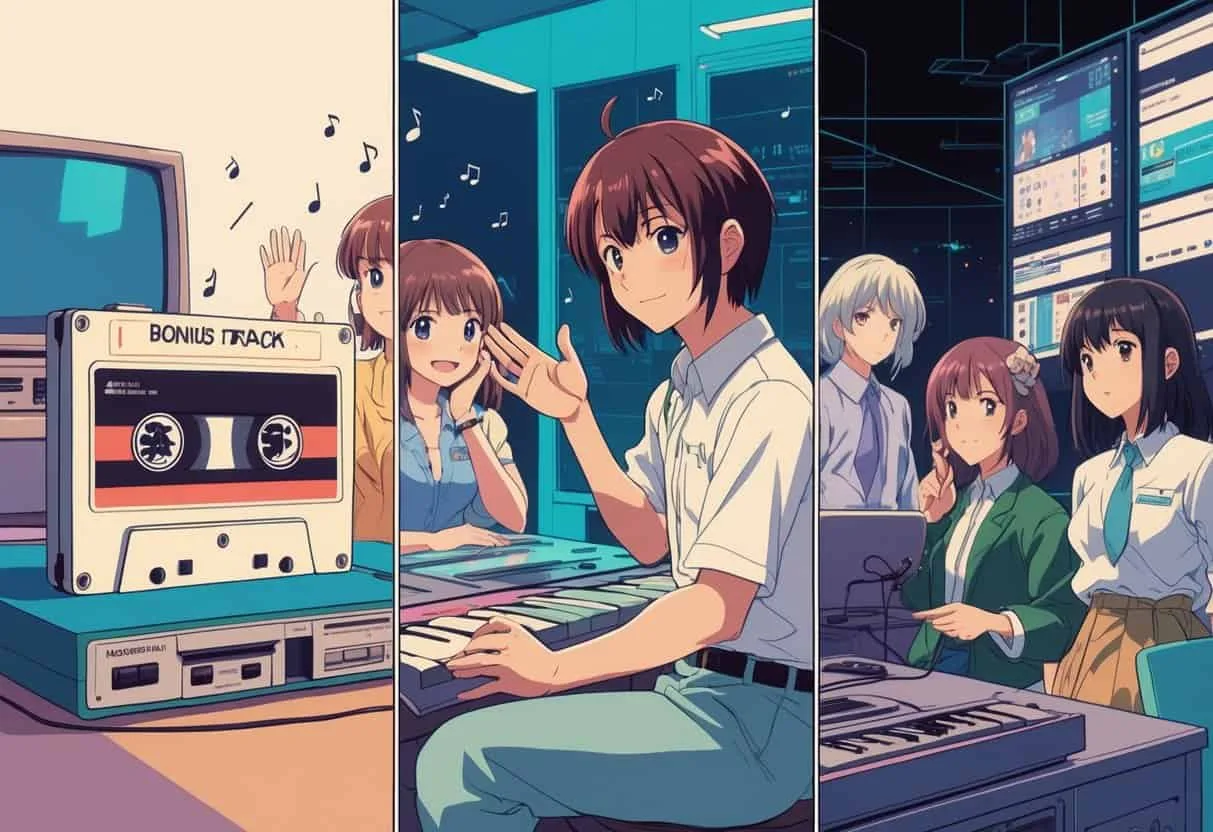
Origins as Bonus Tracks
In the earliest days of television anime, ending sequences were pragmatic. A simple jingle or short instrumental piece ran under the credits, often pulled from a library of stock cues or quickly arranged by the show’s composer. These tracks had no lyrical connection to the story and rarely matched the episode’s mood. They functioned as sonic wallpaper—audible cues that the broadcast was wrapping up, giving viewers time to change the channel or turn off the VCR. The animation was typically static: a still frame of the main cast waving, a sunset shot, or a logo slowly fading in and out.
These endings were essentially bonus tracks in the production sense. They existed because television formats required them, not because anyone in the creative chain saw them as a vehicle for meaning. Budgets and tight schedules reinforced this separation; directors reserved their best ideas for the episode body, leaving the ending as an obligation rather than an opportunity.
Evolution Across Decades
The 1980s saw the first meaningful shifts. As the anime industry matured and tie-in music sales became a significant revenue stream, ending themes gained attention from record labels. Series like Urusei Yatsura cycled through multiple ending songs, treating each one as a mini-single debut. The songs were still primarily poppy and light, but the frequency of rotation signaled that endings could carry marketing weight. By the 1990s, marquee titles like Neon Genesis Evangelion repurposed classic songs—most famously “Fly Me to the Moon” in varied renditions—to unsettle and reframe the viewer’s emotional state.
That creative choice turned the ending into a psychological pocket dimension, where the familiar tune became a vehicle for ironic distance or aching melancholy depending on the episode.
Into the 2000s, long-running shonen series like Naruto and Bleach turned ending themes into artist launchpads. Record labels competed for slots, and the visual sequences grew more elaborate. Directors began embedding character moments, flashbacks, and symbolic imagery that deepened without distracting. A 2018 feature on ANN noted how the ending sequence for Fullmetal Alchemist: Brotherhood’s “Uso” recontextualized a major character’s internal conflict entirely through stills and piano, demonstrating that endings could function as standalone short films. The music was no longer just the sound of credits; it was now a parallel narrative track.
Influence of Classical Music
Classical idioms have long threaded through anime scores, but their presence in ending themes is especially instructive. When a series closes with strings, a solo piano, or a full orchestral arrangement, it signals an elevation of stakes and an invitation to sit with the episode’s weight. The Monogatari series, for instance, often uses delicate, almost baroque arrangements to underscore its dialogue-heavy denouements. Studio Ghibli, while famously avoiding traditional TV formatting, influenced a generation of television composers with Joe Hisaishi’s approach: melody as emotional language, independent of lyrics.
This orchestral turn does more than goose sentiment. It borrows the structural clarity of classical forms—the return of a motif, the resolution of a harmonic tension—to create endings that feel like the final cadence of a long sentence. For the viewer, a classically informed ending like Your Lie in April’s “Orange” (performed by 7!!) can transform a pop melody into something that echoes Chopin’s introspection, aligning the music with the show’s own central metaphor of performance and loss. A Naxos feature on anime music explores how such cross-pollination has expanded the audience for both anime soundtracks and classical repertoire, creating a feedback loop that benefits composers and listeners alike.
Ending Themes as Narrative and Emotional Tools
If the opening theme is the handshake, the ending theme is the whisper in the hallway. It’s the space where a show can affirm its themes without dialogue, using sound and image movement to drop the viewer into a reflective state. This dual role—structural and psychological—makes the modern ending sequence a unique instrument in the anime toolkit.
Connection to Storytelling
The strongest ending themes act as a second layer of narration. They don’t repeat what the episode already showed; they reinterpret it. In Steins;Gate, the ending “Toki Tsukasadoru Juuni no Meiyaku” shifts between timelines and perspectives, its lyrics hinting at the protagonist’s hidden isolation before the plot fully exposes it. The visuals often include symbolic clocks, fractured glass, and character postures that mirror the show’s emotional geography. For a viewer rewatching the series, those endings become a map of foreshadowing, each clue laid out in plain sight but only legible in retrospect.
Visual direction during the ending often matches or even exceeds the innovation found in the episode body. Attack on Titan’s endings, particularly “Akatsuki no Requiem,” transform the entire sequence into a jarring diorama of memory and regret, using grainy textures and childlike drawings to prefigure the moral collapse to come. The practice of swapping or evolving ending visuals across cours—as done in Re:Zero and Hunter x Hunter—lets the ending function as a running commentary on character arcs, not a static bookend.
Enhancing Audience Engagement
A well-placed ending sequence becomes an anchor of anticipation. The weekly ritual of hearing that same melody, now imbued with newer emotional context, wraps the episode in a familiar yet deepening loop. This repetition cultivates a Pavlovian response where the first chords alone summon the week’s tension or hope. When a show deliberately withholds the ending theme until after a post-credits stinger, as Made in Abyss does, the absence itself speaks volumes.
Engagement extends beyond the broadcast. Streaming platforms make it easy to loop ending playlists, and fan communities dissect lyrics on forums in multiple languages. The music becomes a shared vocabulary. A r/anime thread cataloging fans’ most affecting ending themes highlights how these tracks often become comfort objects—songs that people return to during personal upheavals, not because of nostalgia for the show alone, but because the music itself encoded a state of mind they need to access again.
Therapeutic and Emotional Impact
Anime endings regularly operate as a form of emotional cooldown. After 22 minutes of high-intensity storytelling, the credits roll and the tempo drops. That shift in pacing signals the parasympathetic nervous system to ease, giving the audience a gentle transition out of an elevated state. It’s a rhythmic ritual that parallels the closing breath after a long sentence.
More substantially, the thematic content of endings can validate complex feelings. March Comes in Like a Lion closes each episode with a piece that feels like a long exhale—often acoustic, intimate, quietly affirming the episode’s struggles. For viewers dealing with isolation or depression, that musical validation can be a small but genuine psychological intervention. Music therapists have noted in case studies how anime soundtrack listening, particularly endings, can support emotional regulation in adolescents. While that therapeutic dynamic isn’t why these songs are made, it’s a real byproduct of their structural caretaking.
Integration with Other Creative Industries
Anime ending themes long ago broke containment. They now circulate through music charts, live concerts, viral social media trends, and video game collaborations, functioning simultaneously as works of art and commercial assets. This multi-platform life repositions the ending theme as a node in a larger creative economy.
Cross-Media Collaborations
Many ending songs are conceived as singles first, produced by major labels with an eye on the Oricon charts. An artist like Aimer or LiSA builds an entire career arc partly through anime tie-ins, where the emotional footprint of a series lends texture to their discography. When Aimer’s “Kataomoi” played over the end of a Kabaneri of the Iron Fortress episode, it wasn’t just a soundtrack cue—it was a music release event with its own marketing cycle, live performances, and radio play. The boundary between anime production and the J-Pop industry has blurred so thoroughly that a hit ending can reverse-invest interest into a show, pulling casual music fans into the anime ecosystem.
These collaborations extend into manga, light novels, and even stage adaptations. A new ending theme may be synchronized with a volume release, creating a coordinated merchandising moment. The multimedia strategy treats the ending theme as a spearhead product, not as a secondary garnish.
Influence of Video Games and Game Development
Rhythm games have been among the largest beneficiaries of anime ending themes. Titles like BanG Dream! Girls Band Party! and Project Sekai: Colorful Stage! treat these songs as core content, allowing players to tap through their favorite EDs. This loops the music back into an active, gamified attention economy, where the listener becomes a performer. The game engine’s note maps are designed in consultation with composers to emphasize rhythmic hooks, creating a new layer of musical appreciation that feeds directly into streaming numbers.
Beyond rhythm games, anime endings now appear as downloadable content in open-world games, as background music in visual novels, and even as inspiration for game development music sprints. The collaboration between Cygames and anime studios on projects like Uma Musume Pretty Derby shows how game development teams now commission ending-like sequences specifically for in-game events, blurring the original distinction. This cross-industry pollination fosters creative business models where a song’s life cycle extends across multiple platforms, and revenue flows through live concerts, game royalties, and digital storefronts simultaneously.
Anime Ending Themes in Popular Culture
Scroll through TikTok or YouTube Shorts and you’ll find thousands of covers, dance challenges, and lip-syncs built around anime ending songs. The melancholic guitar riff of Your Name.’s “Nandemonaiya” or the explosive chorus of Demon Slayer’s “from the edge” have become sonic memes, detached from their original visual context but still carrying an emotional shorthand that even non-anime viewers recognize. This cultural saturation turns the ending theme into a public domain of feeling.
Cosplayers frequently choreograph full dance routines to ending themes, performing them at conventions and uploading them as part of their portfolio. That participatory energy feeds back into the music’s lifespan, keeping songs alive years after the series ends. The Kaguya-sama: Love Is War Chika dance—technically an ending sequence—became so pervasive that it cemented the show’s identity more thoroughly than any opening ever could, demonstrating that a well-crafted ending can, in rare cases, become the brand’s flagship moment.
Modern Innovations and the Future of Anime Endings
The tools available to animators and composers today are reshaping what an ending can be. Real-time rendering, AI-assisted composition, and advanced motion capture have expanded the visual vocabulary, while streaming data provides instant feedback on which endings resonate and why. The future is not just shinier—it’s smarter, more responsive, and potentially more personalized.
Role of Artificial Intelligence and Automation
AI now plays a supporting role in both music and visual production. Generative audio tools can assist composers in prototyping melody variations or harmonizing complex chord progressions, freeing them to focus on the emotional architecture of a piece. On the animation side, machine learning models help interpolate frames, clean up line art, and even generate background elements, reducing manual labor and allowing smaller studios to produce visually rich endings on tighter budgets.
AI-driven data visualization is also beginning to appear in ending sequences that integrate live social media reactions or algorithmic interpretations of a show’s themes. Imagine an ending that shifts its color palette based on the collective emotional sentiment of real-time Twitter chatter—an experiment already tested in interactive web projects and likely to migrate into more experimental anime. Balancing this automation with human intention will be the critical challenge; the goal is to augment creativity, not homogenize it. A Wired piece on AI in anime production explores how studios are experimenting with these boundaries while preserving the hand-drawn soul of the medium.
Visual Design and Animation Techniques
Hybrid 2D–3D pipelines are now standard in many studios, and the ending sequence often serves as a testing ground for new visual ideas before they’re deployed in full episodes. Demon Slayer’s “from the edge” ending overlays delicate watercolor textures on subtly 3D-modeled character silhouettes, creating a depth that feels both painterly and cinematic. Motion capture, once reserved for high-budget films, now informs the subtle body language in ending animations, as seen in the limp, exhausted gait of characters in Vinland Saga’s second season ending “Ember.”
The influence of cyberpunk aesthetics and cybernetics-inspired design language—circuitry, data streams, glitch effects—continues to surface in endings that mirror society’s growing entanglement with technology. Cyberpunk: Edgerunners famously used its ending, “Let You Down,” to double down on the genre’s thematic core of bodily modification and emotional fallout, embedding neon glitch transitions and corrupted frame loops that echoed the protagonist's mental fragmentation. This is visual storytelling that operates at a subcutaneous level, bypassing dialogue entirely.
Opportunities for Creators
The democratization of creative software means that a solo artist or a small cooperative can produce an ending-quality animation without a major studio budget. Tools like Blender, DaVinci Resolve, and even consumer-friendly platforms like WonderShare Filmora have lowered the technical barrier to entry. While the industry still runs on the craftsmanship of large teams, independent animators now post short films on YouTube that rival official endings in emotional impact and polish, often using Creative Commons-licensed music or original compositions produced in home studios.
This shift opens up a global talent pipeline. Outsourcing no longer just means sending grunt work to overseas studios; it means collaborating with remote artists who bring unique cultural perspectives. An Indian animator working with a Japanese composer might craft an ending that blends Bharatanatyam-inspired choreography with J-rock. Such cross-pollination could define the next decade of anime music visuals, expanding the definition of what “anime” visually looks like while staying true to its narrative heart. The AI revolution complements this by handing creators tools that handle repetitive technical tasks, letting them pour more energy into concept, story, and atmosphere.
Shaping the Next Era of Entertainment
Anime endings are morphing into something akin to interactive mood capsules. In the near future, we might see endings that adapt to the individual viewer’s watch history, pulling visual motifs from earlier episodes that resonated most or adjusting the music’s tempo to match the emotional arc of the preceding minutes. While this level of personalization raises questions about directorial intent and shared cultural experience, it also hints at a new kind of intimacy between spectator and story.
Extended reality (XR) technologies—encompassing VR, AR, and mixed reality—will further dissolve the screen boundary. Imagine donning a headset and watching an anime ending not as a flat video but as an immersive environment you can walk through, with the song playing from different angles as you explore symbolic spaces. Festivals like Anime Expo already feature experimental VR installations that point in this direction, and as hardware becomes more accessible, the ending theme could become a playground rather than a passive outro. This evolution will likely be driven by the same cybernetic and techno-cultural curiosities that inspire the sci-fi stories themselves, creating a feedback loop between what anime depicts and how audiences consume it.
Case Studies: Endings That Reshaped the Medium
A handful of ending sequences didn’t just accompany their shows—they transformed expectations for what an ending could accomplish, influencing both creators and fans in lasting ways.
“Fly Me to the Moon” – Neon Genesis Evangelion By taking a standard jazz standard and filtering it through a dozen arrangements depending on episode tone, Evangelion’s ending turned a classic love song into a cipher for existential dread, aspiration, and fractured intimacy. Each version commented on the episode’s psychological state, making the ending a diagnostic tool. This approach proved that an ending could be neither happy nor sad but ambivalent—matching the series’ core emotional register.
“The Real Folk Blues” – Cowboy Bebop Yoko Kanno’s blues-drenched finale cue, paired with a simple solo walk into the sunset, distilled the entire series’ themes of fatalistic cool and lingering regret into three minutes. The ending is wordless except for the song’s English refrain, allowing it to function across languages and setting a template for how music could serve as the primary storytelling agent in a closing sequence. Years later, its influence is palpable in endings for series like Samurai Champloo and Megalobox.
“Lost in Paradise” – Jujutsu Kaisen This funk-soul explosion, complete with city-pop aesthetics and choreographed dance, did something audacious: it created a mood entirely separate from the often grim horror action of the episode, yet somehow felt tonally truthful to the characters’ youthful energy outside of combat. The ending’s viral success demonstrated how an ending can be a sharp marketing tactic without sacrificing artistic credibility, pulling in viewers who’d never normally touch a shonen battle series.
These case studies underscore a shared principle: the ending theme’s power lies not in explaining the plot, but in holding the emotional truth the plot can only circle. When a director and composer align on that truth, the credits become sacred ground.
Anime ending themes have journeyed from disposable filler to indispensable narrative instruments, and their evolution is far from complete. Each new season brings experiments in form, technology, and emotional range that continue to redefine how a story says goodbye—and, crucially, what it leaves humming in the viewer’s chest long after the screen goes dark.