Table of Contents
The Leadership Qualities of Tai and Matt
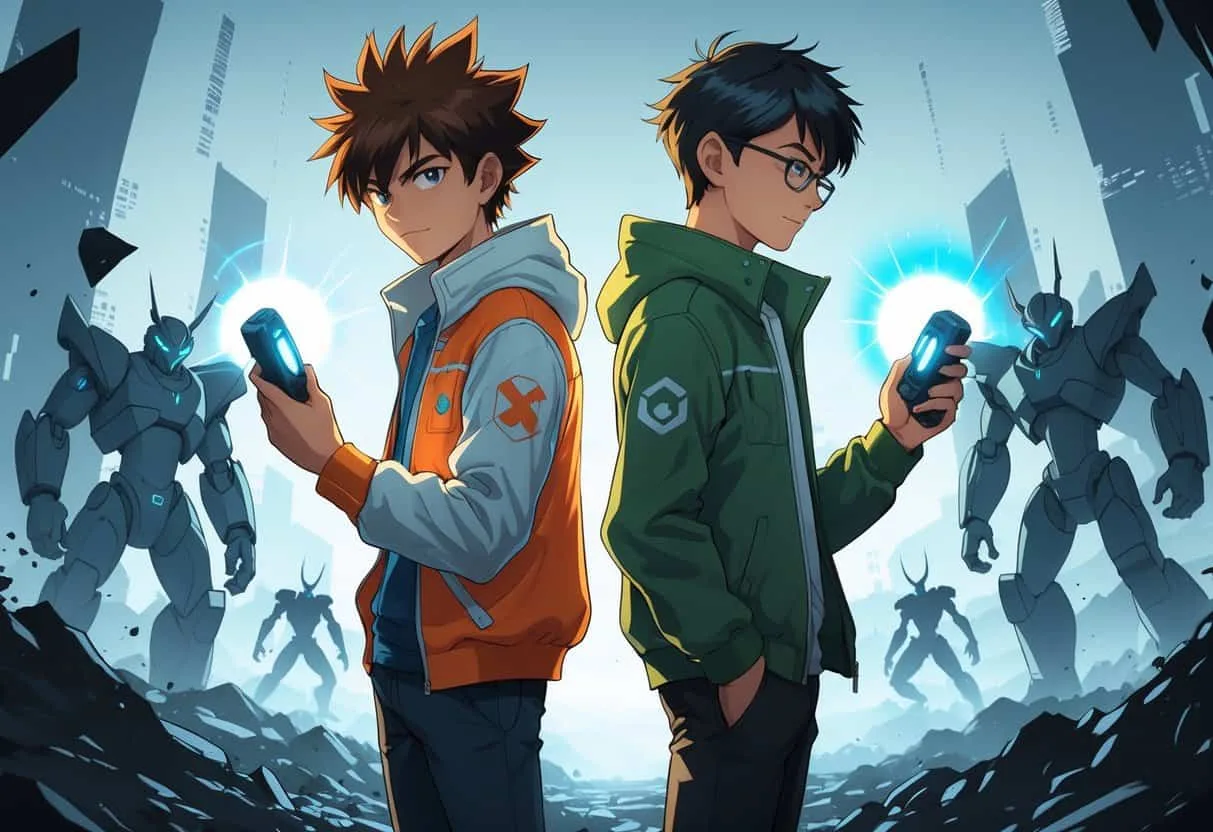
Tai Kamiya and Matt Ishida embody two distinct leadership philosophies, each rooted in the core values that define the DigiDestined. Tai operates from a place of instinctual courage and strategic audacity, while Matt draws strength from loyalty, emotional depth, and a protective instinct that often puts him at odds with Tai’s headstrong approach. Understanding their individual styles is essential to appreciating how their dynamic became the driving force behind the team’s survival in the Digital World.
Tai’s Approach: Courage and Strategic Command
Tai’s leadership is inseparable from his Crest of Courage and his unbreakable bond with Agumon. From the moment the children landed on File Island, Tai naturally assumed the role of field commander. He didn’t wait for a vote—he acted. When Greymon first appeared against Shellmon, it was Tai’s desperate but decisive will that triggered the Digivolution, a pattern that would repeat throughout the series. His willingness to stand between danger and his friends established him as the emotional anchor of the group long before anyone officially called him “leader.”
The SkullGreymon incident is perhaps the most revealing moment in Tai’s leadership arc. Driven by an overzealous need to force Agumon to reach the next level, Tai abandoned sound judgment and triggered a dark evolution. The sheer terror of seeing his partner transform into a mindless berserker forced Tai to confront the toxicity of reckless courage. This failure, more than any victory, shaped his maturity as a leader. He learned that true courage isn’t blind aggression; it’s acting despite fear while still respecting the limits of one’s team.
After that trauma, Tai’s calls became more measured, his confidence tempered by empathy.
His iconic goggles became a symbol of this burden. Often seen adjusting them before a major decision or battle, Tai wears the weight of command visibly. By the time Agumon reached WarGreymon during the battle against VenomMyotismon, Tai had transformed from a hot-headed kid into a leader capable of sacrificing his safety without sacrificing the group’s emotional well-being. He led from the front, but he also learned when to delegate, trusting Izzy’s intellect, Sora’s nurturing, and even Matt’s contrary voice to round out his plans.
Matt’s Approach: Friendship and Protective Leadership
Matt’s leadership style is often misunderstood as rebellion, but it’s better described as loyalty-driven caution. Bearing the Crest of Friendship, he defines success not by winning battles but by keeping his loved ones safe—especially his younger brother T.K. and later Kari. This protective instinct frequently collides with Tai’s mission-first mentality, but it fills a critical gap in the team’s decision-making process.
Unlike Tai, who thrives in chaos, Matt leads through quiet resolve. His partner Gabumon’s evolutionary line—Garurumon’s wolf-like tenacity, WereGarurumon’s disciplined strength, and MetalGarurumon’s calculated power—mirrors Matt’s own journey from lone wolf to a dependable second-in-command. Early in the series, Matt struggled with isolation and jealousy, particularly when Tai’s assertive style overshadowed his contributions. The conflict came to a head during the Puppetmon arc, when Matt, consumed by self-doubt and responsibility for T.K., separated from the group entirely. This wasn’t an abdication of leadership; it was Matt’s way of evaluating what mattered most.
His eventual reconciliation with Tai under the lake remains one of the franchise’s most honest portrayals of shared leadership. By admitting his faults and acknowledging Tai’s importance, Matt demonstrated a rare aspect of leadership: the willingness to follow when someone else’s strength is needed. From that point forward, Matt’s role solidified into that of a strategic counterweight. He guarded the team’s emotional stability, questioned reckless plans, and stepped into a command role when Tai was incapacitated or overwhelmed—proving that leadership isn’t always about being the loudest voice in the room.
Comparative Analysis: Two Halves of a Whole
Viewing Tai and Matt through a single lens of “who is the better leader” misses the point. Their complementary strengths created a system of checks and balances that no single child could replicate. The table below summarizes their contrasting, yet interdependent, leadership traits:
| Leadership Aspect | Tai Kamiya | Matt Ishida |
|---|---|---|
| Crest | Courage | Friendship |
| Core Motivation | Defeat threats, advance the mission | Protect individuals, preserve bonds |
| Decision-Making | Rapid, bold, instinct-driven | Deliberate, emotionally weighted |
| Team Role | Primary field commander, motivator | Emotional guardian, strategic critic |
| Greatest Weakness | Recklessness, impatience | Alienation, avoidance of direct conflict |
| Signature Digimon | WarGreymon (dramatic, direct combat) | MetalGarurumon (precise, cold efficiency) |
Without Tai, the DigiDestined would have lacked the decisive push to confront enemies like Myotismon or the Dark Masters. Without Matt, the group might have fractured under the emotional strain of constant warfare. Their rivalry was not a weakness but the friction that ignited growth, forcing both to refine their leadership into something greater than the sum of its parts.
Team Dynamics and the Influence of Leadership
The DigiDestined functioned as a fragile ecosystem of personalities, where leadership was distributed across relationships, shared trauma, and evolving trust. Tai’s and Matt’s influence extended beyond battle commands; it shaped how the team processed fear, failure, and hope.
How Tai Rallied the Troops
Tai’s ability to motivate stemmed from a contagious conviction that they would find a way home. When the group was separated after Etemon’s attack or lost in a new part of the Digital World, it was Tai’s voice—sometimes literally through his Digivice—that rekindled their resolve. He gave clear, tangible goals: “We need to reach that mountain before dark,” or “Agumon and I will buy you time while you find the exit.” This task-oriented leadership gave the younger children, including T.K. and Kari, a sense of security in an otherwise bizarre world.
Even his mistakes served a purpose. After the SkullGreymon disaster, Tai openly admitted his error to the whole team, something a less confident leader might have hidden. That vulnerability humanized him and encouraged others to own their fears. Sora began to talk about her conflicted feelings regarding love and motherhood; Izzy confronted his identity struggles. Tai set a tone where failure was acceptable as long as the group learned from it—a lesson that became essential as the threats grew more psychological and not just physical.
Matt’s Role as the Counterbalance
Matt’s influence was quieter but equally vital. He operated as the team’s emotional compass, often noticing when someone was silently struggling. His bond with T.K. gave him an early sense of responsibility, and he extended that protective instinct to Kari during the Dark Masters arc, even when it meant clashing with Tai. This protective dissent kept the group from becoming an echo chamber. When Tai proposed a direct assault on Piedmon’s palace, Matt demanded a contingency plan for the younger children.
That friction forced Tai to refine his tactics, ultimately saving lives.
Matt also connected with the more reserved members. Izzy, who often buried himself in logic, found a listening ear in Matt during moments of personal crisis. Mimi, overwhelmed by the Digital World’s chaos, responded to Matt’s calm steadiness more than Tai’s relentless forward momentum. By being an alternative leadership presence, Matt ensured that the team never became a cult of personality around Tai; instead, they remained a coalition of individuals who could challenge and support one another.
Key Turning Points and Group Decisions
The group’s most pivotal moments came when both leaders had to crystallize their roles. During the battle against VenomMyotismon in the human world, Tai and Agumon led the charge while Matt coordinated the defense of the other children and civilian bystanders. This division of responsibilities—offense and defense—was not assigned but organically emerged from their mutual understanding of each other’s strengths.
Later, in the Dark Masters’ world, the decision to split the group was agonizing but necessary. Tai trusted Matt to lead a separate party, a massive turning point from the early days when they competed for dominance. Matt’s successful independent command during that period validated his leadership as something entirely separate from, yet compatible with, Tai’s. By the time they faced Apocalymon, the dual-leadership model had become the very engine that powered Wargreymon and MetalGarurumon’s ability to work in perfect sync.
Iconic Digimon, Crests, and Defining Moments
The DigiDestined’s journey is inseparable from the visual and thematic symbolism of their partners and crests. For Tai and Matt, these elements are narrative shorthand for the very qualities that make their leadership stand out, and certain story arcs highlight how each grew into the role they ultimately played.
The Evolutionary Paths of Agumon and Gabumon
Agumon’s line is a masterclass in leadership evolution. Greymon represents brute force and early-stage boldness—much like Tai at the beginning, charging in without full consideration. MetalGreymon’s cybernetic upgrade reflects a leader who integrates new tools and strategies, while WarGreymon’s arrival coincides with Tai’s full maturation. The Dramon Destroyer claws, designed specifically to defeat dragon-type Digimon, symbolize a leader who has learned to dismantle threats with surgical precision rather than blind power. That evolution was only possible after Tai confronted his own darkness—literally, when he was pulled into the darkness of his own heart during the Warp Digivolution process.
Gabumon’s transformations mirror Matt’s internal arc just as tightly. Garurumon, the lone wolf, parallels Matt’s early detachment. WereGarurumon, a bipedal fighter, emerges when Matt begins to stand firmly for his beliefs rather than lingering in Tai’s shadow. MetalGarurumon’s final form, all calculated ice-missile salvos, epitomizes Matt’s cold, protective logic. It’s no accident that MetalGarurumon’s strongest attacks are defensive countermeasures; Matt’s leadership, too, is defined by preemptive protection rather than head-on assault.
The Symbolism of the Crests
Beyond mere power-ups, the DigiDestined crests are philosophical keys to each character’s deepest truth. Tai’s Crest of Courage is often misunderstood as fearlessness. In reality, the crest activated most brilliantly when Tai was terrified but chose to act anyway—episodes like the fight against Devimon, where he stood frozen until his will to save his friends overrode his terror. The crest taught that courage is not absence of fear but mastery over it.
Matt’s Crest of Friendship is equally nuanced. It didn’t glow because Matt was friendly; it glowed when he acted out of genuine care for others, even when it cost him. The crest’s power surged during the climax of the Puppetmon arc when Matt rushed to T.K.’s aid, pulling his brother from a deadly trap. It also shone when he reconciled with Tai, proving that friendship requires the courage to be vulnerable and admit mistakes. Thus, the crests interlock: Tai’s courage requires the team Matt’s friendship protects, and Matt’s friendship needs the bold direction of Tai’s courage.
Their partnership is written into the very mythology of the show.
Pivotal Battles and Character Growth
Certain confrontations etch the duality of their leadership into memory. The fight against Myotismon’s forces in Odaiba showcased Tai’s ability to inspire ordinary humans and DigiDestined alike, while Matt’s parallel story—protecting Kari and Gatomon—underscored the personal stakes that drove his every action. The movie Digimon Adventure: Our War Game! (often considered a high point of the franchise) crystallized their dynamic further: Tai’s frantic, scorched-earth tactics against Diaboromon contrasted with Matt’s methodical effort to rejoin the battle despite physical isolation, their eventual link-up making Omnimon’s fusion possible. This moment—two leaders merging into one ultimate form—is arguably the definitive statement on their shared leadership.
Against Piedmon, Tai’s head-on approach alone would have failed, and Matt’s defensive stance alone would have only delayed the inevitable. It was the combination—WarGreymon’s frontal assault and MetalGarurumon’s calculated flanking—that exposed Piedmon’s vulnerability. These moments prove that the DigiDestined’s greatest asset was never a single leader, but the tension and trust between two.
The Enduring Debate: Who Was the True Leader?
For over two decades, fans have debated whether Tai or Matt deserves the title of the DigiDestined’s true leader. The question, while initially simple, reveals deeper assumptions about what leadership should look like.
Fan Perspectives and Franchise Legacy
Many fans point to Tai’s canonical role as the group’s elected leader in Digimon Adventure Season 1 as definitive evidence. The older kids—and even the narrative itself—consistently treat Tai as the final authority. His Digivice was the first to activate the Crest of Courage, and his partner reached Mega level first, milestones that the series often associates with leadership. Moreover, Tai’s post-Adventure 02 career as a diplomat fits neatly into the leader archetype, while Matt’s path as an astronaut and J-pop singer does not, reinforcing the perception of Tai as the “official” leader.
However, a substantial portion of the fandom argues that Matt’s consistent role as the one willing to confront Tai’s decisions is itself a higher form of leadership. In forums and retrospectives, many note that without Matt’s challenges, Tai might have become a tyrant or, worse, a martyr. The Digimon Adventure tri. series even revisits this tension, showing an older Matt still wrestling with internal insecurities while functioning as a stable second-in-command. The franchise’s exploration of multiple leaders across series—Davis, Takato, Mikey, and others—only highlights that Digimon never intended a one-size-fits-all definition of leadership.
The Shared Leadership Model
The most compelling answer, and the one that the core of the series supports, is that leadership in the Digital World is inherently shared. Tai and Matt represent the visible spectrum of command: initiation and reflection, courage and protection, instinct and deliberation. In the extended Digimon lore, particularly Digimon Adventure and its sequels, the most effective groups—whether the DigiDestined or the Tamers—thrive when no single personality dominates. Tai could never have carried the team alone through the emotional intensity of losing a digivolution or watching a friend fall. Matt could never have mobilized the group to take the offensive against the Dark Masters without Tai’s push.
The dual leadership of Tai and Matt is not a flaw in the series’ writing but its greatest strength. It models a realistic, messy, and ultimately resilient form of collaboration that resonates with anyone who has ever struggled to balance decisiveness with empathy in a crisis. Their goggle-wearing frontman and his lone-wolf counterpart remind us that the best leaders are not those who command without question, but those who can both lead and be challenged—and who know when to step forward and when to step aside.
In the end, asking who was the true leader misses the magic of their bond. Tai was the leader in the light; Matt was the leader in the shadows. Together, they were Omnimon—a fusion that could never have existed if either had tried to stand alone.