Table of Contents
The Enduring Appeal of the Quiet Warrior
In the high-octane world of anime, where screams power up transformations and emotional monologues punctuate every battle, a different kind of hero often steals the spotlight. The stoic anime character, defined by a calm exterior, measured speech, and an economy of emotional expression, commands a unique and powerful presence. Their strength is not broadcast but contained, a quiet intensity that draws viewers in. These figures are far more than just “the strong, silent type”; they are a sophisticated blend of classical philosophy and deep-seated Japanese cultural values, creating a character archetype that resonates with a global audience. Their appeal lies in the mystery of what they hold back, and the seismic narrative impact when their walls finally, and briefly, crumble.
This controlled demeanor doesn’t exist in a vacuum. It directly channels the Zen-like discipline of the samurai, the collective restraint valued in Japanese society, and the philosophical tenets of Stoicism that originated in ancient Greece but found a parallel home in the East. Understanding this fusion reveals why a character like Levi Ackerman’s silent fury or Mikasa Ackerman’s unwavering focus can be more compelling than the most explosive protagonist. This exploration unpacks the essence, history, and global impact of stoic anime characters, showing how they transform a lack of expression into a profound storytelling device.
The Anatomy of an Anime Stoic
Defining stoicism in an anime context goes beyond a simple poker face. It’s a multi-layered behavioral construct that reveals character depth through suppression and action. The true anime stoic is not devoid of feeling; they are, in many cases, a crucible of the most intense emotions, which are deliberately processed internally. Their stoicism becomes a narrative proxy for immense inner strength, past trauma, and an unshakeable commitment to a personal code.
Defining the Archetype: More Than a Lack of Emotion
In narrative terms, an anime stoic is a character who consistently prioritizes logic, duty, or a long-term goal over immediate emotional expression. They are reactive only in the most extreme circumstances, and even then, their reactions are often subtle—a narrowing of the eyes, a sharp intake of breath, a single tear in a moment of extreme solitude. This performance of calm is a powerful aesthetic. It creates a magnetic emptiness that the audience actively works to fill, projecting their own interpretations onto the character's silence. This is a stark contrast to characters in series like My Hero Academia, whose power literally stems from emotional catharsis.
For the stoic, emotion is a liability to be managed, a fuel source that must be burned cleanly and privately to avoid an explosion that could harm themselves or others. Their dialogue is functional, rarely confessional, making every word they do speak carry disproportionate weight.
Emotional Control and the Performance of Composure
The control of negative emotions is the stoic's primary arena of performance. Anger, fear, grief, and despair are not absent but are rigorously managed through what can be described as a conscious, often painful, self-discipline. This manifests as a strategic advantage in battle, where a clear mind is essential, but it also serves a deep social function. By not displaying their pain, stoic characters shield their allies from additional emotional burdens. Think of any scene where a stoic captain leads their team through a hopeless situation; their unflinching composure is a gift to their subordinates, a focal point of stability in chaos.
This external calm is often a sacrifice, a form of labor they perform for the sake of others. The emotional restraint is a shield, but it’s also a prison, and the story’s tension often arises from the cracks that form in this meticulously maintained facade, hinting at the inferno raging underneath.
The Weight of the Past: Trauma and Forged Resolve
Rarely is an anime character born stoic; they are forged in fire. Their composure is almost always a scar tissue, a direct consequence of a traumatic backstory that obliterated their ability to process emotion openly. The premature death of parents, the genocide of their people, or a formative betrayal are common origin points. This is a core tenet of the Stoic philosophy as well: the past is beyond our control, and only our response to it defines us. For the anime stoic, their response is a radical form of internalization.
A character like Hiei from Yu Yu Hakusho is initially a creature of pure spite and isolation, his emotional armor welded shut by a lifetime of abandonment. The narrative arc for these characters is rarely about becoming “more emotional.” Instead, it involves learning to place their trust in a chosen few, transforming their stoicism from a trauma response into a conscious, proud choice of dedication. Their silence is a living memorial to what they’ve lost, and their continued, controlled action is how they honor that memory.
Cultural & Historical Foundations in Japan
The stoic anime archetype is not a Western import—it is a modern expression of ancient Japanese ideals. The code of the samurai and the aesthetic philosophies that shaped the nation’s worldview provide a ready-made template for characters who value honor, self-control, and action over verbal expression. This cultural resonance is what makes the stoic figure feel so authentic and self-evident within the medium.
The Samurai Ethos: Direct Line to Bushido
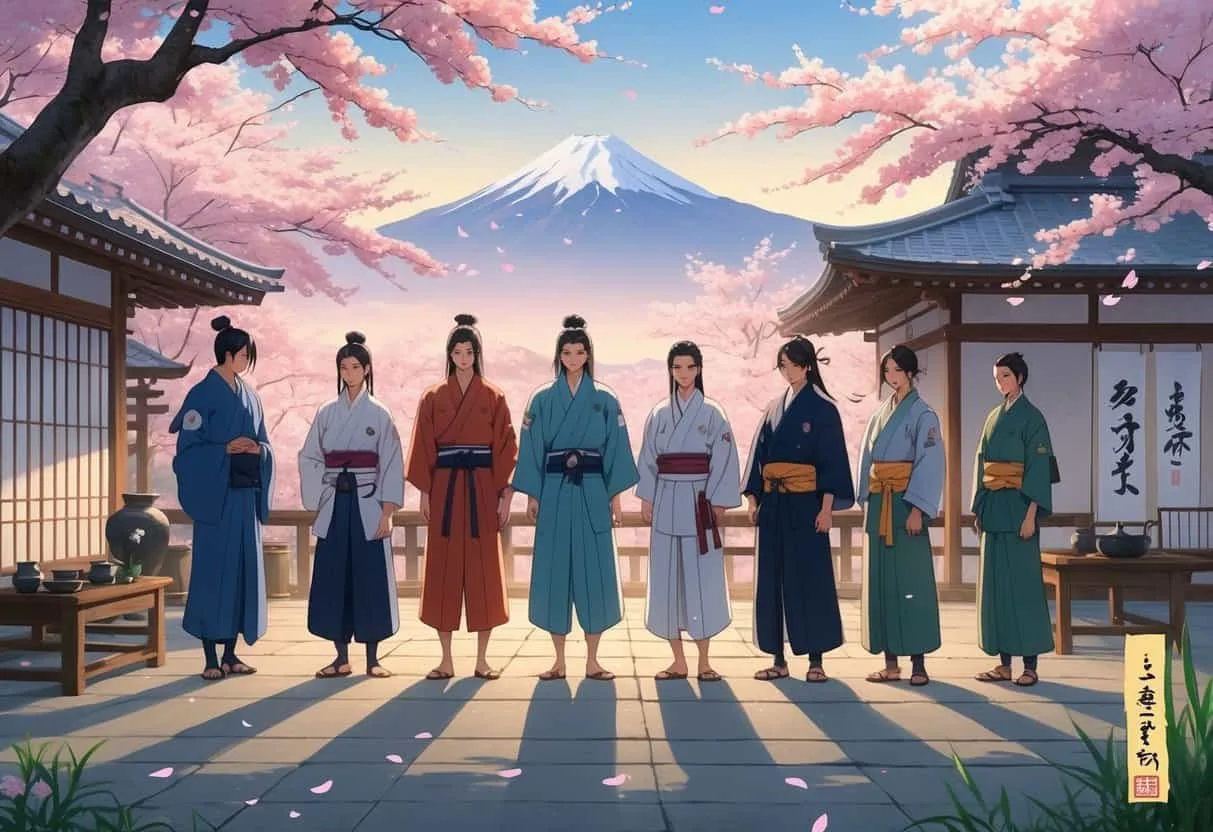
The direct lineage of the anime stoic runs back to the samurai and the unwritten code of Bushido. This “Way of the Warrior” emphasized virtues that map perfectly onto our silent heroes: righteousness (gi), courage (yū), benevolence (jin), respect (rei), honesty (makoto), honor (meiyo), and above all, loyalty and self-control. A samurai was expected to maintain unerring composure in the face of death, as chaos in the mind would lead to failure on the battlefield. This same principle is applied to characters like Guts from Berserk, whose early life as a mercenary hardens him, or the countless shinobi in Naruto taught to be tools first and feeling people second. The concept of gaman, enduring the seemingly unbearable with patience and dignity, is a direct cultural descendant of this ethos and remains a powerful social expectation in Japan today.
The stoic hero endures their personal tragedy not with a loud breakdown, but with the quiet, unyielding strength of a warrior upon the precipice.
An Era of Chaos: Forging Identity in the Warring States Period
The Sengoku period (1467-1615), a century and a half of near-constant civil war, formed a societal pressure cooker where stoic traits became survival mechanisms. The “Warring States” chaos is a favorite setting for anime precisely because it historically demanded a society built on vigilant self-control and absolute loyalty. In a world where a clan could be eradicated overnight, trust was a rare commodity and emotional transparency was a fatal vulnerability. Anime protagonists modeled on this era—like the samurai and ronin of Samurai Champloo or the heroes in a historical fantasy like Dororo—reflect this pragmatic hardness. Their stoicism isn’t philosophical coolness; it’s a survival instinct.
This deep-seated cultural memory of a world governed by impermanence reinforces the stoic character’s worldview: attachment is the root of suffering, and preparing calmly for the worst is not pessimism but a practical mindset. The iconic, unflappable stance of an anime swordsman is a direct aesthetic echo of a history written in steel and blood.
Honor, Loyalty, and the Ultimate Act of Control
The most extreme and definitive expression of this cultural stoicism is the ritual of seppuku, or ritualized suicide by disembowelment. Far from a simple act of despair, seppuku was a privilege reserved for the warrior class to restore or protect their honor, or to follow their lord in death. It required a terrifying physical and emotional control, an acceptance of mortality so complete that it erased the fear of pain. This is the historical and spiritual underpinning for the anime stoic’s ability to stare down death without flinching. It’s present in the character who volunteers for a suicide mission with an expression of absolute serenity.
The unwavering loyalty to a single person or ideal—often a master, a village, or a personal vow—is another key vector. It explains a character’s total subjugation of self-interest. These values are not merely historical; understanding them provides a critical lens for analyzing the high-stakes drama of many anime plots, where a character's silence speaks of an unbreakable, ancient commitment.
Archetypes in Action: Deconstructing Signature Characters
The theoretical model of stoicism finds its living, breathing expression in some of anime's most iconic figures. By examining protagonists, female warriors, and conflicted anti-heroes, we can see how this archetype is flexed, twisted, and perfected to drive narrative and create unforgettable character studies.
The Iconic Stoic Protagonist: The Center That Holds
The stoic protagonist serves as the narrative’s gravitational center, a fixed point around which the chaos of the plot orbits. Levi Ackerman from Attack on Titan is the quintessential example. His stoicism is expressed through an almost obsessive cleanliness and clinical precision, a desperate need to impose order on a world consumed by monstrous chaos. His rare moments of raw emotion—a tight grip on a dying comrade’s fist, a single quiet command to “make it mean something”—land with the force of a thunderclap precisely because of his unwavering baseline of control. Similarly, Spike Spiegel from Cowboy Bebop performs an existential stoicism, a lanky, laconic coolness that masks a man already dead to his past, walking through a noir future with the relaxed grace of a ghost.
As noted by an analysis on stoic anime leads, these characters redefine heroism, treating sheer emotional fortitude as a superpower. Their leadership is authoritative not because they shout the loudest, but because they project an aura of absolute, unshakable competence.
Redefining Strength: The Stoic Female Lead
Female stoic characters carve out a particularly progressive space, challenging and redefining gendered expectations of emotional labor. The most prominent example is Mikasa Ackerman, also from Attack on Titan, whose stoicism is a fortress built on the foundational trauma of losing her family. Her devotion is frightening in its power and stillness, communicated through action, not words. She doesn't offer tearful confessions of love; she destroys any threat that gets within a hundred meters of her ward. Another powerful archetype is the composed, analytical woman like Kuchiki Rukia from Bleach, whose early arc revolves around her duty-bound struggle to suppress her personal desires for the sake of her noble clan’s law.
These characters are not emotionless—they are profoundly emotional, but their emotions are weapons, channeled into ferocious protection and unbreakable loyalty. They reject the “manic pixie dream girl” or the “hysterical woman” tropes, instead presenting a version of strength that is silent, relentless, and powerfully self-possessed on a fundamentally gender-neutral battlefield.
The Cold Rival and the Stoic Anti-Hero
The stoic anti-hero and rival add essential complexity and moral ambiguity to a story. The narrative is often a dialectic between the emotional, hot-blooded protagonist and their cold, stoic counterpart. Sasuke Uchiha from Naruto is the platonic ideal of this figure. His stoicism is a fortress of darkness built from the trauma of his clan’s massacre, a deliberate severing of bonds he perceives as chains. His silence is a psychological weapon and a cry for help, and his rivalry with Naruto is a philosophical battle between the power of connection and the isolation of vengeance.
In the seinen realm, Guts from Berserk begins as the ultimate survivor-stoic, his sword and his silence the only things standing between him and a world that has always tried to kill him. His slow, painful evolution into someone who can tentatively form a team and protect others is a masterclass in character development. These characters show that stoicism can be a mask for profound, corrosive pain, and their slow, often reluctant thawing is a more compelling victory than any physical battle.
A Global Force: The Stoic's Transmedia Footprint
The power of the anime stoic has transcended its medium of origin, becoming a recognizable and influential archetype in global pop culture. From the nuances of its vocal performance to its visual design and adaptation into interactive media, this figure has become a key cultural export that defines a particular mode of cool.
The Aesthetics and Voice of Silence
The translation of stoicism from a drawn concept to a living character relies heavily on synergistic audio-visual design. The visual language involves sharp, angular features, often a lack of superfluous adornment, and a restricted color palette dominated by blacks, whites, grays, and deep blues—a minimalist aesthetic that signals clarity and severity. The character designs of Ninja Scroll or the minimalist cool of Ghost in the Shell’s Major Motoko Kusanagi are visual essays on composure. The voice acting is equally critical. Japanese voice actors (seiyuu) often employ a low, monotone register, conveying a wealth of unspoken emotion through subtle changes in breath and pace.
English dubs follow suit, with actors like Steve Blum (Spike Spiegel) and Crispin Freeman (Alucard from Hellsing) creating iconic performances defined by a resonant, controlled calm. This calm tone is not a lack of affect; it’s the audible manifestation of a character who has complete command of themselves and the situation, a voice that suggests if this person is worried, the world should be terrified.
Interactive Stoicism in Video Games
Video games provide a uniquely powerful platform for the stoic archetype because they allow the player to inhabit that composure. The lone, silent protagonist has been a staple of RPGs and action games for decades, directly inspired by the anime and manga model. The famously mute Link from The Legend of Zelda allows for total player projection, while a character like Cloud Strife from Final Fantasy VII initially performs a false stoicism that masks his own shattered identity—a narrative explored actively through gameplay. These characters are perfect for supporting the long-form, grinding narratives of strategy and patience that define many game genres. Their external calm mirrors the internal focus a player needs to master a complex combat system.
The stoic hero is also a perfect avatar for exploration of psychologically intense worlds, as seen in the quiet, resigned determination of a protagonist in a FromSoftware title, who dies again and again but always rises, uncomplaining, to face a crumbling world one more time.
A Global Archetype: Cross-Cultural Resonance
The journey of the stoic anime character from a local cultural expression to a global archetype is a testament to the universal appeal of quiet competence. In Western media, characters like the Man with No Name in Sergio Leone’s spaghetti westerns or even the modern, restrained action heroes of the John Wick films share a direct aesthetic DNA with the lone anime samurai. This global resonance is explored in various character studies, such as analyses on Comic Book Resources, which maps out how this trait builds a loyal fandom. In a media landscape saturated with quippy, often emotionally immature protagonists, the stoic offers a refreshing counter-narrative. They represent a fantasy of absolute self-reliance, a mastery not just over a skill but over one's inner world.
This is a universal power fantasy. When an international audience connects with the quiet dignity of these characters, they are also connecting, often unknowingly, to the deep, quietest currents of Japanese aesthetic and moral tradition, making the stoic anime hero one of the country's most successful and compelling cultural ambassadors.
The Silent Center
The stoic anime character endures because they turn the act of watching into an act of interpretation. Their minimalism invites us to lean in, to look for the micro-expressions, the unspoken pledges, and the weight of the history they carry in their silence. They are a narrative anchor in stories filled with spectacle, a reminder that the most dramatic action is often the one you do not take—the outburst restrained, the tear you hold back, the fear you refuse to let travel from your heart to your face. Drawing strength from the honor-bound samurai who defined an era and the universal philosophy of controlling one’s perception, these characters teach a counter-intuitive lesson: true power is not about making noise, but about having the discipline to be silent, steadfast, and unbroken when it matters most. Their quiet influence, spread across anime, games, and global cinema, has ensured that the silent warrior’s voice will forever echo loudest in our imagination.