Table of Contents
Introduction: Two Titans of Modern Anime
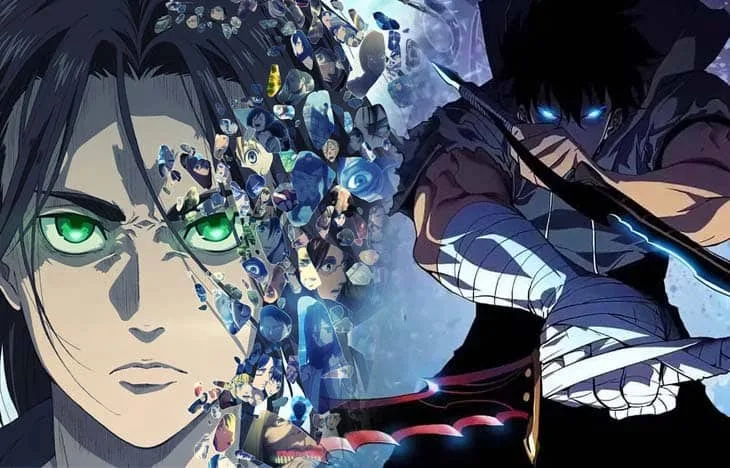
When anime fans debate the greatest series of recent years, two names inevitably surface: Solo Leveling and Attack on Titan (AoT). The question “Solo Leveling vs AoT — which is better?” echoes across forums, social media, and watch parties worldwide. Both have redefined their respective genres, amassed colossal global followings, and left an indelible mark on the medium. Yet, despite their shared dark fantasy DNA, they offer profoundly different journeys: one is a power-fantasy ascent of a lone hunter, the other a sprawling, tragedy-laced epic about war, freedom, and human nature.
The challenge in comparing them isn’t merely subjective preference; it’s the contrast in eras, production cycles, and storytelling ambition. Attack on Titan concluded its decade-long run with a finale that split audiences, while Solo Leveling’s anime adaptation is still unfolding under the masterful eye of A-1 Pictures. The question isn’t simply “which one is better,” but rather “which strengths resonate most with you?”
In this comprehensive breakdown, we’ll dissect both series across five key dimensions: storytelling, characters, animation style, fan reception, and the final verdict. By the end, you’ll have a clear framework to decide which anime earns a permanent spot on your watchlist — or why both deserve it. Let’s dive in.
1. Storytelling: The Art of the Narrative
Solo Leveling’s Addictive Power Climb
Solo Leveling began as a South Korean web novel by Chugong, later adapted into a phenomenally popular webtoon. The story centers on Sung Jinwoo, the weakest E-Rank hunter in a world where mystical gates spawn monsters. After a catastrophic double dungeon incident leaves him the sole survivor, Jinwoo awakens a unique “System” that grants him the ability to level up boundlessly — a privilege no other hunter possesses. The premise is deceptively simple: from zero to hero, with each arc delivering increasingly high-stakes battles and breathtaking growth.
The storytelling thrives on a propulsive, almost video-game-like structure. Each gate, each quest, each level-up carries tangible, visible progression. Jinwoo’s journey from an impoverished, ridiculed weakling to the awe-inspiring Shadow Monarch is meticulously paced. The narrative weaves in political intrigue between hunter guilds, international power struggles, and a deeper mystery surrounding the gates’ origins. However, the focus remains laser-sharp on Jinwoo.
Side characters, while charming, often exist to react to his growing supremacy, which gives the story a satisfyingly straightforward but sometimes narrow lens.
What makes Solo Leveling’s storytelling exceptional isn’t thematic complexity but sheer execution. The adaptation stays faithful to the source’s best moments — the jaw-dropping reveal of Igris the Bloodred, the chilling arrival of the Ant King, the global conference where nations tremble at Jinwoo’s might. Every arc feels like a reward, making it one of the most compulsively watchable anime in recent memory.
Attack on Titan’s Labyrinth of Morality
In stark contrast, Attack on Titan — born from Hajime Isayama’s manga — is a narrative onion. What begins as a straightforward struggle for survival against man-eating Titans evolves into a geopolitical thriller, an exploration of historical trauma, and a searing dissection of the cycle of hatred. The world beyond the walls isn’t just larger; it’s poisoned by centuries of oppression, propaganda, and ethnic cleansing. Eren Yeager’s personal vendetta becomes a catalyst for global catastrophe, forcing viewers to constantly re-evaluate who the real monsters are.
The series masterfully shifts perspectives. The time-skip after the basement reveal transforms the story from action-horror into a morally gray war drama. The Marley arc, where we follow Warrior candidates like Gabi and Falco, doesn’t just humanize the “enemy”; it flips the narrative so thoroughly that Eren’s eventual rumbling — a literal genocide — becomes both inevitable and horrifying. The storytelling demands active engagement, rewarding those who piece together its dense foreshadowing and philosophical underpinnings.
While Solo Leveling’s plot is a thrilling sprint, Attack on Titan’s is a marathon through a minefield of ethical dilemmas. The pacing can feel overwhelming, and the finale’s controversial choices left many divided. Yet, the sheer ambition — tackling freedom, determinism, and the cost of peace — positions AoT’s narrative as one of the most layered in anime history.
Storytelling Verdict
If you seek an electrifying, satisfyingly straightforward tale of self-improvement and domination, Solo Leveling delivers in spades. If you want a narrative that challenges your worldview and lingers long after the credits, Attack on Titan stands in a league of its own. Both excel in their lanes, but AoT’s narrative depth gives it a marginal edge for those craving intellectual weight.
2. Characters: The Faces of Power and Despair
Solo Leveling’s Sung Jinwoo: The Lonesome King
Few protagonists embody the “weak to strong” trope as iconically as Sung Jinwoo. His evolution is visceral, from the trembling boy praying for a miracle to the cold-eyed monarch who commands legions of shadows. His design — razor-thin, black military uniform, glowing purple eyes — has become a global symbol of power fantasy. But Jinwoo’s strength isn’t merely physical. The narrative roots his drive in a deeply relatable need: to provide for his sick mother and protect his younger sister.
That human core prevents him from becoming a detached powerhouse.
The supporting cast, while less developed than AoT’s, still offers memorable moments. Cha Hae-In, the skilled S-Rank hunter with an acute sense of smell, provides both romantic tension and a peer-level ally who senses Jinwoo’s difference. Thomas Andre, the brash American Goliath, begins as an antagonist but evolves into a grudging ally, his defeat at Jinwoo’s hands a highlight of the series. Hunter guild leaders like Go Gunhee and Baek Yoonho add institutional weight, while Jinwoo’s shadow army — especially Beru and Igris — steal scenes with their loyalty and personality. However, the narrative rarely gives these characters arcs independent of Jinwoo, making the story feel like a one-man show.
Attack on Titan’s Tragic Ensemble
Attack on Titan’s character work is its soul. Eren Yeager is one of anime’s most radical protagonists, morphing from a vengeance-fueled idealist into a genocidal anti-villain whose actions shatter the story. His transformation is so drastic that by the final season, old footage of his Shiganshina tears feels like a relic of another person. Mikasa Ackerman, bound by both love and an inherited clan mark, grapples with the agonizing choice to stand against the man she cherishes most. Armin Arlert, the strategic heart, embodies the hope of diplomacy and empathy even as the world burns.
Beyond the core trio, the series boasts a staggering pantheon. Erwin Smith’s final charge, a suicidal gambit of patriotic deception, is a masterclass in leadership and sacrifice. Levi Ackerman carries the weight of being humanity’s strongest, his stoicism cracking under relentless loss. Characters like Reiner Braun, torn between warrior and soldier identities, exemplify the series’ deep trauma. Even side figures like Floch Forster evolve into terrifying reflections of radical nationalism.
Each character serves the theme: no one is purely hero or villain, just survivors making horrific choices.
Characters Verdict
Solo Leveling’s Jinwoo is the ultimate escapist icon — undeniably cool and endlessly watchable. But Attack on Titan’s ensemble is a tragic symphony. The moral complexity, growth, and heartbreak woven into characters like Eren, Reiner, and Erwin elevate them beyond narrative tools into lasting legends. For emotional resonance and character-driven storytelling, AoT sets the bar impossibly high.
3. Animation Style: Crafting Spectacle
Solo Leveling’s Stunning A-1 Visuals
Produced by A-1 Pictures, the studio behind Sword Art Online and Fate/strange Fake, Solo Leveling’s anime adaptation immediately set social media ablaze with its visual opulence. The color palette is bold yet disciplined: dungeons glow an eerie blue, while Jinwoo’s shadow realm consumes all light in a smooth void. Character designs by Tomoko Sudo preserve the webtoon’s sharp, model-like elegance without sacrificing movement fluidity.
Action sequences are where the series truly excels. The clash with the dungeon boss Kasaka, the rain-soaked fight against the assassin clan, and the iconic beatdown of the giant statue — each battle is choreographed with cinematic camera work that emphasizes Jinwoo’s speed and brutality. The use of low-angle shots, slow-motion impacts, and particle effects (floating embers, shadow tendrils) creates a visual language of power. Standout moments like Jinwoo’s “Arise” command, when fallen enemies rise as loyal shadows, are delivered with such dramatic shading and sound design that they’ve become hallmarks of modern anime.
Attack on Titan’s MAPPA Evolution
Attack on Titan’s animation journey spanned two major studios: WIT Studio (Seasons 1-3) and MAPPA (Final Season). WIT defined the series’ early aesthetic: thick linework, visceral 2D Titan designs, and fluid ODM (Omni-Directional Mobility) sequences that made the first Levi chase scene globally viral. The Colossal Titan’s steam-drenched emergence, the Armored Titan’s iron punch, the Beast Titan’s devastating pitches — all were rendered with a gritty, hand-drawn intensity.
MAPPA’s takeover for the final season marked a deliberate tonal shift. The color grading became desaturated, mirroring the narrative’s descent into grim realism. CGI Titans, initially controversial, gradually integrated more naturally, with the Founding Titan’s grotesque, skeletal form being a standout achievement. The Rumbling’s apocalyptic scale — rivers of colossal bodies trampling entire continents — showcased ambitious crowd animation and environmental destruction. While some fans lamented the loss of WIT’s raw line work, MAPPA’s visual presentation captured the denouement’s oppressive despair with harrowing fidelity.
Animation Verdict
Choosing here feels like picking a favorite painting in a museum. Solo Leveling offers modern, polish-first spectacle — every frame screams “next-gen anime.” Attack on Titan, meanwhile, delivers a cinematic experience that matured visually with its story. For sheer wow-factor consistency, Solo Leveling’s A-1 production may edge ahead for many, but AoT’s visual ambition across seasons remains a historic achievement.
4. Fan Reception: Global Impact and Legacy
Both series have carved immense digital footprints. According to MyAnimeList, Attack on Titan consistently tops popularity charts, with the final season achieving near-universal attention. Solo Leveling, as a relative newcomer, shattered streaming records on Crunchyroll and became one of the most-anticipated anime of 2024.
Solo Leveling’s reception has been overwhelmingly positive, particularly among fans of the webtoon who finally saw Jinwoo’s battles fully animated. Viewers praise the adaptation’s faithfulness, the striking art, and the exhilarating pacing. On platforms like Rotten Tomatoes, audience reviews highlight the series’ ability to hook even non-anime viewers with its game-like progression. The anime’s original soundtrack — notably SawanoHiroyuki[nZk]’s contributions — further amplified its epic tone. Criticism tends to center on the simpler plot and limited side character depth, but for the target audience, these are minor quibbles.
Attack on Titan’s reception is more complex. The early seasons were hailed as a cultural phenomenon, breaking into mainstream Western media. The narrative’s later turns polarized the fandom: some found the Marley arc’s moral ambiguity brilliant, others grew frustrated with Eren’s darker path. The finale, in particular, sparked intense debate over character conclusions and thematic closure. Yet, the series’ IMDb ratings and lasting discourse prove its staying power.
AoT remains a benchmark for anime that transcend entertainment, entering classrooms and critical essays on fascism, war, and free will.
Fan Reception Verdict
Both commands massive, passionate bases. Solo Leveling enjoys a more unified, hype-driven fan culture; Attack on Titan’s legacy is etched in nearly a decade of intense debate and academic analysis. It’s a draw — each series meets its audience exactly where they need it.
5. The Final Verdict: Which Is Better for You?
After dissecting every facet, the answer to “Solo Leveling vs Attack on Titan” crystallizes not into a winner but into a compass. Your preference reveals what kind of story you crave right now.
Choose Solo Leveling if:
- You love a tight, protagonist-focused narrative about relentless self-improvement.
- You want visually stunning, high-octane action with minimal downtime.
- Power fantasy without excessive moral ambiguity is your comfort zone.
- You’re new to anime and want a gateway series that’s instantly rewarding.
Choose Attack on Titan if:
- You seek deep, philosophical themes about freedom, hatred, and human nature.
- A morally gray cast of complex, evolving characters intrigues you.
- You appreciate slow-burn narrative twists and don’t mind a divisive ending.
- You want to engage with a series that sparks discussions long after viewing.
In my own assessment, Attack on Titan’s narrative ambition and character tragedy give it a slight edge for those valuing profound storytelling. However, Solo Leveling’s flawless execution of its core appeal — making you fist-pump at every level-up — makes it no lesser achievement. The best advice? Watch both. Let Solo Leveling recharge your hype when AoT’s darkness lingers too long, and let AoT deepen your perspective when you need more than a power-up.
Frequently Asked Questions
Which anime is better for beginners, Solo Leveling or Attack on Titan?
Solo Leveling is often more beginner-friendly due to its straightforward plot and faster payoff. Attack on Titan’s complex narrative and longer runtime can be intense for newcomers, but its immediate hook — giant monsters and survival — still draws in millions.
Did Solo Leveling copy Attack on Titan?
No. While both share dark fantasy settings and themes of survival against overwhelming odds, Solo Leveling’s game-inspired leveling system and solo-progression structure are distinct. They belong to the same broad genre but tell fundamentally different stories.
Is Sung Jinwoo stronger than Eren Yeager?
In a direct crossover, Jinwoo’s shadow army and near-Monarch powers would likely dominate Eren’s Titan forms, but such comparisons are purely speculative. Both characters are the apex of their respective universes, measured by entirely different power scales.
What should I watch after finishing Solo Leveling or Attack on Titan?
For Solo Leveling fans, series like Tower of God, The God of High School, or Mushoku Tensei offer similar progression or fantasy elements. For AoT devotees, Vinland Saga, Code Geass, or 86 Eighty-Six provide comparable thematic depth and moral complexity.
Ultimately, the Solo Leveling vs AoT debate is a celebration of anime’s diversity. Whichever you crown as champion, both series have reshaped what the medium can achieve. Dive in, form your own verdict, and enjoy the ride.