Table of Contents
Shikamaru Nara: The Mind Behind Leaf's Greatest Victories
Shikamaru Nara enters the story as a character many fans quickly categorize: the slouched posture, the constant complaints about anything “troublesome,” the habit of staring at clouds rather than training. On the surface, he seems designed to be a comedic side act. But this perception shatters the moment you realize his laziness masks one of the sharpest intellects in the entire ninja world. His journey is not about acquiring flashier jutsu or hitting harder. It’s about refining a rare gift for cold analysis and transforming it into a leadership style that ultimately saves thousands of lives and reshapes the Hidden Leaf Village’s strategic doctrine.
Shikamaru’s arc tracks an internal shift. Early on, he resists responsibility because he fears the pain of failure. Over time, devastating losses and hard-won victories forge something far more resilient: a leader who carries immense burdens without ever letting the weight compromise his judgment. His evolution from a “lazy genius” into Konoha’s mastermind strategist is one of the most understated yet powerful narratives in Masashi Kishimoto’s work.
Core Insights into Shikamaru's Leadership
- Intelligence alone is not enough; Shikamaru’s growth hinges on pairing his IQ with an unshakeable sense of duty.
- Each critical mission forces him to make decisions with life-or-death stakes, accelerating his maturity far beyond his years.
- True strategic leadership relies on deep, trusting bonds with allies who can execute complex plans without hesitation.
Shikamaru's Early Life: Shaped by the Nara Clan
Nara Clan Heritage and Family Influence
Shikamaru was born into the Nara clan, a family synonymous with tactical brilliance and the unique ability to manipulate shadows. The clan’s traditions prize intellect over raw power, a value system that shaped every expectation placed on him. His father, Shikaku Nara, served as the Jonin Commander and later as the chief strategist for the entire Allied Shinobi Forces during the Fourth Great Ninja War. Watching his father calmly dissect battlefield situations and give orders that turned the tide of conflicts gave Shikamaru a template for what leadership could look like: never frantic, always several steps ahead, and rooted in protecting one’s comrades.
Shikamaru’s mother, Yoshino Nara, also played a critical role, though often through her sharp tongue and strict nature. Her insistence on discipline and her ability to verbally spar with him taught Shikamaru patience and the skill of reading people’s motives beneath their words. That domestic environment, surprisingly intense despite his lazy demeanor, laid the groundwork for his later ability to negotiate with stubborn shinobi and outmaneuver hostile negotiators.
Personality: The Lazy Genius Complex
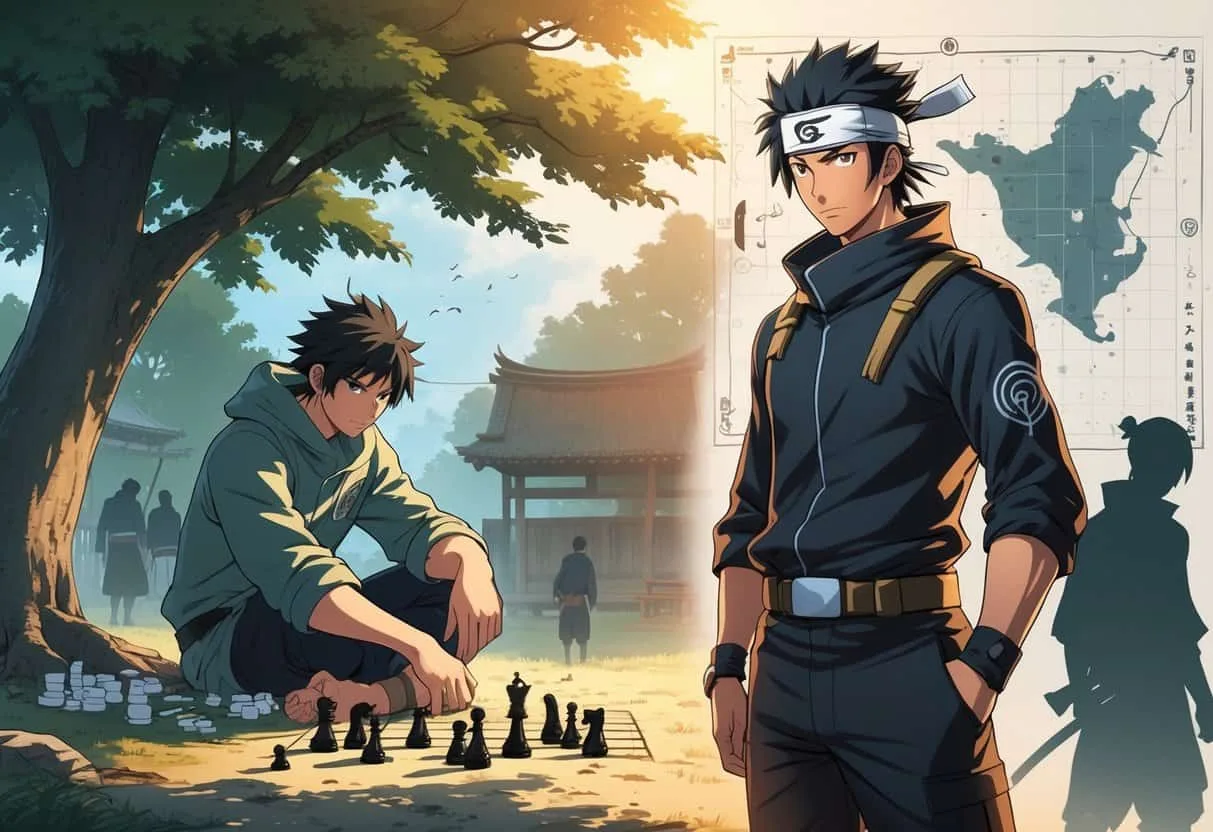
At first glance, Shikamaru’s defining trait is his reluctance. He calls nearly everything “troublesome,” and he consciously avoids physical strain. But this laziness is deceptive. Shikamaru’s mind never stops working, even when his body appears idle. He plays shogi constantly, often in his head, and he analyzes cause-and-effect chains with an instinct that surpasses many veteran jounin.
The IQ of over 200 frequently cited in the series is not just a number; it manifests in his ability to consider dozens of possible future moves while his opponent is still reacting to the first.
This combination of apathy and brilliance becomes a core tension. In the early series, Shikamaru would rather forfeit a match than expend unnecessary effort. His growth as a leader requires him to abandon that safety net. He has to learn that walking away is not an option when the lives of his teammates—and eventually his entire village—depend on him embracing the very thing he dreads: active engagement.
Academy Years: A Mind Beyond Combat
At the Ninja Academy, teachers quickly identified Shikamaru as an anomaly. He consistently finished written exams far ahead of his classmates, often while napping through the remaining time. During practical exercises, he would feign mediocrity until forced to demonstrate his true skill. His Nara clan shadow techniques gave him a natural advantage, but it was his strategic mind that truly set him apart. Even Iruka Umino, who struggled to motivate him, admitted that Shikamaru’s potential exceeded almost anyone else’s in his generation.
What the Academy really cemented was Shikamaru’s understanding of roles within a team. He saw early on that his strength lay not in overpowering foes but in controlling the battlefield so that others could strike the deciding blow. This self-awareness—knowing exactly what he was and was not capable of—would later define his leadership philosophy.
The Crucible of Leadership: Chunin Exams and Beyond
Chunin Exam Breakthrough: Temari and Tactical Wit
Shikamaru’s moment of public arrival came during the Chunin Exams. His match against Temari of the Sand Village was a flawless demonstration of brains over brawn. While Temari wielded a devastating fan that could level terrain, Shikamaru used the environment, the sun’s angle, and precise shadow manipulation to trap her in a web of feints and calculated risks. He eventually cornered her with his signature move, Shadow Possession Jutsu, and though he forfeited due to chakra exhaustion, the examiners recognized something extraordinary: a shinobi who could win a war without throwing a single punch.
That promotion to chunin, the first among his peers from the Konoha 11, was a watershed. It validated an approach to ninja life that prioritized intellect, and it placed a target of expectation on Shikamaru’s back that he could no longer shirk.
The Sasuke Retrieval Mission: Forging a Leader
If the Chunin Exams gave Shikamaru his rank, the Sasuke Retrieval Mission gave him his soul as a leader. Trusted with assembling and leading a handpicked team to recover Uchiha Sasuke, Shikamaru faced an agonizing reality: he was directly responsible for lives in a high-risk operation against far stronger opponents. The mission was a tactical success but a personal failure—Sasuke escaped, and several teammates came close to death. Choji Akimichi and Neji Hyuga were critically injured, and Shikamaru carried the guilt of issuing orders that nearly killed his dearest friends.
This traumatic aftermath transformed him. Instead of retreating deeper into laziness, he vowed never again to let a team member fall if he could help it. His father, Shikaku, offered a pivotal lesson at this juncture: a leader must sometimes let subordinates take risks, but he must also carry the weight of every wound. From that point forward, Shikamaru’s strategies became bolder and more protective simultaneously—a hallmark of his mature style.
Learning from Asuma: The Will of Fire Embodied
No relationship shaped Shikamaru’s understanding of leadership more profoundly than his bond with Asuma Sarutobi. As the leader of Team 10, Asuma saw past the lazy front and recognized a future pillar of the village. He taught Shikamaru not just shogi, but a philosophy: the king in shogi represents the village and its future generations, and it is the duty of the knight, rook, and other pieces to protect that king. Asuma viewed Shikamaru as the one who would one day safeguard the “king.”
Asuma’s brutal death at the hands of Hidan, a member of the Akatsuki, shattered Shikamaru. Yet it also crystallized his purpose. The revenge mission against Hidan was not fueled by rage alone; it was a masterclass in dispassionate, calculated vengeance. Shikamaru buried Hidan in a trap that exploited every scrap of intelligence he had gathered, using his shadow technique to force the immortal into a pit of explosive tags and rock, his final words to Hidan reflecting a cold, simmering fury. Afterward, smoking one of Asuma’s final cigarettes, Shikamaru shed tears not for himself but for a mentor who would never see him grow.
That mission announced the end of his adolescence and the birth of a leader ready to guide the village through its darkest hours.
Building Bridges: Relationships that Defined a Strategist
Naruto Uzumaki: The Unbreakable Trust
Shikamaru’s bond with Naruto Uzumaki often goes understated, but it forms a critical axis of Konoha’s future. Unlike many who initially dismissed Naruto as a loudmouthed failure, Shikamaru recognized Naruto’s unique ability to inspire and persevere. He became one of Naruto’s earliest genuine supporters, and when the village turned on Naruto during the Pain crisis, Shikamaru stood firm. In turn, Naruto trusted Shikamaru’s intellect implicitly. This mutual respect allowed Shikamaru to later advise Naruto as Hokage with an honesty that few others could manage, blending loyalty with necessary bluntness.
Team 10 and the Shadow Bonds
The Ino-Shika-Cho trio is not just a formation; it is a generational pact. Alongside Ino Yamanaka and Choji Akimichi, Shikamaru forms the 16th generation of this legendary combination. Their synergy relies on absolute trust: Ino’s mind-body jutsu, Choji’s destructive power, and Shikamaru’s shadow capture. Under Shikamaru’s command, this dynamic reached its peak, but the emotional glue was their shared history. They had lost Asuma together, grieved together, and avenged him together.
That shared trauma forged a loyalty that no opposing force could break.
Cross-Village Alliances: Temari, Gaara, and Beyond
Shikamaru’s marriage to Temari is far more than a romantic subplot. It symbolizes the enduring peace between Konoha and Sunagakure. Their early battles, marked by mutual respect for each other’s strategic minds, paved the way for an alliance that proved crucial during the Fourth Great Ninja War. Shikamaru also cultivated a working relationship with Gaara, the Fifth Kazekage, based on shared experiences as young leaders thrust into enormous responsibility. These bonds allowed Shikamaru to coordinate multi-village operations with a diplomat’s touch, ensuring that allied forces moved as one coherent unit rather than a collection of separate armies.
Master Strategist of the Great Ninja Wars
Fourth Great Ninja War: Chief Tactician of the Allied Forces
When the Shinobi Alliance formed to counter Madara Uchiha and the resurrected shinobi army, Shikamaru’s father Shikaku was the primary strategist. But after the devastating assault of the Ten-Tails and the death of Shikaku at the hands of the Tailed Beast Bomb, command passed directly to Shikamaru. In the chaos of the Fourth Great Ninja War, he stepped into his father’s role with a terrifying calm, directing divisions, adjusting formations in real time, and exploiting the terrain of a world on fire. His plans enabled the Allied Forces to hold off an enemy that wielded godlike power long enough for Naruto and Sasuke to deliver the final blow.
Shadow Possession: The Ultimate Control Technique
Shikamaru’s signature Shadow Possession Jutsu evolved far beyond a simple immobilization tool. By the war arc, he had refined it to bind multiple targets simultaneously, to choke enemies, to manipulate allies out of danger, and to stitch together entire tactical sequences. Combined with his intellect, the jutsu became an extension of his will to control any chaotic variable on the battlefield. This technical mastery allowed him to neutralize threats that outclassed him in raw power, making him an invaluable asset even when facing opponents like the Ten-Tails’ spawn.
Advisor to the Seventh Hokage: Guiding a New Era
Following the war, Shikamaru took on the official role of chief advisor to Naruto Uzumaki after Naruto became the Seventh Hokage. Their partnership represents the culmination of a long friendship built on complementary strengths. Naruto’s empathy and strength of will, balanced by Shikamaru’s cold realism and foresight, create an administration that handles both diplomatic subtleties and existential threats. Shikamaru serves as the gatekeeper of the Hokage’s time, filtering problems that need immediate attention and offering unvarnished counsel, even when it clashes with Naruto’s idealistic impulses. As seen in Boruto’s era, Shikamaru continues to shape policy, negotiate with the Land of Fire’s daimyo, and mentor a new generation that includes his own son, Shikadai Nara.
Legacy for Future Generations
Shikamaru’s enduring legacy is not in a flashy monument, but in a fundamental shift in how the Hidden Leaf values intellect. Young shinobi now see that a sharp mind can rival any jutsu, and many strive to emulate his analytical approach to combat. His life demonstrates that leadership does not require a commanding voice or overwhelming power; it requires the willingness to carry the burden of choice. By marrying Temari, raising Shikadai, and tirelessly serving two Hokage, Shikamaru has become the quiet pillar that supports the Will of Fire from the shadows—precisely where a Nara belongs.
His story, from a boy who wanted only to watch the clouds to a man who safeguards the peace of an era, proves that true strength lies in the courage to think, to grieve, and to act with unflinching resolve when others cannot.