Table of Contents
The intersection of psychological depth and nonlinear storytelling creates some of the most provocative and enduring works in anime. When a series abandons the safety of chronological progression, it asks you to engage with the material on a fundamentally different level. You are no longer a passive recipient of a neatly packaged narrative. Instead, you become an active participant, assembling fragmented moments into a coherent whole while simultaneously grappling with the internal chaos of characters whose minds rarely operate in straight lines.
Psychological anime thrives on this disorientation. The genre is built to explore anxiety, trauma, identity dissolution, and existential uncertainty—states that resist clean, linear representation. A mind in distress does not process events in tidy sequence. It loops, it fractures, it buries memories and resurrects them without warning. Nonlinear storytelling mirrors this internal reality with a fidelity that traditional narrative structures cannot match.
When executed well, the technique transforms the viewing experience into something closer to inhabiting another consciousness than simply observing a story.
This article examines how nonlinear storytelling functions within psychological anime, which series have deployed it most effectively, and why the technique continues to shape both the medium and its audience. The works discussed here represent a spectrum of approaches, from the recursive time loops of The Tatami Galaxy to the fractured identity explorations of Perfect Blue and the sprawling, interconnected timelines of Baccano!. Each demonstrates a distinct method of breaking temporal expectations while deepening psychological resonance.
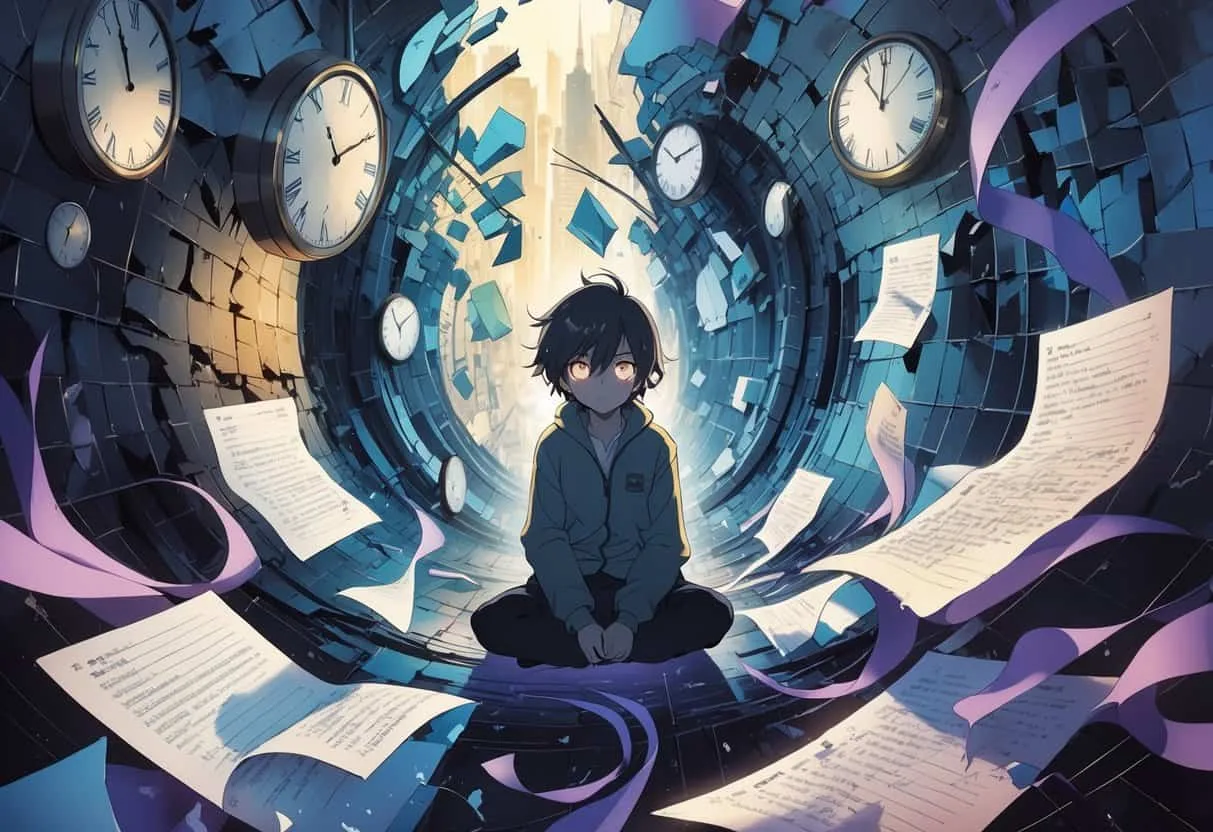
What Defines Nonlinear Storytelling in Psychological Anime
Nonlinear storytelling refers to any narrative structure that deviates from a straightforward chronological sequence. Rather than moving from point A to point B to point C, these stories might begin at the conclusion, jump backward to an origin, or interweave multiple timelines simultaneously. In psychological anime, this structural choice is rarely decorative. It serves a specific function tied to the mental and emotional states being portrayed.
Core Structural Characteristics
Several techniques recur across the genre. Flashbacks are the most common, but psychological anime pushes beyond simple reminiscence. A flashback in a conventional drama might provide backstory; in a nonlinear psychological work, it often functions as an intrusive memory, arriving unbidden and disrupting the present moment just as traumatic recollections do in lived experience. Flash-forwards, by contrast, create dread and anticipation, seeding questions about how the characters arrived at a particular future.
Parallel timelines represent another key technique. Some series present alternate realities or competing versions of events, forcing you to weigh contradictory information without clear resolution. This approach externalizes internal debates about choice, regret, and identity. Episodic scrambling—where installments are deliberately ordered in non-chronological sequence—creates a puzzle-box effect that rewards attentive viewing while reflecting the fragmented nature of memory and perception.
Multiple perspective storytelling rounds out the toolkit. By shifting between different characters' viewpoints, often across different time periods, these narratives demonstrate how subjective and unreliable any single account can be. What one character remembers as a minor interaction might, from another's vantage point, emerge as a formative trauma. The gaps between perspectives become as revealing as the perspectives themselves.
Character Development Through Temporal Disruption
Linear storytelling tends to present character growth as a smooth arc. Nonlinear approaches reveal something truer to psychological reality: that people often change in fits and starts, that growth can be invisible until retroactively recognized, and that past selves continue to haunt present identities.
When you encounter a character's future self before understanding their past, you are positioned to read every earlier action through the lens of what they will become. This creates dramatic irony but also psychological depth. You see the seeds of later behavior long before the character themselves could recognize them. Conversely, meeting a character's past after witnessing their present can reframe everything you thought you understood about their motivations.
The technique also allows for the portrayal of psychological states that resist linear explanation. Trauma, for instance, does not heal along a predictable timeline. It resurfaces, recedes, and transforms. Nonlinear storytelling can dramatize this process by returning to pivotal events at different points in the narrative, each time revealing new dimensions as the surrounding context accumulates meaning.
Restructuring Narrative Expectations
Conventional narratives rely on causation: event one leads to event two, which triggers event three. Nonlinear psychological anime often inverts this logic, presenting effects before causes or suggesting that causation itself might be less stable than assumed. This destabilization serves thematic purposes. When a series questions whether events are predetermined or chosen, whether memories are reliable or fabricated, whether identities are fixed or fluid, a fractured timeline becomes more than an aesthetic choice—it becomes an argument about the nature of reality and selfhood.
The structure also intensifies engagement. Because you cannot rely on chronology to guide your understanding, you must attend to emotional logic, symbolic connections, and thematic resonance. The narrative meaning emerges not from sequence but from pattern recognition. This active mode of viewing mirrors the interpretive work that characters themselves must perform as they navigate their own fractured experiences.
Essential Nonlinear Psychological Anime: A Detailed Examination
The series and films discussed below represent the most accomplished applications of nonlinear storytelling within the psychological anime tradition. Each deploys temporal disruption toward distinct psychological ends, from examining dissociative states to exploring the weight of accumulated choices.
Serial Experiments Lain: Dissolution of Self in the Digital Age
Serial Experiments Lain remains one of the most uncompromising explorations of identity fragmentation in anime. The series follows Lain Iwakura, a withdrawn teenager who becomes entangled with the Wired—a global communications network that increasingly blurs the boundary between virtual and physical existence.
The narrative structure mirrors Lain's psychological disintegration. Scenes shift without clear transitions. Events repeat with subtle but disturbing variations. The timeline fractures so thoroughly that by the series' midpoint, you can no longer be certain which version of Lain you are watching, or whether the distinction even holds meaning. This structural approach transforms viewing into an experience of the same uncertainty Lain endures.
The series does not describe dissociation; it induces a version of it through its storytelling mechanics.
The nonlinearity extends beyond simple temporal scrambling. The series layers competing realities—the material world, the Wired, and spaces that seem to exist in neither or both—without clearly demarcating their boundaries. Lain's character development occurs across these layers, with different aspects of her personality manifesting in different contexts. By refusing to privilege any single reality as definitive, the narrative suggests that identity itself might be a distributed phenomenon, a set of performances rather than an essential core.
Perfect Blue: The Unraveling of Performed Identity
Satoshi Kon's Perfect Blue is a masterclass in using nonlinear editing to portray psychological collapse. The film follows Mima Kirigoe, a pop idol who transitions to acting, only to find her sense of self eroding as the demands of her new career collide with the persona she has left behind.
Kon weaponizes the cut. Scenes transition in ways that deliberately obscure whether what follows is reality, hallucination, a scene from Mima's acting role, or some fusion of all three. A murder depicted on screen might be part of the television drama Mima is filming, or it might be happening in the film's diegetic reality. The ambiguity is the point. As Mima's grip on her identity loosens, the film's grip on a stable timeline loosens with it.
This technique positions you inside Mima's deteriorating consciousness. You cannot solve the mystery through careful attention to chronology because chronology has been deliberately dissolved. Instead, you must experience the film emotionally, registering the accumulating weight of Mima's terror and confusion without the comfort of a reliable framework. The nonlinear structure externalizes what linear storytelling could only describe: the experience of losing the thread that connects past, present, and self.
The Tatami Galaxy: Recursive Time and the Weight of Choice
The Tatami Galaxy takes a radically different approach to nonlinearity, one built on repetition and variation rather than fragmentation. The series follows an unnamed protagonist through his college years, but each episode resets the timeline and explores a different parallel reality based on the campus club he joins at the start of his university career.
This structure is explicitly psychological. The protagonist is consumed by regret, convinced that a single different choice at the outset would have led to the idealized "rose-colored campus life" he believes he has been denied. The recursive narrative tests this hypothesis exhaustively, cycling through club after club, reality after reality, each time revealing that the protagonist's fundamental patterns of avoidance, self-sabotage, and unrecognized privilege persist regardless of the initial conditions.
The nonlinearity here works through accumulation. No single episode tells the complete story, but each adds a layer to your understanding of the protagonist's character. Patterns visible only across timelines—the friendships he consistently undervalues, the opportunities he consistently overlooks—become the true subject of the narrative. By the final episodes, the structure has demonstrated what a linear telling could only assert: that meaningful change requires not different circumstances but different ways of being.
Baccano! and the Ensemble Timeline
Baccano! deploys nonlinearity across an ensemble cast spread across multiple years and interconnected plotlines. The series jumps between 1930, 1931, and 1932, following gangsters, alchemists, and immortals whose stories intersect in ways that only become apparent gradually.
This approach transforms the viewing experience into an act of assembly. You are given fragments—a train hijacking here, a search for a missing brother there, a turf war elsewhere—and must actively construct the relationships between them. The narrative energy comes not from the forward momentum of any single plotline but from the pleasure of recognizing connections across timelines.
The psychological dimension emerges through the series' treatment of immortality. Characters who cannot die experience time differently than mortals do, and the nonlinear structure mirrors their perspective. For an immortal, past and present coexist; events from decades ago remain as immediate as yesterday's. The narrative structure externalizes this temporal experience, making the audience inhabit a version of the immortal characters' relationship to time.
Steins;Gate: Causality and Psychological Consequence
Steins;Gate uses nonlinearity to explore a specific psychological burden: the weight of knowing outcomes that others cannot see. The protagonist, Rintaro Okabe, possesses the ability to retain memories across altered timelines. As he repeatedly travels through time to prevent tragedies, he accumulates knowledge of suffering that, from any outside perspective, never occurred.
This premise generates a unique form of isolation. Okabe's psychological deterioration across the series stems not from what happens to him in any single timeline but from the accumulated trauma of witnessing and rewitnessing events that he alone remembers. The nonlinear structure—with its branching paths and erased timelines—makes this accumulation legible to the audience. You see the same traumatic events play out in variations, and you feel the exhaustion of a character who has experienced each version.
The series also deploys nonlinearity to examine the ethics of intervention. By showing outcomes before causes, Steins;Gate forces you to sit with the tension between knowing what will happen and questioning whether it should be changed. The psychological complexity arises from the recognition that altering timelines does not simply erase suffering; it transfers and transforms it.
Monogatari Series: Memory, Perspective, and the Unreliable Past
The Monogatari series, beginning with Bakemonogatari, adopts a deliberately scrambled chronological structure across its installments. Events are presented out of sequence, with later arcs often retroactively illuminating earlier ones. This approach reflects the series' central preoccupation with how memory and self-narrative shape identity.
Each arc is filtered through a specific character's perspective, and each perspective is demonstrably incomplete. Characters misremember events, omit inconvenient details, or reinterpret past actions through present rationalizations. The nonlinearity forces you to hold multiple versions of events in tension, never quite settling on a single authoritative account.
The psychological depth emerges from this epistemological uncertainty. The series suggests that identity is largely a storytelling practice—that who we are depends on which version of our past we choose to emphasize or suppress. The nonlinear structure makes this argument formally, by demonstrating how the same events yield different meanings depending on when and through whose eyes they are encountered.
The Psychological Mechanisms of Nonlinear Storytelling
Nonlinear storytelling does more than complicate plot. It engages specific psychological processes in both the characters portrayed and the audience experiencing them. Understanding these mechanisms clarifies why the technique resonates so powerfully within the genre.
The Unreliable Narrator as Psychological Portrait
Unreliable narrators flourish in nonlinear structures. When a story jumps between timelines or perspectives, discrepancies between accounts become visible. A narrator might describe an event one way, but seeing it from another angle or at another time reveals the gaps and distortions in their telling.
This technique does more than create mystery. It portrays the psychological reality that all narration is unreliable to some degree. Memory is reconstructive, not reproductive. People edit their histories, consciously and unconsciously, to preserve self-image, manage shame, or make sense of chaos. Nonlinear storytelling makes this editorial process visible, allowing you to see the gap between what a character says happened and what the broader narrative context suggests.
Series like Perfect Blue and Serial Experiments Lain push this further by making the narrator's unreliability symptomatic of deeper psychological fractures. The distorted timeline is not a trick played on the audience but an authentic representation of a mind unable to maintain coherent self-narration. The experience of watching becomes an experience of that disorientation.
Trauma, Memory Fragmentation, and Temporal Disruption
Trauma research has long recognized that traumatic memories operate differently from ordinary recollections. They are often fragmented, sensory rather than narrative, and prone to intrusive re-experiencing that disregards temporal distance. Nonlinear storytelling in psychological anime frequently mirrors this phenomenology.
When a series returns repeatedly to a traumatic event, showing it from different angles, at different distances, with different degrees of clarity, it replicates the way trauma survivors encounter their own memories. The event is never fully past; it remains present and active, capable of erupting into current experience without warning. Flashbacks in these narratives are not expository devices but representations of intrusive recall.
This structural fidelity to traumatic experience gives psychological anime its particular emotional force. It does not merely describe psychological distress; it enacts it through the way the story is told. The form and the content become inseparable, each reinforcing the other's impact.
Identity Exploration Across Temporal Planes
Nonlinearity allows for a more sophisticated exploration of identity than linear narrative typically permits. When you see a character at multiple points in their life simultaneously or in scrambled sequence, you perceive identity as a layered and contested phenomenon rather than a simple trajectory.
A character might appear as a victim in one timeline and a perpetrator in another. The tension between these versions is not resolved by chronology—the perpetrator is not simply the victim grown up and morally compromised. Instead, both versions coexist in your understanding, complicating any impulse toward simple judgment. This approach reflects the psychological reality that people contain multitudes, that past selves are never fully superseded, and that identity is an ongoing negotiation rather than a settled fact.
The Broader Influence of Nonlinear Psychological Anime
The techniques pioneered and refined by these series have influenced storytelling far beyond anime itself. Their impact is visible in video games, visual novels, and the broader evolution of narrative across media.
Video Games and Interactive Nonlinearity
Visual novels and narrative-driven games have drawn heavily from nonlinear psychological anime. Titles like Zero Escape, Danganronpa, and 13 Sentinels: Aegis Rim build their structures around timeline manipulation, parallel realities, and fragmented perspectives. These games make the audience's active role in assembling narrative meaning explicit by turning it into gameplay mechanics.
In visual novels specifically, the branching structure—where player choices lead to different timelines—echoes the parallel reality explorations of The Tatami Galaxy. The psychological weight comes from experiencing all branches and recognizing patterns across them, much as the protagonist of that series does across his recursive loops. The medium's capacity to make nonlinearity interactive deepens the engagement that psychological anime first cultivated through purely observational means.
Narrative Innovation Across the Medium
The experimental narrative structures of psychological anime have influenced the broader anime landscape. Series like The Melancholy of Haruhi Suzumiya gained notoriety for broadcasting episodes in non-chronological order, a decision that transformed a school comedy into a puzzle demanding active reconstruction. This approach has been echoed, refined, and pushed further by subsequent creators who recognize that nonlinearity can generate engagement and thematic depth unavailable through conventional sequencing.
Contemporary anime increasingly incorporates nonlinear elements even outside the psychological genre. Flash-forwards, parallel timelines, and multi-perspective storytelling have become standard tools rather than experimental outliers. The legacy of series like Baccano! and Steins;Gate is visible in how comfortably modern anime audiences navigate complex temporal structures that would have been considered challenging in earlier eras.
Why the Technique Resonates
The enduring appeal of nonlinear psychological anime lies partly in how accurately it reflects lived mental experience. Human consciousness does not unfold in clean chronological sequence. Thoughts drift, memories intrude, futures are imagined and revised. The nonlinear narrative feels truer to internal experience than the orderly progression of conventional storytelling.
There is also the satisfaction of the puzzle. These series reward attention, patience, and interpretive effort. The act of assembling a coherent understanding from scattered fragments produces a distinctive pleasure that passive consumption cannot replicate. This active engagement mirrors the psychological work of self-understanding, lending the viewing experience an almost therapeutic dimension.
Finally, the technique respects the audience's intelligence. It trusts you to hold complexity, to sit with ambiguity, and to find meaning without having it delivered in simple terms. This trust creates a bond between the work and the viewer that more didactic storytelling rarely achieves.
Challenges and Limitations
Nonlinear storytelling is not without its pitfalls. When executed poorly, it can confuse rather than illuminate, obscuring character development beneath structural gimmickry. The technique can also alienate viewers who find the cognitive demands excessive or who simply prefer the immersive flow of linear narrative.
Some critics argue that nonlinearity can become a crutch—a way of making thin material seem deeper than it is by dressing it in complexity. The best nonlinear psychological anime avoid this trap by ensuring that the temporal structure serves genuine thematic and character purposes. When the structure is justified only by novelty, the work collapses under scrutiny.
Accessibility remains an ongoing concern. The series discussed here largely succeed because they provide enough coherence within their complexity to reward both first-time and repeat viewing. Works that fail to establish this baseline of intelligibility risk losing their audience before the psychological payoffs can land.
The Future of Nonlinear Psychological Storytelling
As anime continues to evolve, nonlinear approaches to psychological material will likely become more sophisticated. Streaming platforms have changed viewing habits, making it easier for audiences to rewatch, pause, and analyze complex narratives. The binge-watching model particularly suits nonlinear structures, as connections across episodes remain fresh in the viewer's memory.
New technologies may also open possibilities. Interactive storytelling formats, already explored in games, could migrate toward animated works that allow viewers to navigate timelines actively. Whatever form these innovations take, the core insight will endure: that the structures through which stories are told can themselves convey psychological meaning, and that sometimes the truest representation of a mind is a narrative that refuses to move in a straight line.