Table of Contents
The Allure of Numbers: How Power Levels Took Over
When Raditz touched down on Earth with a scouter clamped over his eye, he brought more than a tail and a bad attitude. He introduced a concept that would define Dragon Ball Z’s early structure: the battle power—what fans everywhere would come to call power levels. This numeric system promised something irresistible. It could quantify a warrior’s life force, turning raw ki into a scannable statistic, a clear-cut figure that told you exactly who was stronger. For a while, it worked beautifully.
You could watch a scouter crackle with numbers and immediately understand the stakes. Goku at 416? Respectable. Raditz at 1,500? Terrifying.
The system was intuitive, almost like a video game stat block that lent a layer of tactical drama to every clash.
The early days of Dragon Ball Z leaned hard into this mechanic. Scouters became symbols of Frieza’s galactic empire, clicking and whirring as they fed combat data to soldiers who saw power as a simple hierarchy. On Earth, the Z Fighters had to learn how to manipulate their own ki to fool the technology, adding a clever strategic layer. Goku and Piccolo’s ability to suppress and spike their battle powers turned fights into a shell game of hidden strength. That cat-and-mouse dynamic made the Saiyan Saga feel like high-stakes military sci-fi, grounded by a measurement system that audiences could follow.
But the very simplicity that made power levels so appealing also planted the seeds of their undoing. As the story progressed beyond planetary threats into cosmic ones, the numbers inflated at a pace that defied logic. The tool that once clarified the narrative soon began to choke it, pushing the series into a corner where numbers became meaningless and the writers had to scramble for new ways to maintain tension. The journey from scouter blips to forgotten arithmetic tells a larger story about how Dragon Ball Z’s identity evolved—and what it sacrificed along the way.
Key Takeaways
- Power levels started as a crisp, accessible way to measure fighting strength, turning martial arts fantasy into a kind of combat data drama.
- The numbers soon spiraled into absurdity, forcing the story to sideline the very system it had built.
- Character growth, battle stakes, and even the meaning of death were reshaped as power levels faded from relevance.
- Modern Dragon Ball media has all but abandoned hard numbers, relying instead on tiers, transformations, and emotional beats.
The Evolution of Power Levels in Dragon Ball Z
Power levels weren’t just a gimmick; they were a narrative engine that powered the show through its most iconic arcs. From the first scouter crackle on Roshi’s island to the reality-bending transformations of later sagas, the system charted the series’ escalating scale. Yet each step up the ladder came with cracks that would eventually split the whole foundation apart.
Origins and Early Saga Power Scaling
The Saiyan Saga set the baseline. Before Raditz, fights were decided by skill, grit, and the occasional secret technique. After him, strength became a number you could look up. Goku’s power level of 416 seemed healthy until Raditz’s 1,500 rendered it laughable. Piccolo’s Special Beam Cannon hitting a charged 1,330 showed that technique could temporarily outpace raw digits, but numbers quickly established the hierarchy.
By the time Nappa and Vegeta arrived, the scale had jumped dramatically: Nappa sat around 4,000, while Vegeta’s 18,000 felt like an insurmountable wall.
Those early figures, drawn from manga and official databooks, gave fans a tangible sense of progression. Goku’s King Kai training boosted him to over 8,000, a number that meant something because it surpassed Nappa. The power multiplication of the Oozaru form—ten times base strength—added a wild card that kept the system exciting without shattering it. At this stage, battle powers were a storytelling asset. They raised tension by showing exactly how outmatched the heroes were and rewarded audiences when those heroes closed the gap.
Escalation During the Saiyan and Frieza Sagas
If the Saiyan Saga ran the numbers up a hill, the Frieza Saga launched them into orbit. The Ginyu Force’s battle powers hovered in the tens of thousands, with Captain Ginyu himself at 120,000. Goku’s arrival at 90,000 after gravity training felt like a triumphant moment—until Frieza’s first form clocked in at 530,000. That was just the appetizer. Second form pushed past one million, and by his final form, Frieza casually mentioned that at half power he was sitting at 60 million.
The scale had become so bloated that fans needed scientific notation just to keep up.
This explosion was fueled by the now-infamous Zenkai boost—the Saiyan ability to grow massively stronger after recovering from near-fatal injuries. Vegeta abused this mechanic relentlessly, rocketing from roughly 24,000 on Namek to levels that could challenge Frieza’s transformations. The numbers were no longer a careful ladder; they were a rocket launch. Near-death power-ups made every defeat a potential step toward victory, but they also eroded any sense of earned progression. The system that once rewarded training now rewarded self-inflicted mortal wounds, pushing the rulebook into absurd territory.
Super Saiyan Transformations and Their Impact
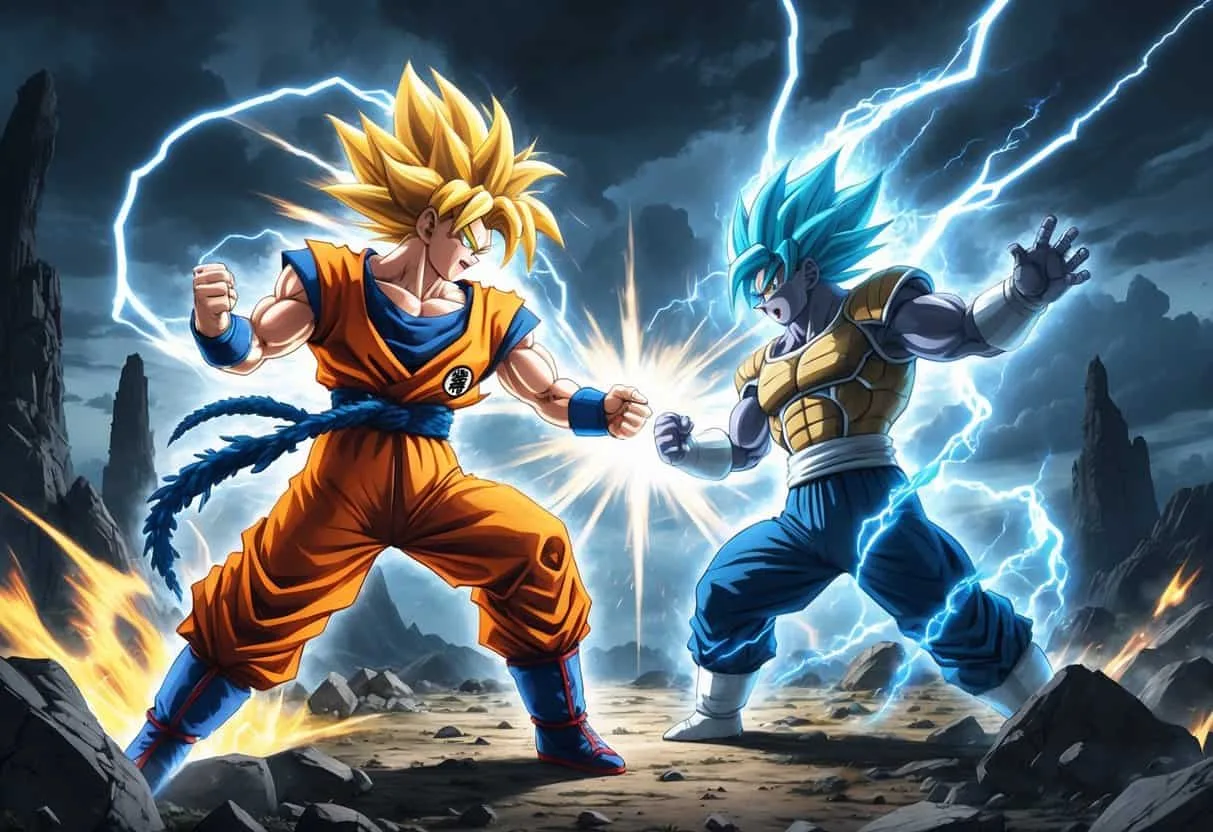
The original Super Saiyan transformation changed everything. Goku’s base power had already skyrocketed, but the fifty-fold multiplier of Super Saiyan blew past 150 million, making Frieza’s final form look quaint. The legend of the golden-haired warrior wasn’t just a power bump; it was a narrative pivot. For the first time, a single transformation redefined the ceiling so completely that older numbers became irrelevant. Vegeta, Trunks, and later Gohan all chased the same transformation, and while the specific multipliers varied, the message was clear: the story was now about emotional breakthroughs, not training math.
The arrival of Broly’s Legendary Super Saiyan form in the movies pushed the concept even further. His power seemed to grow limitlessly during combat, defying any static measurement. At this point, the series had effectively outgrown its own numbering system. The scouter that once drove plots was smashed to pieces, both literally and figuratively. Power became a vibe—an aura, a scream, a hair color change—and fans had to recalibrate how they understood strength.
How Power Levels Shaped Storytelling and Character Growth
Before the numbers broke, they shaped the very soul of Dragon Ball Z. The drive to reach higher battle powers dictated character arcs, training montages, and the stakes of every major confrontation. The system may have collapsed later, but its influence left permanent marks on how the Z Fighters grew and the kind of stories that could be told about them.
Training and Pushing Limits
Power levels turned training into a numbers race. Characters weren’t just getting stronger; they were chasing specific benchmarks that would let them survive the next threat. Goku’s time in the Hyperbolic Time Chamber was all about raw numeric gains, while Gohan’s potential unleashed by Guru on Namek was framed as a hidden power level finally erupting. King Kai’s training, the gravity rooms aboard Capsule Corp ships, and the endless sparring sessions all orbited one goal: hit the next threshold.
Even non-Saiyans had to adapt. Piccolo, Krillin, and Tien couldn’t ride Zenkai boosts, so they refined techniques—like the Tri-Beam and Destructo Disc—that could punch above their numeric weight class. Senzu beans allowed immediate recovery, enabling back-to-back training that compressed years of growth into days. This turbo-charged progression made for exhilarating television, but it also painted the heroes into a corner: when every arc demanded a tenfold increase, the numbers couldn’t possibly stay coherent.
Iconic Battles and Their Stakes
Numeric power levels set the emotional temperature of fights. The early Android saga, where Future Trunks warned of androids whose power dwarfed a Super Saiyan, leaned on a frightening power gap that didn’t need a scouter to feel real. Android 17 and 18’s dismissive attitude came from a place of absolute statistical superiority. Later, Perfect Cell’s calm confidence was backed by a battle power so immense that even Vegeta’s fresh Super Saiyan grade couldn’t scratch it. The numbers may not have been spoken aloud, but their shadow loomed over every exchange.
Majin Buu took the concept to its stranger extremes. Absorption, regeneration, and magical transformations made a mockery of any fixed figure. Yet the underlying logic remained: you had to be powerful enough to win. The fusion dance and Potara earrings were narrative shortcuts to multiply strength, effectively creating instant power-level spikes that bypassed training entirely. The stakes shifted from “can Goku surpass this number?” to “can the heroes patch together a fighter whose combined parts overcome this?”
It was storytelling by arithmetic, and while it produced unforgettable moments, it also signaled that the numeric system had been stretched past its breaking point.
Consequences for Earth and Other Worlds
When battle powers reached planet-busting levels, the consequences extended far beyond the fighters. King Kai’s planet, the afterlife, even the sacred realm of the Kais became fair game for battles that literally shook other dimensions. Earth’s cities were erased with casual ki blasts, only to be restored by the Dragon Balls. This cycle of destruction and wish-based resurrection drained death of its permanence. If everyone could be wished back, what did a power level’s lethal potential actually mean?
The Dragon Radar itself became a plot device that mitigated the apocalyptic fallout. Bulma’s tech allowed the team to gather the Dragon Balls and undo any tragedy caused by overwhelming numbers. This loop—escalation, obliteration, resurrection—created a strange equilibrium. Power levels had grown so large that the only way to maintain any dramatic tension was to threaten not just lives but the very existence of the Dragon Balls, or to drag battles into realms where resurrection rules didn’t apply. The system that began as a sports-like stat sheet had mutated into a cosmic liability.
Breaking the System: The Decline of Power Level Relevance
At some point, Dragon Ball Z stopped caring about the figures. The scouter readings that once dictated strategy became an afterthought. The franchise had to find new ways to define strength, and that pivot created a fascinating, often messy, legacy that still echoes in modern Dragon Ball.
The Limits and Inconsistencies of Numeric Power Scaling
The numbers were always a little loose, but by the Android and Buu arcs they had become a creative burden. How high could the numbers go without sounding silly? In the Frieza Saga, a power level of 150 million broke the conversation; by the time of Super Saiyan 3, any attempt at a concrete figure would have sounded like a joke. Power suppression, hidden techniques, and transformations with arbitrary multipliers made a mockery of consistency. A fighter’s stated battle power rarely matched what happened on screen, because the story had moved beyond the system that gave it birth.
Even official sources muddied the waters. The Daizenshuu battle power lists attempted to provide numbers for later forms but eventually stopped, acknowledging that the scale had become unrealistic. Scouters, once critical tools, began exploding when trying to read fighters like Super Saiyan Goku or Frieza. That imagery was as much a meta-commentary as a plot point: the technology itself couldn’t handle the story’s demands. The numeric framework was breaking, and the franchise had to let it go.
The Role of Narrative Devices Over Numbers
As hard numbers retreated, emotional and thematic beats rushed in to fill the void. Transformations became less about multipliers and more about character moments. Gohan’s Super Saiyan 2 awakening against Cell wasn’t about hitting a specific digit; it was about rage, grief, and the unleashing of long-suppressed potential. Vegeta’s sacrifice against Buu was powerful because of its emotional weight, not because it closed a numerical gap. Techniques like the Spirit Bomb or the Father-Son Kamehameha relied on collective energy and narrative buildup rather than a scouter’s beep.
Rivalries shifted from “my number is bigger” to philosophical clashes. The tension between Goku’s joyful pursuit of strength and Vegeta’s pride-driven obsession didn’t need a statistic. The drama came from who they were, not how many units of ki they possessed. Even newer characters like Bra (in spin-off media) are defined more by their lineage and personality than by any listed battle power. The Dragon Ball universe had evolved from a data-driven martial arts epic into a character-driven myth, and in many ways that saved it from the dead end of infinite stat inflation.
The Legacy of Power Levels in Dragon Ball Lore
Power levels might be a broken relic, but their ghost still haunts the franchise. The early obsession with numerical strength gave Dragon Ball Z a unique identity that separated it from its more whimsical predecessor. Characters like the Ginyu Force, who posed and preened over their scouter readings, became iconic because of the system. Vegeta’s entire ego was anchored in his status as an elite Saiya-jin whose birth power level set him above everyone else. Those early numbers, however inconsistent, baked a sense of measurable growth into the DNA of the series.
Modern Dragon Ball, including Super and the latest movies, has almost entirely abandoned concrete battle powers. The focus has shifted to “god ki,” angelic hierarchies, and transformations that defy mortal measurement. Yet the conversation never really stops. Fans still debate multipliers for Super Saiyan God and Ultra Instinct, proving that the urge to quantify strength never really left. The difference is that the storytelling no longer depends on those numbers.
They’ve become a background texture—a nostalgic nod to a time when a scouter’s crackle could tell you everything you needed to know about the fight ahead.
Ultimately, power levels broke the series’ balance at the exact moment they threatened to turn it into a spreadsheet. By collapsing under their own weight, they forced Dragon Ball Z to grow up, to value spirit over statistics, and to craft drama that didn’t require a calculator. The numbers may be gone, but the lessons they left behind continue to shape how the series treats strength, growth, and the unquantifiable power of a good story.