Table of Contents
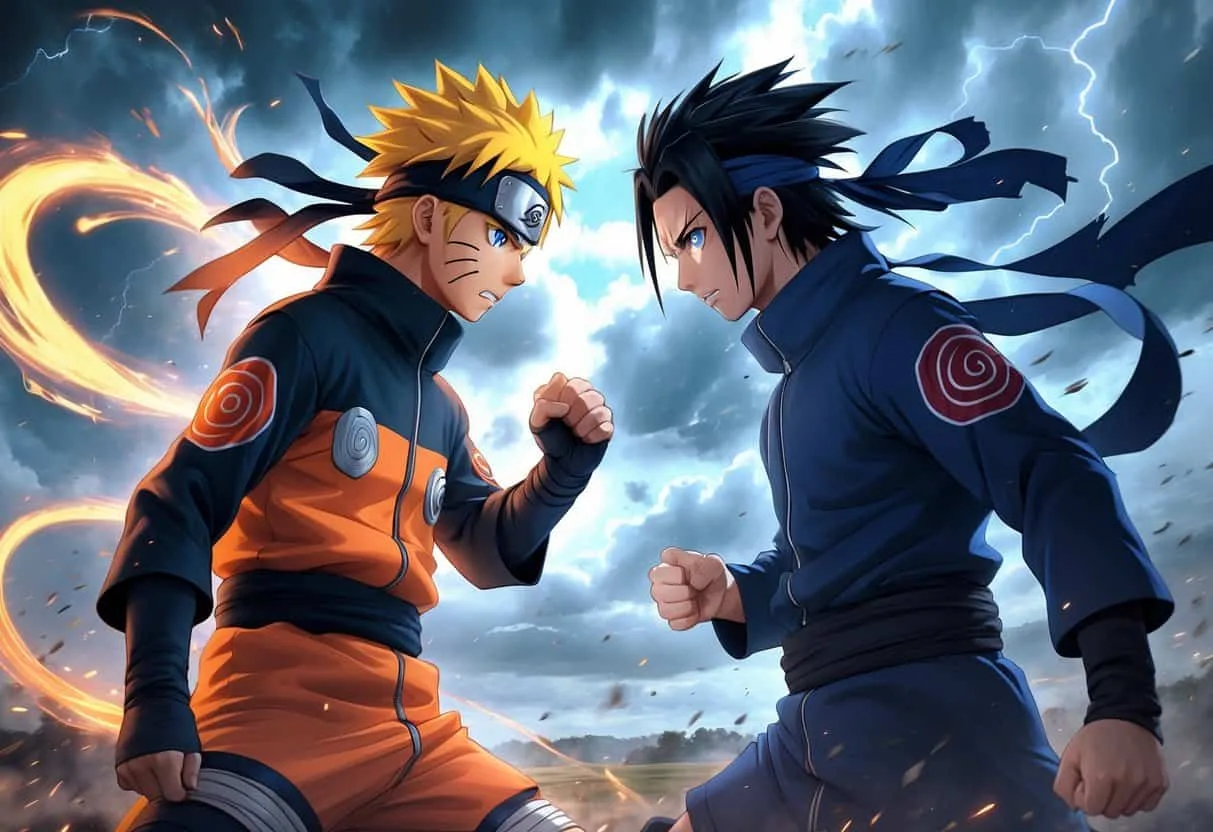
Every shinobi has a story, but none are as fiercely intertwined as Naruto Uzumaki and Sasuke Uchiha. From the moment they were placed on Team 7, their destinies locked together in a rivalry that would define an era. What began as childish one-upmanship exploded into clashes of ideology, power, and near-fatal resolve. Across the years, their battles became the emotional engine of the entire Hidden Leaf Village—and the ninja world at large.
When you watch them fight, you aren’t just seeing jutsu and tactical brilliance. You’re watching two souls try to understand each other through violence. Every punch, every desperate plea, and every near-death moment forces them to confront who they are—and who they could become. Their confrontations are never just about winning. They’re about survival, identity, and a bond so stubborn it refuses to break.
To truly grasp the weight of Naruto and Sasuke’s relationship, you have to examine each fight in order. Doing so reveals a roadmap of growth, heartbreak, and the slow, painful forging of an unbreakable connection. It’s a rivalry that doesn’t just pit strength against strength—it pits loneliness against loneliness, hope against despair, and one dream of the future against another.
Key Takeaways
- Each fight tracks a critical shift in Naruto and Sasuke’s emotional and physical growth.
- The rivalry acts as both destructive force and creative catalyst for Team 7 and Konoha.
- Understanding their battles is essential to understanding the heart of the entire series.
Naruto vs Sasuke: A Rivalry Defined by Growth
The dynamic between Naruto and Sasuke isn’t born overnight—it’s layered through shared trauma, mutual irritation, and a grudging admiration that neither wants to admit. From academy days to world-shaking showdowns, their relationship evolves in lockstep with their abilities. Each fight peels back another layer of their psyche, exposing raw vulnerabilities that no other opponent could reach.
Origins of the Rivalry
The seeds were planted long before they understood what a rival truly was. Naruto, the village pariah desperate for acknowledgment, saw in Sasuke everything he lacked—talent, respect, and a cool composure that drew eyes without effort. Sasuke, haunted by the massacre of his clan, viewed Naruto as an irritating loudmouth who somehow kept improving despite having no natural gifts. That friction alone was combustible.
Their first real testing ground came during the bell test under Kakashi. While the exercise was meant to teach teamwork, it instead ignited a primal competition. Naruto’s shadow clones couldn’t match Sasuke’s refined taijutsu, but his unpredictability rattled the Uchiha prodigy. In that moment, a silent race began—who could become Hokage first, who could prove they were the strongest. It was childish, yes, but it lit a fire that would never stop burning.
The early missions as Team 7 only deepened the crackle. On the Land of Waves mission, Sasuke’s willingness to die for Naruto and Naruto’s explosive rage at seeing him seemingly killed revealed an undercurrent of care neither would verbalize. That paradox—competing fiercely yet needing the other alive—became the cornerstone of their entire relationship.
Friendship and Competition
For all the outward clashes, a real friendship was tangled up inside the rivalry. Naruto saw Sasuke as a brother he never had, someone who understood loneliness without needing to explain it. Sasuke, though he’d never admit it, recognized a kindred spirit in Naruto’s isolation. That silent understanding made the competition feel safer, like a language only they spoke.
But competition quickly turned toxic. As Sasuke grew stronger under Orochimaru’s influence and the weight of Itachi’s memory, he began to see bonds as weaknesses. Naruto, in contrast, clung to bonds as his greatest source of power. This ideological gulf turned every later confrontation into something far heavier than a brawl—it became a fight over the very definition of strength.
Even in the quieter moments, the tension hummed. Kakashi often found himself mediating two kids who expressed care through fists. Sakura and others could only watch as Naruto’s relentless hope smashed against Sasuke’s cold resolve. The rivalry didn’t just shape them; it shaped everyone on the periphery.
Major Turning Points
Certain clashes irrevocably altered the trajectory of their lives. Understanding these pivot points is key to ranking what came after.
| Event | Impact on Rivalry |
|---|---|
| Chunin Exam Forest of Death | Forced teamwork under pressure; Sasuke’s curse mark awakens true darkness. |
| Sasuke’s defection (Valley Part I) | The point of no return—brothers become enemies with opposite paths. |
| Itachi’s truth and Sasuke’s revolution | Sasuke’s motivation shifts from vengeance to remaking the world, raising stakes to a global scale. |
| Final Valley Part II | Resolution—not through victory, but through mutual exhaustion and understanding. |
Every Naruto vs Sasuke Fight Ranked
Ranking their fights isn’t just about choreography or power scaling. It’s about emotional weight, character fallout, and how each battle redefined their bond. Here they are, ordered from the raw but foundational to the cataclysmic clash that ended an era.
4. First Clash at the Academy
Before they were rivals, they were classmates sizing each other up. This initial scuffle wasn’t a formal duel—more like a chaotic mix of playground pride and burgeoning talent. Naruto, clumsy with his shadow clones and fueled by years of rejection, threw himself at Sasuke without a plan. Sasuke, already a prodigy, deflected with minimal effort, his expression a mix of annoyance and cold superiority.
What made it matter: The fight established the dynamic that would haunt years to come. Naruto as the underdog, desperate to prove himself. Sasuke as the unattainable standard. Even then, you could sense a strange fascination beneath the surface—Sasuke, for all his talent, noticed Naruto’s refusal to stay down. That spark would later become the glue that held their broken friendship together.
The academy clash had no life-or-death stakes, but it set the emotional countdown. In a way, every future battle was just an echo of this first struggle: the loud, ignored boy trying to reach the aloof genius who couldn’t see past his own pain.
3. Battle on the Hospital Rooftop
After the Chunin Exams and the Konoha Crush, Sasuke was already slipping away. Frustrated by his perceived weakness against Itachi and jealous of Naruto’s explosive growth, he challenged his teammate to a fight on the hospital rooftop. What followed was less a spar and more a dangerous escalation of suppressed rage.
Naruto’s shadow clones had evolved significantly; his control over the Nine-Tails’ chakra gave him a raw power that startled even Sasuke. The Uchiha, meanwhile, unveiled his perfected Chidori, a lightning blade capable of piercing nearly anything. When their two signature techniques collided—Rasengan and Chidori—the damage nearly demolished the water tower behind them.
The real impact: This fight was a mirror reflecting their divergent paths. Naruto wanted to stop Sasuke from leaving, while Sasuke needed to sever all ties. The difference in damage on the water tower spoke volumes: Naruto’s Rasengan had scattered its force outward, while Sasuke’s Chidori punched a clean, deadly hole. It was a symbolic preview of their approaches—Naruto’s expansive, hopeful reach versus Sasuke’s focused, destructive intent. The moment pushed Sasuke over the edge, cementing his decision to abandon Konoha.
2. The Valley of the End: Part One
If the hospital rooftop was a warning, the first battle at the Valley of the End was the detonation. Sasuke, determined to gain power from Orochimaru, walked away from everything. Naruto, armed with nothing but desperation and a promise to Sakura, chased him down. The stage: two colossal statues of Madara Uchiha and Hashirama Senju, frozen in eternal conflict—just like them.
Naruto unleashed the Nine-Tails’ chakra in a way he never had before, his features turning feral as a red cloak of bubbling energy enveloped him. Sasuke advanced his Sharingan to its third tomoe, matching Naruto’s speed and ferocity with cold precision. The fight escalated beyond technique—it became a raw, bloody, emotional slugfest. At its climax, Sasuke’s Chidori met Naruto’s Rasengan in a blaze of black and blue, with Sasuke choosing not to kill his friend in the final moment.
This battle is the emotional core of Part I. It’s where the rivalry shattered any pretense of a simple competition. Naruto lost, not just the fight but his best friend, and the failure haunted him for years. The rain falling on his unconscious face as Sasuke walked away still hits hard. It was the fight that taught Naruto that saving someone can’t be done with fists alone—you need to understand their pain.
1. Final Showdown at the Valley of the End
After the Fourth Great Ninja War, with Kaguya defeated and the Infinite Tsukuyomi undone, Sasuke’s radical plan to revolutionize the shinobi world brought them back to the same sacred ground. This time, both were at the absolute peak of their power. Naruto, wielding Six Paths Sage Mode and the cooperation of all nine tailed beasts, faced Sasuke’s Rinnegan-enhanced Susanoo and mastery over the tailed beasts’ chakra. The scale was apocalyptic.
What makes this the definitive fight isn’t the scale—it’s the resolution. It’s two worldviews clashing in a space where neither can hold back. Sasuke, having learned the truth of Itachi’s sacrifice, concluded that the current system was rotten and that he must become a common enemy to unite the world. Naruto, still stubbornly believing in bonds and forgiveness, refused to let his friend walk that lonely path again.
The battle ended in mutual destruction: both lost an arm, lying bleeding in the valley as the sun rose. It was a draw in the truest sense—a stalemate that forced them finally to talk. Sasuke, for the first time, admitted defeat not in strength but in ideology, acknowledging Naruto’s way. This fight didn’t just settle a rivalry; it closed a cycle that began with two lonely kids sitting on a dock, not knowing how to speak. The remade valley became a symbol of reconciliation, not conflict.
Analyzing the Impact and Meaning of Each Fight
Each battle between Naruto and Sasuke is a chapter in a larger narrative about human connection. Their fights map directly onto their psychological states, revealing truths that dialogue could never capture.
Personal Growth and Strength
Tracking their growth through these fights is like watching two meteors hurtle toward each other. Naruto begins as a talentless goofball whose only weapon is stubbornness; by the final valley, he embodies the spirit of a sage, capable of sharing chakra and hope across an army. His fighting style evolves from clumsy brawls to intricate strategy wrapped in overwhelming force—a direct result of chasing after Sasuke.
Sasuke’s progression is darker but no less impressive. He starts as a gifted but emotionally stunted child. Through the curse mark, the Mangekyo Sharingan, and eventually the Rinnegan, his power becomes terrifyingly absolute. Yet each upgrade is stained with trauma. The fights serve as pressure tests, forcing both to refine their techniques under maximum stress: Naruto develops the Wind Style: Rasenshuriken to match Sasuke; Sasuke perfects Kirin and later inherits Itachi’s visual prowess to surpass Naruto’s tailed-beast boosts.
More important is the emotional growth. Naruto learns that true strength means bearing hatred and still choosing forgiveness. Sasuke learns that isolation is a prison, not a power source. Their final battle, as much as it tears them apart, is the crucible that finally tempers these realizations into something unbreakable.
Shifting Motivations and Ideals
At the start, Sasuke’s only motivation was killing Itachi—a path of pure vengeance. Naruto’s goal was simple: become Hokage and earn acknowledgment. But as the fights intensify, their goals transform. Sasuke’s revenge evolves into a desire to destroy the very system that created his brother’s tragedy, then into a twisted plan to become a dictator of peace. Naruto’s dream expands from personal recognition to protecting everyone he loves, no matter the cost.
Their battles become debates spoken in fire and lightning. When Sasuke argues that the shinobi system must be burned down, he’s using Amaterasu as punctuation. When Naruto counters that connection can overcome hatred, he’s backing it up with the strength of a thousand shadow clones. These aren’t simple clashes of the strong; they’re philosophical warzones where the loser might surrender not just their body but their entire worldview.
Without these fights, neither would have been forced to truly examine what they believed. The violence, paradoxically, enabled honesty. Only by pushing each other to the brink could they finally hear what the other had been trying to say for years.
Consequences for Team 7 and Konoha
The personal war between Naruto and Sasuke had massive repercussions for their village and the team they left behind. Kakashi, who saw himself in both boys, carried the weight of his failure to guide them away from this collision. Sakura’s entire journey—her training under Tsunade, her desperate pleas, her resolve to kill the man she loved—was forged in the heat of their rivalry.
Konoha as an institution was repeatedly shaken. Sasuke’s defection led to the failed retrieval mission that nearly killed several genin, pushing Tsunade to rethink shinobi deployment. The village’s eventual decision to label Sasuke a rogue ninja and authorize his elimination was a direct result of the unresolved Valley fight. Yet paradoxically, that label strengthened Naruto’s defiance. He refused to accept a world where brothers fought to the death, and that defiance eventually swayed the entire Allied Shinobi Forces.
The ripples reached far beyond Team 7. The Five Kage Summit, the formation of the Shinobi Alliance, and the final confrontation with Madara and Kaguya—all were influenced by the magnetism of this rivalry. When the dust settled, the village that once feared the Nine-Tails’ jinchuriki and the last Uchiha now saw them as its greatest heroes. The fights didn’t just change them; they changed history.
The Broader Cast: Influences and Outcomes
Naruto and Sasuke didn’t walk this path alone. A constellation of allies, mentors, and antagonists pushed, pulled, and sometimes nearly severed the thread between them.
Key Characters Who Shaped the Rivalry
Itachi Uchiha stands as the invisible architect. His love for Sasuke, expressed through genjutsu and a final forehead poke, drove his little brother into darkness and eventually back into the light. The truth of Itachi’s sacrifice—revealed by Obito—shattered Sasuke’s entire framework and redirected his rage toward the village itself. Without that reveal, the final valley fight would never have happened on such a global scale.
Orochimaru’s influence was equally corrosive. By offering Sasuke power and exploiting his hatred, the Sannin nearly severed the bond permanently. His cursed seal acted as a constant temptation toward darkness. Counterbalancing him were mentors like Jiraiya, who taught Naruto that true strength came from protecting others, and Kakashi, who tried desperately to show Sasuke another way through teamwork and chakra control.
Friends and comrades played pivotal roles. Sakura’s love and Hinata’s quiet support kept Naruto anchored. Gaara, once a monster, became a living example that even the most isolated soul could find redemption. The Akatsuki—especially Pain and Obito—presented challenges that forced Naruto and Sasuke to evolve or die. Even Tobirama and Hashirama Senju’s history echoed through the valley, reminding everyone that the cycle of Uchiha and Senju would repeat unless someone broke it.
Lasting Impacts on the Ninja World
The rivalry’s conclusion reshaped the shinobi order. After the final battle, Sasuke’s acceptance of Naruto’s path meant the end of the curse of hatred. The Uchiha clan’s tragic cycle of love and loss finally found peace, embodied by Sasuke’s decision to wander the world as a silent protector rather than a revolutionary tyrant. This act alone prevented a new era of conflict.
The Allied Shinobi Forces, forged in the heat of war, became a symbol of the unity Naruto championed. Gaara’s leadership, Tsunade’s reluctant but crucial decisions, and the many shinobi who once fought against each other now standing together—all of it traces back to Naruto’s unwavering belief that bonds could bridge even the deepest chasms. Sasuke’s later missions with Karin and Fu helped further stabilize the hidden villages, proving that cooperation wasn’t just an ideal but a practical path forward.
In the end, the rivalry gave the ninja world a new blueprint. Where once the strongest ruled through fear, Naruto and Sasuke’s story showed that two opposing forces could collide, shatter, and reassemble into something stronger. The Hidden Leaf became a place where Uzumaki and Uchiha stood as brothers, not enemies. That legacy continues in the next generation, with Boruto and Sarada carrying a friendship that was nearly impossible to imagine decades earlier. The valley where they bled now stands as a monument to the truth that growth often hurts—but it’s the only way to heal.