Table of Contents
Why Anime Rankings Differ from Country to Country
The most watched anime in one nation might barely register in another, and that tells a fascinating story about cultural taste, distribution history, and community-building. A series like Dragon Ball Z holds near-mythical status across Latin America, while Attack on Titan dominates streaming charts in the United States and Europe. In Japan, the birthplace of the medium, seasonal hits rise and fall rapidly, but legacy franchises like One Piece and Detective Conan remain pillars of the television landscape. Understanding these differences requires looking beyond simple view counts—it means exploring broadcast schedules, local dubbing traditions, social media trends, and the deep-rooted ways that anime has woven itself into regional pop culture.
Data from global demand measurement platforms such as Parrot Analytics, alongside viewership reports from streaming giants like Crunchyroll and Netflix, offers a clearer picture of which titles are truly resonating worldwide. For example, a 2023 report by Statista highlighted that the Asia-Pacific region still accounts for the largest share of anime consumption, but Latin America and Europe are growing at staggering rates. This article breaks down the most watched anime by country, examining the cultural forces behind those numbers and the distinct flavors that local audiences bring to the global anime conversation.
Regional Breakdown: Where Each Genre Finds Its Home

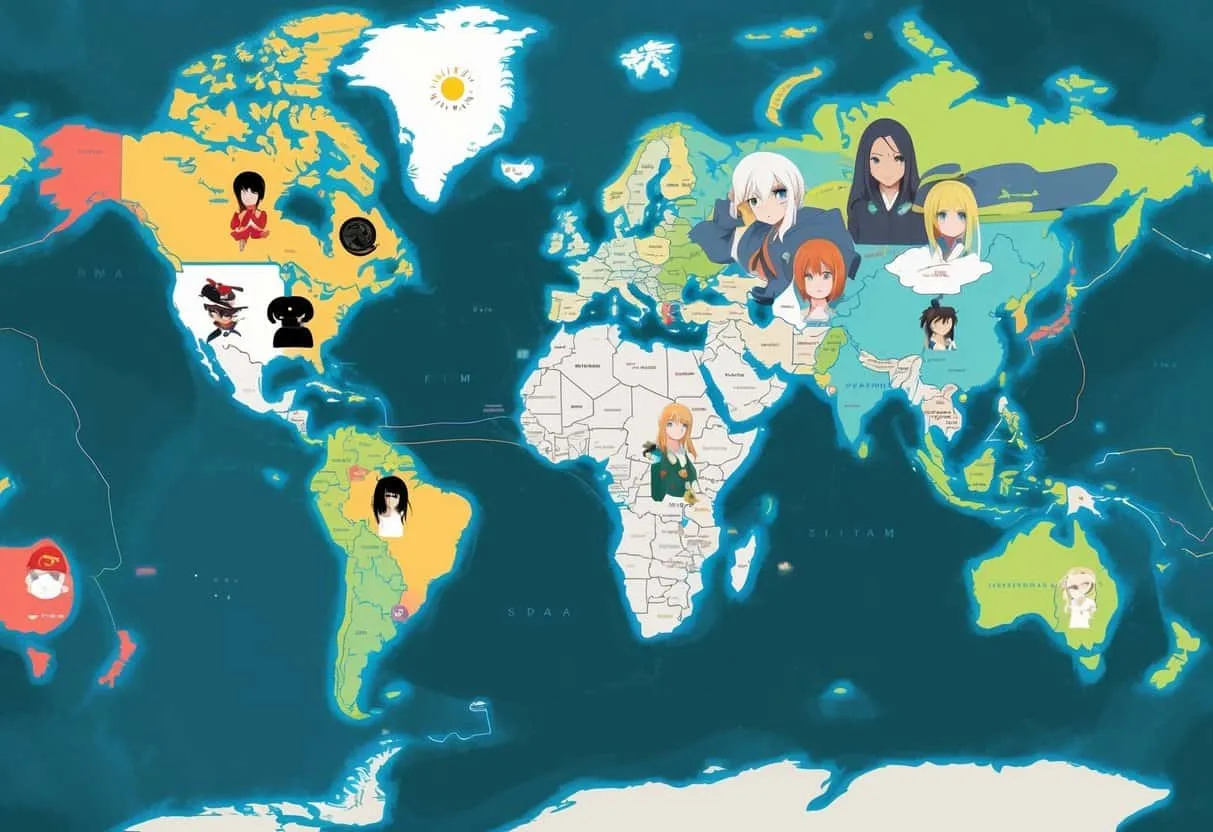
Mapping the most watched anime by country reveals clusters of genre preference. Action-driven shonen epics tend to dominate in the Americas and Europe, while slice-of-life and romance have surprisingly strong footholds in parts of Asia. Here is a closer look at how regional habits carve out distinct top anime lists.
Japan: The Evergreen Powerhouses
As the home market, Japan’s relationship with anime is unique. Weekly television ratings still matter, but so do late-night broadcasts and streaming exclusives. Long-running series like One Piece, Detective Conan, and Sazae-san occupy top spots in household viewership, while newer juggernauts such as Demon Slayer: Kimetsu no Yaiba and Jujutsu Kaisen smash box-office records and streaming metrics. In 2023, Oshi no Ko broke records for opening week streaming, demonstrating that domestic audiences leap onto fresh properties with intense passion.
Japanese rankings are heavily influenced by the seasonal model. Every three months, dozens of new series debut, and fan polls from sites like Anime Trending capture which shows become the talk of the moment. However, nostalgia-driven franchises like Pokémon and Gundam never really fade. The Mobile Suit Gundam franchise, in particular, remains a cultural institution, with the latest iteration The Witch from Mercury drawing younger viewers while honoring the giant robot tradition. Meanwhile, Studio Ghibli films hold a permanent place in the national psyche, with annual broadcasts of Spirited Away or My Neighbor Totoro pulling in millions of viewers.
North America: Streaming Shapes the Conversation
In the United States and Canada, the most watched anime lists are almost entirely dictated by streaming platforms. Crunchyroll, Hulu, and Netflix publish regular popularity charts, and titles like Attack on Titan, Demon Slayer, and My Hero Academia routinely top them. According to data from Crunchyroll’s year-end wrap-ups, the region shows a strong preference for high-stakes action and world-building. Chainsaw Man and Spy x Family both captured massive audiences, blending bloody spectacle with slapstick comedy in ways that resonate deeply with North American fans.
Dubbing quality and accessibility play outsized roles here. Shows that get a simultaneous English dub and a strong marketing push tend to climb faster. The enduring popularity of Naruto and Dragon Ball Z in reruns and VOD libraries proves that early syndication on networks like Toonami permanently embedded certain series into the cultural fabric. Even today, conventions like Anime Expo in Los Angeles draw over 100,000 attendees, where cosplay and merchandise for legacy series stand shoulder-to-shoulder with the latest hits.
Europe: France Leads, Others Follow
Europe’s anime market is not monolithic, but France stands out as the second-largest consumer of manga and anime in the world after Japan. French broadcasters were early adopters: Dragon Ball Z, City Hunter, and Captain Tsubasa have been beloved since the 1980s and 1990s. Today, France’s most watched anime include One Piece, Naruto Shippuden, and Attack on Titan, with streaming service ADN (Anime Digital Network) releasing weekly popularity rankings that often align with Japanese seasonal hits. The strong manga publishing industry, led by houses like Kana and Glénat, creates a symbiotic relationship that fuels anime viewership.
The United Kingdom and Germany also show rising demand. In Germany, Pokémon and Digimon maintain a generational connection, while Demon Slayer and Tokyo Revengers attract younger demographics. Across the continent, the most watched anime lists reflect an interesting blend: nostalgic classics get regular rebroadcasts, but new simulcasts are embraced with equal fervor. Streaming has greatly expanded access in countries like Spain and Italy, where dedicated anime platforms have seen subscriber numbers soar.
Latin America: The Unshakeable Dragon Ball Kingdom
No discussion of global anime favorites is complete without examining Latin America’s deep-rooted loyalty to Dragon Ball. Almost no other region matches the intensity of fandom for Goku and company. In Mexico, Brazil, Argentina, and beyond, Dragon Ball Z is more than a show—it’s a cultural event. Public screenings of landmark episodes, such as the Tournament of Power finale, have drawn massive crowds in city plazas. The most watched anime lists in these countries consistently place Dragon Ball Super and Dragon Ball Z at the pinnacle, years after their original runs.
However, the landscape is diversifying. Naruto and One Piece enjoy tremendous followings, and Demon Slayer broke records in Brazilian theaters. Censorship-free broadcasts in the 1990s, often on open television channels, built a multi-generational fanbase that now streams new series on Crunchyroll and Netflix. In Brazil, the anime community is so robust that fan-dubbing projects and local conventions rival those of Japan and the United States.
Asia and Oceania: Local Tastes and Regional Collaborations
Beyond Japan, stark differences emerge across Asia. In South Korea, webtoons often influence anime consumption, and series like Tower of God and Solo Leveling generate massive buzz. Chinese audiences, navigating censorship and platform-specific offerings, gravitate toward titles like Detective Conan and Doraemon, as well as domestically produced donghua that rival Japanese animation in quality. Southeast Asian countries, including the Philippines and Indonesia, show strong attachment to Naruto, Demon Slayer, and Voltes V—a classic super robot series that holds legendary status in the Philippines.
Australia and New Zealand reflect viewing habits similar to North America, with Attack on Titan, Jujutsu Kaisen, and My Hero Academia leading pack. However, anime film screenings often outperform per capita, with Demon Slayer: Mugen Train and Jujutsu Kaisen 0 breaking records. The relative ease of importing merchandise and the active convention scene in cities like Melbourne and Auckland fuel year-round engagement.
Cultural Significance: How Anime Reshapes Identity and Soft Power
The most watched anime by country does more than entertain; it shapes national identities and influences global perceptions of Japan. Viewers often internalize values like perseverance (ganbaru), friendship, and collective good through their favorite series. In Japan, anime serves as a mirror of societal anxieties and aspirations, with shows like Neon Genesis Evangelion delving into trauma and isolation, and Your Name exploring longing and connection in modern Tokyo.
Outside Japan, anime becomes a gateway to deeper cultural appreciation. French fans, for instance, have created thriving subcultures that mix Japanese aesthetics with local art and fashion. The Japanese government actively recognizes this influence as a form of soft power. According to a BBC Culture article, anime has become one of Japan’s most potent exports, driving tourism, language study, and cross-cultural exchange. Millions of travelers visit iconic locations featured in shows, from the real-life settings of Lucky Star in Saitama to the rural landscapes of Your Name’s Gifu Prefecture.
Global otaku communities, built around a shared love for anime, transcend borders. Online forums, Discord servers, and fan art platforms create spaces where viewers from different countries bond over weekly episode discussions or fan theories. These communities often adopt Japanese honorifics and customs, demonstrating how entertainment can spark genuine cultural learning. While stereotypes occasionally emerge—both in the way anime depicts foreign cultures and in how fans are perceived—the overall effect is a more connected, globally literate generation.
Popular Genres, Themes, and Character Types That Dominate Worldwide
Certain genres consistently top the most watched anime lists across continents. Shonen (action-oriented series aimed at young males) is the undisputed champion, with Demon Slayer, Jujutsu Kaisen, and My Hero Academia packing the top tiers of streaming services worldwide. However, slice-of-life and romance have quietly grown into major categories, particularly in regions where female viewership is on the rise. Fruits Basket, Horimiya, and Komi Can’t Communicate command devoted international followings.
Science fiction, once the dominant genre in the 1980s and 1990s with titles like Akira and Ghost in the Shell, experienced a relative dip, but series like Cyberpunk: Edgerunners on Netflix revived global interest in gritty, futuristic anime. Isekai—where characters are transported to other worlds—has become a massive subgenre, with Mushoku Tensei and Re:Zero regularly appearing in top-watched rankings across Europe and the Americas.
Female representation has evolved substantially. While many classic shonen series relegated women to supporting roles, recent hits like Jujutsu Kaisen and Chainsaw Man feature nuanced female fighters, and series such as Violet Evergarden and Bocchi the Rock! place women’s emotional journeys at the center. The variety of female-led shows across genres—from action to drama to comedy—gives audiences a broad spectrum of characters to connect with.
Unique storytelling techniques keep the medium fresh. Nonlinear narratives in Baccano! and the genre-busting mix of music and samurai action in Samurai Champloo illustrate anime’s willingness to experiment. Distinctive tropes like giant robot transformations (Gundam), dramatic mid-battle power-ups, and exaggerated facial expressions are celebrated internationally. For long-time fans, these elements feel like shared language that reinforces community identity, and for newcomers, they offer an instantly recognizable visual vocabulary.
The Merchandise Economy and Cross-Media Dominance
Viewership alone doesn’t capture anime’s full impact. The industry thrives on merchandise: figurines, apparel, posters, and collectibles that allow fans to physically own a piece of their favorite series. Companies like Good Smile Company and Bandai release scale figures that sell out within hours, with limited-edition pieces becoming sought-after investments. The most watched anime by country often correlates directly with merchandise sales; Demon Slayer’s Nezuko figures and Jujutsu Kaisen’s Gojo Satoru statues fly off shelves from Akihabara to New York’s Kinokuniya.
Anime’s influence on video games is impossible to ignore. Franchises like Genshin Impact, a Chinese open-world RPG, draw heavily from anime aesthetics, while Japanese titles such as Persona 5 and Fire Emblem blur the line between interactive storytelling and animated series. The rhythm game BanG Dream! and the multimedia juggernaut Love Live! show how anime can spawn music, concerts, and mobile games that keep fans engaged for years. Even Western game developers adopt cel-shaded visual styles and character-driven narratives inspired by anime, demonstrating the medium’s far-reaching creative footprint.
American and European animation has also absorbed anime’s influence. Shows like Avatar: The Last Airbender and Castlevania wear their anime inspirations openly, employing dramatic framing, serialized storytelling, and expressive character acting rooted in Japanese techniques. This cross-pollination enriches global animation and introduces anime tropes to audiences who might never have watched a subtitled show. The result is a dynamic feedback loop: the most watched anime inform Western production, and those Western shows, in turn, bring new viewers into the anime ecosystem.
Tracking the Shifting Landscape of Global Anime Favorites
The most watched anime by country is never a static picture. Seasonal hits, viral moments on TikTok, and surprise Netflix global releases can reshuffle the rankings overnight. A series like Oshi no Ko can debut and immediately dominate conversations from Tokyo to São Paulo, while the ongoing march of One Piece ensures that a 25-year-old pirate saga stays relevant for yet another generation. Anime News Network and other industry trackers provide weekly data on streaming performance and fan engagement, giving a real-time pulse on which titles are capturing the world’s imagination.
Localization efforts, from quality subtitles to culturally adapted dubs, play a huge role in determining what becomes “most watched.” In regions where a series received a dedicated dub cast and prime-time slot years ago, nostalgia keeps those titles at the top. In newer markets, the algorithm-driven recommendations on streaming platforms are increasingly shaping taste. As the global anime audience continues to swell—estimates put it at well over 300 million people—the map of top favorites will only get richer and more nuanced. The next big thing might be a sci-fi romance from a small studio or a crossover event that unites fans from six continents.
What remains constant is anime’s power to transcend borders and build communities out of shared stories and unforgettable characters.