Table of Contents
Supernatural anime has long captivated audiences with its blend of the extraordinary and the everyday, but beneath the flashy battles and eerie mysteries lies a rich undercurrent of psychological exploration. Many series use ghosts, demons, alternate dimensions, and psychic phenomena not merely as plot devices, but as powerful symbols for the hidden struggles of the human mind. From depression and anxiety to post-traumatic stress and dissociative states, mental illness is rarely addressed head-on in these stories; instead, it is woven into the fabric of the narrative through metaphor, allegory, and atmospheric storytelling.
This indirect approach offers viewers a unique lens through which to understand complex emotional states. By externalizing internal chaos into supernatural threats or surreal landscapes, anime creators can explore the nuances of mental health without the clinical detachment of a documentary. The result is a deeply empathetic and resonant experience that connects fantasy with real human vulnerability. For audiences, recognizing these symbolic languages can transform simple entertainment into a profound reflection on suffering, resilience, and self-discovery.
Key Takeaways
- Supernatural anime draws on visual and narrative symbolism to represent mental health conditions such as depression, anxiety, and identity fragmentation.
- Characters’ internal battles are often personified as demons, ghosts, or distorted realities, offering insight into trauma and emotional distress.
- The blending of personal pain with larger social and cultural themes makes these stories a powerful medium for discussing mental illness in a relatable yet imaginative way.
The Language of Shadows: Symbolic Depictions of Mental Illness
Symbolism is the cornerstone of how supernatural anime translates intangible psychological states into something visible and visceral. Rather than relying on explicit dialogue about mental health, these shows construct a visual and narrative grammar that allows viewers to feel the weight of a character’s inner world.
Shadows, Mirrors, and Broken Reflections
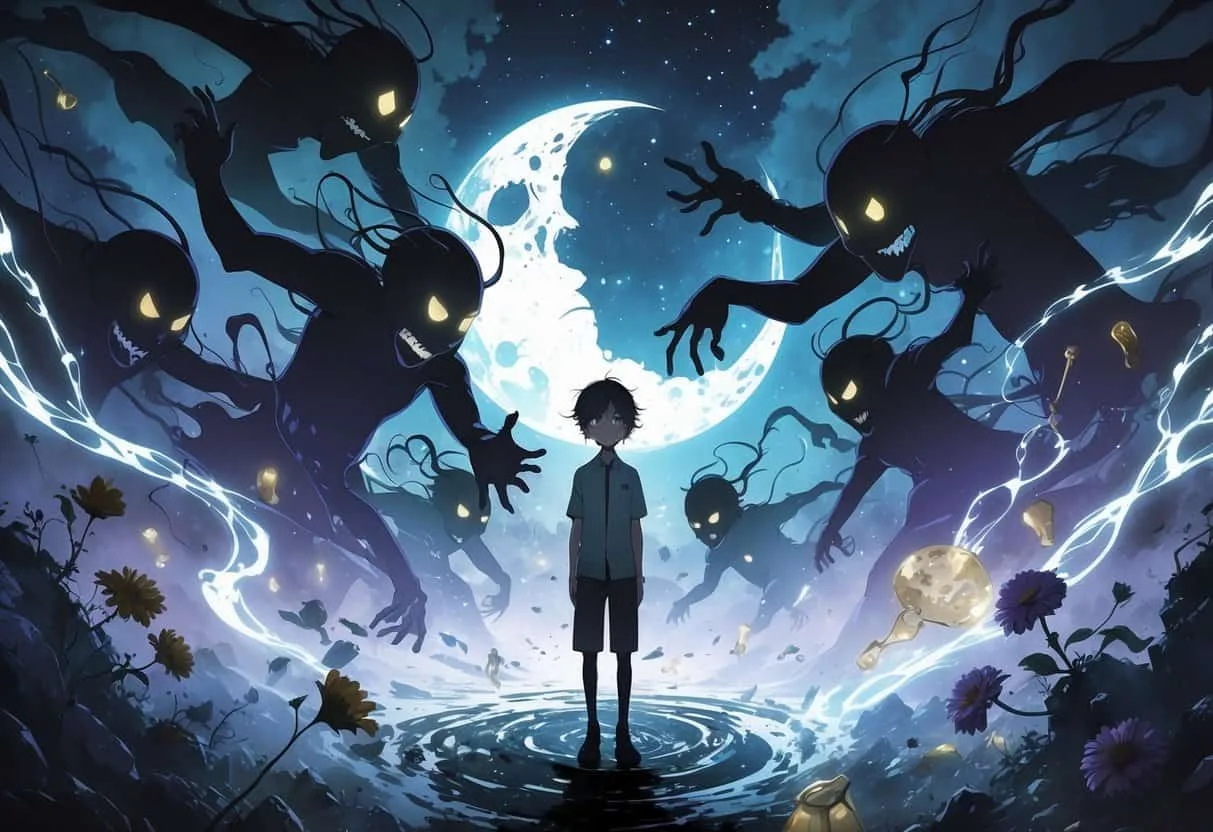
Darkness in anime often does more than set a spooky mood; it can represent the encroaching fog of depression or the pervasive anxiety that follows a character. Shadows that stretch unnaturally, consume spaces, or move independently of their casters appear repeatedly in series like Serial Experiments Lain and Mononoke. They embody the parts of the self that are repressed or denied, a visual echo of the Jungian Shadow. Similarly, mirrors and broken reflections are powerful motifs. A cracked mirror might symbolize a fractured identity or the inability to reconcile one’s public face with private turmoil.
In Revolutionary Girl Utena, the duel arena serves as a surreal stage where inner conflicts are externalized, and the recurring imagery of roses and glass coffins hints at the psychological entrapment of its characters.
Other symbols recur across the genre: chains that bind, cages that imprison, and endless corridors that loop back on themselves, mirroring the sensation of being trapped in obsessive thought patterns. Color palettes shift to desaturated blues and grays when a character’s mental state deteriorates, while bursts of violent reds signal uncontrolled rage or panic. These visual cues bypass intellectual analysis and communicate directly with the viewer’s own emotional memory, making the experience of mental illness tangible.
Demons as Internal Tormentors
One of the most direct metaphors in supernatural anime is the literal demon. While Western media sometimes frames demons as external evil forces, anime often presents them as manifestations of inner pain. In Demon Slayer, the tragic backstories of many demons reveal that they were once humans whose overwhelming grief, loneliness, or anger transformed them into monsters. This recontextualizes the demon as a walking embodiment of untreated mental illness—a person consumed by their own suffering who now hurts others as a result. The demon-slaying corps acts not merely as warriors but as compassionate interveners who seek to understand and release the human pain trapped within the monstrous form.
Possession, too, serves as a powerful metaphor for losing control of one’s mind. When a character is taken over by a malevolent spirit, it mirrors the dissociative experience of feeling alienated from one’s own thoughts or actions—common in conditions like dissociative identity disorder or severe anxiety. The fight to expel the possessor becomes a battle for self-ownership, a theme that resonates deeply with anyone who has struggled against intrusive thoughts or compulsive behaviors.
Gothic Atmospheres and the Uncanny
Gothic and horror traditions lend supernatural anime a vocabulary of dread that perfectly encapsulates the experience of mental illness. Crumbling mansions, fog-shrouded streets, and doll-like figures populate series such as Ghost Hunt and Another, where the environment itself seems sick with an unspecified malaise. The uncanny—familiar things made strange—mirrors the way mental illness can distort one’s perception of reality. A school that seems ordinary during the day becomes a labyrinth of horrors at night, reflecting how a person with depression might see the world as fundamentally changed, even if nothing has shifted externally.
Sound design amplifies these gothic elements: echoes, distant laughter, and silence that stretches too long create an aural landscape of unease. These techniques externalize the isolating nature of many mental health conditions, where the sufferer hears things others do not, or perceives a constant hum of anxiety that the outside world cannot detect. Through such atmospheric storytelling, anime invites viewers to inhabit the character’s altered state rather than observe it from a distance.
Fantasy Worlds and Psychological Landscapes
Beyond horror, fantasy and science fiction settings offer allegorical spaces where mental illness can be explored through quests and magical rules. In Mob Psycho 100, psychic powers are directly tied to emotional stability: the protagonist’s explosive abilities only manifest when his repressed feelings reach a certain threshold, a brilliant metaphor for how bottling up emotions can lead to unpredictable and destructive outbursts. The show frames emotional growth as the true source of strength, not the spectacle of psychic combat.
Similarly, Madoka Magica uses the magical girl genre to examine despair, hope, and the cycle of trauma. The witches’ labyrinths are surreal nightmares that visually represent the mental collapse of the magical girls who become them, filled with distorted personal symbols and repetitious patterns that mimic rumination and depressive thinking. These fantastical landscapes make the invisible visible, allowing the audience to connect with the characters’ suffering on a visceral level. For a broader perspective on how media reflects mental health, the National Alliance on Mental Illness highlights how thoughtful representation can reduce stigma.
Faces of Inner Turmoil: Characterization and Subtext
While symbolism sets the stage, characterization breathes life into the subtext of mental illness. Protagonists and supporting characters in supernatural anime often carry histories of trauma that inform their every action, making their journeys feel urgent and authentic.
Trauma and the Protagonist’s Burden
Many central figures in supernatural anime are walking wounded. Shinji Ikari from Neon Genesis Evangelion is perhaps the most analyzed example: his deep-seated depression, anxiety, and desperate need for approval stem from childhood abandonment and relational trauma. The series literalizes his psychological fragmentation through the Evangelion units—giant robots that cannot function without a deep, painful connection between pilot and machine. The Angels, bizarre and alien, become external projections of the trauma he must confront. Shinji’s repeated reluctance to pilot, his self-loathing, and the famous instrumentality sequence all paint a harrowing portrait of a young person grappling with severe mental strain.
Other shows approach trauma differently: in Tokyo Ghoul, Kaneki’s transformation into a half-ghoul mirrors the painful, violent shift in identity that can accompany traumatic experiences. His struggle to accept his new self—caught between the human world and the ghoul world—parallels the internal conflict of someone living with a condition that society finds monstrous. The physical hunger he cannot control becomes a metaphor for the uncontrollable aspects of mental illness, such as cravings, mood swings, or intrusive thoughts. Psychology Today has noted how anime’s willingness to linger in the aftermath of trauma provides a rare and valuable emotional education for viewers.
Gendered Pain: Female Characters and Societal Mirrors
Supernatural anime often sensitively portrays the unique mental health challenges faced by female characters in patriarchal societies. The pressure to conform to ideals of purity, self-sacrifice, and quiet endurance can exacerbate depression and anxiety. In Fruits Basket, the Sohma family curse physically transforms members into animals of the Chinese zodiac, a supernatural burden that metaphorically traps them in cycles of abuse and low self-esteem. The female characters, particularly Tohru, navigate a web of trauma with gentle persistence, but the series also highlights characters like Rin, whose aggressive reactions and self-harm tendencies reveal the gut-wrenching effects of gendered violence and emotional neglect.
Certain magical girl series deconstruct the genre to expose the psychological cost of expecting young women to bear the world’s pain. Homura Akemi’s obsessive time-looping in Puella Magi Madoka Magica is a stark depiction of love twisted into isolation and despair, resembling the desperation seen in codependency and severe anxiety disorders. The series refuses to romanticize magical power, instead showing it as a corrosive force that eats away at the soul—a metaphor for how society often asks women to absorb suffering without complaint until they break.
Identity Fractures: Paranoia and Alienation
A recurring theme in supernatural anime is the disintegration of a coherent self. Characters plagued by paranoia often find their reality shifting, as seen in Paranoia Agent, where a mysterious assailant’s attacks serve as a collective release for characters grappling with unbearable stress, guilt, and delusions. The show masterfully weaves together multiple narratives of psychological collapse, suggesting that societal pressure can manifest a shared psychosis. This mirrors the way paranoia disorders blur the line between real and imagined threats.
Alienation frequently accompanies these identity crises. Characters like Lain Iwakura in Serial Experiments Lain withdraw from the physical world into a digital realm, reflecting the dissociative tendencies that can accompany depression and social anxiety. Her fragmented self, spread across the Wired, becomes a poignant symbol of how technology can both connect and further isolate individuals struggling with their sense of self. The series’ cold, sterile aesthetic reinforces the feeling of emotional numbness that many with depression describe.
The Stigma Silenced: Mental Illness as Unspeakable
Perhaps the most insidious subtext in supernatural anime is the depiction of mental illness as a taboo topic. Characters often suffer in silence, fearing that revealing their inner demons—literal or metaphorical—will lead to ostracism. This secrecy can extend to entire families, as seen in Clannad or Anohana, where grief remains unprocessed for years because no one dares to speak about the supernatural presence that lingers. The ghost or spirit becomes the secret that cannot be named, an allegory for the shame that surrounds mental health struggles in many cultures.
When the stigma is finally broken, it often coincides with the supernatural element being acknowledged or confronted. This narrative arc suggests that healing begins with the bravery to voice one’s pain. Anime thus critiques a society that valorizes silent endurance, instead championing vulnerability and the act of seeking connection as the antidote to isolation.
Bonds and Barriers: Relationships, Family, and Society
Supernatural anime does not exist in a vacuum; the relationships that characters maintain—or fail to maintain—play a central role in the exploration of mental health. Family, friends, and broader community dynamics can either exacerbate or heal psychological wounds.
The Weight of Family Loyalty and Isolation
Family bonds are often depicted as double-edged swords. In Natsume’s Book of Friends, the protagonist’s ability to see yokai isolates him from human relatives while drawing him into a found family of spirits. His loneliness stems from a childhood marked by rejection and the burden of a secret he cannot share—a clear parallel to the isolation experienced by those whose mental health conditions are invisible to others. The series gently suggests that acceptance and understanding can bridge the gap between worlds.
Conversely, supernatural anime frequently portrays families as the source of deep psychological damage. The Zoldyck family in Hunter x Hunter trains its children as assassins, embedding trauma into their very identities. Killua’s struggle with self-worth and his violent conditioning are direct consequences of this familial toxicity, and his eventual break from the family represents a reclamation of his own mental agency. These dynamics illustrate how mental illness can be intergenerational and how breaking free requires both internal and external support.
Love, Friendship, and Healing Spaces
Romantic and platonic relationships in supernatural anime often serve as safe harbors where characters can begin to heal. The concept of a “soul bond” or psychic link between individuals can literalize the deep empathy that is essential for mental health recovery. In Given, a music-centered romance, the supernatural element is subdued, but the emotional bond allows one character to process grief and survivor’s guilt, showing how love can unlock suppressed pain and facilitate mourning.
Friendship, too, is a recurring balm. The found family in Demon Slayer provides Tanjirō and his companions with the emotional anchor they need to face relentless horrors. Their mutual support counters the isolating nature of trauma, echoing therapeutic principles of community and connection. At the same time, anime does not shy away from showing that dependency can become unhealthy; the possessive and controlling aspects of certain relationships highlight how love can sometimes mimic the grip of mental illness, demanding sacrifices that cross the line from devotion to self-destruction.
Community Pressures and Collective Identity
Beyond personal circles, supernatural anime frequently critiques the pressures exerted by society and national identity. Shinsekai Yori (From the New World) imagines a utopian future built on psychic abilities, but its society suppresses and eliminates those who exhibit psychological instability. The monstrous “fiends” and “karma demons” are, in reality, children whose mental health crises have been ignored or exacerbated by systemic cruelty. This chilling allegory speaks to the way communities often ostracize those with mental illness rather than providing care.
Nationalism and cultural conformity can also serve as sources of psychological strain. In Attack on Titan, the perpetual cycle of violence and the pressure to serve a nationalistic cause drive numerous characters to despair, paranoia, and moral fragmentation. The supernatural titans are both literal threats and symbols of the dehumanizing effect of war on mental health, illustrating how collective trauma can perpetuate suffering across generations. For a deeper dive into the psychology of such narratives, resources like Anime News Network’s features regularly explore these intersections.
Echoes Across Cultures: Influences and Impact
The way supernatural anime handles mental illness is not created in a vacuum; it draws from decades of cultural exchange, influential creators, and genre experimentation that have expanded the possibilities of animated storytelling.
Visionary Creators and Seminal Works
The legacy of Osamu Tezuka, who imbued Astro Boy with emotional depth and questions of identity, set the stage for later explorations of the psyche. Directors like Hideaki Anno (Neon Genesis Evangelion) and Satoshi Kon (Perfect Blue, Paprika) pushed the medium further, weaving psychological distress into every frame. Kon’s works, though often more thriller than supernatural, blur reality and delusion so seamlessly that they function as masterclasses in representing dissociative states and identity disturbances. His influence ripples through series that use the supernatural to fracture reality, such as Monogatari and The Tatami Galaxy.
Western media has also left its mark. The narrative structure of shows like Buffy the Vampire Slayer, where monsters are metaphors for adolescent trauma, echoes through anime series that treat demons as emotional roadblocks. This cross-pollination ensures that supernatural anime remains a fertile ground for discussing mental health, as creators draw on both Eastern philosophical concepts (such as mono no aware and the acceptance of impermanence) and Western psychological frameworks.
East-West Dialogues on Mental Health
Japanese cultural attitudes toward mental health, which have historically emphasized stoicism and group harmony, create a distinctive subtext in anime. The shame associated with seeking help is often embedded in a character’s reluctance to share their burden, a theme that resonates with global audiences struggling with similar stigma. Conversely, the Western lens through which many international fans view these series can highlight themes of individualism and self-actualization that might not be the primary focus of the original text, leading to rich, layered interpretations.
This dialogue has practical effects: online communities and fan discussions frequently unpack the mental health symbolism in anime, creating support networks where viewers can share their own experiences. The anime Welcome to the N.H.K., though not purely supernatural, uses conspiracy theories and hallucinatory elements to tackle hikikomori (acute social withdrawal) and depression, sparking international conversations about isolation and the need for intervention. Such stories transcend cultural boundaries, proving that the language of symbolism is universally understood.
Genre-Bending Narratives and Emotional Depth
Supernatural anime’s willingness to blend genres—horror, mecha, slice-of-life, and psychological thriller—creates unexpected spaces for mental health narratives. A slice-of-life series like Mushishi uses ethereal creatures called mushi to explore how humans cope with inexplicable phenomena, often paralleling chronic or invisible conditions. The calm, meditative tone offers a counterpoint to more frantic depictions, reminding viewers that healing is a slow, natural process.
Even comedy and parody contribute to the conversation. The Disastrous Life of Saiki K. features a psychic protagonist who sees his abilities as a nuisance and a source of social anxiety, humorously underscoring the desire to be “normal.” By normalizing these feelings through laughter, the series chips away at the stigma that silences so many. This narrative innovation—treating mental health not as a special episode but as an integrated, ongoing aspect of character and plot—marks supernatural anime as a uniquely powerful medium for fostering empathy and awareness.