Table of Contents
Why Manga and Anime Feel Like Different Worlds
A reader who finishes a beloved manga and then watches its anime adaptation often experiences a curious double vision. The same characters walk similar paths, the same major events unfold—yet the atmosphere, pacing, and emotional resonance can shift in ways that feel almost disorienting. This gap exists not because of carelessness, but because manga and anime speak two fundamentally different creative languages, even when they narrate an identical plot.
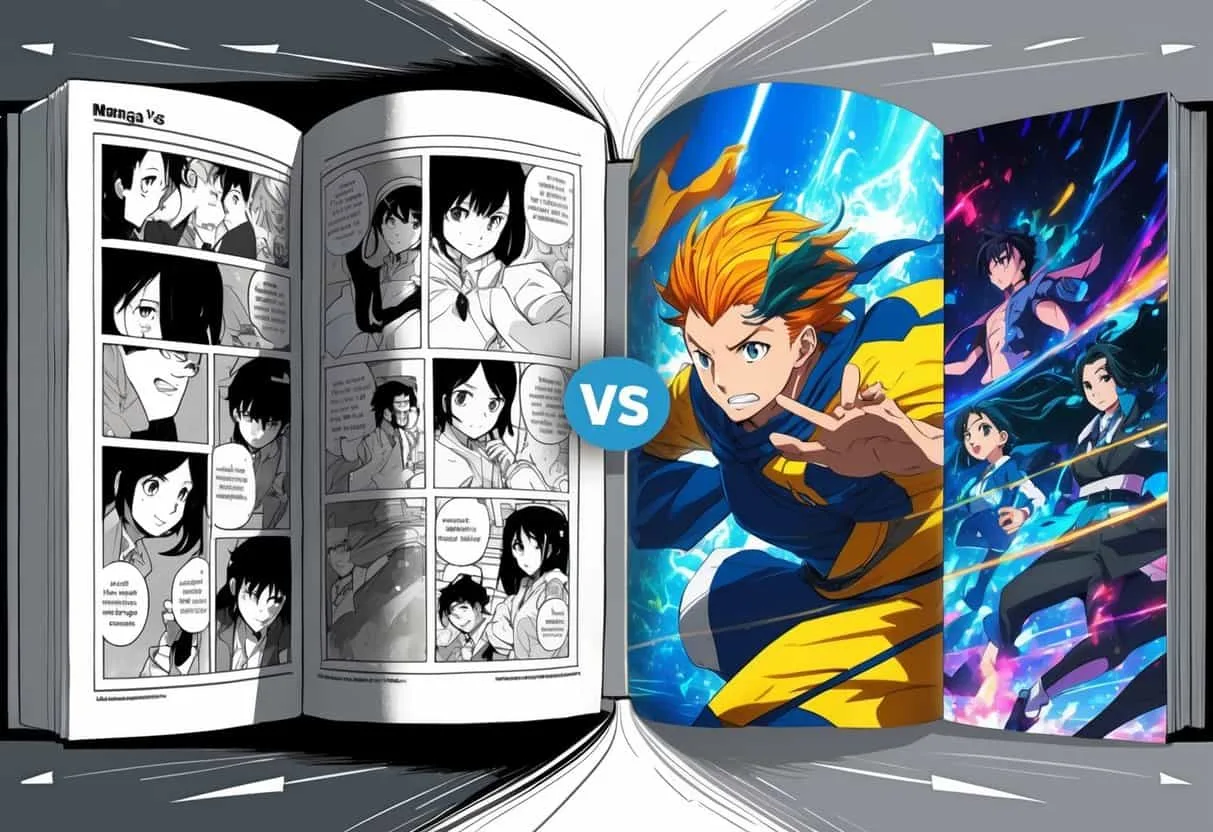
Manga gives you a static, black-and-white page you control. You set the rhythm of your eyes across panels, linger on a silent close-up as long as you want, or flip back to catch a forgotten line. That intimate relationship between reader and page invites a slow, contemplative engagement with the material. Anime, by contrast, moves you through a story at a director’s chosen pace. Color, motion, music, and voice acting flood your senses all at once, making the experience immersive but far less self-directed.
When a manga becomes an anime, the core narrative must bridge this sensory chasm, and that translation forces creative decisions that sometimes delight purists and sometimes frustrate them.
The process reveals an often overlooked truth: adaptation is not a straightforward copy but a reimagining of how the story’s heart should beat on screen. Understanding that process clarifies why your favorite scene might get cut, why a minor character suddenly gets a backstory, and why a manga’s ending might never appear in its animated counterpart.
How Manga and Anime Speak Different Creative Languages
The Reader’s Hand vs. the Director’s Baton
In manga, the creator trusts you to navigate the page. Panel layouts guide your eye, but the speed at which you absorb a fight sequence or a quiet dialogue remains yours. This means a mangaka can embed dense visual information—background details, subtle expressions, ambient text—without worrying about how long you’ll take to notice it. You might reread a single chapter four times and still uncover new layers. That depth becomes a hallmark of long-running serialized manga, where weekly or monthly chapters accumulate into a rich tapestry over years.
Anime surrenders that control to the director and storyboard artist. Each cut, each camera pan, each held frame is a deliberate choice about where your attention should go. A scene that the manga dedicates sixty seconds of reading time to might fly by in twenty seconds of animation, and the viewer cannot slow down the episode to reexamine the background art without pausing. As a result, anime storytelling leans heavily on visual flow, sound design, and editing to convey what the manga might have left static on the page. The adaptation must decide: do we replicate the manga’s meticulousness and risk a sluggish episode, or do we trim for momentum and hope the emotional core survives?
The Power of Music, Voice, and Motion
No manga page can make you hear a character’s voice crack during a confession, nor can it swell a soundtrack at a moment of triumph. Anime wields these tools to amplify emotion in ways that can surpass the source material. A well-scored scene can transform a relatively simple manga moment into an iconic cultural touchstone. The first encounter in Demon Slayer between Tanjiro and Giyu, for instance, hits with a cinematic force that the manga’s stark black-and-white panels could only suggest. Conversely, a lackluster soundtrack or miscast voice actor can deflate a scene that the manga made unforgettable in a reader’s imagination.
Motion itself changes the nature of action. Manga fights often rely on impactful still images, speed lines, and the reader’s mental filling of the gaps between panels. Anime must animate every transition, every punch, every leap. This often leads to choreographic extensions and flourishes that weren’t in the original, giving fight scenes a kinetic spectacle that manga can only imply. For series like One Punch Man, the anime’s fluid combat sequences elevated the series into a global sensation, showcasing how motion can become a storytelling asset entirely separate from the source material’s visual strengths.
The Adaptation Trade-Off: Fidelity vs. Flow
Narrative Compression and the Art of Cutting
Adaptation begins with a brutal math: a 20-minute episode can house roughly three to four manga chapters, depending on the density of dialogue and action. A completed 200-chapter series would theoretically need about 60 episodes to tell its entire story, but production realities rarely allow that luxury. Studios compress, merge, and excise. Subplots that develop side characters get axed, internal monologues shrink into a single expression, and transitional scenes vanish. The goal is to preserve the spine of the narrative while keeping the viewer from drowning in digression.
This compression can sharpen a story’s focus or gut its soul. Death Note’s anime adaptation largely stuck to the manga’s major beats but streamlined the second half’s complex mind games, resulting in a tighter, if somewhat less nuanced, conclusion. Berserk (2016), on the other hand, compressed too much into rushed, poorly animated sequences, losing the manga’s oppressive atmosphere. The difference often lies in how well the adaptation identifies which quiet moments matter to character development and which ones can be sacrificed for pacing.
Dialogue Localization and Content Editing
When a manga’s dialogue moves from printed speech bubbles to a voice actor’s performance, a layer of interpretation enters the picture. The original Japanese script might get tweaked to flow better when spoken aloud, and localized translations face yet another filter. Puns, idiomatic expressions, and cultural references that resonate with Japanese readers may fly over the head of an international audience. Professional translation teams must decide whether to preserve the original flavor or replace it with something more accessible—a choice that can spark heated debates among fans about whether the adaptation has “ruined” a beloved line.
Content editing adds another dimension. Manga serialized in magazines aimed at older teens or adults can include graphic violence, nudity, or dark psychological themes. Television broadcast standards, especially for daytime slots, often force studios to soften these elements. Scenes get dimmed, blood turns to shadow, and suggestive content gets reframed. Even streaming platforms impose content guidelines, meaning the anime you watch might be several degrees tamer than the manga you read, regardless of the studio’s original intent.
This sanitization can frustrate fans who see the rawness as essential to the story’s identity.
Character Design Simplification
Manga artists can lavish insane detail onto a single panel because it’s a static image. Animators, tasked with drawing that same character thousands of times across 24 frames per second, face an economic reality that forces simplification. Intricate hair strands, layered clothing folds, and elaborate armor details get reduced to their essential lines. This is why anime adaptations of highly detailed manga like Vagabond or Vinland Saga often smooth out the character art, trading some of the grit for fluid motion.
Color introduces a whole new visual vocabulary. A character’s design in black-and-white leaves much to the reader’s imagination. Once colored, that character’s mood and personality can shift dramatically. Think of how the subdued palette of Attack on Titan’s anime reinforces its bleak world, a choice not present in the manga’s stark ink. The collaboration between the original mangaka and the anime’s color designers can make or break the visual identity of the adaptation, turning fan-favorite designs into something that feels either perfectly realized or subtly off.
When Anime Diverges: Filler, Original Endings, and Bold New Paths
Sometimes, the adaptation process hits a wall: the manga hasn’t finished its story yet. Weekly anime series that catch up to an ongoing manga face an impossible choice—halt production and lose momentum, or continue with original content. This dilemma gave birth to the infamous “filler arc,” an anime-original storyline designed to buy time for the source material to get ahead. Long-running shonen series like Naruto and Bleach became synonymous with filler, producing dozens of episodes that fans often skip without losing the main narrative thread. While some filler arcs explore interesting character dynamics or side stories, others are derided as meandering padding that kills pacing.
Original endings represent a more permanent divergence. When the 2003 Fullmetal Alchemist anime outpaced Hiromu Arakawa’s ongoing manga, the studio crafted an entirely different conclusion that veered into its own emotional and thematic territory. Years later, Fullmetal Alchemist: Brotherhood remade the story with full fidelity to the manga, creating a unique situation where two adaptations coexist, each with passionate defenders. Other series, like Akame ga Kill!, created anime-only endings that shocked manga readers accustomed to a longer, darker finale in the source material. These divergences illuminate how an adaptation is never merely a mirror; it’s a creative interpretation shaped by schedule, budget, and the studio’s artistic vision.
Some adaptations even introduce new characters or alter major relationships. These changes can feel jarring but occasionally enrich the world in ways the original manga didn’t explore. The final arc of Tokyo Ghoul √A diverged so drastically from Sui Ishida’s manga that it remains a focal point of discussion about the limits of adaptation liberties.
The Production Machine: Studios, Publishers, and the Digital Revolution
Series vs. Films: The Scope of Storytelling
Anime series and anime films tackle the same source material with vastly different constraints. A 12-episode weekly series can spend hours developing character arcs and world-building gradually, allowing slow-burn storytelling that mirrors a long-running manga’s depth. Films, by contrast, must condense an entire story into roughly two hours, which often means focusing on a single iconic arc or creating an entirely original narrative that captures the spirit without the length. Studio Ghibli’s adaptations, for instance, rarely attempt to mirror a manga chapter-by-chapter; they instead extract its emotional essence and rebuild it cinematically.
The budget gap matters enormously. Films generally command higher per-minute animation budgets, enabling fluid, movie-quality sakuga sequences that few TV series can sustain. This is why Demon Slayer: Mugen Train looked visually staggering compared to even the high-quality TV season that preceded it. Series have to budget their animation peaks carefully, often reserving the best cuts for climactic battles and coasting on dialogue-heavy episodes elsewhere. The adaptation’s visual fidelity thus becomes a strategic resource allocation problem as much as an artistic one.
Key Industry Players and Global Distribution Networks
Adaptations don’t happen in a vacuum. Production committees—comprising manga publishers like Shueisha, Kodansha, and Shogakukan alongside animation studios like MAPPA, Bones, and Production I.G—decide which manga gets the green light based on sales data, merchandising potential, and market trends. A breakout manga with millions of copies in circulation becomes a near-certain candidate for adaptation, fueling a cycle where anime boosts manga sales and vice versa.
On the distribution side, companies like Viz Media, Viz’s manga localization division, and Dark Horse Comics handle the flow of manga to English-speaking readers, while streaming platforms like Crunchyroll and Netflix spearhead anime distribution. The explosion of simulcasting—releasing episodes worldwide within hours of Japan’s broadcast—has collapsed the traditional wait of years for localized versions. This real-time global access makes adaptation choices more visible and immediately scrutinized by international fans, who now have a direct voice in online discourse about what works and what doesn’t.
Digital Tools and the Streaming Double-Edged Sword
Technology has shrunk the production pipeline. Digital animation tools allow faster turnaround, letting studios keep pace with weekly manga releases more closely and reducing the need for filler. Shows like Jujutsu Kaisen benefit from modern compositing techniques that integrate hand-drawn characters into dynamic CGI environments, something unthinkable a decade ago. However, the streaming era’s insatiable demand for new content pressures studios to produce more adaptations than ever before, often stretching talent thin.
Crunchyroll’s production reports note that the sheer volume of adaptations has led to visible crunch and, in some cases, a dip in animation quality during mid-season stretches. The same digital tools that enable efficiency can also homogenize output, with some critics arguing that modern anime’s color palettes and lighting effects have coalesced into a shiny uniformity that erases the unique grit of older, film-based productions. The adaptation process now navigates not just fidelity to the manga, but fidelity to a streaming audience’s quick-swipe attention span.
Global Impact and Case Studies in Adaptation Brilliance
Gateway Series: From Niche to Mainstream
Certain anime adaptations have transcended their medium to become cultural phenomena that define entire eras. Fullmetal Alchemist: Brotherhood remains a landmark of faithful adaptation, preserving the manga’s intricate alchemical world and moral complexity while imbuing it with a flawless score and powerful voice performances. Its success proved that loyal adaptation could be commercial gold, influencing later projects to trust the source material more deeply.
Demon Slayer represents a newer paradigm: a decently popular manga exploded into a global juggernaut solely because its anime adaptation, led by studio ufotable, delivered a visual and emotional spectacle that the source material could only hint at. The anime’s success retroactively made the manga the best-selling series of its year, demonstrating how a truly exceptional adaptation can transform a franchise’s destiny. Similarly, Attack on Titan’s early seasons captured a grim, desperate aesthetic that matched Hajime Isayama’s rough art style, amplifying the sense of dread and making the story accessible to millions who might never have picked up a manga volume.
Thematic Depth: Philosophy, Identity, and Social Commentary
The most enduring adaptations aren’t just action showcases; they’re vessels for philosophical inquiry that resonates across cultures. Mamoru Oshii’s 1995 Ghost in the Shell film took Masamune Shirow’s dense cyberpunk manga and distilled its core questions about consciousness and identity into a meditative, visually groundbreaking work that influenced Western science fiction for decades. The film’s success at exploring the boundary between human and machine proved that anime adaptations could tackle intellectual themes without sacrificing commercial viability.
Crime sagas like Sanctuary or yakuza-infused stories delve into loyalty, power, and corruption, using organized crime as a lens for Japanese societal anxieties. Manga such as The Fable gained new layers in their anime adaptations as voice acting and sound design intensified the tension between a hitman’s mundane life and his violent profession. Identity struggles, exemplified by characters like Rin in Fate/stay night or Raki in Claymore, translate powerfully through animation that can visualize internal turmoil via color shifts, dream sequences, and symbolic imagery far more vividly than black-and-white panels. These adaptations don’t just retell stories; they reinforce the thematic heft that keeps viewers thinking long after the credits roll.
The Future of Manga-to-Anime Adaptations
As AI-assisted animation tools and real-time rendering technologies mature, the adaptation landscape will shift again. Studios may soon produce higher-quality episodes faster, reducing the gap between manga serialization and anime broadcast. Yet the fundamental tension will remain: a manga is a personal conversation between an artist and a reader, while an anime is a collaborative performance delivered to a crowd. The best adaptations will never be word-for-word replicas; they’ll be translations that understand when to stand still with the reader and when to run ahead with the screen.
The global fandom’s growing sophistication pushes studios toward greater faithfulness, but also rewards bold reinterpretation when done with respect. The conversation between manga and anime is a living dialogue—sometimes harmonious, sometimes contentious, but always evolving. For every purist who decries a cut scene, there’s a new fan who discovered the story through that very adaptation. The adaptation process, messy and imperfect as it is, remains the lifeblood that keeps these stories circulating across continents, generations, and mediums.
Learn more about adaptation ethics and fan reactions at Anime News Network’s feature on adaptation changes, and explore how publishers select titles for animation at Kodansha’s official site.