Table of Contents
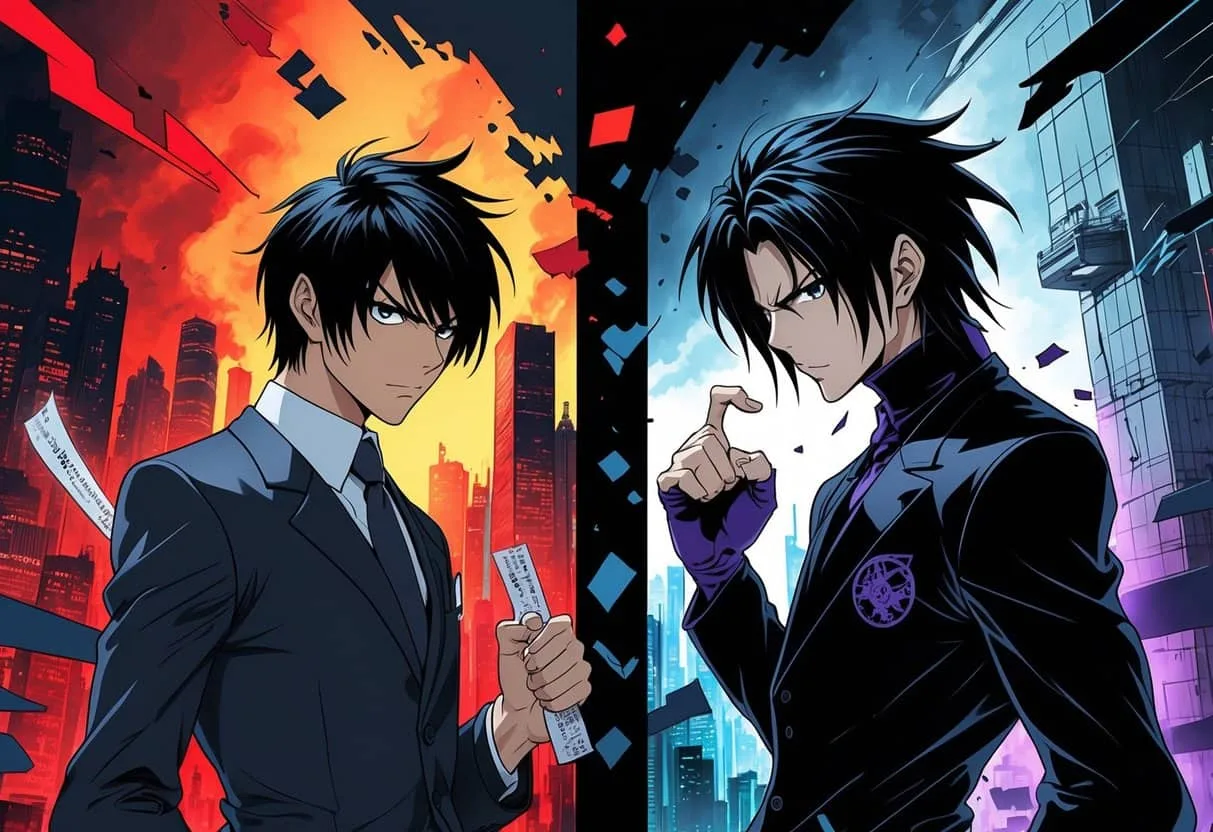
Anime has gifted us with two of the most compelling strategic minds ever written: Light Yagami of Death Note and Lelouch vi Britannia of Code Geass. Both characters manipulate systems, outwit powerful enemies, and pursue world-altering goals through sheer intellect. The question of who played the game better—the self-proclaimed god or the exiled prince turned masked revolutionary—has sparked endless debate. A deep examination of their methodologies, adaptability, and legacies reveals that Lelouch outclasses Light in nearly every strategic dimension. His ability to pivot under pressure, leverage human relationships while maintaining emotional distance, and design multi-layered endgames gives him a decisive edge over Light’s rigid, information-dependent crusade.
The Core Motivations: Justice vs. Revenge
Understanding who played the game better begins with motivation. Light Yagami’s journey starts when the honor student picks up a supernatural notebook that can kill anyone whose name and face are known. His initial rationale—ridding the world of criminals—morphs swiftly into a god complex. Light believes he alone can judge humanity, and he measures success by the fear he instills. His ultimate aim is to be worshipped as a supreme arbiter of justice, ruling over a cowed, crime-free world.
Lelouch’s drive is more personal yet equally consuming. Exiled from the Britannian imperial family after his mother’s assassination and his sister Nunnally’s crippling, Lelouch vows to destroy the empire that discarded them. He wants to create a gentle world for Nunnally—a place where strength does not dictate worth. Unlike Light’s abstract, self-aggrandizing mission, Lelouch’s goal is anchored in familial love and vengeance. This difference shapes their strategic philosophies: Light’s every action serves to elevate his power and anonymity, while Lelouch’s decisions, however ruthless, circle back to protecting a specific person.
When a strategy fails, Lelouch can recalibrate around that core emotional anchor; Light, lacking such an external tether, doubles down on his own infallibility.
Light Yagami: The God Complex in Practice
Light operates under a simple principle: eliminate all opposition. He uses the Death Note to kill not only criminals but also law enforcement agents who get too close. His method relies heavily on controlling information. He manipulates media narratives, feeds misinformation to the police, and even orchestrates his own surveillance to throw off investigators. The psychological warfare he wages against L, the world’s greatest detective, is a tense game of cat and mouse where a single slip means death.
Yet Light’s dependence on a single, inflexible tool—the notebook’s rules—means he can be cornered when his information advantage erodes. His arrogance often blinds him to the possibility that someone might outthink him, a flaw that repeatedly places him in near-fatal predicaments.
Lelouch vi Britannia: The Mask of Zero
Lelouch operates with a completely different toolkit. His Geass, granted by the immortal witch C.C., allows him to issue an absolute command to anyone once through direct eye contact. The command can be anything from “die” to “follow all my orders.” This power is both more versatile and more dangerous than the Death Note because it can create assets. Lelouch builds an entire resistance movement—the Black Knights—around his alter ego Zero, blending charismatic leadership with strategic genius.
He wins battles not by vanishing enemies but by converting, confusing, and outmaneuvering them on physical and political battlefields. His mask symbolizes his ability to separate the compassionate brother from the ruthless commander, a psychological compartmentalization Light never masters. As explored in analysis of his key strategies, Lelouch’s plans often involve multiple win conditions, ensuring that even a “defeat” advances his larger goals.
The Tools of Manipulation: Death Note vs. Geass
The nature of their powers shapes every strategic choice. The Death Note is a long-range assassination weapon. It leaves no physical trace but carries rigid constraints: the user must picture the victim’s face and know the real name, and death occurs within 40 seconds of writing unless specified otherwise. Light uses proxies, careful timing, and cleverly orchestrated death sequences to sow chaos or eliminate specific threats. However, the notebook cannot grant him loyal followers, nor can it force nuanced behavior from survivors.
It is a blunt instrument for removing pieces from the board, and its effectiveness degrades the moment Light’s identity is suspected.
Lelouch’s Geass, in contrast, is a scalpel for surgical manipulation. A single command can turn an enemy general into a spy, compel a pilot to sabotage their own forces, or extract critical intelligence without bloodshed. The limitation of one command per person forces Lelouch to think several moves ahead: he must decide precisely what order will yield maximum long-term value. Unlike Light, Lelouch can lose his physical anonymity and still win because his network of controlled and converted allies extends far beyond himself. The Geass also carries a psychological cost—knowing he subjugates free will—but Lelouch uses this burden to fuel his resolve rather than fracture his judgment.
Strategic Flexibility: The Decisive Factor
This is where the gap widens. Light is a meticulous planner who thrives in closed systems. His entire battle against L takes place within controlled environments: his room, a task force headquarters, a carefully curated circle of contacts. Once L deduces that Light is likely connected to the Japanese police and narrows the suspect pool, Light spends the rest of the series reacting, scrambling to patch leaks, and manufacturing alibis. His “masterstrokes”—such as forfeiting ownership of the Death Note to erase his memories—are brilliant but also desperate, revealing a fundamental brittleness.
Light cannot adapt his endgame; he only refines his path toward the same monolithic goal of godhood. When confronted with the unpredictable, like the appearance of the rogue Shinigami Rem or Near’s cold analytical approach, his house of cards collapses.
Lelouch, by contrast, treats the entire geopolitical landscape as his chessboard. He leads open rebellions, orchestrates coups, and manipulates the Britannian Empire’s internal politics. When his original Black Knights are pushed to the brink, he doesn’t just refine a single plan; he reconsiders his entire strategic framework. He creates the United States of Japan, builds an alliance with the Chinese Federation, and eventually turns enemies like Suzaku Kururugi into indispensable allies. His “Zero Requiem” plan—the ultimate gambit where he casts himself as a global tyrant only to be assassinated by his friend—is the pinnacle of adaptive thinking.
It achieves world peace through intricate manipulation of public perception, personal sacrifice, and precise timing. Light could never conceive of a strategy that required his own public execution, because his ego precludes self-loss. Lelouch’s flexibility extends to his emotional core: he channels grief into resolve, betrayal into new strategies, and love into a reason to fight rather than a weakness to exploit.
Rivals and Obstacles: The Weight of Antagonists
Both protagonists face exceptionally brilliant enemies who test their limits. Light’s primary antagonist, L, is a detective of unparalleled logic and intuition. Their conflict is a closed, psychological duel where misreading a single variable means death. L gradually strips Light of his anonymity, forcing him into ever more convoluted schemes. Later, Near and Mello exploit the cracks L left behind.
Light’s failure to permanently outwit a genius who never shows his face highlights a critical weakness: Light’s victory over L is fleeting and ultimately achieved through Rem’s intervention, not solely his own intellect. He loses the long game to opponents who learn from his patterns.
Lelouch’s opponents are more varied and exist on a broader canvas. Suzaku, his childhood friend turned Britannian knight, serves as both moral foil and lethal adversary. Suzaku’s superhuman piloting skills and rigid idealism force Lelouch to navigate emotional minefields that amplify strategic complexity. Beyond individuals, Lelouch battles the entire Britannian system, including its emperor—his own father—and the shadowy Geass Order. Each opponent forces Lelouch to expand his repertoire; he shifts from terrorist tactics to conventional warfare to political statecraft.
The sheer scale of resistance tests his adaptability and proves his superiority in handling multi-front conflicts. Where Light is a serial killer operating in the shadows, Lelouch is a revolutionary who must command armies, win hearts, and dismantle centuries of imperial doctrine. The depth of his opposition demands a higher order of strategic skill.
Loyalty, Betrayal, and the Human Element
No grand strategy succeeds without allies, and here the contrast is stark. Light views everyone as pawns—including the Shinigami Ryuk, the besotted Misa Amane, and the members of his task force. He manipulates Misa’s devotion, eventually discarding her when she becomes inconvenient. His father, Soichiro Yagami, dies unaware his son is the monster he hunts. Light’s inability to forge genuine human connections leaves him isolated even at the height of his power.
When his house of lies crumbles, there is no one willing to save him. His betrayal of everyone close to him is total, creating a void of trust that echoes his empty victory.
Lelouch also uses people, but with a crucial difference: he inspires genuine loyalty and acknowledges his debts. The Black Knights follow Zero because he delivers results and offers a vision of liberation. While Lelouch keeps secrets and makes ruthless calls—including using his Geass on allies when necessary—he also risks his life in battle and mourns those who fall. His dynamic with C.C., Kallen, and even the enemy-turned-ally Jeremiah Gottwald demonstrates an ability to convert enemies into devoted followers. The ultimate expression of this is Suzaku.
Once bitter enemies, they unite under a shared purpose for the Zero Requiem. Lelouch’s relationships evolve; he can be betrayed (as by the Black Knights when Schneizel exposes him) and still rebuild because his foundation is not built solely on fear. The strategic lesson is profound: adaptable loyalty systems—where allies are bound by shared vision rather than forced obedience—outlast pure terror.
The Final Outcome and Legacy
Light Yagami dies on a warehouse floor, exposed, panicked, and pleading. His legacy as Kira dissolves into infamy; crime rates eventually return to normal after his death. His godhood was a temporary illusion sustained only by the Death Note’s power. The world learns of his existence and brands him a mass murderer. He leaves no lasting structural change, no better world.
His strategic failure is not just in dying but in achieving nothing beyond his own brief, tyrannical spectacle.
Lelouch’s death is a deliberate victory. He orchestrates the Zero Requiem to concentrate all the world’s hatred onto himself, then dies smiling at Suzaku’s hand. The world, united by the shared experience of a monstrous tyrant being slain, enters an era of peace and cooperation. Nunnally lives in a gentle world. Lelouch’s strategy transcends his own life, reshaping global geopolitics permanently.
The Zero Requiem stands as perhaps the most audacious and successful endgame in anime history. His methods remain ethically tangled, but the strategic outcome is undeniable: Lelouch won in the way that matters most—he achieved his objective and left a functioning, improved system in his wake.
Conclusion: Lelouch Played the Better Game
Placed side by side, Light and Lelouch represent two archetypes of the mastermind. Light operates with surgical precision in a narrow domain, relying on a supernatural tool’s absolute lethality to remove obstacles one by one. His downfall stems from an ego that mistakes intelligence for infallibility and a strategy that cannot survive exposure. Lelouch operates across multiple domains—military, political, psychological—with a power that expands his options rather than narrowing them. He adapts to reversals, converts enemies into allies, and crafts a self-sacrificial finale that ensures his vision outlasts him.
Both characters have left indelible marks on anime storytelling, but when evaluating who played the game better using criteria of resource management, adaptability, emotional intelligence, and lasting impact, Lelouch vi Britannia stands as the superior strategist. The game was always larger than a battle of wits; it was a fight for the future, and only Lelouch had the breadth of vision to win it on his own terms.