Table of Contents
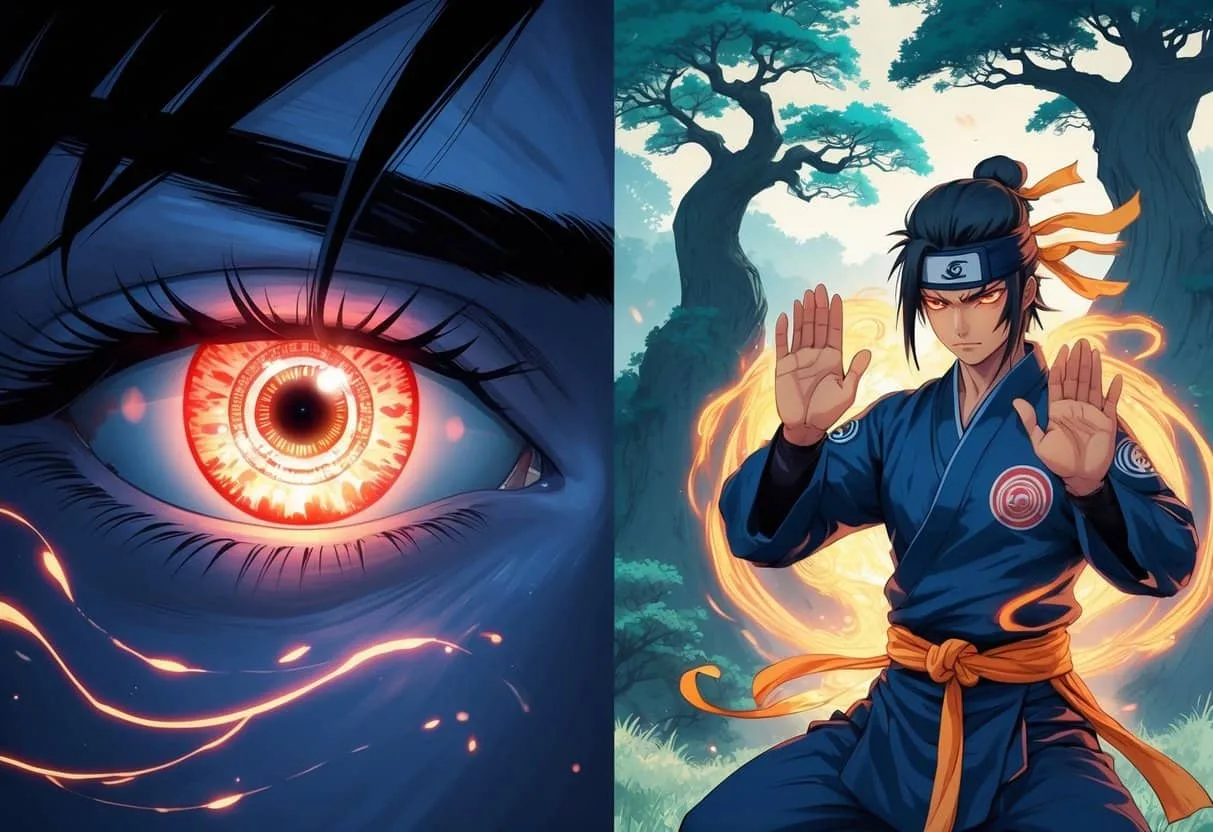
From the subtle art of Genjutsu to the earth-shattering force of a Rasenshuriken, the world of Naruto brims with techniques that define its legendary shinobi. At the heart of many iconic battles lie two contrasting power systems: the bloodline-gifted Sharingan and the nature-infused Sage Mode. While the Sharingan offers unparalleled perceptive and hypnotic abilities tied to the Uchiha clan's heritage, Sage Mode taps into the very energy of the world to push a ninja's physical and sensory limits beyond ordinary boundaries. This guide breaks down these cornerstone jutsus—and more—so you can appreciate the mechanics, the risks, and the unforgettable moments they create.
Key Takeaways
- Jutsu are powered by chakra, a blend of physical and spiritual energy, and fall into three main categories: Ninjutsu, Taijutsu, and Genjutsu.
- The Sharingan is a hereditary dōjutsu that evolves through emotional trauma, granting perception, copying, and powerful illusion techniques.
- Sage Mode combines a ninja’s chakra with natural energy, dramatically boosting strength, sensory range, and attack potency.
- Mastering these abilities often comes with brutal risks—blindness from Mangekyō overuse or petrification from mishandled natural energy.
The Foundations: Chakra and Jutsu Categories
Before diving into specific techniques, it’s essential to understand the universal fuel behind every jutsu: chakra. Chakra is produced when physical energy from the body’s cells merges with spiritual energy cultivated through training and experience. The resulting life force flows through a network of 361 tenketsu (chakra points), and a ninja’s ability to mold and control it determines the scope of their arsenal. Larger reserves and precise control unlock everything from basic elemental attacks to world-altering transformations.
The Three Pillars: Ninjutsu, Taijutsu, Genjutsu
Jutsu are broadly classified into three categories. Ninjutsu manipulates chakra to shape elements or create effects—fireballs, water dragons, earth walls, and lightning strikes all fall here. This category also includes sealing techniques and medical ninjutsu. Taijutsu relies on raw physical prowess and hand-to-hand combat, often without any chakra, though some styles, like the Hyūga’s Gentle Fist, inject chakra into the opponent’s system. Genjutsu targets the mind, trapping the enemy in illusions by disrupting their chakra flow in the cerebral nervous system.
A versatile ninja often blends two or all three pillars, but mastery in any single one can make a shinobi feared across the Five Great Nations.
Chakra Control and Elemental Nature
All ninja have a natural affinity for one of the five basic natures: Fire, Water, Wind, Earth, or Lightning. By learning to transform chakra into that element, they can perform elemental ninjutsu. Advanced users add shape manipulation—for instance, giving fire the form of a dragon—to increase lethality. Elite shinobi combine two natures, creating kekkei genkai like Wood Release (Earth + Water) or Ice Release (Wind + Water). The Sharingan often aids this process by copying an opponent’s hand seals and chakra molding, while Sage Mode internalizes nature’s own energies, elevating elemental techniques to a whole new magnitude.
The Sharingan: Uchiha Bloodline Legacy
The Sharingan is the visual prowess of the Uchiha clan, characterized by a crimson iris and a variable number of tomoe (comma-like marks). Its influence on the series is so profound that every significant conflict involves an Uchiha whose eyes unlock ever-greater stages of power. The dōjutsu doesn’t just enhance combat; it reshapes the psychology of its wielder, feeding on loss and ambition.
Stages of the Sharingan
A basic Sharingan awakens under strong emotional stress, typically with one tomoe per eye. As the user faces life-or-death situations or processes grief, more tomoe appear, up to three. Each stage improves kinetic vision, allowing the user to read an opponent’s muscle tension and anticipate movements. This predictive ability makes the Sharingan a near-impenetrable defensive tool. Additionally, the eye can copy almost any non-kekkei genkai jutsu it sees, memorize seals, and cast hypnotic suggestions with a glance.
Evolution to Mangekyō Sharingan
The apex of the Sharingan’s evolution is the Mangekyō Sharingan, which awakens when the user experiences the trauma of witnessing a loved one’s death. The distinct pattern of the Mangekyō varies between individuals and unlocks a trio of devastating abilities. Itachi Uchiha could trap opponents in an inescapable illusion with Tsukuyomi and burn anything to ash with the black flames of Amaterasu. Sasuke mastered Amaterasu as well and developed the ability to shape those flames with Kagutsuchi. The ultimate Mangekyō technique, however, is Susanoo—a gigantic, spectral warrior that acts as an avatar of the user’s will.
Susanoo evolves through skeletal, armored, and perfect forms, each granting immense offensive and defensive power.
The Mangekyō’s curse is its toll: every use damages the optic nerve, progressively dimming the light of the eyes until they seal shut with blindness. The only escape is to transplant the eyes of a close blood relative, creating the Eternal Mangekyō Sharingan, which halts the deterioration and merges the patterns of the two sets. This fusion allowed Madara and Sasuke to sustain their ocular prowess indefinitely, while Obito’s long-term Mangekyō management relied on Hashirama’s cells to offset the strain.
Legendary Users and Their Styles
Madara Uchiha remains the benchmark of Sharingan mastery. He could wield Susanoo without needing to summon the full form and once dropped a meteor on the Allied Shinobi Forces with a single jutsu. Itachi blended psychological warfare and precise timing, using his Mangekyō sparingly to preserve his failing eyesight. Sasuke’s progression from a vengeful teenager to a battle-hardened rogue tracked his eye’s evolution, culminating in the Rinnegan after receiving half of Hagoromo’s chakra. Obito utilized Kamui, a space-time ability that warped himself or parts of his body into a pocket dimension, making him nearly untouchable.
Each user demonstrates that the Sharingan is not a monolithic power but a mirror of the wielder’s personality and trauma.
Sage Mode: Harnessing Nature’s Power
While the Sharingan leans on heritage, Sage Mode is a skill accessible to any ninja with the diligence to accept nature’s harsh lessons. It does not originate from bloodline but from the ability to connect with the planet’s ambient life force—natural energy. When this energy is balanced with the user’s own chakra, the result is senjutsu chakra, which pushes combat parameters into the realm of the sage.
The Danger of Imbalance
Natural energy is everywhere, but it is inert and absorbs into the body only if the user actively draws it in while remaining perfectly still. A disruption during this process—movement, loss of concentration—causes the petrification cascade: the body slowly turns to stone, often fusing with the surrounding nature. The Mount Myōboku toads train students by coating them with a special oil that draws in natural energy and striking anyone who shows signs of imbalance, forcing immediate expulsion of the foreign energy. Only when a shinobi can maintain equilibrium and enter the state without external help have they truly mastered Sage Mode.
Senjutsu Chakra and Physical Boosts
Once activated, Sage Mode alters the user’s physical appearance—pigmentation around the eyes, horizontal pupils (in toad-style sages), and sometimes animalistic features if mastery is incomplete. The infusion of natural energy grants superhuman strength: a simple punch can shatter stone, and leaps cover vast distances. Senses expand dramatically, allowing the sage to detect chakra signatures across an entire battlefield without direct sight. Techniques like Naruto’s Frog Kata use the surrounding natural energy as an extension of the body, landing invisible strikes that hit beyond the reach of fists. Durability also skyrockets; a sage can sustain direct impacts that would incapacitate a normal shinobi.
Prominent Sage Mode Practitioners
Jiraiya was the first to bring toad-style Sage Mode to widespread legend. His imperfect form left him with warty features, but he compensated with the support of the elder toads Shima and Fukasaku, who gathered natural energy for him during battle to extend his time limit. Naruto Uzumaki perfected the technique, using his shadow clones to gather natural energy remotely and transfer it to himself, sidestepping the motionless requirement entirely. He then combined Sage Mode with his Nine-Tails chakra to attain a state that could sense negative emotions and react to attacks before they were launched. Hashirama Senju utilized a unique form of Sage Mode tied to his Wood Release, amplifying the scale of his jutsu until he could create living forests and a thousand-armed statue that dwarfed tailed beasts.
In the shadows, Kabuto Yakushi integrated Ryūchi Cave’s snake-style Sage Mode, granting him dragon-like resilience and the ability to liquefy his body to evade damage.
Legendary Techniques That Defined the Ninja World
Beyond the Sharingan and Sage Mode, Naruto’s world is rich with high-risk, high-reward jutsu that hinge on raw willpower, chakra volume, or an intimate bond with monstrous entities. These techniques often become the final card a shinobi plays when all else is lost, and their execution leaves permanent marks on both the user and the landscape.
Unlocking the Eight Gates
The Eight Inner Gates are limiters situated along the chakra pathway system that restrict the body’s physical output to a safe threshold. Opening each gate removes a block, flooding the user with power at the cost of tearing muscles and snapping bones. The first gate (Gate of Opening) undoes mental inhibitions; the third gate (Gate of Life) turns the skin crimson from accelerated blood flow; by the sixth gate (Gate of View), the user can unleash shockwaves with a simple palm thrust. The seventh gate (Gate of Wonder) emits a blue sweat of evaporated body fluids, while the eighth and final gate—the Gate of Death—ignites the blood itself, granting power far surpassing a Kage but guaranteeing death once the effect wanes.
Might Guy’s stand against Madara during the Fourth Great Ninja War stands as the ultimate testament to the Eight Gates. After opening all eight, he unleashed the Evening Elephant, a series of five consecutive air cannons that distorted space, and the final blow, Night Guy, a kick that bent the very fabric of reality. Though Madara survived, Guy’s show of force earned recognition as the strongest taijutsu user in history. Rock Lee, his protégé, also demonstrated the gates’ terrifying potential in the Chunin Exams, but his inexperience left him with lifelong injuries that underscored the technique’s unforgiving nature.
Rasengan and Rasenshuriken
The Rasengan is a sphere of pure chakra that rotates violently in multiple directions, grinding whatever it touches. Minato Namikaze designed it after observing the Tailed Beast Ball, and it demands no hand seals—only perfect chakra control. Naruto added wind-natured transformation, creating the Rasenshuriken, a shuriken-shaped projectile that delivers countless microscopic wind blades to sever the chakra network on a cellular level. Early versions damaged Naruto’s own arm, so he learned to throw it to maintain a safe distance. The Rasenshuriken became his signature range attack, capable of carving through mountains and outmaneuvering opponents who dodged conventional jutsu.
Shadow Clone Jutsu: The Ultimate Learning Tool
Kage Bunshin no Jutsu creates solid duplicates that split the user’s chakra evenly among them. While notoriously chakra-hungry for the average shinobi, a jinchūriki like Naruto can produce hundreds or even thousands. The clones act independently, and any experience they gain—knowledge, battle instincts, chakra molding practice—transfers back to the original when they disperse. Naruto weaponized this feedback loop to compress years of training into days, mastering wind nature manipulation and Sage Mode integration far faster than should have been possible. Clones also serve as complex misdirection tools, creating a fluid battlefield where the real body hides among an army.
Tailed Beasts and Jinchuuriki
The nine Tailed Beasts are sentient chakra entities formed by the Sage of Six Paths from the Ten-Tails’ essence. Each beast is sealed inside a human host—a jinchūriki—who can access its vast reserves and unique abilities. Gaara’s bond with Shukaku granted him automated sand defense even while sleeping, but early in life it turned him into an isolated weapon of Sunagakure. Naruto’s partnership with Kurama evolved from a parasitic relationship to a friendship that allowed full KCM (Kurama Chakra Mode) and later Six Paths Sage Mode, merging the fox’s chakra with his own to fly and sense malice. Killer Bee demonstrated perfect jinchūriki status with Gyūki, using its tentacles and ink creations in battle while rapping his way through combat.
The path to mastery, however, is littered with failures: unstable jinchūriki release chakra cloaks that erode their bodies, and full transformations can break free and rampage, as seen with the Nine-Tails’ attack on Konoha.
Other Renowned Abilities
The ninja world’s depth is mirrored by the sheer variety of specialized jutsu. Neji Hyūga’s Byakugan granted a near-360° field of vision and the ability to see chakra pathways, which he exploited with the Gentle Fist to shut down internal organs with a few taps. Orochimaru pushed the boundaries of immortality through forbidden body-transfer techniques, storing every jutsu he learned inside his soul. Sasori turned himself into a human puppet, controlling an army of marionettes that wielded poisoned weapons, and his “Third Kazekage” puppet could rain iron sand spikes across a battlefield. Tsunade’s Milotic Regeneration and Strength of a Hundred Seal allowed her to heal catastrophic wounds in real time while enhancing her physical strikes to shatter the very ground.
Each of these abilities exists outside the classic Sharingan-Sage dichotomy, reminding us that ingenuity and dedication often rival inherited gifts.
Across the Hidden Leaf and beyond, jutsu are never just flashy attacks—they are expressions of a ninja’s history, sacrifices, and unyielding will. Whether it’s the crimson glare of a Mangekyō or the serene stillness before a sage strikes, every technique carries a story. Understanding the mechanics behind them sharpens the viewing experience and reveals why certain battles resonate long after the credits roll.