Table of Contents
In the sprawling shinobi world of Masashi Kishimoto’s Naruto, where clans wield genetic legacies and eye techniques rule the battlefield, one character stands as a stark anomaly. Rock Lee, a student from the Hidden Leaf Village, was born without the ability to use ninjutsu or genjutsu—the two foundational pillars of a ninja’s arsenal. Relegated to the sidelines by his peers and instructors who viewed raw talent as the ultimate decider of worth, Lee embarked on a path that would challenge the very definition of a ninja. Through sheer physical training, indomitable spirit, and an unshakable belief in the mantra that “hard work surpasses genius,” Lee transformed from an object of ridicule into one of anime’s most enduring symbols of perseverance. This article analyzes how Rock Lee’s journey, his key battles, his mentor-bond, and his cultural resonance have cemented his legacy as an icon of determination, inspiring millions to rewrite their own stories of limitation.
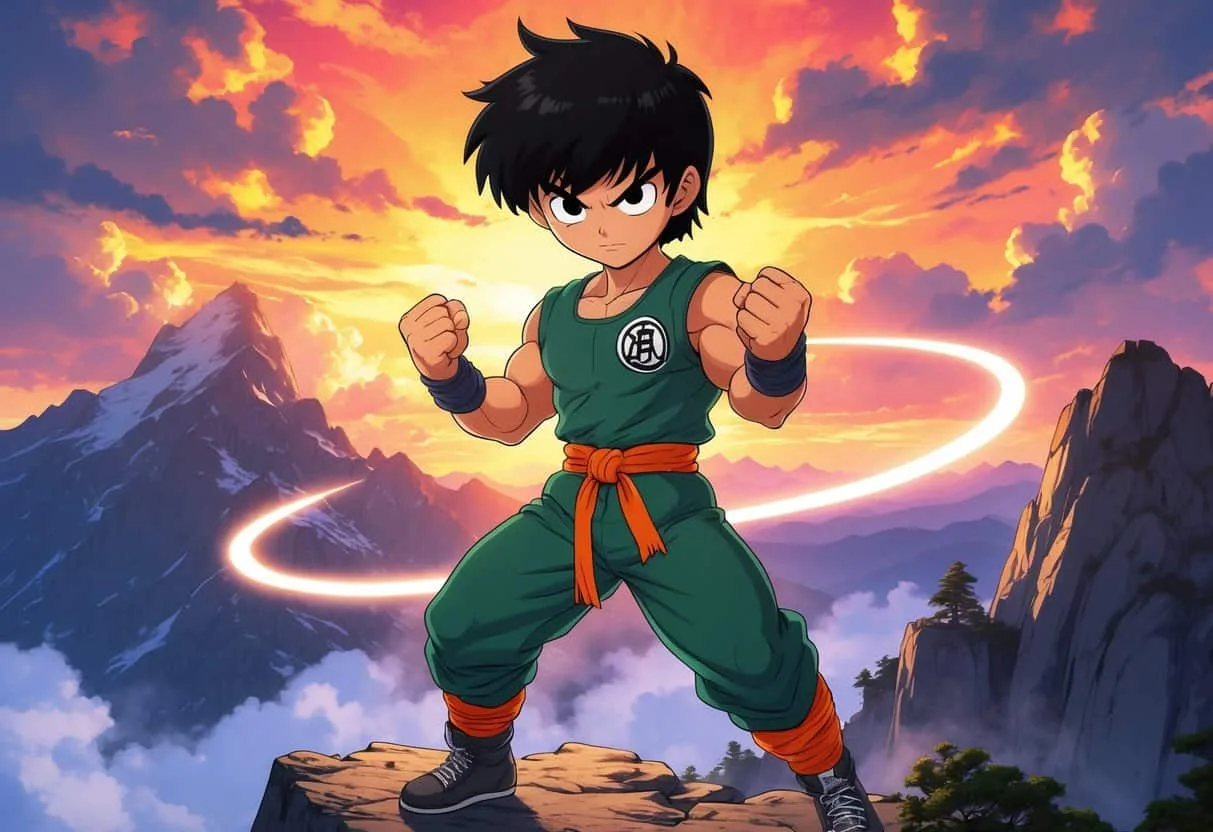
The Origins of an Underdog
Rock Lee’s story begins with a stark truth: in a world where prodigies are celebrated, he was a complete failure by conventional standards. At Konohagakure’s ninja academy, young Lee could neither mold chakra for a basic clone technique nor weave illusions. His peers laughed at him, labeling him a “dropout” who would never graduate. What they failed to see—and what Lee himself struggled to articulate—was a furnace of resolve burning inside. While other children progressed through elementary jutsu, Lee spent every waking hour doing push-ups, running laps, and practicing punches until his knuckles bled.
His transformation began when he caught the attention of Might Guy, the exuberant taijutsu master who saw in Lee a reflection of his own past. Guy recognized that while Lee lacked the genetic gifts of a Neji Hyuga or the latent power of a Sasuke Uchiha, he possessed something rarer: an unconditional willingness to work. Guy took him under his wing and taught him that taijutsu—hand-to-hand combat—was not a fallback for the untalented, but a sublime art in its own right. Lee seized this philosophy with both hands. He replaced self-pity with a simple creed: if I cannot do ninjutsu, I will become the best taijutsu user the world has ever seen.
“A genius, huh? What does that mean? ‘Genius’? So I was not born with a lot of natural talent, not gifted like Neji… but I work hard and I never give up! That is my gift; that is my ninja way!”
This quote, delivered during his Chunin Exam bout, encapsulates the core of Lee’s identity. It rejects the fatalism that had long defined the shinobi ranking system and instead posits that self-worth is self-made. From the very first days at the academy to the final arcs of the series, Lee’s origin narrative consistently reinforces that limitations are not permanent; they are simply starting points.
The Mentor Connection: Might Guy and the Power of Youth
Central to Lee’s development was his sensei, Might Guy, a jonin who had once been told he would never amount to anything either. Guy’s father, Might Duy, was the laughingstock of the Leaf Village—a perennial genin who drilled the Eight Gates technique into his son out of pure love. Guy inherited this ethos and perfected it, eventually passing it down to Lee. Their bond became the emotional heart of Lee’s storyline: a mentor who did not just train a student, but nurtured a soul.
Guy’s training regimen was brutal but purposeful. He believed that each drop of sweat spent in training was one less drop of blood lost in battle. Together they performed thousands of squat kicks, ran marathon distances on their hands, and pushed their bodies past what modern sports science would deem safe. But the goal was never merely physical. Guy instilled in Lee the “Power of Youth”—a concept that frames passion, discipline, and self-belief as the truest measures of a shinobi.
This philosophy aligns closely with the psychological concept of grit, the perseverance and passion for long-term goals that research shows can predict success more reliably than IQ or talent alone.
The Eight Gates technique itself serves as the ultimate metaphor for Lee’s journey. Opening each gate releases a limit on the body’s chakra flow, granting enormous power at the cost of severe physical damage. For Lee, who had no other avenues, the gates were not just a technique; they were a representation of what it meant to give everything for a cause. When he later opens the gates against Gaara, the spectacle is both horrific and beautiful—a body breaking itself to prove that spirit can transcend flesh.
Defining Battles that Forged a Legend
The Chunin Exams: Lee vs. Gaara – A Philosophy Made Flesh
The preliminary rounds of the Chunin Exams in the anime serve as the crucible where characters prove their mettle, and no match is more emblematic than Lee’s confrontation with Gaara of the Sand. Gaara, the jinchuriki host of Shukaku, possessed an automatic sand defense that had never been penetrated. He was seen as invincible, a monster whose power came from a cursed birth. When Lee was matched against him, the crowd anticipated a swift, brutal end. Even his own teammates, Neji and Tenten, prepared for his defeat.
What unfolded instead was a masterpiece of kinetic storytelling. Lee, weighted leg-weights falling to the ground with earth-shaking thuds, revealed a level of speed that shocked everyone, including Naruto, Sakura, and Kakashi. He danced around Gaara’s sand, his movements so swift that even the automatic defense struggled. The imagery of Lee’s green jumpsuit blurring past Gaara’s gourd remains one of the most iconic sequences in shonen anime.
Then came the gates. Lee opened the first four gates, his skin turning crimson as blood vessels strained. He unleashed the Front Lotus, then the devastating Reverse Lotus, pummeling Gaara into the arena floor. Yet Gaara’s sand armor cushioned the blows, and in a final cruel twist, Gaara crushed Lee’s left arm and leg with his sand coffin technique. Lee stood unconscious, still in a fighting stance.
Though he lost the match, the psychological victory was his. Gaara, the boy who believed in nothing but his own sand’s protection, was left trembling—not from the physical strikes, but from confronting a will stronger than his own trauma. This fight, often ranked among the most iconic battles in Naruto, condensed the entire thematic arc of the series into fifteen minutes: effort, sacrifice, and the beauty of a falling leaf.
Recovery and the Rescue Mission: Facing Kimimaro
The aftermath of the Gaara fight was bleak. Tsunade, the Fifth Hokage and a legendary medical ninja, gave Lee a grim prognosis: the shattered bone fragments in his spine and limbs from the gates might end his career permanently. A risky surgery offered a fifty-percent chance of recovery, but the alternative was a life of disability. Lee faced a far deeper battle now—the mental one. Could he still be Lee without his taijutsu?
The answer came through Guy’s unwavering support and his own internal resolve. He chose the surgery, determined to walk back onto the battlefield.
His return coincided with the Sasuke Retrieval Arc, where he intercepted the Sound ninja Kimimaro. Like Lee, Kimimaro was a physically oriented fighter driven by a singular purpose—in his case, serving Orochimaru. The duel is a collision of opposing philosophies: Kimimaro’s cursed bloodline and tragic servitude versus Lee’s self-made strength and loyalty to his friends. Lee, still not at full capacity, even unveils the Drunken Fist style, a chaotic and unpredictable form that turns his awkwardness into an asset. The encounter underscores that Lee’s true power lies not in any one technique but in his refusal to surrender.
When Gaara later arrives to finish the fight, Lee’s contribution was not diminished—he had held the line, and in doing so, demonstrated that a “crippled” ninja could still protect what mattered most.
The Fourth Great Ninja War and Beyond
In Naruto Shippuden, Rock Lee did not receive the same level of narrative spotlight as the main trio, but each appearance reinforced his matured legacy. During the Fourth Great Ninja War, he could open up to six of the Eight Gates, a level Guy himself had only reached through decades of training. Lee fought alongside his mentor against Madara Uchiha’s reanimated forces, and in a breathtaking moment, he landed a spinning kick that bisected Madara—a being who had transcended mortal limits. This feat, often glossed over in discussions of the climactic battles, served as the ultimate validation of his path. While Naruto and Sasuke received divine power-ups through the Sage of Six Paths, Lee stood shoulder to shoulder with them using nothing but the body he had forged from countless mornings of conditioning.
The Boruto era continues this thread. Rock Lee is now a jonin with his own team, and his son Metal Lee inherits his anxiety but also his father’s unwavering work ethic. The legacy of perseverance is generational, proving that Lee’s influence is not a one-time inspirational flash but a sustainable model for living.
Symbolism and Philosophy: Redefining the Ninja Ideal
Hard Work vs. Innate Talent
Lee’s existence in the narrative serves as a direct counterpoint to characters like Neji Hyuga and Sasuke Uchiha. Neji, a prodigy of the Byakugan, preached a doctrine of fate: that destiny is determined at birth and that a “failure” can never defeat a “genius.” Lee’s challenge of Neji during the Chunin preliminaries—though we don’t see it fully—is symbolic of the ideological war at the heart of the story. When Lee stood up, bloody and beaten, refusing to accept his predetermined loss, he embodied the counter-narrative that would later free Neji from his own chains. In a sense, Lee was the first to chip away at the Hyuga fatalism that had enslaved both Neji and Hinata’s spirits.
Sasuke, too, represents inherited power through the Sharingan and the curse of the Uchiha. Where Sasuke’s growth stemmed from a vengeful quest that often isolated him, Lee’s growth was communal, built through relationships with Guy, Tenten, and Naruto. Lee’s approach to improvement echoes real-world martial philosophies. Drawing inspiration from the legendary Bruce Lee’s martial philosophy, which emphasized adaptability and the rejection of rigid styles, Rock Lee demonstrates that technique is meaningless without the mindset of a lifelong student. In the world of anime, where bloodlines frequently dictate a character’s ceiling, Lee stands as a rare figure who says, No, I will hammer through that ceiling.
The Lotus Blossom and the Symbol of Perseverance
The lotus flower, which blooms in muddy water, is a recurring motif associated with Rock Lee. His signature techniques—the Front Lotus and the Reverse Lotus—are not just fancy names; they are visual metaphors for his life. A lotus cannot bloom without the murky depths; similarly, Lee’s greatness could not have emerged without the abject humiliation and struggle of his early years. The image of Lee spinning and driving an opponent headfirst into the ground while wrapped in the green glow of opened inner gates evokes the lotus rising from the mud toward the sun.
This symbolism extends to his appearance. His bowl cut, thick eyebrows, and green jumpsuit make him visually distinct from the “cool” ninja designs of Kakashi or Itachi. He looks like an earnest, almost ridiculous child. And yet, when he fights, that same appearance becomes majestic. The contrast reveals a profound truth: value is not in the packaging but in the action.
As fans, we learn to see past the superficial and appreciate the beauty of unyielding effort. Lee’s aesthetic becomes a badge of honor, worn by cosplayers and artists who identify with his message.
Cultural Impact and Enduring Legacy
Rock Lee’s influence extends far beyond the panels of the manga and frames of the anime. He has become a global shorthand for perseverance, referenced in motivational speeches, memes, and social media posts. A simple image of Lee dropping his ankle weights with the caption “When you remove your limitations” has been shared millions of times, resonating with students, athletes, and anyone facing a daunting challenge. In a medium often criticized for power creep and destiny-based storytelling, Lee’s arc remains a bulwark of meritocratic hope.
Academically, one can draw parallels between Lee’s training philosophy and modern concepts of deliberate practice, as studied by psychologist Anders Ericsson. Lee’s constant, focused, and feedback-driven training under Guy mirrors the very methods experts use to achieve mastery in fields from music to sports. This alignment makes him not just an emotional touchstone but an intellectually coherent model of achievement.
In the broader anime landscape, few characters have so thoroughly embodied a single theme without being reduced to a caricature. Shows like My Hero Academia have their own quirkless underdogs (Izuku Midoriya, before inheriting One For All), but those arcs often resolve by gifting the protagonist a power. Lee was never given a cheat. He earned every ounce of respect. Even critics who dismiss shonen tropes often make an exception for the “Green Beast of Konoha.”
Fan communities celebrate Rock Lee through dedicated forums, analysis videos, and “Rock Lee Appreciation Days.” His birthday, November 27, trends on social platforms as fans share art and personal stories of how his character helped them through depression, academic failures, or physical rehabilitation. The character’s ability to connect on such a personal level is a testament to Kishimoto’s writing and to the universal hunger for stories that say, You are enough; you just have to work.
The Unyielding Will of a Shinobi
Rock Lee’s narrative is a testament to the belief that the human spirit can bridge any gap. He was not born with a demon fox sealed inside him, nor did he inherit ocular jutsu that could rewrite reality. He had only his body and his will. From the taunts at the academy to the cheers after his battles, from a shattered leg to the honor of fighting beside the Hokage, Lee’s life arc mirrors the core promise of the Naruto series: that a nobody can become a somebody through sheer tenacity.
When you find yourself at the bottom of a hill you never thought you’d have to climb, remember Rock Lee. Remember that the gate of limits is self-placed, and you hold the key. His legacy whispers across the fandom, in every push-up done past exhaustion and every study session past midnight: the lotus of the soul blooms in muddy water, but it can bloom for everyone who refuses to quit.