Table of Contents
Anime Aesthetics and Indigenous Storytelling: A Modern Cultural Fusion
Across the globe, Indigenous artists are bending the familiar lines of anime into something entirely their own. By infusing dynamic character designs, emotive pacing, and lush world-building popularized by Japanese animation, these creators are weaving ancestral knowledge, oral histories, and community resilience into visual narratives that feel both timely and deeply rooted. The result is not a simple imitation but a deliberate, expressive fusion—one that insists traditional stories belong in every medium, including the ones young people already love.
Through anime-inspired visuals, Indigenous creators are constructing story-worlds where cultural memory meets the immediacy of digital art.
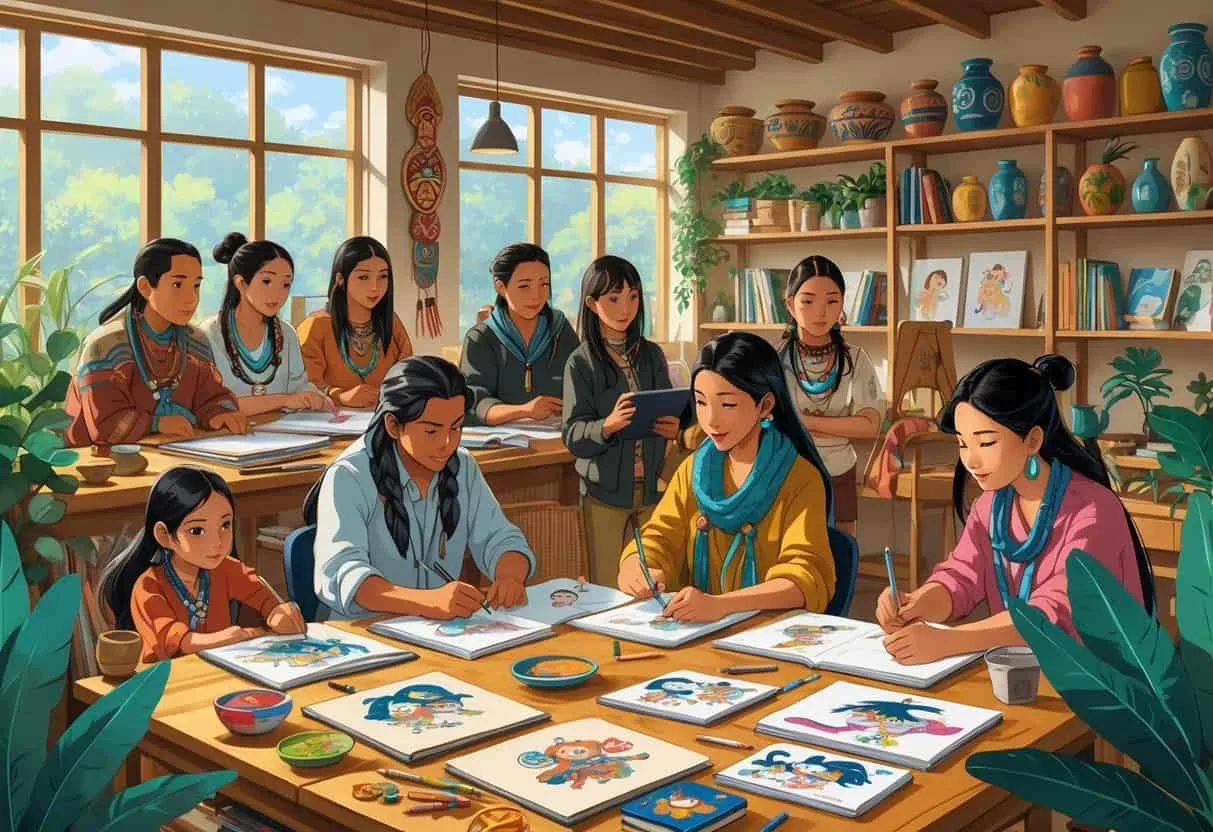
This movement is not simply about aesthetics. It is a strategic reframing of identity that pushes back against erasure and stereotypes. For younger generations who scroll through streaming platforms and gaming communities as naturally as they breathe, an anime-influenced short film about a Cree trickster or a Navajo creation story can feel far more accessible than a textbook or a museum diorama. It opens a door, and that door leads to deeper engagement—with language, ceremony, land, and the living continuity of Indigenous cultures.
Animation, once seen as a niche import, has become a tool of cultural resurgence. It empowers communities to control their own imagery, to sidestep the gatekeepers of traditional publishing or broadcasting, and to speak directly to a global fanbase that already appreciates emotional visual storytelling.
The Roots of Anime Influence in Indigenous Art
The relationship between Indigenous creators and anime is not an overnight trend. It grew out of decades of cross-cultural media consumption, internet fan networks, and a quiet recognition that something in the art form resonated with Indigenous ways of seeing the world.
How Japanese Animation First Reached Indigenous Communities
In the late 1980s and 1990s, as anime filtered into North American television via syndicated shows like “Sailor Moon,” “Dragon Ball Z,” and later “Pokémon,” Indigenous youth were among the millions tuning in. For many, these shows offered more than entertainment. The stylized emotions, the reverence for nature spirits, the ensemble casts that operated like extended families—these elements echoed values already present in their own communities. Satellite television, VHS trading, and early internet forums allowed fans on reserves and in urban centers to access subtitled series long before mainstream retailers caught on. By the early 2000s, anime clubs and convention meetups became places where young Native fans could geek out freely, and for some, that enthusiasm sparked a desire to create.
Early Adopters and Artistic Mentors
The first wave of Indigenous anime-influenced artists often honed their skills by tracing manga panels, then gradually merging those techniques with Woodlands style, Coast Salish formline, or Pueblo pottery motifs. Artists like Jeffrey Veregge (Port Gamble S’Klallam) famously combined Salish design principles with comic book and pop culture references, pointing toward a broader appetite for hybrid visual language. Early independent comics, webcomics, and DeviantArt galleries became low-risk spaces to experiment. Mentorship from older Indigenous storytellers, meanwhile, helped ground these aesthetic experiments in cultural protocol—ensuring that sacred symbols were not misused even as the art style pushed boundaries.
Visual Language: Adapting Anime Techniques for Cultural Storytelling
Anime’s toolkit is vast: speed lines, exaggerated emotional expressions, elaborate costumes, and backgrounds that shift from hyper-detailed realism to dreamlike abstraction. Indigenous creators are not simply borrowing these tricks; they are retuning them to carry cultural meaning.
Signature Anime Elements Reimagined
In many anime, the large, reflective eyes of a character convey internal struggle and empathy. In Indigenous adaptations, those eyes might also reflect the landscape—a prairie sky, a northern lake—linking the character’s spirit to the land itself. The genre’s love of transformation sequences, where characters shift between forms, resonates powerfully with traditions of shape-shifting beings like the Anishinaabe Nanabozho or the Navajo Coyote. Even the anime convention of hair that defies gravity becomes a way to echo the fluid lines of traditional hide paintings or ribbon work. Background art, often in anime a character in its own right, can be imbued with specific plant knowledge or the sacred geometry of basket patterns.
Digital Tools Empowering Indigenous Artists
The same digital pipelines that produce anime—vector graphics, 2D rigging, digital painting software—have lowered barriers for Indigenous creators working from home studios or community media labs. Open-source programs like Blender and Krita, along with affordable drawing tablets, mean that a teenager in a remote fly-in community can produce a short animation that rivals the polish of far larger studios. Organizations such as the Indigenous Film Artists Network have begun offering animation residencies that explicitly explore the intersection of anime aesthetics and Native storytelling. This democratization of tools allows for rapid prototyping of ideas and direct distribution on YouTube, TikTok, or dedicated streaming platforms, bypassing the historical lack of Indigenous representation in mainstream animation networks.
Cross-Cultural Bridges: Shared Values and New Subcultures
At its best, the blend of anime and Indigenous storytelling creates a two-way exchange. Japanese audiences and fans worldwide are being introduced to Indigenous philosophies, while Native creators find a global language for their messages.
Overlapping Worldviews: Nature, Ancestors, and Community
Japanese anime frequently explores themes of living in balance with nature—Spirited Away’s polluted river spirit, Princess Mononoke’s forest gods—that closely parallel Indigenous ecological teachings. The Shinto notion of kami, spirit presences in natural objects, can feel familiar to many Indigenous people who understand that rocks, rivers, and animals are relatives, not resources. The anime trope of the “found family,” where unrelated characters form deep bonds of loyalty, echoes the expansive kinship networks of many Indigenous communities. These philosophical meeting points give artists a rich foundation for stories that do not feel forced but rather like a natural extension of both traditions.
Conventions as Cultural Hubs
Anime conventions have evolved into unexpected but vital venues for Indigenous storytelling. At events like Anime Expo or smaller regional cons, artist alleys and panel rooms now regularly feature Indigenous-led sessions. You can find a booth selling prints that reinterpret Star Wars with Navajo designs right next to someone selling hand-drawn manga. Panels like “Indiginerd 101” or “Decolonizing Cosplay” unpack the politics of representation while celebrating fandom. These spaces foster direct mentorship, with established creators offering portfolio reviews to young Indigenous artists who see themselves in the panelists’ journeys.
For many fans, it’s the first time they encounter an Indigenous perspective outside of a classroom, and the exchange often sparks deeper curiosity.
The Rise of Indiginerd Spaces Online
Online, hashtags like #Indiginerd, #NativeAnime, and #IndigenousComics have carved out digital gathering places. Discord servers and Reddit communities allow artists to swap techniques, share cultural stories behind their designs, and organize collaborative projects. One notable example is the collective project “Urban Native Warriors,” a webcomic series that uses a distinctly anime visual style to follow Indigenous superheroes protecting Toronto’s waterways. These online subcultures are not just fan spaces—they are incubators for a cultural renaissance, offering peer support, accountability, and a shared visual vocabulary that spans from the Navajo Nation to the Māori communities of New Zealand. Articles on outlets like Remezcla have documented how these communities are reshaping the very definition of what Indigenous art can be in the digital age.
Youth Empowerment and the Digital Preservation of Heritage
Perhaps the most profound impact of anime-influenced storytelling lies in how it engages Indigenous young people. In a landscape where youth suicide rates, cultural disconnection, and colonial trauma are urgent realities, offering a creative outlet that feels authentic and cool can be literally lifesaving.
Animation as a Gateway to Cultural Learning
When a Cree teen designs a character based on the wîsahkecâhk stories but draws them in an anime style, they are not abandoning tradition—they are doing the work of a storyteller. That process often involves consulting Elders to ensure the character’s behaviors align with the teachings, learning the Cree names of animals, and researching traditional regalia. The animation becomes a container for language and oral history. Community workshops that pair youth with animators and knowledge keepers have proven effective: participants not only produce a short film but also internalize creation stories, clan responsibilities, and the moral lessons embedded in the narratives. The final product can then be screened at local schools, serving as a peer-to-peer teaching tool.
Reclaiming Narratives Through Fantasy and Symbolism
Anime’s license to be symbolic and surreal lets Indigenous creators address heavy topics—residential schools, missing and murdered Indigenous women, environmental destruction—without being trapped in a purely realist, trauma-focused frame. A story might feature a young girl who channelsthe strength of a spirit fox to confront a shadowy monster that literally feeds on language loss. That monster is a metaphor, but the anime aesthetic makes the metaphor visceral and the victory cathartic. By embedding social messages in fantasy, creators honor the pain of their communities while offering a vision of healing and agency. This approach resonates with youth who are tired of victim-centered narratives and hungry for stories where Indigenous characters are the heroes of their own worlds.
Pioneering Projects and Creators Redefining Representation
Across North America and beyond, a growing number of specific projects illustrate the range of this fusion. They are not theoretical; they are viewable, shareable, and often funded through community grants or crowdfunding.
- “The 7th Generation” by Indigenous Nation Studios is a sci-fi anime series pitch that places Anishinaabe futurism at its center, featuring mechas powered by sacred medicines and clan symbols. The concept art went viral on social media, drawing attention from both anime fans and Indigenous art collectors. Native Arts and Cultures Foundation has highlighted similar projects as part of their Indigenous Futures initiative.
- “Tales from the Rez” is a webcomic turned animated short series that uses a comic manga style to depict everyday life on a Plains Cree reserve with humor and heart. Its creator, a self-taught artist from Saskatchewan, ran a successful Kickstarter that attracted backers from Japan, intrigued by the cultural mash-up.
- “Káá’sąǫǫ’s Journey” blends Athabascan storytelling with a watercolor anime look. The short film, narrated entirely in the Hän language, follows a young girl’s vision quest, using flowing lines and subdued palettes reminiscent of Makoto Shinkai’s landscapes. It premiered at an international animation festival and has since been used in language revitalization classrooms.
These projects share a common thread: they privilege Indigenous voice and aesthetic control, often led by creators who serve as their own directors, writers, and character designers. The anime influence is undeniable but secondary to the cultural integrity of the story being told.
Navigating Cultural Sensitivity and Avoiding Appropriation
The fusion of anime and Indigenous storytelling is not without tension. Critics within both Indigenous and Japanese communities raise valid points about the risks of superficial borrowing and the need for respectful engagement.
Respecting the Origins of Anime
Some Japanese scholars and fans express concern that the term “anime” can be diluted when applied loosely to any non-Japanese animation that uses big eyes and spiky hair. For Indigenous creators, acknowledging this history means understanding anime’s own evolution from post-war manga and Japanese folklore. Many Indigenous artists show that respect by openly crediting their Japanese influences, sometimes even collaborating with Japanese animators. A Pueblo artist might study the work of Studio Ghibli’s background painters to understand how they layer meaning into landscapes, not just to copy the look. When done ethically, the relationship is one of inter-cultural dialogue, not extraction.
Internal Community Standards and Protocols
Within Indigenous nations, there are rigorous discussions about which stories are appropriate for public animation. Some narratives are sacred, meant only for specific seasons or ceremonial contexts. Anime’s global reach can inadvertently expose restricted knowledge if proper consultation is neglected. To address this, many Indigenous-led studios now develop cultural protocols documents in partnership with Elders’ councils before production begins. These guidelines determine which symbols can be used, how characters may interact with creators’ realms, and who holds the copyright to the resulting stories.
This ensures that the fusion is not merely creative but culturally responsible—protecting the very heritage it aims to celebrate.
The Path Forward: Sustaining the Movement
For anime-inspired Indigenous storytelling to flourish long-term, it needs more than passion; it needs structural support, institutional partnerships, and a pipeline for emerging talent.
Funding, Distribution, and Education
Federal arts councils in Canada, Australia, and the United States have begun to fund animation projects through Indigenous screen offices, but the application process can be daunting for grassroots artists. Simplified micro-grant programs and in-kind support (equipment loans, mentorship circles) are crucial. Distribution partnerships with platforms like Crunchyroll or Hulu—already expanding their international libraries—could amplify these works dramatically, as seen with the recent addition of Māori science fiction series. Universities and art schools are also creating specialized tracks for Indigenous digital arts, blending traditional knowledge with industry-standard animation training. The National Film Board of Canada’s Indigenous Cinema catalog offers a model of how public institutions can showcase and promote these hybrid works.
The Global Indigenous Animation Network
What began as isolated experiments is coalescing into a transnational movement. Artists from the Sámi of Scandinavia, the Ainu of Japan, and the Mapuche of Chile are connecting online, trading techniques and finding solidarity in the shared experience of merging Indigenous identity with anime-inspired visual language. The upcoming “Indigenous Anime Festival” planned in Winnipeg hopes to bring these threads together physically, with screenings, workshops, and a market for Indigenous-made character goods. Such gatherings build economic sustainability—turning fan art commissions into livelihoods—and reinforce the message that Indigenous stories belong on any screen, in any style.
As the movement matures, the definition of “Indigenous anime” may itself evolve into something that neither culture fully claims but both enrich. For now, the most exciting work happens when a young artist in a remote community opens a blank digital canvas and sketches a character whose eyes hold the reflection of their grandfather’s teachings, whose hair flows like northern lights, and whose story has been waiting centuries for exactly this moment to be told.