Table of Contents
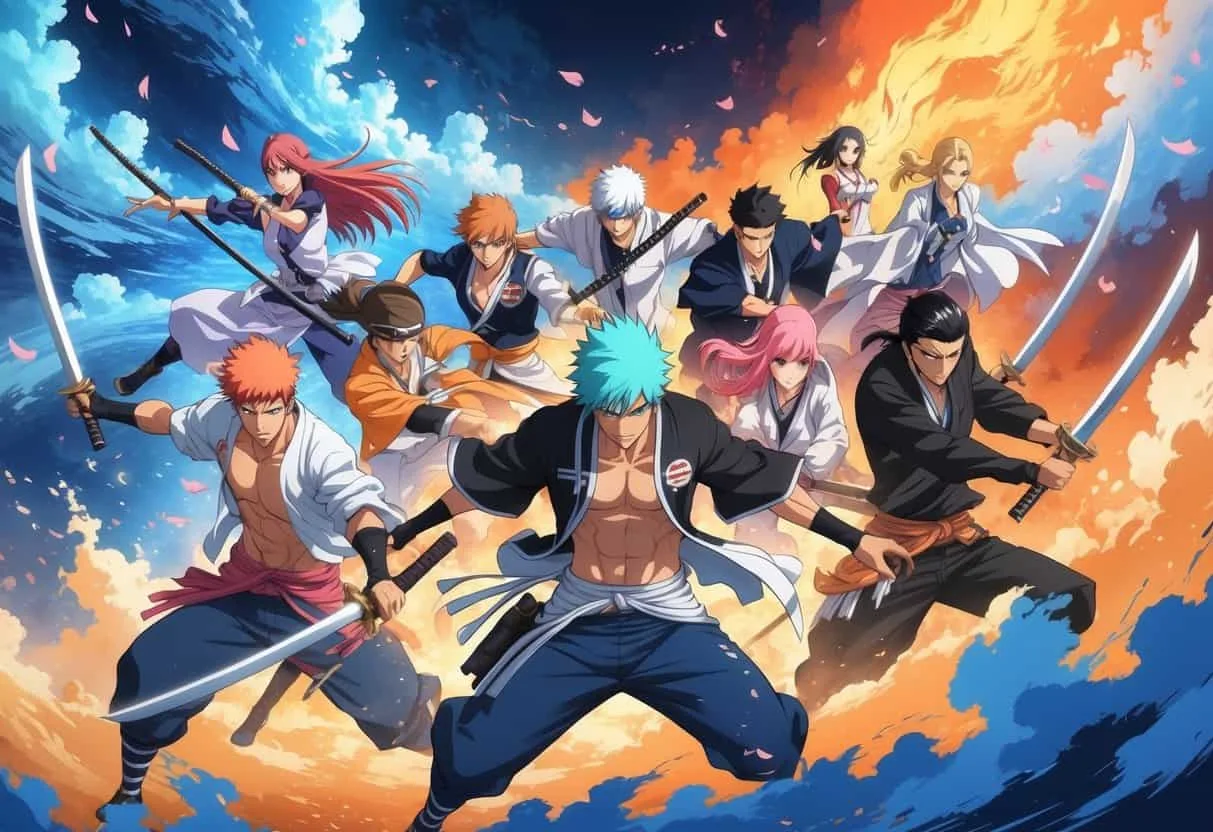
When Tite Kubo’s Bleach launched in 2001, it transcended the simple blueprint of a boy inheriting supernatural powers. What transformed it into a layered epic was the sprawling ensemble of supporting characters who turned monochromatic battles into rich explorations of duty, identity, and sacrifice. The extensive cast—from the rigid corridors of the Gotei 13 to the cold deserts of Hueco Mundo—ensured that Ichigo Kurosaki’s journey resonated far beyond a lone warrior’s struggle. These souls gave the narrative texture, injecting moral ambiguity and emotional weight into a series that could have easily relied on escalating power levels. Every squad member, hollow, and Quincy carried a history that rippled through the story, making each confrontation a collision of philosophies rather than a mere test of strength.
Unlike many shonen series that rotate focus among a small core, Bleach built a living world where even minor characters could steal an arc. The Soul Society’s political machinations, the hollows’ tragic origins, and the Quincy’s genocidal past all demanded attention from the viewer. Ichigo’s growth mattered, but the series truly shined when it paused to let a captain’s scarred back or a fracción’s dying wish speak volumes. The result is a saga where the ensemble does not just support—it elevates, challenges, and ultimately completes the journey.
Rukia Kuchiki: The Catalyst of Souls
Rukia Kuchiki’s decision to transfer her Shinigami powers to Ichigo was the tremor that shattered his ordinary world, but her role as the story’s linchpin extended far beyond that desperate moment. Her imprisonment and scheduled execution in the Soul Society were not simply plot devices; they were a mirror reflecting the dogmatic cruelty of a centuries-old institution. Rukia’s personal history, marked by her sister Hisana’s death and her adoption into the noble Kuchiki clan, ingrained a profound sense of unworthiness that the Soul Society’s laws exploited. When Ichigo, Sado, Uryū, and Orihime stormed the Seireitei to save her, their mission became a referendum on whether individual worth should be sacrificed on the altar of tradition.
Her evolution did not end with that rescue. In the Thousand-Year Blood War arc, Rukia faced the Sternritter Äs Nödt and transcended Byakuya’s shadow. Achieving her Bankai, Hakka no Togame, she became a master of absolute zero, a visual apex symbolizing her journey from self-doubt to sovereignty. Her trajectory is a masterclass in how a supporting character can simultaneously anchor the protagonist’s morality and command her own breathtaking destiny. Her bond with Ichigo never felt romantic or possessive—it was a profound mutual recognition of warriors who had each other’s back through life, death, and rebirth.
Rukia’s fighting style, rooted in kido and dance-like flash steps, also underscored her refinement versus Ichigo’s raw power. Her early reliance on her shikai’s ice effects gave way to a graceful precision that finally erupted into absolute cold. When she froze Äs Nödt’s nerves into helplessness, she avenged not only herself but every soul trapped by fear. Rukia’s smile in that moment—seeing her own reflection in the shards—was the series’ quiet triumph over inherited shame.
Renji Abarai and Byakuya Kuchiki: The Unspoken Oath
The Soul Society arc would have lost its edge without the emotional friction supplied by Renji Abarai and Byakuya Kuchiki. Renji’s fight with Ichigo on the execution hill was layered with raw, desperate tears; he was fighting his own powerlessness as much as he was fighting a Ryoka. Rising from the Rukongai slums, Renji’s fierce determination to surpass Byakuya spotlighted the rigid class divides haunting the afterlife. His wooden sword Zabimaru was fitting for a brawler who chose the raw path over refinement. His eventual mastery of the true Bankai, Sōō Zabimaru, visually cements the series’ theme that rebirth requires acknowledging one’s deepest flaws.
Captain Byakuya Kuchiki, in contrast, represented a cold, beautiful wall of tradition. In early arcs, his obedience to the law nearly cost him his sister twice. The internal war beneath his stoic features—between the promise he made to Hisana and the Soul Society’s code—fueled intense visual poetry during his Bankai, Senbonzakura Kageyoshi. The “Senkei” scene against Ichigo was a philosophical standoff, not just a fight. By the Thousand-Year Blood War, Byakuya’s walls had crumbled.
His near-death plea to Ichigo to protect the Soul Society marked a complete inversion of pride, turning a rigid noble into a vulnerable, relatable brother.
Their dynamic as captain and subordinate became more poignant as the series progressed. Renji’s growth from a hot-headed lieutenant to a man who could stand beside Byakuya in battle mirrored the healing of the Kuchiki household. When Byakuya finally acknowledged Rukia as his true sister without reservation, it was Renji who nodded silently in the background—a testament to how supporting characters can embody the quiet victories that never steal the spotlight.
Uryū Ishida and Sado “Chad” Yasutora: Highborn Pride and Grounded Strength
Ichigo’s inner circle was defined by the contrasting natures of Uryū Ishida and Yasutora Sado. Uryū, the proud Quincy, entered as an antagonist challenging Ichigo to a Hollow-killing contest. His arc dives into the trauma of genocide; his grandfather Sōken’s death at the hands of Hollows—and the Soul Reapers who arrived late—instilled a bitter hatred that fueled his clinical perfectionism with the Heilig Bogen. Yet his dynamic with Ichigo morphed from rivalry into a bond where he willingly shredded his pride to save a comrade. Uryū’s later entanglement with Yhwach’s Sternritter made his struggle to reconcile heritage with chosen family a weighty counterbalance to black-and-white morality.
If Uryū is high-minded intellect, Chad is a moral anchor rooted firmly in the earth. His power—Brazo Derecha de Gigante and Brazo Izquierda del Diablo—flows from a promise never to use violence for his own sake. Chad’s Fullbring links him to the human world’s physical bonds, and his quiet, steadfast sacrifice—often blocking a blow for Orihime or Ichigo—demonstrated a strength that flashy Zanpakutō wielders rarely acknowledged. The friendship between Ichigo, Uryū, and Chad forms a trinity: instinct, intellect, and endurance. Their teamwork during the invasion of Hueco Mundo proved that trust anchors raw spiritual pressure.
Chad’s story often felt underutilized by fans, yet his moral certainty provided a grounding force. When everyone else doubted, Chad stood firm. His fight against Shunsui Kyōraku in the substitute shinigami arc, though brief, showed his potential. In the final war arc, his Fullbring evolved into a full armored form that withstood assaults from Sternritter. His quiet determination never wavered, making him the unsung pillar of the human team.
Orihime Inoue: Rejection as the Supreme Shield
Orihime Inoue’s arc is a dramatic subversion of the damsel-in-distress trope. Her Shun Shun Rikka power was designed to “reject” phenomena, denying wounds and events on a reality-warping plane. During the Arrancar arc, her capture by Ulquiorra Cifer was a tense psychological drama exploring the nature of the “heart” in a hollow creature. Sōsuke Aizen never wanted her healing; he wanted her rejection ability, hinting at a potential to transgress the Hōgyoku’s boundaries.
Orihime’s agency in the final arcs dispels any notion of helplessness. Her shield, Santen Kesshun, blocked attacks from Yhwach, stunning even the strongest Shinigami. Watching her move from naive pacifism to a determined defender willing to stand in front of a god highlights Tite Kubo’s skill in weaving vulnerability into strength. Her bond with Rukia, built on mutual respect, also proved that female friendships can thrive without being sacrificed for the protagonist’s attention.
Her power to reject events also carried a heavy emotional toll. Every time she restored what was broken, she erased a moment of history—a burden she bore alone. Her refusal to use her power offensively was not weakness but a conscious moral choice. In the end, Orihime’s role as the one who mends—both physical wounds and broken hearts—made her indispensable to Ichigo’s world. Her “Kurosaki-kun” became a rallying cry for hope in the darkest hours.
Building the Afterlife: The Gotei 13’s Role in World-Building
The Soul Society would be a sterile backdrop without the color of its thirteen court guard squads. The Gotei 13 is a collection of barely contained anarchy and ancient grudges, not just a military force. Captains like Kenpachi Zaraki, who subconsciously suppressed his own power for a longer fight, and Shunsui Kyōraku, whose lazy demeanor masks terrifyingly pragmatic swordsmanship, signal that Soul Society is where the strongest rule by sheer force of will. The presence of the morally flexible Mayuri Kurotsuchi and his grotesque experiments continually questions the ethical lines the Gotei 13 will cross for victory. For an exhaustive look at squad structures, visit the Bleach Fandom: Gotei 13 page.
Even lesser-seated officers contributed richness. Ikkaku Madarame and Yumichika Ayasegawa’s fierce 11th Division pride, or Momo Hinamori’s tragic blind loyalty to Aizen, fleshed out the messy, clan-like structures of military life. These dynamics transformed the “soul balance” into a living political machine where a character’s power was measured not just by Reiatsu but by the history they dragged behind them like a blood-soaked haori. The Gotei 13’s internal conflicts, like Tōsen’s defection and Gin’s betrayal, kept the institution feeling organic and precarious.
The Visored and Their Redemption
The Visored—Shinigami who gained hollow powers—added another layer to the ensemble. Hirako Shinji, Love Aikawa, and the others were outcasts who nevertheless fought to protect the Soul Society that had rejected them. Their return during the Fake Karakura Town battle was a powerful moment of forgiveness. Their instability as hybrid beings reflected Ichigo’s own inner turmoil, and their guidance helped him accept his hollow side. Without the Visored, Ichigo’s growth would have lacked a crucial mirror for his identity struggle.
Evolution of Antagonism: From Hollows to Sternritter
Bleach’s supporting monsters systematically deepened the narrative’s philosophical core. The Arrancar arc introduced the Espada, with characters like the nihilistic Ulquiorra Cifer and the feral Grimmjow Jaegerjaquez. Grimmjow’s obsession with Ichigo mirrored the protagonist’s own instinctual love for battle, making their clashes feel like a recognition between apex predators. The Arrancar’s quest for a “heart” forced the Soul Reapers to confront their moral authority, blurring the line of where monstrosity truly lies. Tier Harribel’s sacrifice for her Fracción starkly contrasted with Soul Society’s noble corruption, proving that “Hollow” was a matter of perspective.
The Thousand-Year Blood War exploded the antagonist framework through the Wandenreich’s Sternritter army. These Quincy warriors, with abilities like “The Fear” (Äs Nödt) and “The Visionary” (Gremmy Thoumeaux), challenged the very concept of reality rather than just raw power. Mask De Masculine’s reliance on popularity to fuel his strength was a twisted homage to narrative power. By introducing existential dread tailored to secondary Shinigami, the arc allowed Rukia, Renji, and Kenpachi to resurrect their importance by defeating specific, psychological abstractions instead of merely scaling power levels.
The Legacy of Aizen’s Betrayal
Sōsuke Aizen stands as the master pivot of the ensemble. His flawless betrayal of the Gotei 13 at the Soul Society arc’s end retroactively transformed the entire cast into pawns. The stunning reveal that he manipulated figures like Hinamori and Tōshirō Hitsugaya deepened every prior interaction’s tragedy. His observation that admiration is the state furthest from understanding became the thematic key to the series, explaining why so many characters fought their own heroes. The Fake Karakura Town clash, where the outcast Visored returned to fight, symbolized the knitting of a broken history.
You can read more about this narrative weaving on the Viz Media Bleach Hub.
Breathing Life into the Arc: The Role of Multimedia
Studio Pierrot’s adaptation and the voice acting talent embedded these characters into global culture. The contrast between traditional 2D visages and 3D CGI flourishes in the Thousand-Year Blood War gave the supporting cast’s battles a cinematic grandeur. The animators allocated equal reverence to quiet details like Shunsui’s layered kimonos fluttering in the wind or Jugram Haschwalth’s haunting stillness. The auditory landscape composed by Shirō Sagisu, from the melancholy “Here to Stay” to the gothic choir of “Invasion,” made the Wandenreich’s arrival iconic. Voice acting, including Masakazu Morita’s guttural Ichigo and Fumiko Orikasa’s controlled Rukia, set a global standard.
For deeper production insights, see the Bleach Fandom: Thousand-Year Blood War page.
The soundtrack itself became a character. “Number One” playing during Ichigo’s entrances, “Treachery” underscoring Aizen’s reveals, and “Invasion” heralding the Sternritter’s march all amplified the emotional impact of key scenes. The anime’s fillers, often criticized, also explored backstories for the Zanpakutō spirits and the Bount arc—though not canonical, they deepened fans’ attachment to the spirit world.
A Climax Built on a Collective Push
The climax of Bleach was a distribution of resolution, not a single duel. Yhwach’s omniscience required every strand of the cast to loosen its chokehold. Former enemies like Nelliel Tu returned alongside the Visored and Soul Reapers in a unity that shattered ancestral barriers. The final battles, spread across the Wandenreich’s floating city, handed resolution to players who had waited decades. Kenpachi’s Bankai-driven rampage against Gerard Valkyrie was a psychological release for a man who had restrained his own strength since childhood.
The emotional memories unearthed during battle—like Byakuya’s quiet acknowledgment of Rukia’s power or the ghost of Kaien Shiba finding peace—elevated the action. The consent between fighters, a rarely addressed theme, surfaced when characters chose to fight not from grand destiny but because wandering through battles together forged an unbreakable link. Ichigo Kurosaki’s final Getsuga Tenshō carried the weight of every friend who believed in him, the ensemble’s faith channeled into a single blade. The measure of Bleach’s success lives in the trembling hands of those running beside him, providing texture and heart that turned clashing swords into a symphony of interconnected wills.
Looking back, the supporting cast of Bleach is not merely a framing device for Ichigo’s heroism. It is a living tapestry of souls—broken, redeemed, defiant, and gentle—whose collective struggles and triumphs elevated the series from a simple shonen to an enduring meditation on what it means to protect, to belong, and to fight for something larger than oneself. Whether through Rukia’s ice, Renji’s roar, Chad’s unwavering fist, or Orihime’s refusal to reject hope, these characters proved that the strongest bonds are forged not in solitude but in the spaces between clashing blades. For fans who grew up with them, they remain an indelible part of the journey—a reminder that no one truly fights alone.