Table of Contents
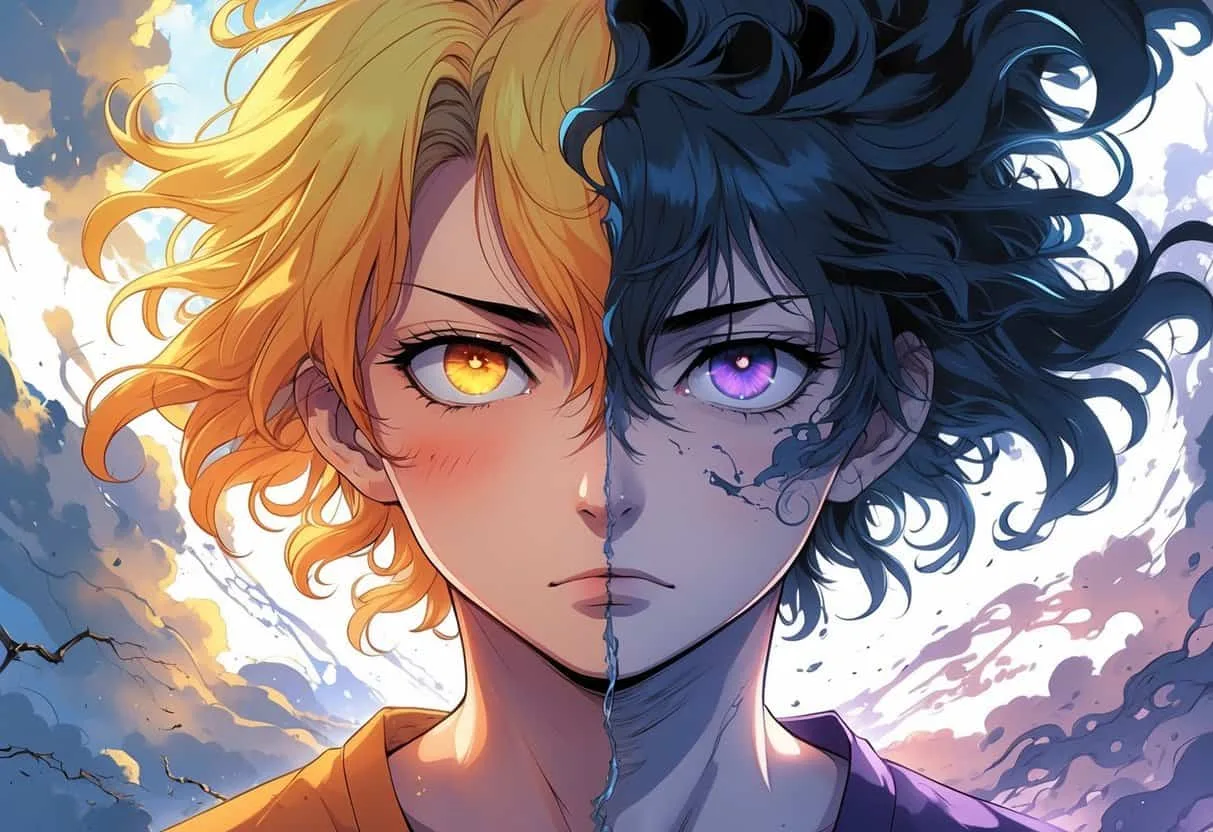
Anime crafts rich narratives through a persistent thematic device: duality. Characters often embody opposing forces—light and shadow, duty and desire, the public self and the hidden self—that collide to shape identity. This ongoing internal friction not only drives plot but also invites viewers to question what identity truly means.
Japanese animation has matured into a medium where psychological depth and philosophical inquiry coexist with spectacular visuals. Duality becomes a lens through which creators examine the fractured nature of the self, making characters feel both extraordinary and profoundly human. As you explore how anime employs twin archetypes, transformation, and symbolic battles, you will uncover a narrative tradition that mirrors real-world struggles with self-understanding.
Far from presenting one-dimensional heroes, anime often refuses easy answers. A protagonist’s journey is rarely a straightforward path from weakness to strength. Instead, it winds through confusion, moral ambiguity, and the painful recognition that identity is never a single, settled thing. This nuanced approach has allowed the medium to address everything from adolescent turmoil to cultural dislocation with remarkable empathy.
The Role of Duality in Shaping Identity in Anime
Duality in anime functions as more than a plot device. It serves as an engine for character growth and a mirror of cultural tensions. By pitting one aspect of the self against another, anime situates identity as a site of constant negotiation. Whether through direct foils, physical transformations, or hidden desires, the medium repeatedly shows that who we are is often defined by what we struggle against.
The following subsections unpack how archetypal contrasts, metamorphosis, and the conflict between social roles and personal truth construct identity within anime narratives.
Archetypes and Contrasting Characters
You will see duality clearly in anime through archetypes—character types that embody opposing traits. Rivals, twins, and complementary duos become visual and narrative shorthand for internal conflict. Consider the dynamic in Death Note, where Light Yagami’s obsessive justice mirrors L’s detached intellectualism. Each defines the other, and their cat-and-mouse game externalizes the clash between ego and morality.
Often, one character wears exaggerated confidence while another carries vulnerability. In Naruto, Naruto Uzumaki’s loud determination contrasts with Sasuke Uchiha’s brooding ambition. Their rivalry reflects a single soul split into two paths: acceptance versus vengeance. The color palette reinforces this binary, with warm oranges pitted against cool blues, and the series constantly asks which version of strength ultimately sustains a person.
Symbolic accessories like masks, uniforms, and even hairstyles highlight the split. The masked anti-hero Tuxedo Mask in Sailor Moon literally hides one identity behind another, while school uniforms in countless series represent a prescribed social self that chafes against the character’s true desires. A deeper analysis of character duality shows how these contrasts create emotional depth by forcing viewers to hold two truths at once: a character can be both heroic and broken, kind and cruel.
This technique also allows anime to explore broader cultural conflicts. The dual protagonists of Psycho-Pass—Akane Tsunemori and Shinya Kogami—embody the tension between systemic justice and vigilante retribution, raising uncomfortable questions about collective identity in a surveillance society. By living in the space between opposites, anime characters model the messy, unresolved nature of real human identity.
Transformation and Self-Discovery
Transformation, or henshin, is perhaps anime’s most iconic visual trope. Magical girls, super robots, and shape-shifters all undergo physical changes that signal inner evolution. Yet beyond the spectacle, transformation sequences often symbolize the painful yet necessary shedding of an old self. When a character transforms, they confront parts of themselves they have hidden or rejected.
In Madoka Magica, the magical girl transformation is explicitly linked to sacrifice, despair, and a metamorphosis into something no longer entirely human. The series refracts the classic henshin through a lens of psychological horror, asking whether the new identity is truly a choice or a trap. Similarly, Paranoia Agent uses the strange creature Shōnen Bat as a catalyst for characters to reveal suppressed aspects of their personality, physically and mentally breaking them open.
Physical change here mirrors identity as fluid, shaped by trauma and ambition. You watch characters grapple with the fear that they are becoming someone they do not recognize, a feeling deeply relatable to anyone who has navigated adolescence or major life upheaval. Studies of transformation in anime note that the sequence is often a liminal ritual, a passage from one state of being to another, mirroring the human experience of growth that feels both exhilarating and destructive.
Even when transformations are technologically induced—as in Ghost in the Shell, where prosthetic bodies can be swapped—the core question remains: what core of identity persists when the outer shell radically alters? This technological duality extends the traditional henshin into a cybernetic age, proving the trope’s enduring relevance.
Sexual Identity and Internal Conflict
Anime frequently explores sexual identity through duality by showing characters torn between social expectations and personal desires. This conflict becomes a key part of their identity crisis. You might encounter a character struggling with hidden feelings that clash with family tradition, career obligations, or even a magical destiny.
In Revolutionary Girl Utena, the protagonist Utena Tenjou refuses to conform to gendered roles, desiring to become a prince while inhabiting a female body. The series uses literal duels and symbolic roses to externalize a battle between internal truth and a world that enforces binaries. The tension between her public performance and private longing creates a layered narrative about queer identity and self-acceptance. Similarly, Given traces the slow, painful process of a young man acknowledging his love for another boy, punctuated by music that gives voice to feelings too complex for ordinary speech.
Anime does not always resolve these tensions neatly. The ambiguity itself is a statement: identity can be a lifelong negotiation rather than a fixed destination. This focus helps you understand that sexual identity is shaped by many pressures, including cultural and personal ones. Recent commentary on LGBTQ+ representation in anime highlights how dual identities—public mask versus authentic self—remain a powerful narrative engine, resonating with audiences around the world.
By refusing to reduce characters to a single label, anime captures the fluid and sometimes contradictory nature of human sexuality. It reminds you that the line between conformity and honest expression is rarely sharp, and that the most compelling characters are those who live in the in-between.
Symbolism, Metaphor, and the Imaginary in Anime
Beyond direct character conflicts, anime layers meaning through symbols, dreams, and alternate realities. These elements externalize the internal, turning psychology into a visual landscape. A character’s inner turmoil may be represented by a fractured mirror, a stormy sea, or an entire pocket universe where the normal rules do not apply.
Dreams and Alternate Realities
Dreamscapes and alternate realities let you witness the subconscious made tangible. In Satoshi Kon’s films, especially Paprika and Perfect Blue, the boundary between dream and waking life erodes. Characters move through distorted spaces that reflect their repressed desires and fears. The dream world becomes a stage where identity fractures and recombines, forcing both character and viewer to question what is real.
Perfect Blue uses the blurring of reality and performance to explore a pop idol’s unraveling sense of self. The protagonist, Mima, can no longer distinguish between her public persona, her private self, and the twisted fiction spun by a stalker. This portrayal of dissociative identity crisis is one of the most acclaimed examples of duality in animation. Scholarly essays on Perfect Blue note how the film’s editing and imagery trap viewers in the same ambiguity, making them experience the confusion firsthand.
Series like Serial Experiments Lain go further by suggesting that the Wired—a virtual world—is as real as the physical one, and that identity exists fluidly across both. In this postmodern vision, the self is no longer singular but distributed, an idea that resonates deeply in an internet-era culture where people maintain multiple online identities.
Death, Violence, and Moral Conflict
Death and violence in anime are rarely gratuitous; they often symbolize deep internal conflict. When a character kills or risks death, the act externalizes a struggle with guilt, sacrifice, or the desire for redemption. In Attack on Titan, Eren Yeager’s escalating violence parallels his moral transformation from victim to aggressor, raising uncomfortable questions about freedom and identity. The series suggests that identity can be consumed and reconstituted through trauma, a literal and figurative devouring of the past.
Violence acts as a language that expresses what words cannot. In Vinland Saga, Thorfinn’s initial obsession with vengeance strips him of identity, reducing him to a single consuming purpose. Only when he lays violence aside does he begin to reclaim a self he thought lost. This arc positions non-violence not as passivity but as a radical redefinition of the person.
Death sometimes appears as an ultimate transformation, pushing characters to face who they really are beyond physical limits. Neon Genesis Evangelion’s instrumentality plot dissolves individual bodies into a collective consciousness, a terrifying vision that equates identity with the very boundaries that death and pain enforce. You are left contemplating whether suffering is essential to being a distinct self.
Allegory and Metaphor in Japanese Anime
Anime frequently uses allegory to comment on cultural identity, environmental catastrophe, and personal growth. Spirited Away turns a bathhouse for spirits into a metaphor for the commodification of identity under capitalism, as Chihiro must remember her real name to escape losing herself completely. The yubaba/zeniba twin sisters embody two sides of the same power, one greedy and controlling, the other generous and wise—a dual archetype rooted in folklore.
In Princess Mononoke, the forest gods and ironworks represent the conflict between nature and industrialization, but the film refuses to designate either side as purely good or evil. The central figures, San and Ashitaka, occupy a middle ground, their identities shaped by the cross-pressures of two worlds. Cultural analyses of Miyazaki’s films frequently note how he uses allegorical duality to critique modern Japan’s relationship with its own traditions.
Even smaller symbols carry weight. A red thread, a broken sword, a falling cherry blossom—these motifs recur across series to signal bonds that tie or sever identity. By employing a shared symbolic vocabulary, anime encourages viewers to read between the lines, recognizing that every visual choice can represent an internal division.
The Influence of Language and Episodic Storytelling
Language in anime is both a narrative tool and a symbolic system. Episode titles frequently contain puns or allusions that hint at the protagonist’s inner state. The Monogatari series, for example, weaves wordplay and direct address to the viewer into its structure, making the act of storytelling itself a metaphor for constructing identity.
Episodic storytelling allows a gradual revelation of internal conflict. Each episode introduces a fragment of the character’s past or a new symbol that reassembles earlier mysteries. In Mushishi, the wanderer Ginko encounters mushi—primordial life forms—that externalize human anxieties; each standalone story peels back another layer of the human psyche. This piecemeal approach mirrors real-life self-discovery, where understanding oneself is rarely a single revelation but an accumulation of moments.
Repeated motifs across episodes—a recurring phrase, a specific camera angle, a musical cue—reinforce the theme of identity as an ongoing process. You begin to see the series itself as a long-form meditation on change, with the episodic structure mimicking the rhythm of memory and reflection.
Cultural, Technological, and Philosophical Contexts
Anime’s treatment of duality stands on a foundation of Japanese cultural traditions, the history of animation as an art form, and the influence of postmodern thought. By situating identity conflict within these contexts, the medium connects personal struggles to larger philosophical questions.
Japanese Cultural Production and Social Relations
Anime is deeply embedded in Japan’s cultural production. It engages with nationalism and tradition while also questioning rigid social structures. Many series draw on Shinto concepts, where spirits (kami) inhabit natural objects, implying that identity is not limited to the human sphere. The prevalence of yokai (supernatural creatures) in series like Natsume’s Book of Friends suggests a world in which the self is porous and interconnected with other beings.
At the same time, anime often critiques the pressure to conform. Hayao Miyazaki’s works balance celebration of Japanese landscape with sharp criticism of militarism and industrial greed. The Wind Rises presents an engineer torn between the beauty of flight and the destruction his creations enable, a duality rooted in Japan’s modern history. Academic works on anime and Japanese society detail how these narratives mediate collective anxieties about identity loss in a rapidly changing nation.
Social relations—particularly the tension between individual desire and group harmony—appear as recurring dualities. Characters who refuse to fit neat social categories become the focal point for narratives about freedom, suffering, and belonging. In doing so, anime becomes an arena where cultural norms are both reproduced and challenged.
Animation History and Notable Creators
Understanding anime’s duality requires looking at its pioneers. Osamu Tezuka, recognized as the “God of Manga,” introduced complex, morally ambiguous characters in series like Astro Boy (Mighty Atom). His use of limited animation, born of budgetary constraints, paradoxically enhanced symbolic expression: a simple gesture could carry immense weight because so much was left to the viewer’s imagination.
Later, directors like Satoshi Kon pushed the medium into psychological territory. His editing techniques in Millennium Actress collapse time and space, blending memory, film, and reality to portray a woman whose identity is woven from the roles she has played. Animation studies resources highlight how Kon’s work reframed anime as a medium capable of exploring the most intricate labyrinths of the self.
These creators laid the groundwork for a tradition where narrative and visual experimentation are inseparable from thematic depth. Their legacy means that when contemporary anime presents a split-screen or a character’s reflection fracturing in water, you recognize it as part of a long conversation about divided identity.
Technology, the Internet, and Postmodern Discourse
Digital technology has reshaped anime production and consumption, and these shifts are reflected in the content. Serial Experiments Lain (1998) anticipated the internet’s ability to fragment and multiply the self, asking whether identity can survive in a networked world. The series’ imagery of wires and cyberspace literalizes the dual existence many people now lead between online and offline personas.
Postmodern themes permeate modern anime, where genres are regularly blended, fourth walls broken, and identity treated as performance. The Melancholy of Haruhi Suzumiya plays with the idea that a single girl’s unconscious will can reshape reality, making the world itself a projection of internal conflict. Such narratives echo philosophical questions from postmodern thinkers about the disappearance of a stable self. Online articles on postmodern anime often cite these series as case studies in the dissolution of traditional identity markers.
The interplay between old techniques and new media creates a unique visual language. The tension between hand-drawn warmth and digital precision itself becomes a metaphor for the duality between tradition and innovation, humanity and machine—themes that anime continues to probe with increasing sophistication.
Case Studies: Iconic Examples of Duality in Anime
To see how these principles converge, certain series and films stand as masterclasses. Each uses duality in a distinctive way, yet all share an insistence that identity is forged through conflict, not despite it.
Neon Genesis Evangelion and the Crisis of Identity
Neon Genesis Evangelion remains perhaps the most exhaustive exploration of psychological duality in anime. Shinji Ikari is an extreme portrait of a divided self, caught between the desire for human connection and a terror of being hurt. The Eva units themselves are dual entities—both machine and organic being, protector and potential destroyer—that externalize the pilots’ traumas.
The series employs mirrored characters like Rei Ayanami, who is literally cloned, raising questions about whether identity resides in the soul, body, or memory. Asuka Langley Soryu’s outward confidence masks deep-seated terror of inadequacy, creating a facade that cracks violently as the series progresses. Each episode peels back another layer, revealing that the true battlefield is the interior of the mind. The infamous final episodes dive entirely into internal monologue, abandoning traditional plot to stage a direct confrontation with the self. This radical choice cemented the show’s status as a landmark in using dual structure to dissect identity crisis.
Hayao Miyazaki’s Exploration of Duality
Across Miyazaki’s filmography, duality manifests through the collision of natural and human worlds. Princess Mononoke gives you San, a human girl raised by wolf gods, who embodies the border between species and loyalties. The forest spirits, especially the Deer God, represent a dual force of life and death, healing and destruction. Ashitaka, cursed by a boar demon, carries a mark that is both a death sentence and a source of supernatural strength, forcing him to see with eyes unclouded by hate—a phrase that acknowledges inner prejudice as a conflict to be overcome.
Spirited Away traps Chihiro in a spirit realm where she must work to reclaim her parents and her name. The duality between Yubaba and Zeniba, twin sorceresses with opposing natures, suggests that every person houses contradictory impulses. Howl’s Moving Castle literalizes dual identity: Howl transforms into a bird-like monster, risking his humanity to protect others, while Sophie’s aged appearance fluctuates with her self-confidence. Miyazaki shows that identity often involves shifting masks, and that authenticity requires acknowledging the parts of ourselves we least admire.
Full Metal Alchemist and the Alchemy of Self
Fullmetal Alchemist: Brotherhood uses alchemical law as a metaphor for personal growth. The principle of Equivalent Exchange—to obtain something, something of equal value must be lost—mirrors how identity is built through sacrifice and loss. Edward Elric’s automail limbs and Alphonse’s soul bound to armor embody the split between physical form and spirit. Their quest to restore their original bodies is a quest to make the self whole again.
The homunculi, each named for a deadly sin, represent fragments of a single person’s identity that have splintered off and taken monstrous form. This externalization of inner flaws makes literal the idea that identity can shatter under pressure, and that integration is a painful but necessary goal. The series insists that true strength arises not from denying one’s weaknesses but from integrating them, a message that resonates with therapeutic narratives of healing from trauma.
Mythic Figures: kami, dios, prince, and Authority
Anime’s mythic figures embody duality at the archetypal level. Kami, or nature spirits, in Princess Mononoke and Mushishi represent forces that are both nurturing and terrifying, reflecting the idea that identity includes a primal, untamable element. Gods in Noragami are shown to depend on human belief for their existence, making divine identity contingent and fragile—a sharp contrast to Western notions of omnipotence.
The princely figure often struggles with dual responsibilities. In The Rose of Versailles, Oscar François de Jarjayes is raised as a man to fulfill military duty, yet grapples with a feminine identity that erupts in love and vulnerability. Princes in anime from Code Geass to Ranking of Kings challenge the audience by balancing noble ideals with ruthless decisions. Authority figures, whether benevolent kings or tyrannical emperors, showcase the dual nature of power: it can protect or consume, and a ruler’s identity is forged in the crucible of that tension.
The Enduring Legacy of Duality in Anime
From early cel animation to today’s digital spectacles, duality has remained a defining pulse of the medium. It enables anime to tackle the most profound questions—Who am I? Can I change? What do I fear becoming?—without relying on exposition. The visual and narrative language of duality gives form to the formless, turning inner turmoil into shared experience.
As you watch new series emerge, the same patterns recur because the human struggle with divided identity is timeless. Anime’s unique ability to blend the symbolic and the hyperreal ensures that duality will continue to drive character development and thematic exploration. Recent features on modern anime trends confirm that the most critically acclaimed works are those that refuse to present easy identities, instead inviting audiences to sit with contradiction and ambiguity.
By engaging with these stories, you participate in a cross-cultural conversation about what it means to be a person in a fragmented world. Duality, in the end, is not something to be solved but something to be acknowledged—a truth that anime, with its infinite capacity for invention, continues to illuminate.