Table of Contents
The Paradox of the Crowded City
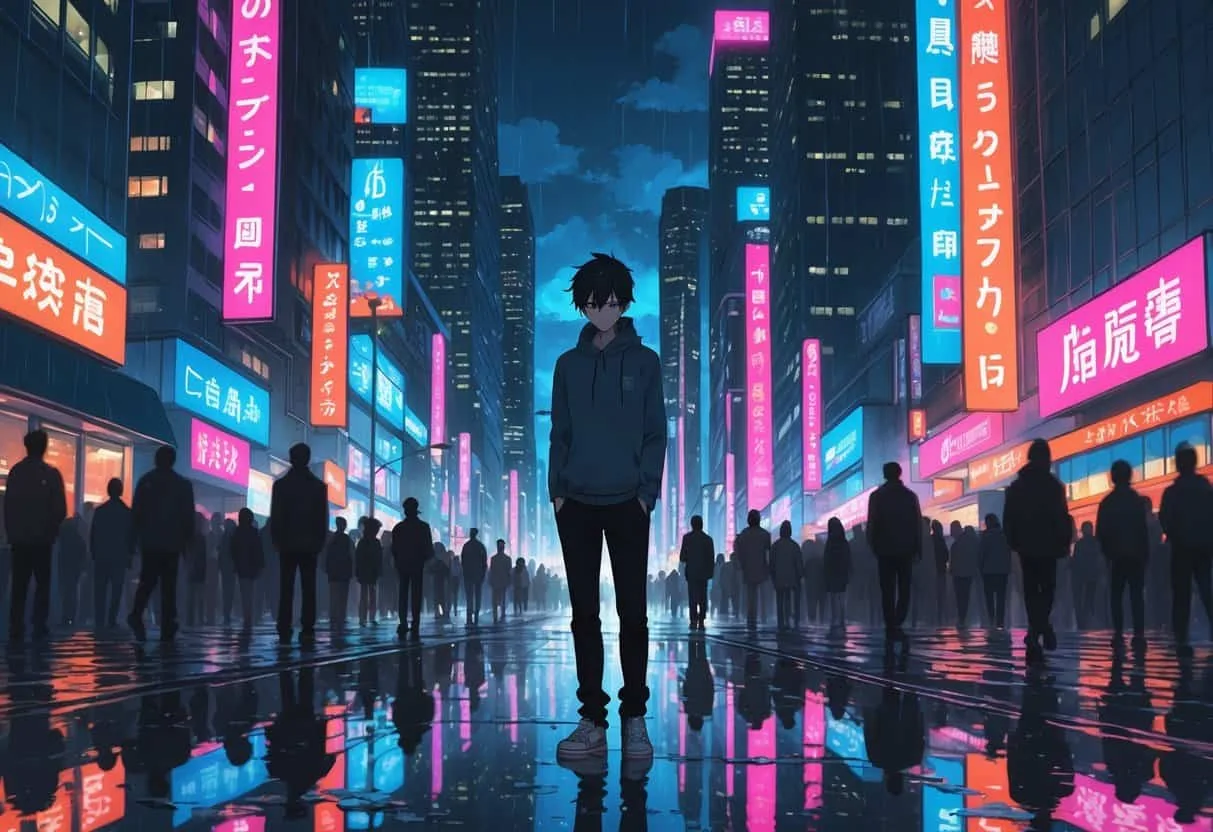
Anime often frames the modern metropolis as a space of profound contradiction. In works set amid neon-lit skylines and thrumming train stations, characters are perpetually buffeted by crowds yet remain unseen. This paradox—to be surrounded by thousands of people and still feel fundamentally alone—forms one of the most persistent emotional undercurrents in Japanese animation. The city becomes a giant mechanism that churns out noise, light, and motion, but rarely warmth.
Urban loneliness in anime is not simply the absence of company. It is a layered sensation of invisibility, a sense that the sheer speed of city life erodes the possibility of genuine connection. Consider the frantic commuter scenes in Tokyo Godfathers or the muted, wide-angle shots of Shibuya crossing in numerous slice-of-life dramas. The image is always the same: a sea of faces without eye contact, a torrent of movement that somehow passes you by. Directors use these moments to remind viewers that the city’s relentless pulse can swallow individual identity whole.
This feeling aligns with real sociological research: a growing body of work links urban density to heightened loneliness when public spaces prioritize efficiency over intimacy.
Yet anime rarely condemns the city outright. Instead, it treats urban loneliness as a condition to be navigated—sometimes deepened, sometimes overcome. The same tower blocks that warehouse people in isolation can also offer a perch for quiet self-reflection. The train that separates lovers also delivers them to destinations where new bonds might form. In this ambivalence, anime captures something essential about contemporary life: that cities amplify both our solitude and our longing for connection, and that the two states exist in an uneasy, perpetual tension.
Visual Language of Isolation
Anime’s visual toolbox is exceptionally well-suited to depicting loneliness. From architectural framing to color grading, the medium can transform an ordinary cityscape into a psychological landscape. When a character feels disconnected, the world around them shrinks, flattens, or turns monochromatic. These choices are never accidental; they form a deliberate visual grammar of alienation that audiences around the globe now instinctively read.
The Architecture of Alienation
Modernist architecture in anime often stands as a monument to emotional distance. Towering glass facades, uniform apartment blocks, and highway overpasses slice the frame into cold, geometric compartments. In Ghost in the Shell, director Oshii Mamoru uses immense, oppressive buildings to convey a future where humans are dwarfed by the systems they built. Narrow corridors and one-room apartments trap characters inside their own thoughts, while lines of identical windows hint at lives lived in parallel but never touching. These spaces feel clean, efficient, and utterly devoid of human presence.
Equally evocative are the forgotten spaces: back alleys puddled with rain, deserted rooftops, and concrete riverbanks gleaming under streetlamps. These interstitial zones—neither fully public nor truly private—become refuges for lonely souls. In The Garden of Words, Makoto Shinkai turns a Shinjuku park shelter into a small cathedral of mutual isolation, where two strangers meet in the rain and slowly unravel their private hurts. The architecture doesn’t just contain the story; it externalizes an inner state, making loneliness visible and almost tangible.
Light, Shadow, and Emptiness
Anime directors manipulate light to signal emotional weather. Cold blue tones wash over nighttime cityscapes, while harsh fluorescent lighting in convenience stores or train carriages bleaches warmth from human skin. Shadows stretch long and thin, carving characters out from their surroundings. In Perfect Blue, Satoshi Kon uses the sterile glow of a computer screen to isolate Mima Kirigoe, reducing her room to a claustrophobic box where reality and hallucination bleed together. The screen illuminates her face but casts the rest of the world into darkness—a precise visual metaphor for the way digital life can separate us from the physical world.
Empty spaces speak loudly in anime. An unoccupied bench, a single pair of shoes by the door, a train seat deliberately left vacant—these compositions whisper of absence. When a crowd is rendered as a blurred, anonymous smear while a single character stands in sharp focus, the technical decision communicates a psychological truth: loneliness is not about the number of people present, but about the perception of distance between oneself and everyone else. Shinkai’s 5 Centimeters per Second elevates this into a defining aesthetic, where trains, stations, and snowy fields act as barriers that keep lovers apart, their isolation painted in exquisite, aching detail.
Narrative Techniques for Conveying Solitude
Beyond visuals, anime relies on storytelling structures that mirror the inner experience of loneliness. Pacing slows to a crawl during moments of introspection; dialogue dwindles; the soundtrack might drop away entirely, leaving only ambient noise like the hum of an air conditioner or the distant murmur of traffic. These structural choices invite the audience to sit inside the character’s solitude rather than simply observe it from the outside.
Escapism and the Inner World
Many anime protagonists respond to urban loneliness by retreating into fantasy, hobbies, or obsessions. This escapism is rarely condemned as simple weakness; instead, it’s examined as a coping mechanism with painful trade-offs. Welcome to the NHK follows a young shut-in whose entire existence has contracted to a tiny apartment, his connection to the outside world mediated through a computer screen and a parade of conspiracy theories. The anime doesn’t shy away from showing how comforting these escapes can feel, nor how they ultimately deepen the isolation they were meant to ease.
This pattern repeats across genres. In Paranoia Agent, Satoshi Kon explores characters who create internal narratives to fend off despair, only to find those narratives collapsing under the pressure of reality. Even gentler works like March Comes in Like a Lion show how a character’s inner world—whether expressed through shogi, art, or quiet brooding—can both cushion and imprison. The city outside remains indifferent, so the mind builds its own architecture, sometimes sheltering, sometimes trapping.
Otaku Culture and Consumerism
Otaku culture emerges in urban anime as a double-edged response to loneliness. On one hand, the intense fandom around anime, manga, games, and collectibles offers a sense of belonging and purpose. Characters who feel invisible in mainstream society can find identity and community within niche interests. Series like Genshiken and Steins;Gate depict these subcultures as legitimate lifelines, spaces where awkward, isolated individuals finally connect over shared passion.
On the other hand, anime frequently critiques the consumerist side of this comfort. The same merchandise that provides temporary solace can become a hollow substitute for real human warmth. Welcome to the NHK again illustrates this with painful clarity, as the protagonist’s purchasing of figurines and media mirrors a transactional approach to emotion—things bought, but never truly fulfilling. The anime suggests that when consumerism fills the gap created by loneliness, it often just smooths the edges of the hole without ever closing it. This ambivalence reflects deeper cultural debates in Japan about the relationship between material comfort and an increasing sense of social atomization.
Digital Technology and Social Media
If otaku culture is one response to urban isolation, digital technology represents another—and in many anime, the two intertwine. Smartphones glowing in dark bedrooms, endless scrolling through social media, and online gaming communities populate the visual landscape of modern anime. Serial Experiments Lain tackled these questions presciently two decades ago, portraying a girl whose entire sense of self becomes entangled with a virtual world that ultimately threatens to absorb her completely.
More recent works like Your Name use the smartphone not just as a communication device but as a repository of memory and longing. When a crucial contact vanishes from a character’s phone, the digital absence delivers a gut-punch of loneliness that feels remarkably true to life. Anime captures the paradox of hyperconnectivity: we can broadcast our lives to thousands and yet feel more invisible than ever. The data that flows between devices often fails to transmute into the emotional data that nourishes human connection. This is the urban condition anime so often returns to—a world wired together but frayed at the level of the heart.
Iconic Anime and Their Lonely Protagonists
Certain anime have become touchstones for the exploration of urban loneliness, each approaching the theme from a distinct angle. Whether through cyberpunk futures, psychological horror, or post-war trauma, these works dig deep into what it means to be alone in a city that never stops moving.
Ghost in the Shell and Technological Alienation
In Ghost in the Shell, the city of New Port City is a gleaming organism of circuits and steel, but its inhabitants drift through it like ghosts. Major Motoko Kusanagi’s existential crisis—wondering whether her cybernetic body contains a true self or merely a ghost—mirrors the alienation of a society where technology has outpaced intimacy. The film’s visual language, with its long tracking shots across reflective skyscrapers and its emphasis on surveillance, suggests that the more connected we become, the less we know who we are. As critics have noted, Oshii’s direction transforms the city into a character—a cold, all-seeing presence that isolates rather than unites.
Satoshi Kon and Psychological Solitude
Satoshi Kon’s entire filmography can be read as a sustained meditation on psychological solitude in the modern metropolis. Perfect Blue dissects the fragmentation of identity under the twin pressures of celebrity culture and digital voyeurism. Mima’s apartment becomes a prison where the line between public performance and private self dissolves. In Tokyo Godfathers, three homeless characters, each carrying their own trauma, find temporary family on the streets—a brief reprieve from the city’s harsh indifference. Kon never offers easy comfort; instead, he shows how loneliness can warp perception, and how the mind, left too long in isolation, may turn against itself.
Death Note and Ideological Isolation
Death Note presents a different strain of loneliness: the isolation that comes from self-appointed moral superiority. Light Yagami’s belief that he alone can judge the world cuts him off from everyone who might have grounded him. His genius becomes a wall, and the city of Tokyo transforms into a game board where he moves pieces from a distance. The more he commits to his ideology, the more invisible he becomes—to his family, to his allies, and ultimately to himself. The crowded streets below his vantage points highlight the gap between his self-image and the messy, human reality he refuses to embrace.
This arrogance-driven solitude is its own kind of urban tragedy, one that anime traces with unflinching precision.
Mecha and Post-War Isolation
The mecha genre, from Mobile Suit Gundam to Neon Genesis Evangelion, weaves loneliness into the cockpit of the giant robot. These war machines are simultaneously protectors and destroyers, isolating their pilots behind armor and interface screens. The trauma of World War II—collective guilt, the loss of identity in defeat, the struggle to rebuild—haunts many of these narratives. Evangelion in particular turns the city of Tokyo-3 into a battleground where Shinji Ikari’s existential despair is as formidable an enemy as any Angel. The giant mecha becomes a metaphor for the self: powerful but hollow, a shell that keeps others at a distance while demanding everything.
Cultural Roots of Isolation in Japanese Anime
Anime’s preoccupation with urban loneliness is not purely artistic invention; it draws deeply from Japanese cultural, historical, and spiritual soil. Understanding these roots enriches the viewing experience and explains why these stories resonate so powerfully across borders.
Folklore, Impermanence, and the Modern Self
Traditional Japanese aesthetics, particularly the concept of mono no aware—the bittersweet awareness of impermanence—infuses anime depictions of transient urban life. The cherry blossoms that fall outside a salaryman’s window, the rain that erases footprints, the train that departs before a farewell is finished: these motifs carry centuries of cultural weight. Shinto and Buddhist ideas about the coexistence of seen and unseen worlds also find their way into anime, where the crowded city feels haunted by absent presences. Spirits, memories, and abandoned selves drift through the streets, making loneliness not just a psychological state but a spiritual one.
When a character in Mushishi or Natsume’s Book of Friends encounters a forgotten god or a wandering spirit, the encounter mirrors the isolation felt by humans who have lost their place in the modern order. The city may be full of people, but it is also full of voids—emotional, historical, and supernatural. Anime bridges the ancient and the contemporary, suggesting that loneliness is both an age-old human condition and a uniquely modern epidemic.
Streaming, Gaming, and Global Resonance
Streaming platforms have made anime’s urban loneliness accessible to a worldwide audience, transforming a culturally specific expression into a global mirror. Services like Amazon Prime and Netflix distribute series that speak directly to the isolation felt in cities from London to São Paulo. Video games, too, extend the theme interactively: Persona 5 lets players navigate a stylized Tokyo where every social bond must be deliberately cultivated, and loneliness is the default state until the protagonist actively reaches out. This interplay between streaming and gaming reinforces the idea that urban solitude is a shared international experience, not a local quirk.
The rising academic attention to urban loneliness underscores anime’s prescience. The medium anticipated, studied, and aestheticized what sociologists would later quantify: that crowded cities produce a specific type of emotional isolation that can affect mental health, social cohesion, and personal identity. Anime doesn’t just reflect this reality; it provides a language for it.
Miyazaki, Shinkai, and the Poetics of Distance
Hayao Miyazaki approaches urban solitude with a gentle, almost elegiac touch. In Spirited Away, the abandoned theme park and the bathhouse for spirits represent the loneliness of a world where people have forgotten the sacred. Chihiro’s journey is one of reconnection—with nature, with spirit, and with her own courage. Miyazaki balances the desolation of modern life with a persistent hope that community can be rediscovered, even if it requires crossing into another realm.
Makoto Shinkai, by contrast, makes distance itself the central subject. 5 Centimeters per Second, The Garden of Words, and Your Name all explore the anguish of separation—geographical, temporal, emotional—and the fragile threads that still bind people across these divides. His cities are achingly beautiful but brutally indifferent, and his characters must fight through time, space, and memory to touch one another. Together, Miyazaki and Shinkai bracket the emotional spectrum of urban loneliness, from nostalgic yearning to desperate longing, capturing the full depth of what it means to seek connection in a world that keeps pulling us apart.
The Search for Connection
Anime that dwells on urban loneliness almost never leaves its characters utterly stranded. The same medium that diagnoses isolation also chronicles the stubborn human effort to bridge it. A Silent Voice traces a young man’s attempt to atone for past cruelty and, in doing so, to rebuild his capacity for empathy and friendship. March Comes in Like a Lion follows a professional shogi player’s slow, awkward integration into a warm family unit that refuses to let him disappear into his depression. Even the bleakest urban stories seed moments of fragile connection—a shared meal, a listening ear, a hand reaching out across an otherwise empty platform.
These narratives suggest that urban loneliness is not a permanent sentence. It can be a passage, a crucible that, when understood, leads toward deeper self-awareness and more intentional connections. The city may be designed for speed and efficiency, but anime insists that slow, deliberate acts of presence—stopping to talk with a neighbor, sitting in a park with a stranger, replying to a message instead of just scrolling past—can reconfigure the landscape. Connection is not the absence of loneliness; it is the hard-won response to it, and anime’s greatest gift is the conviction that this response is always worth attempting, even in the middle of the coldest city night.