Table of Contents
Beyond the Cherry Blossoms: Understanding Japanese School Life Through Anime
Anime has become one of the most influential windows into Japanese culture for international audiences, and school-life series hold a special place in this cultural exchange. These shows blend genuine customs like uniform dress codes, club commitments, and exam pressures with dramatic storytelling that prioritizes entertainment over strict accuracy. The result is a fascinating hybrid that teaches viewers about real Japanese educational practices while simultaneously creating fictional worlds where romance unfolds on rooftops and supernatural events disrupt ordinary classroom routines.
This tension between reality and fiction is what makes school anime so compelling. You learn about the importance of group harmony through cleaning duties, witness the intensity of sports festival competitions, and observe the subtle social hierarchies that govern student interactions. Yet you also encounter love polygons, secret identities, and magical powers that have no place in actual Japanese schools. Understanding where authenticity ends and creative license begins transforms how you watch these series, revealing both the cultural depth and the artistic choices that define the genre.
What You Will Discover in This Analysis
- The daily customs and routines that anime portrays with high fidelity
- How club activities and social structures mirror real Japanese schools
- The dramatic exaggerations and supernatural additions that define fictional school life
- How studio influences and manga origins shape on-screen depictions
- The global impact of school anime on perceptions of Japanese education
The Accurate Foundations of School Life in Anime
Daily Rhythms and Physical Spaces
Japanese school mornings in anime begin with a familiar ritual: students walking or cycling along tree-lined streets, meeting friends at the school gate, and pausing at the shoe lockers to exchange outdoor footwear for indoor slippers. These getabako appear so frequently that they have become a visual shorthand for school settings, appearing in everything from romantic comedies to supernatural thrillers. The detail is authentic—real Japanese schools require students to change shoes, and these locker areas function as social hubs where friendships form and important conversations happen.
Classes typically begin at 8:30 a.m. with homeroom, where teachers take attendance and deliver announcements before subject specialists rotate through the day. Anime captures the structure of six or seven periods with breaks between them, though the pacing often compresses time for narrative efficiency. Lunch period receives faithful treatment in many series, with students eating together in their classrooms rather than in a central cafeteria. The bento boxes that characters exchange and share are genuine cultural artifacts, reflecting the care that goes into meal preparation in Japanese households. Schools with lunch programs, known as kyushoku, serve balanced meals that students eat together, a practice that reinforces community values.
One of the most accurate depictions across the genre is the daily cleaning time, or souji. Students sweep floors, wipe desks, and tidy common areas without janitorial staff, embodying the educational philosophy that responsibility for shared spaces belongs to everyone. Anime rarely exaggerates this practice because it is already visually distinct and culturally meaningful. Afternoon club activities follow, with sports teams practicing on fields, music ensembles rehearsing in dedicated rooms, and cultural clubs pursuing their specialized interests. The commitment level shown—students staying until dusk, returning on weekends, and prioritizing club responsibilities—reflects genuine Japanese school culture.
However, anime often grants characters extended free time for wandering rooftops or lingering after practice, whereas real students face stricter schedules and limited unsupervised access to school facilities. For a comprehensive breakdown of Japan’s educational calendar and daily structure, resources covering Japan’s education system provide valuable context.
Uniforms as Cultural Markers
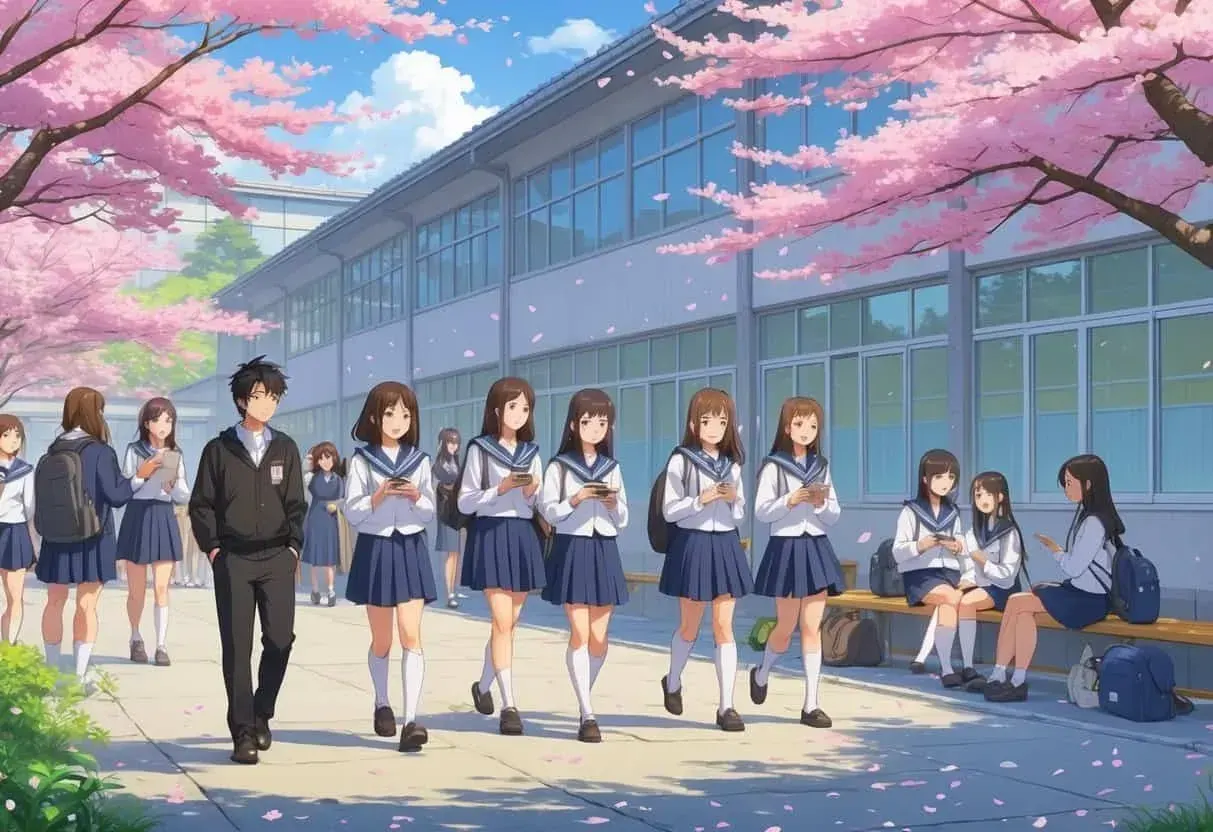
School uniforms in anime are immediately recognizable and aesthetically varied, drawing from real-life styles while taking creative liberties. The traditional gakuran for boys—dark, high-collared jackets with brass buttons—dates to the Meiji era and appears in period pieces and traditional schools. Sailor-style outfits for girls, with their distinctive collars and pleated skirts, became iconic through series like Sailor Moon, though that show famously transformed the uniform into a magical battle costume. Modern anime frequently features blazer-style uniforms with neckties or ribbons, reflecting contemporary trends in actual Japanese schools.
Real schools enforce strict dress codes that govern hem lengths, sock height, hair color, and accessory rules. Students who violate these codes may face warnings or disciplinary action. Anime characters, by contrast, often personalize their uniforms with rolled-up sleeves, loose neckties, skirts shortened to varying degrees, or dyed hair that would never pass inspection in a real school. These visual choices signal character personality: rebellious students show their defiance through uniform modifications, while rule-following characters keep their appearance pristine. The seasonal uniform rotation between summer and winter versions appears in some anime, though many series maintain a consistent look for visual simplicity.
The cultural significance of uniforms extends beyond aesthetics, symbolizing belonging, discipline, and the transition between childhood and adulthood that school represents.
Club Culture and Social Hierarchies
Club activities, or bukatsu, dominate after-school life in both real Japanese schools and their anime counterparts. Students typically join one club—sports, music, academic, or cultural—and commit substantial time to practice, competitions, and performances. The senpai–kohai relationship, where senior students mentor juniors, governs club dynamics and appears frequently in anime storylines. This hierarchy carries real weight, with juniors expected to show respect, perform supportive tasks, and learn from their seniors' experience. Anime like Haikyuu!! and K-On! capture the intensity of these relationships, showing how they create both support systems and sources of tension.
Inter-school tournaments and competitions generate genuine excitement in Japanese education, and anime magnifies this energy into climactic narrative arcs. The emotional stakes of a volleyball match reaching its final point or a music club performing at a national competition reflect real pressures that students face, though anime often heightens the drama with personal backstories and high-stakes consequences. Student councils appear in many series as influential bodies that organize school events and represent student interests, though their power in anime is frequently exaggerated. In reality, student councils have limited authority within the administrative structure of schools, serving more as a forum for student input than a decision-making body. The depth of Japanese bukatsu culture has been extensively documented, showing how these activities shape student development and social bonds.
Academic Pressure as a Central Theme
The examination system that governs Japanese education creates intense pressure that anime portrays with varying degrees of accuracy. High school and university admissions depend heavily on standardized test scores, leading many students to attend juku—cram schools that provide supplementary instruction in the evenings and on weekends. Series like Assassination Classroom and The Quintessential Quintuplets place academic struggle at the center of their narratives, showing characters confronting test anxiety, ranking systems, and fear of failure. The rituals of mock exams, study sessions, and the solemn atmosphere of examination halls are rendered with noticeable fidelity to real experiences.
Where fiction departs from reality is in the resolution of academic challenges. Anime protagonists often achieve dramatic improvement through sudden motivation, unconventional teaching methods, or heroic study sessions that produce unlikely results. In real Japanese schools, academic progress is gradual, and the psychological toll of examination pressure can be severe. Students who fail their first-choice university entrance exams may become ronin—literally meaning "masterless samurai"—spending an additional year or more preparing for another attempt. This experience carries significant social stigma and financial cost, yet anime rarely explores these darker outcomes, preferring narratives of triumph over adversity.
The societal weight of Japan’s exam-oriented education system shapes adolescent experiences in ways that extend far beyond the classroom.
Where Creative Liberties Define School Anime
Amplified Romance and Emotional Drama
Anime thrives on emotional intensity that bears little resemblance to the reserved social norms of real Japanese schools. Love confessions beneath cherry blossom trees, dramatic rooftop declarations, and multi-person romantic rivalries are crafted for maximum narrative impact rather than cultural accuracy. In actual Japanese schools, relationships develop gradually and privately. Public displays of affection are uncommon, and overt emotional expressions are often socially discouraged, particularly in school settings where group harmony takes precedence over individual desires. The festival confession scene, where a character interrupts a fireworks display or school performance to declare their feelings, is almost entirely a narrative invention.
Cultural festivals and sports days do provide genuine social inflection points where students interact outside normal classroom dynamics, but anime transforms these events into life-altering moments that rarely occur in real life.
The harem genre and its variations, where one ordinary student becomes the romantic focus of multiple classmates, represent the most extreme departure from reality. These narratives use the school setting as a convenient container for character interactions while abandoning any pretense of social authenticity. Even in more grounded romance series, the frequency and drama of romantic encounters exceed what typical students experience. The appeal lies not in realism but in wish fulfillment and emotional catharsis, giving viewers the heightened feelings they crave from entertainment.
Supernatural and Folkloric Dimensions
A significant portion of school anime incorporates supernatural elements drawn from Japanese folklore, Shinto beliefs, and urban legends. Transfer students may reveal themselves as kami or yōkai, school buildings might harbor spirits, and clubs may investigate paranormal phenomena. Series like Mushishi, Natsume's Book of Friends, and Tokyo Ravens weave traditional beliefs into school settings, creating worlds where the ordinary and extraordinary coexist. These supernatural elements draw on Japan's rich mythological heritage, introducing international audiences to concepts like kamisama, yōkai, and ayakashi that have deep cultural roots.
In real Japanese schools, folklore and spiritual beliefs appear primarily in cultural studies classes, local festivals, and informal storytelling. Students may visit shrines during New Year or participate in Obon festivals, but supernatural encounters remain firmly in the realm of imagination. The inclusion of these elements in anime allows creators to explore themes of identity, tradition, and the unknown while providing the spectacle that distinguishes animation from live-action storytelling. Even series that ground themselves in realistic school settings often incorporate a single supernatural premise, using the contrast between mundane school life and extraordinary events to generate narrative tension.
Recurring Tropes and Their Cultural Significance
The Transfer Student as Narrative Catalyst
Anime frequently introduces a mysterious transfer student who arrives with secrets, unusual abilities, or hidden pasts that reshape the social dynamics of their new class. While student transfers do occur in Japanese schools—typically due to parental job relocations—the process is far less dramatic than anime portrays. Actual transfer students receive standard orientation, adapt to their new environment gradually, and rarely possess supernatural attributes or traumatic backstories that drive the plot. The trope persists because it provides an efficient mechanism for introducing conflict, mystery, and character development without requiring elaborate setup. The transfer student enters as an outsider, compelling existing characters to reveal their own values and relationships through their responses to the newcomer.
Rooftops as Sanctuaries
School rooftops in anime function as private retreats where characters share confessions, confront each other, or reflect on their experiences. These scenes carry emotional weight precisely because the rooftop feels separate from the regulated world of classrooms and hallways. In reality, most Japanese schools restrict rooftop access for safety reasons, with doors locked and students prohibited from entering without supervision. The rooftop meeting is a narrative convenience that provides a visually striking, emotionally charged setting unavailable in actual schools. The trope has become so established that viewers accept it without question, despite its departure from realistic school layouts.
Cherry Blossoms and Seasonal Symbolism
Cherry blossoms, or sakura, appear in nearly every school anime set during spring, their petals drifting across scenes of new beginnings and bittersweet farewells. The timing is accurate—cherry blossoms bloom in late March to early April, coinciding with the Japanese school year start. The cultural significance of sakura as symbols of transience and renewal is deeply embedded in Japanese aesthetics, and anime amplifies this meaning through stylized animation that emphasizes their beauty. Where anime diverges is in the frequency and prominence of cherry blossom scenes. In real life, the blooming period lasts only one to two weeks, and students experience cherry blossoms primarily during hanami viewing parties rather than as a constant backdrop to their daily lives.
The visual shorthand of drifting petals has become so powerful that it instantly communicates seasonal setting and emotional tone to audiences worldwide.
Lunchtime Rituals and Food Culture
The comedic trope of students racing to the school store for yakisoba pan or melon bread reflects a creative exaggeration of actual lunchtime practices. While some Japanese schools have small shops or vending machines where students can purchase snacks, the theatrical sprint is a narrative device designed to generate visual comedy and character interactions. Real lunch periods are orderly, with students eating together in their classrooms, sharing food, and talking quietly. School lunch programs, where designated students serve meals to their classmates, appear accurately in series that choose to highlight communal dining, but many anime substitute these realistic scenes with more dynamic scenarios that allow characters to interact outside the classroom setting. The food itself—onigiri, bento boxes, curry rice, and other staples—is typically depicted with high fidelity, reflecting the importance of food culture in Japanese daily life.
Influences That Shape School Anime Representation
Urban Settings and the Tokyo Effect
Tokyo and other major cities frequently serve as backdrops for school anime, their crowded streets, neon lights, and vertical school buildings reflecting the density and pace of urban student life. The morning commute on packed trains, the anonymity of a mega-city, and the pressure to stand out in competitive environments all become thematic elements that shape character experiences. Series like Toradora!, Fruits Basket, and Your Lie in April embed their stories in recognizable Tokyo neighborhoods, creating a sense of place that international viewers associate with modern Japan. The urban setting amplifies themes of isolation, ambition, and connection, offering a specific vision of Japanese adolescence that differs significantly from rural experiences. Real school anime tourism, where fans visit locations featured in their favorite series, demonstrates how these settings create meaningful connections between fiction and reality.
Studio Ghibli’s Legacy of Grounded Realism
Studio Ghibli, under the direction of Hayao Miyazaki and his collaborators, has profoundly influenced how anime approaches everyday life. Films like Whisper of the Heart and From Up on Poppy Hill prioritize quiet authenticity over dramatic spectacle, finding emotional resonance in mundane activities: walking through familiar streets, preparing meals, studying in libraries, or cleaning classrooms. Miyazaki’s philosophy emphasizes the dignity of ordinary experience, treating school life not as a backdrop for fantasy but as a meaningful context for human growth. This approach has shaped global expectations for realistic school depictions, establishing a standard of grounded authenticity that other anime may embrace or deliberately subvert. Even fantastical Ghibli films like Spirited Away and My Neighbor Totoro ground their supernatural elements in the textures of daily Japanese life, creating worlds that feel simultaneously magical and real.
Manga as the Foundation for School Narratives
The vast majority of school anime originate as manga, where creators develop detailed classroom arcs, character relationships, and seasonal storylines over months or years of serialization. Manga offers unique advantages for depicting school life: panel layouts can capture fleeting expressions, extended sequences can explore emotional nuances, and the serial format allows for gradual character development that mirrors the real passage of school years. Creators like Rumiko Takahashi, Ai Yazawa, and Mitsuru Adachi have built entire careers around school settings, establishing conventions that subsequent generations of artists reference and subvert. When manga is adapted into anime, the source material provides a detailed blueprint for cultural accuracy—uniform styles, classroom layouts, teacher-student dynamics, and social codes all carry over from the original work. The collaborative pipeline between manga artists and animation studios ensures that many cultural nuances survive the transition, even when studios add original scenes for pacing or visual appeal.
Global Impact and Cultural Perception
Shaping International Views of Japanese Education
For millions of international fans, school anime serve as the primary introduction to Japan’s education system and adolescent culture. Images of students cleaning their classrooms, bowing to teachers, participating in club activities, and preparing for exams create lasting impressions about Japanese discipline, community values, and academic rigor. These elements are authentic and contribute to positive perceptions of Japanese education. However, the dramatized aspects of school anime also foster misconceptions. International viewers may assume that romantic confessions are daily occurrences, that all students engage in intense club rivalries, or that transferring schools routinely involves supernatural encounters.
The blending of fact and fiction means that viewers must actively distinguish between cultural education and entertainment, a process that can be challenging without supplementary context.
Cultural commentators have noted that school anime contribute significantly to Japan’s soft power, driving interest in Japanese language study, tourism, and cultural exchange. Fans visit real school locations featured in anime, participate in events inspired by series, and seek authentic experiences that connect them to the fictional worlds they love. The phenomenon extends beyond passive consumption, with fans learning about Japanese festivals, food, and social customs through their engagement with anime. The BBC has explored how anime became a global phenomenon, highlighting the role of school-life series in building international audiences.
Preserving and Adapting Cultural Traditions
Anime simultaneously preserves and reimagines Japanese cultural traditions for global audiences. Seasonal festivals like Tanabata, cultural celebrations, and traditional arts appear in storylines that make these customs visible and accessible to viewers worldwide. Tea ceremony clubs, calligraphy practice, kimono wearing, and shrine visits all feature in school anime, introducing cultural practices that international viewers might otherwise never encounter. At the same time, anime adapts these traditions for entertainment value, mixing traditional elements with contemporary twists that appeal to modern audiences. A school cultural festival might include a maid café alongside a kabuki performance, or a traditional dance might be reimagined as part of a competition storyline.
This dual role makes anime a powerful vehicle for cultural transmission, though one that requires critical engagement. The medium is not bound to strict accuracy, and creators prioritize storytelling over ethnographic precision. The result is a version of Japanese culture that is recognizable but filtered through artistic choices, narrative demands, and commercial considerations. For informed viewers, recognizing the difference between accurate representation and creative reinterpretation enriches the viewing experience, allowing appreciation for both the cultural authenticity and the imaginative freedom that define the genre.
Finding the Balance Between Reality and Fiction
Anime’s portrayal of Japanese school life succeeds precisely because it does not choose between accuracy and invention. The genuine customs—uniforms that signify belonging, cleaning duties that teach responsibility, club activities that build character, and examinations that determine futures—provide a foundation of cultural authenticity that makes the fictional elements meaningful. The supernatural beings, exaggerated romances, and improbable events that populate school anime would have less impact if they were not set against a recognizable background of real adolescent experience.
Understanding this balance transforms how you watch school anime. You can appreciate the cultural nuances woven into everyday scenes while also enjoying the creative liberties that make each series unique. The shoebox where characters exchange greetings, the classroom where friendships form, the clubroom where dreams take shape—these spaces carry genuine cultural significance even when the events that unfold within them are pure fiction. The next time you watch a school anime, you will see both the authentic roots and the imaginative branches, recognizing how the genre honors Japanese educational traditions while building worlds that could only exist in animation.