Table of Contents
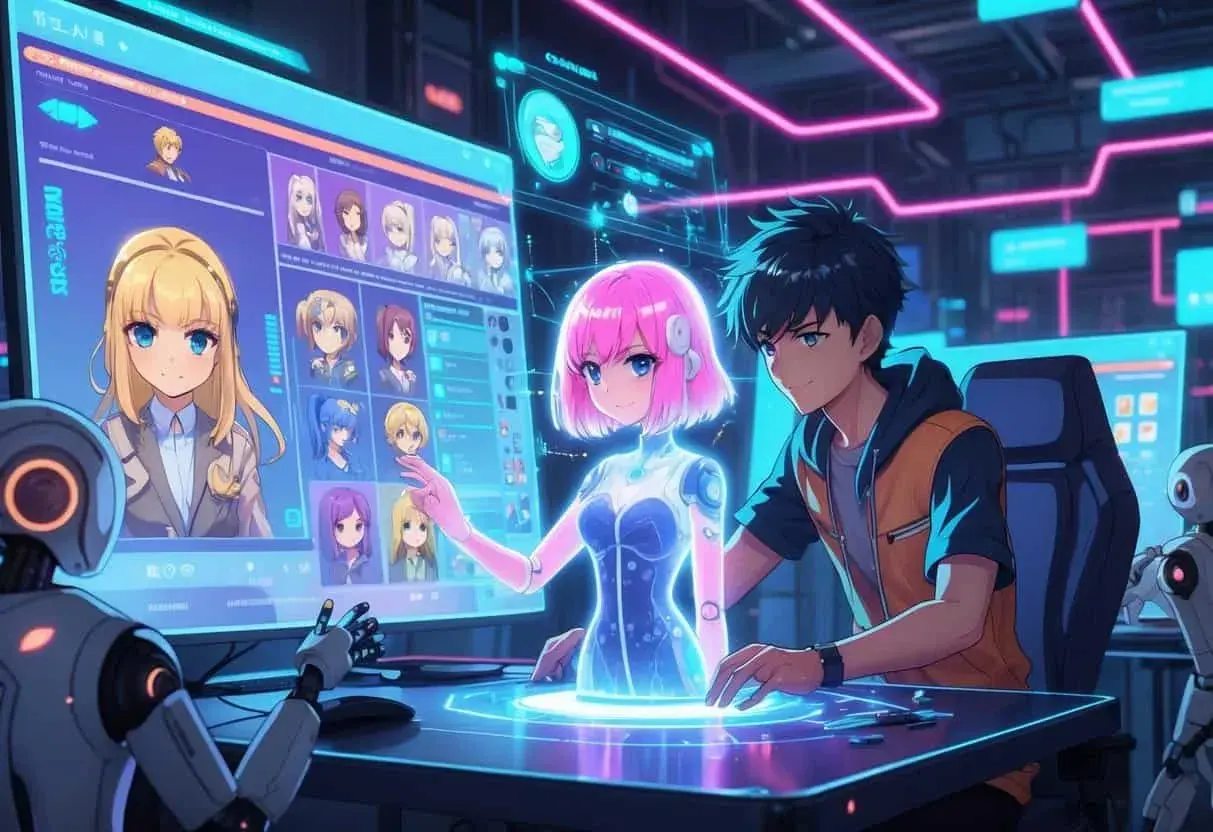
The integration of artificial intelligence into anime game character customization is reshaping how players create and connect with digital avatars. AI enables the generation of characters that not only look distinctive but also move and react with heightened realism, fostering a more immersive and personalized experience. This shift means that unique facial features, expressive animations, and adaptive behavioral traits can be realized without requiring extensive artistic skill or countless hours of manual design. As a result, both independent developers and major studios are leveraging machine learning to streamline production pipelines and deliver richer, more dynamic character systems. The technology is not merely an automation shortcut—it is a creative amplifier, allowing artists and players to explore a broader range of styles and narratives within anime-inspired game worlds.
For players, this transformation removes many of the traditional barriers to customization. Sophisticated AI tools can interpret natural language descriptions, rough sketches, or even emotion cues to generate high-fidelity anime characters. These characters can then be fine-tuned with granular controls or left to evolve as the game progresses, opening up storytelling possibilities where the avatar becomes a true extension of individual identity. In the following sections, we examine the core AI techniques, the platforms leading this change, and the profound impact on game design and player engagement.
Key Takeaways
- AI enhances character visuals, motion, and behavior, making anime game worlds feel more alive.
- Customization platforms use generative models to simplify design and multiply creative options.
- Machine learning personalizes characters based on player preferences and gameplay patterns.
- Cloud-based tools enable real-time collaboration and high-end rendering without expensive local hardware.
- Storytelling gains depth as AI generates adaptive narratives and lifelike avatars from multimodal inputs.
The Core AI Technologies Powering Customization
Underpinning the new wave of anime game character tools are several advanced AI disciplines. These technologies work in concert to automate tedious modeling, refine animation, and tailor characters to individual users. Understanding them helps developers choose the right stack and players appreciate the complexity behind a seamless customization experience.
How AI Is Transforming Character Modeling
Procedural generation and neural networks have substantially accelerated the character modeling process. Instead of placing every vertex by hand, an artist can feed a model with a large dataset of existing anime designs—facial structures, hair styles, body proportions—and the AI learns to synthesize new variations that respect the art style while introducing fresh combinations. This allows for rapid prototyping, where a simple prompt like “cyberpunk samurai with flowing silver hair” yields a high-quality 3D mesh ready for further refinement. AI also corrects common anatomical issues, ensuring symmetry and proportion, which significantly reduces the back-and-forth typically required in manual modeling. For smaller teams, this capability can be the difference between shipping a game on time and being stuck in asset creation for months.
Platforms that act as an AI anime character creator often bundle these modeling features with style transfer, so a character can smoothly transition between different anime aesthetics—from shonen to shojo—with a single click.
Advancements in AI-Powered Animation
Animation has historically been one of the most labor-intensive aspects of game development. AI changes this by applying motion learning from real-world footage or motion capture to virtual skeletons. Deep learning models predict natural movement trajectories for limbs, clothing, and hair, allowing characters to react fluidly to in-game physics and player commands. What used to require weeks of keyframe animation can now be generated procedurally. For instance, an AI system can create a full set of idle animations, combat maneuvers, and emotes from a short motion clip, adapting them to characters of varying heights and builds.
Real-time adjustment means that if a character picks up a heavy object, its gait automatically shifts to reflect the added weight. Such nuance makes the game world feel responsive and credible. Tools like NVIDIA’s Animation SDK demonstrate how AI interpolation and inverse kinematics can produce smooth transitions and emotive facial expressions, even on lower-end hardware. This democratizes high-quality animation, empowering indie studios to compete with AAA productions in terms of character expressiveness.
Personalization Through Machine Learning
Beyond static design, machine learning personalizes characters over time. By analyzing a player’s choices—preferred color palettes, gear loadouts, even play style—the system can recommend cosmetic features or behavioral quirks that align with that individual’s taste. For example, if a player consistently chooses elegant, stealthy outfits, the AI might suggest a flowing cape with dynamic cloth physics or a silent movement animation set. This goes beyond simple filtering; the engine adapts its generative outputs to match learned profiles, making the customization feel genuinely tailored rather than algorithmically generic. In narrative-driven games, this extends to personality traits: a character who often resolves conflicts through dialogue might subtly adjust idle expressions to appear more approachable.
Such depth strengthens the player’s emotional investment, as the avatar evolves like a digital companion that reflects personal style and in-game history.
Innovative Tools and Platforms
The practical implementation of AI in anime game character customization depends on a growing ecosystem of specialized tools. From browser-based creators to enterprise-grade cloud solutions, these platforms abstract the technical complexity and put creative power directly into the hands of developers and players.
AI Anime Character Creator Platforms
Dedicated creator platforms have become the entry point for many aspiring designers and small development teams. Services such as zmo.ai integrate generative models with intuitive sliders and preset libraries, enabling users to craft fully rigged anime characters in minutes. These platforms often include AI-driven animation previews, where characters demonstrate a range of movements—from combat stances to casual emotes—immediately after creation. The underlying AI handles mesh deformation, texture blending, and even automatic LOD (level of detail) generation, ensuring the character performs well in real-time engines like Unity or Unreal Engine. By automating the technical backend, these platforms let creators focus on visual identity, dramatically shortening the concept-to-implementation cycle.
Text-To-Image and Image-To-Image Innovation
Generative models such as Stable Diffusion have been fine-tuned on anime datasets to deliver stunning text-to-image and image-to-image capabilities directly relevant to character design. A developer can write a detailed description—“crimson-eyed warrior with mechanical arm and a tattered cloak, anime style, cel-shaded”—and receive multiple concept art variations within seconds. Further, the image-to-image pipeline accepts a rough sketch or a photograph and transforms it into a polished anime character, preserving the core composition while upgrading the style. This workflow is particularly powerful for iterating on character concepts during brainstorming sessions. Some implementations use a large backend compute system, often called a bigp backend system, to handle the heavy lifting of image generation at scale, ensuring that even complex requests return results quickly.
This allows studios to generate entire rosters of NPCs with consistent artistic direction, saving months of manual illustration work.
Integrating Multimodal Generative Models
The next frontier is multimodal AI that merges text, voice, images, and even motion input to craft characters in a more holistic manner. Imagine describing a character verbally while holding up a reference image on a phone; the AI fuses these cues to produce a model that matches the described personality and visual cues. Push-to-talk voice commands let artists adjust minor details—like eye shape or garment trim—hands-free while sculpting, speeding up iterative design. By understanding context from multiple modalities, these systems reduce ambiguity and deliver results that closely align with the creator’s intent. This approach is particularly valuable in collaborative environments where a team might need to quickly align on a character’s look without lengthy manual adjustments.
The AI becomes a responsive design partner, translating abstract ideas into concrete assets.
Collaborative Creation with Real-Time Cloud Orchestration
Working on complex character pipelines used to require powerful local workstations and convoluted file-sharing processes. Real-time cloud orchestration changes this by connecting team members to a shared compute pool that handles rendering, simulation, and asset storage on demand. A compute pool system dynamically allocates GPU resources, so multiple artists can test animations or model variants simultaneously without bottlenecks. Changes propagate instantly, allowing a narrative designer in one country to tweak an expression while an animator in another perfects the corresponding gesture. This intercontinental co-creation is becoming standard for studios that pursue ambitious anime game projects.
It removes the friction of asset handoffs and version conflicts, accelerating the entire production timeline. Additionally, cloud-based AI services can automatically optimize characters for different platforms—mobile, console, VR—ensuring consistent quality across devices. This is especially relevant for mobile games developers who must deliver high visual fidelity within strict performance budgets.
Enhancing Game Design and Storytelling
AI-driven character customization extends its influence far beyond the avatar creator screen; it fundamentally reshapes how stories are told and how players interact with game worlds. Characters that evolve, environments that react, and narratives that branch dynamically all become achievable with AI assistance.
Interactive Narratives and Visual Storytelling
When characters can be customized with a high degree of granularity, the narrative can treat them as unique entities rather than generic vessels. AI tools can generate dialogue, quests, and cinematic sequences that acknowledge specific character traits—scars, clothing choices, even moral alignment inferred from past decisions. This creates a feedback loop where player customization directly influences story beats. Visually, AI-powered comic video generators can render key story moments in a dynamic panel format, using the player’s exact customized avatar and gear, making the narrative feel intensely personal. The time saved on manually creating these assets allows writers and artists to concentrate on crafting richer branching paths, resulting in games that feel authored and responsive at the same time.
Scene Design and Automated Scene Recreation
Environment artists also benefit from AI that can reconstruct or generate scenes from simple descriptions. For a game with a strong anime aesthetic, maintaining visual consistency between characters and backgrounds is critical. Automated scene design tools can generate cities, forests, or interiors that match the character’s style profile, ensuring a cohesive art direction even when the player customizes heavily. If the player opts for a futuristic cyborg look, the AI can gradually shift ambient mechanics—holographic ads, robotic NPCs—to match that tone, enhancing immersion. Scene recreation AI also makes prototyping faster; a designer can sketch a rough layout, and the AI fleshes it out with textures and props that complement existing character assets.
This seamless integration between character and environment fosters a world that feels alive and reactive.
Lifelike Avatars and Hyper-Realistic Portraits
Beyond the game engine, AI-generated hyper-realistic portraits serve multiple purposes: loading screens, companion apps, social media avatars, and in-game biographies. Using neural networks trained on millions of images, these generators can produce a character portrait that looks nearly photographic while retaining anime stylization. This bridges the gap between stylized 3D models and high-fidelity 2D art, giving players a tangible symbol of their in-game identity. In multiplayer settings, such portraits can be used for player cards, fostering a sense of pride and community. The technology also enables features like aging or damage states: after a difficult battle, the portrait might show wear, aligning visual representation with gameplay events.
This narrative-driven adaptation deepens emotional connection without adding significant development overhead.
Impact on the Gaming Industry and Player Experience
The adoption of AI in character customization is not an isolated technical update; it is shifting business models, player expectations, and the very fabric of interactive entertainment. The effects ripple across indie and AAA studios, mobile and PC platforms, and even into adjacent digital spaces.
Player-Focused Apps and Customizable Styles
Companion apps like Brainpix allow players to design, store, and share their anime characters outside the game. These apps often use the same underlying AI models as the game itself, so a character created or modified on a phone syncs instantly with the player’s game profile. This continuous engagement—tweaking outfits during a commute, trying out new hairstyles before bed—keeps the player mentally invested. For digital marketers, this ecosystem provides multiple touchpoints to introduce themed cosmetics, collaboration events, and limited-edition styles that generate revenue. The customization becomes a social activity, with players sharing creations on platforms like Discord or Twitter, effectively marketing the game organically.
By giving players a strong sense of ownership over their characters, studios increase retention and foster loyalty that extends beyond individual game sessions.
Global AI-Driven Gaming Platforms
AI tools are increasingly being integrated directly into game engines and platform services. Companies like Siyata Mobile Inc are exploring AI-driven communication and identity features that could link a player’s customized anime character across multiple titles and virtual experiences. When a global platform standardizes character data through a shared AI-generated identity, a player might carry their unique avatar from an anime RPG to a social virtual world, maintaining continuity and reducing the need to start from scratch each time. This interoperability encourages broader participation in the gaming ecosystem and enables cross-promotions that feel organic. The AI behind these platforms learns from aggregated (and anonymized) player behavior to refine its recommendation and generation models, so the entire system becomes smarter and more intuitive the more it is used.
Future Trends: Metaverse and Core Gaming
Looking ahead, the metaverse concept relies heavily on persistent digital identities. AI-customized anime characters are perfect candidates for these identities because they blend appealing aesthetics with deep personal meaning. As VR and AR technologies mature, players will expect their avatars to move, gesture, and emote with equal fidelity across hardware. AI that can generate real-time facial expressions from voice input, or translate hand gestures into anime-style actions, will be essential. Core gaming will continue to evolve with AI-assisted design tools that allow even non-technical users to create entire character rosters and narrative arcs.
The line between player and creator blurs as modding tools powered by AI let communities build expansions that seamlessly fit the original art style. Ultimately, anime character customization driven by AI will be not just a feature but a foundational layer of interactive entertainment, shaping how people express themselves in digital realms for years to come.
Navigating Challenges and Ethical Considerations
While the creative potential is vast, integrating AI into character customization also raises important questions. Developers must address data privacy when machine learning models are trained on player behavior. There is a need for transparent consent and control over what information feeds into personalization algorithms. Additionally, the risk of inadvertently generating offensive or culturally insensitive designs through unmoderated AI outputs requires robust filtering and human oversight. Intellectual property is another gray area: if an AI model is trained on existing anime art, the boundaries between inspiration and infringement become blurry.
Studios that proactively establish ethical guidelines and licensing agreements will build trust with their communities. By coupling technical innovation with responsible practices, the industry can ensure that AI remains a tool for empowerment rather than exploitation.
The Road Ahead for AI-Driven Character Customization
The evolution of anime game character customization is accelerating toward a future where every player can effortlessly manifest their imagination. Advances in AI will continue to lower barriers, making professional-grade design accessible to anyone with a creative spark. As cloud orchestration matures and multimodal models become more context-aware, the process will feel less like engineering and more like a natural dialogue between creator and machine. Gaming narratives will deepen, art styles will diversify, and player communities will thrive around shared creative tools. Those who embrace these changes thoughtfully will deliver experiences that resonate on a profoundly personal level, cementing AI’s role as a cornerstone of modern game development.