Table of Contents
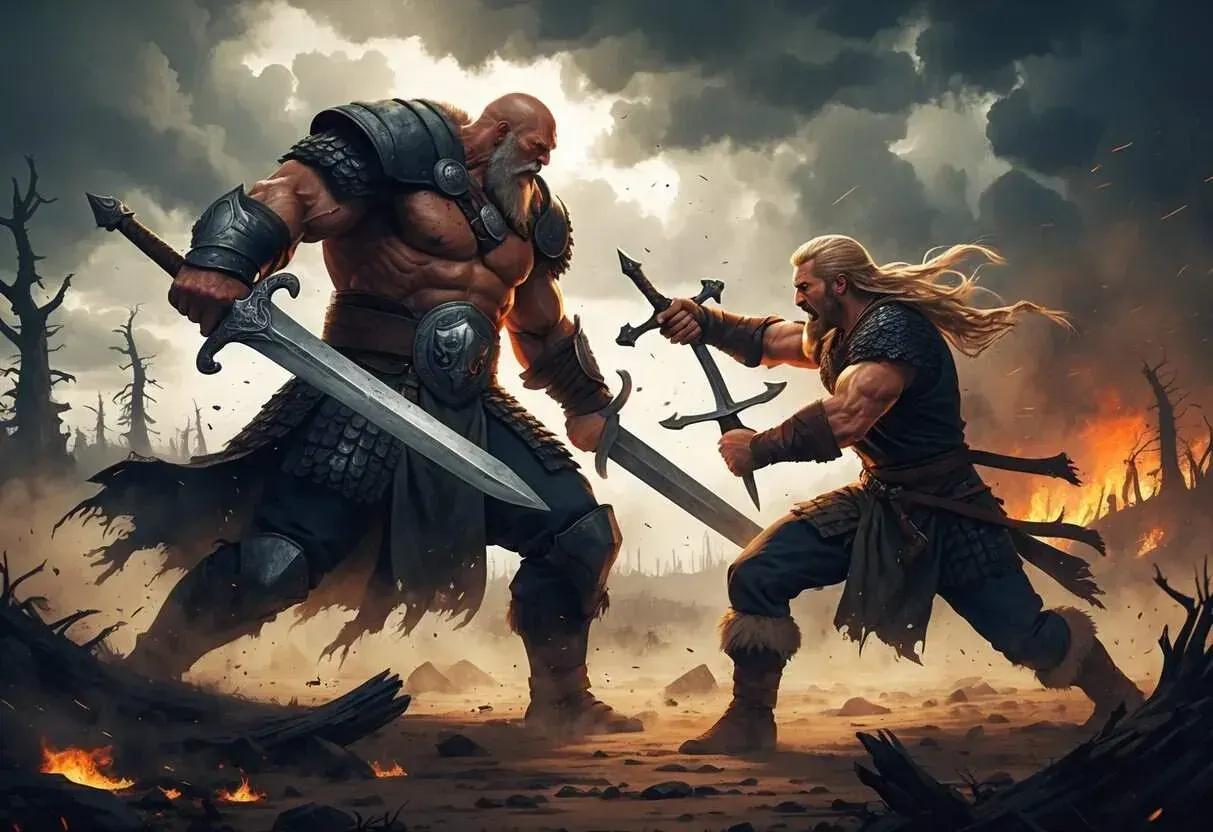
Guts from Kentaro Miura’s Berserk and Thorfinn from Makoto Yukimura’s Vinland Saga occupy a rare space in manga and anime: each is a warrior forged by unbearable loss, driven by a burning need to make sense of a life soaked in blood. At first glance, their paths share the same dark gravity—a fall into vengeance, a slow crawl toward something that resembles atonement. Look closer, though, and the architecture of their suffering couldn’t be more different. Guts battles demons, both literal and figurative, in a world that seems engineered to crush him. Thorfinn wades through a more recognizably human mire of grief, hate, and eventual self-reckoning.
The question isn’t just who suffers more, but what their separate brands of brutality teach us about redemption itself.
- Guts’ journey is defined by ceaseless violence, supernatural threats, and an almost primal fight for survival.
- Thorfinn’s arc pivots on internal transformation, the pursuit of peace, and the slow dismantling of a revenge mindset.
- Both men are shaped by loss, but their responses to trauma illuminate two distinct, punishing roads toward redemption.
The Weight of Origin: How They Became Who They Are
Guts’ beginning reads like a curse. Born from a hanged corpse and raised on a battlefield by a mercenary band, he learns that existence is a transaction of strength. His adoptive father figure, Gambino, offers only brutality and betrayal, cementing a worldview where trust invites death. The trauma of Guts’ childhood makes the sword an extension of his body and rage his default emotional register. When the Band of the Hawk gives him a taste of belonging, it’s ripped away in an eclipse of cosmic horror—a sacrifice that brands him and leaves his lover Casca shattered.
From that moment, revenge becomes oxygen. But even before the Eclipse, Guts is a man who defines himself through struggle. His motivation is a raw, almost feral need to protect what little he has left, even when that means cutting through apostles, godlike entities, and his own humanity.
Thorfinn’s origins are comparatively gentle. He is the son of Thors, a legendary warrior who had renounced violence. Growing up in a small Icelandic village, Thorfinn hears tales of heroism and dreams of adventure, but his world collapses when his father is murdered by the mercenary Askeladd. Unlike Guts, Thorfinn doesn’t inherit a life of violence by birth—he chooses it, sneaking onto Askeladd’s ship, desperate to earn the right to duel and avenge his father. This choice locks him into a decade of raiding, killing, and emotional numbness.
Where Guts’ drive stems from a cosmic betrayal, Thorfinn’s is ignited by a very personal wound. His early motivation is a child’s promise twisted into an obsession. And yet, beneath the rage, there’s a flicker of the boy who admired a peaceful father—a flicker that will eventually demand he find a different way to live.
Violence as a Spiral vs. Violence as a Ladder
For Guts, violence is both the problem and the only tool he has to solve it. The Berserk world is infested with demonic entities called Apostles, and after the Eclipse, he is hunted nightly by specters drawn to his brand of sacrifice. Every swing of the Dragon Slayer sword is a defiance of fate, but it’s also a confirmation that his existence is defined by combat. Physical pain is a constant companion; his body is a tapestry of scars, lost limbs, and endless fatigue. Yet violence also offers a grim clarity.
In battle, Guts doesn’t have to think about Casca’s broken mind or Griffith’s ascension. The Berserker armor amplifies this paradox—it lets him fight beyond human limits but threatens to consume his sanity. The more he fights, the more he risks becoming the very monster he despises.
Thorfinn’s relationship with violence functions more like a ladder he eventually decides to climb down. Through his adolescence, he becomes a killing machine, cold and efficient, earning the nickname “the son of Thors” with bitter irony. His duels with Askeladd are rituals of hatred that never bring satisfaction. The turning point arrives when Askeladd, the object of his revenge, dies at the hands of someone else. Thorfinn is robbed of his purpose and spirals into emptiness, sold into slavery, reduced to a hollow shell.
It is in this desolation that violence loses its meaning. Unlike Guts, for whom combat is an inescapable reality, Thorfinn hits a wall where violence no longer promises anything—not even a cathartic end. From that point, his arc becomes about dismantling the ladder he spent years climbing, learning that peace is not a destination but a practice.
The scars they carry tell the story. Guts’ wounds are externalized; Thorfinn’s are woven into his conscience. Both suffer, but the nature of the spiral differs: one is locked in a battle against demons, the other in a battle against the demon inside.
Family, Loss, and the Ghost of Loneliness
If there’s a single current that electrifies both stories, it’s the absence and reconstruction of family. Guts is orphaned not once but repeatedly. His mother figure was a corpse; his father figure tried to kill him. The Band of the Hawk became a surrogate family, only to be sacrificed in an act of ultimate betrayal. After the Eclipse, Guts isolates himself almost pathologically, convinced that anyone close to him will suffer.
His relationship with Casca, once a source of fragile hope, becomes a well of guilt—she can’t even recognize him without screaming. The found family that slowly gathers around him—Puck, Isidro, Schierke, Farnese, Serpico—pries open the door he’s tried to bolt shut, but Guts remains wary, terrified that his proximity is a death sentence. Loneliness, for him, is a suit of armor just as much as the black iron he wears.
Thorfinn’s story begins with family and never really lets go. The specter of his father, Thors, looms over every choice. Thorfinn’s entire revenge quest is, in a twisted way, an attempt to honor his father by killing his killer. When that fails, he is emotionally orphaned. But where Guts pushes people away, Thorfinn eventually gravitates toward connection.
Canute, Einar, and later his own wife and child become key to his healing. In the farm arc of Vinland Saga, Thorfinn literally digs in the earth alongside another slave, Einar, and through that friendship reclaims his humanity. His journey suggests that loneliness is not a shield but a poison, and that salvation lies in rebuilding the family bonds that violence shattered. For Thorfinn, fatherhood becomes the ultimate act of redemption, a conscious break from the cycle of vengeance.
Both characters are shaped by the holes left by their fathers, but where Guts treats closeness as a threat, Thorfinn eventually treats it as medicine.
Redemption’s Architecture: Which Road Demands More?
Redemption is never a single gesture. For Guts and Thorfinn, it’s a construct built from patience, relationships, and the terrifying act of facing one’s own past. The materials are the same; the blueprints are radically different.
Patience and Self-Examination
Guts doesn’t have the luxury of quiet reflection. His growth happens in the margins between slaughters, often through actions rather than words. He learns patience by caring for Casca, by restraining his rage so he doesn’t harm her, by letting others fight alongside him instead of always charging ahead alone. This is hard-earned emotional discipline, not philosophical enlightenment. Thorfinn’s patience is cultivated in stillness—years of farming, of listening, of choosing not to fight even when provoked.
He examines his sins meticulously, understanding that his past murders cannot be undone but that future choices can still carry meaning. If Guts’ patience is survival forged in adrenaline, Thorfinn’s is a slow-burning act of self-reconstruction.
The Role of Companionship
Isolation nearly destroys both men, but they escape its gravity through different doors. Guts’ companions find him, practically dragging him back into the world of human connection. Puck’s relentless positivity, Schierke’s steady magic, and even Isidro’s brashness chip away at the Berserker’s solitude. These relationships are lifelines he never asked for but desperately needs. Thorfinn’s connections are more actively sought.
He chooses to trust Einar, he chooses to reconcile with Canute, he chooses to build a family. Friendship, in Thorfinn’s world, is a deliberate pillar of redemption, not just a fortunate accident.
Confronting the Past
For Guts, the past is a literal monster. Griffith, the white hawk, is not just a memory—he’s a godlike being who reshapes the world. Guts must confront him physically, but the psychological weight is equally crushing. Every time he sees Casca’s vacant eyes, the Eclipse replays. Thorfinn’s confrontation is internal.
He must accept that he wasted years as a hate-fueled killer, that his own hands are stained. His moment of reckoning isn’t a duel but a vow: to create a land of peace, a Vinland where no one has to fight. Both acts require staring into the abyss, but the abyss stares back in very different forms.
| Theme | Guts’ Approach | Thorfinn’s Approach |
|---|---|---|
| Patience | Grudging emotional restraint; survival-driven | Conscious cultivation of calm; philosophical |
| Understanding | Earned through battle and trauma | Through empathy and self-awareness |
| Isolation | Deep solitude; suspicion as armor | Emptiness; eventually replaced by bonds |
| Companionship | Reluctantly accepted; rare but deep | Actively rebuilt; central to healing |
| Inner Demons | Rage and trauma that require constant management | Guilt and the need for self-forgiveness |
Brutality’s Signature: Physical Torture vs. Emotional Erosion
Measuring suffering is a fool’s game, but the texture of pain in Berserk and Vinland Saga is strikingly distinct. Guts inhabits a universe where the supernatural amplifies human cruelty to grotesque extremes. The Eclipse alone is a nightmare of dismemberment, sexual violence, and psychological annihilation. Even outside that event, Guts’ daily existence is a gauntlet: trolls, ogres, possessed animals, and the ever-present God Hand. His body is a testament to endurance, but the toll on his mind is equally severe—the Berserker armor erodes his senses, and each near-death experience drags him closer to becoming a beast.
The brutality is external, relentless, and grandiosely horrific.
Thorfinn’s brutality digs deeper into the mundane atrocities of war. As a Viking mercenary, he participates in raids, pillaging villages, and he does so with a blank expression that speaks of a soul already dead. The emotional erosion is quieter but no less devastating. He watches people die for petty reasons, sees the futility of honor on the battlefield, and eventually becomes the very thing his father despised. The turning point—being robbed of revenge—plunges him into a catatonic depression that lasts years.
Unlike Guts, whose story is punctuated by monstrous enemies, Thorfinn’s most harrowing enemy is the weight of his own guilt. The physical injuries are fewer, but the scar tissue on his psyche covers everything he once believed.
Moral Dilemmas and the Possibility of Forgiveness
Guts operates in a moral grey zone where forgiveness is almost nonexistent. He kills apostles who were once human, fights mercenaries who are simply doing their job, and sometimes loses control and endangers his own friends. His moral compass is survival and protection; he rarely has time to contemplate whether he deserves redemption. Yet, there are flashes—like letting the count’s daughter escape in the early Black Swordsman arc—that show the ember of mercy still glowing. The psychology of revenge often traps a person in perpetual outrage, and Guts’ struggle is to avoid being swallowed by that fire.
Thorfinn’s journey leads him directly to the question of forgiveness. After Askeladd’s death, he must forgive himself for a wasted youth and eventually extend understanding even to those who wronged him. His philosophy, heavily influenced by his father’s teachings, becomes radical: a true warrior needs no sword. The moral dilemmas shift from “who deserves to die” to “how do I live without killing.” This internal revolution is brutal in its own right because it means discarding an identity forged in blood and embracing vulnerability.
For many readers, this emotional rigor is just as punishing as any physical trial.
| Aspect | Guts | Thorfinn |
|---|---|---|
| Physical Trials | Endless, often fatal battles; monstrous enemies | Fewer injuries; emotional pain dominates |
| Emotional Struggles | Revenge, survival, protecting loved ones | Trauma, shifting from hate to peace |
| Moral Challenges | Rare chances for forgiveness; mercy as instinct | Conscious pursuit of forgiveness; ethical reconstruction |
Echoes Across Cultures: Why These Stories Resonate
The arcs of Guts and Thorfinn are not trapped in their own pages; they echo through a wide canon of redemption narratives, from ancient myths to modern fantasy. The interplay of vengeance, forgiveness, and self-discovery taps into a universal nerve. In Vinland Saga’s philosophical pivot, we see shades of Norse sagas where warriors grapple with fate and morality. Berserk, meanwhile, channels the darkness of European medieval brutality and cosmic horror, turning personal trauma into a battle against gods. The cultural influences are manifold, but the core appeal remains the same: watching someone claw their way out of hell.
From Spells to Swords: Shared Struggles Across Fantasy
Consider the redemption rivalry in another beloved series: Harry Potter. The tension between Harry and Draco Malfoy has its own weight, but it mirrors a similar dynamic—a protagonist burdened by loss and a rival trapped by family expectations. Draco, like a young Thorfinn, is shaped by parental influence and struggles to step out of a destructive legacy. The moments where Harry chooses mercy, like refusing to use lethal force with Expelliarmus, parallel the choice Guts sometimes makes to spare an enemy’s life, or Thorfinn’s decision to let go of the dagger. Even the Imperius Curse—the stripping of personal will—feels akin to the Berserker armor’s influence or Thorfinn’s years as a hollow killing tool.
These parallels remind us that stories of moral conflict are boundaryless, whether fought with wands or greatswords.
Love and Support as Anchors
Romantic and platonic bonds soften the brutality in all these narratives. In Berserk, Casca’s presence—even in her broken state—keeps Guts tethered to his humanity. The affection of his companions acts as a counterweight to the armor’s bloodlust. In Vinland Saga, Thorfinn’s love for his wife and child, as well as his deep friendship with Einar, are the very justification for his pacifism. Even small objects carry this weight: Inga’s blade, a family heirloom, becomes a symbol of inherited values rather than violence.
Such anchors—a sword that protects instead of kills, a friend who believes in you—can redirect a brutal journey toward something like hope.
The Harsher Road: A Final Look at Two Redemptions
So, which journey is truly more brutal? Guts endures a reality of perpetual, escalating horror; his every step is a war against fate that never allows a true respite. His redemption is an ongoing struggle to hold onto love without destroying it. Thorfinn’s path, while less overtly nightmarish, demands a complete psychological overhaul—a dismantling of identity that is its own form of agony. There’s no shortcut in either story, no magic spell that washes the blood away.
The difference lies in the direction of their growth: Guts fights outward to protect a fragile inner world, while Thorfinn fights inward to build a peace that can withstand the outer one.
One thing is certain: both men prove that redemption is not a prize but a process forged in pain, patience, and the stubborn refusal to stay the monster the world tried to make them. Whether you find the supernatural onslaught of Berserk more crushing or the emotional dissolution of Vinland Saga more harrowing, the real victory is that either journey can still end with a man reaching for something gentler than a sword.