Table of Contents
Introduction
Few debates in the Dragon Ball fandom are as enduring—or as emotionally charged—as the question of whether Son Goku is a good father. For every viewer who sees a carefree, battle-hungry Saiyan who routinely abandons his family to train in the afterlife or on some distant world, there is another who interprets Goku’s hands-off style as a profound and, in its own way, loving philosophy of empowerment. This split isn’t just about preference; it reflects a fundamental tension between traditional expectations of parental presence and the unique psychological world that Goku inhabits. Goku isn’t a bad parent, but his priorities lean toward strength and adventure, which really changes how he shows up for his kids.
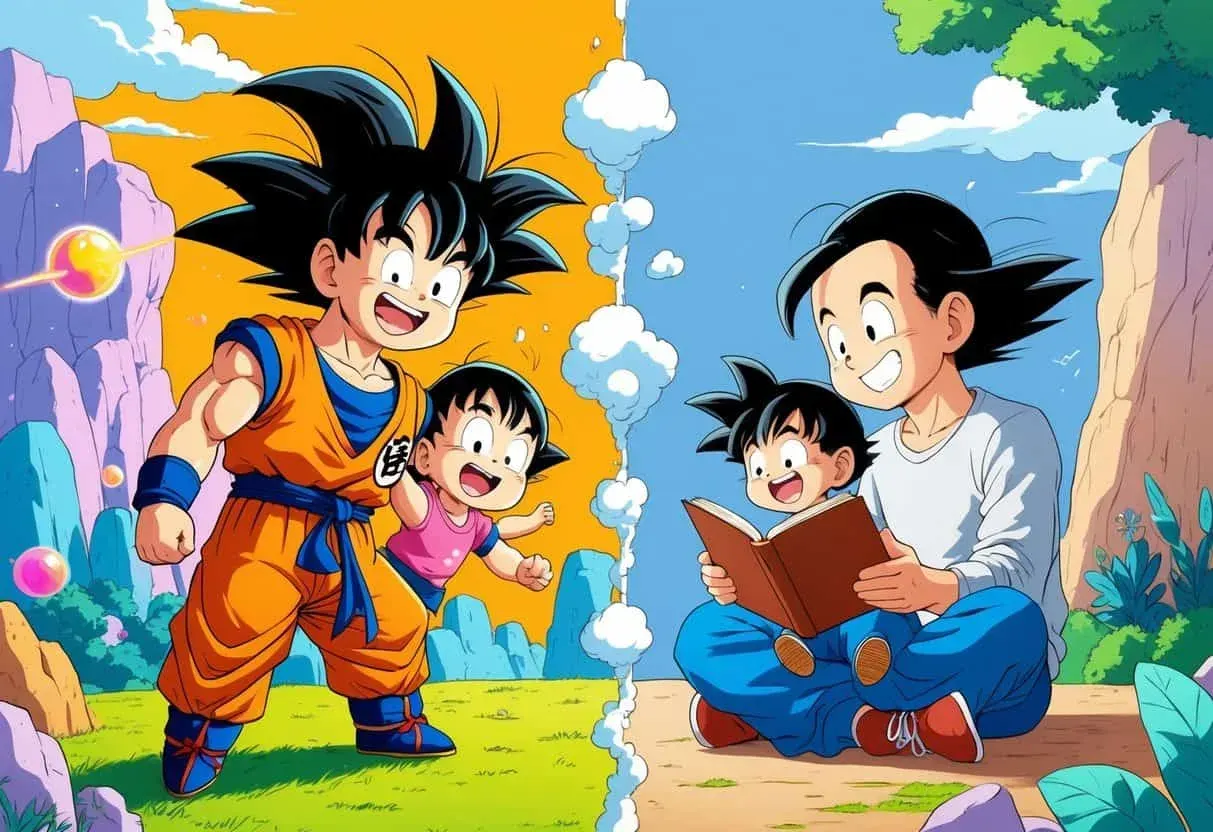
You might wonder if Goku’s way would ever work outside fiction. His choices can seem risky or even odd, but they come from hope and belief in his kids’ potential. There’s this balance between being hands-off and still rooting for their growth. It makes Goku a complicated, sometimes frustrating, but always interesting dad. Understanding Goku’s parenting means looking past traditional ideas.
His actions show care, just not in the usual way most parents do.
To truly evaluate Goku, one must set aside the Western nuclear-family ideal and instead look through the lens of a Saiyan-raised martial artist who, despite his humanity-adjacent heart, operates on an internal logic shaped by training, combat, and the thrill of self-improvement. When we examine the arcs of his sons, Gohan and Goten, we see a pattern—not of neglect, but of a deliberate, if sometimes reckless, push toward independence. This article explores the core elements of Goku’s parenting, dissects where he falls short, highlights the ideals behind his actions, and assesses the cultural legacy of one of anime’s most debated dads.
Key Takeaways
- Goku’s focus on training and battle shapes his entire approach to fatherhood.
- His parenting mixes genuine care with sky-high expectations and a startling tolerance for risk.
- Public perceptions are starkly divided—some label him irresponsible, while others defend his idealistic faith in his children.
- Compared to other parents in the Dragon Ball universe, Goku’s style is uniquely hands-off yet paradoxically transformative.
- His influence extends beyond the series, helping to redefine the template for the “flawed but heroic” anime father.
Core Elements of Goku’s Parenting Style
Goku’s approach is a blend of radical freedom, subtle emotional cues, and lessons forged in the heat of battle. He consistently refuses to micromanage his children’s lives, yet he willingly places them in the path of overwhelming challenges so they can shatter their own ceilings. To the casual observer, it looks like disinterest; to someone who has watched Goku’s own childhood—raised in solitude by Grandpa Gohan and later trained by Master Roshi—it’s a familiar blueprint of tough love disguised as neglect.
Emphasis on Independence and Freedom
From the moment Gohan is kidnapped by Raditz, Goku’s parenting philosophy crystallizes: the world is dangerous, and the only reliable shield is one you build yourself. Rather than cloistering his son from danger, Goku allows—and sometimes forces—Gohan to face threats head-on. During the year of training for the Saiyans, Goku is absent (dead, no less), and Gohan must survive the wilderness under Piccolo’s brutal supervision. Yet when Goku returns, he doesn’t apologize for the hardship; he applauds the growth. This is the core of his method: he sees self-reliance as the ultimate gift.
With Goten, the pattern repeats, though softened by circumstance. When Goku returns from the Other World after seven years, he barely knows his second son. Instead of overcompensating with helicopter parenting, Goku immediately engages Goten in sparring and play-fighting, feeding the boy’s natural enthusiasm. He allows Goten and Trunks to fuse and confront Majin Buu, a decision that would horrify any real-world parent but which, in Goku’s world, represents trust. He truly believes that his sons will figure things out—and they usually do.
This extreme freedom fosters fierce independence, but it also creates moments where the boys are left without a parental anchor during quieter, non-cataclysmic times.
Approach to Emotional Support
Goku’s emotional intelligence is not absent; it’s just expressed in a dialect of sparring sessions and shared adrenaline. He rarely sits his children down to talk about their fears, dreams, or heartaches. Instead, he communicates care by standing beside them in battle, offering a grin, and saying something like, “You’ve got this.” When Gohan faces Cell, Goku’s decision to stay on the sidelines—even throwing the villain a Senzu Bean—is a statement of profound faith. It’s also, arguably, emotional recklessness.
But to Goku, belief is a form of love stronger than any hug.
This can leave deep gaps. Chi-Chi is clearly the primary emotional caregiver, handling school meetings, meals, and the thousand tiny reassurances children need. Goku’s sons learn early that if they want a heart-to-heart, they’re better off talking to their mother or Piccolo. Yet Gohan, reflecting on his father, never expresses bitterness. He seems to have internalized Goku’s silent encouragement as a kind of bedrock confidence.
The problem, of course, is that not every child will interpret absence as faith; some will see it as indifference. Goku is lucky that Gohan and Goten are resilient, but the narrative never seriously grapples with the emotional damage that could have occurred.
Balance Between Nurturing and Challenge
If one were to map Goku’s parenting onto an extreme sports coach, the fit would be uncanny. He nurtures by giving his children the chance to prove themselves, and he challenges them with trials that would break lesser spirits. After the Cell Games, he chooses to stay dead, reasoning that his presence attracts enemies. It’s a nurturing sacrifice wrapped in a chillingly logical package: he loves his family enough to remove himself from their lives. Whether that’s a noble act or a convenient excuse to train with King Kai is open to interpretation.
The balance works, in the sense that both Gohan and Goten grow into extraordinarily capable, kind-hearted adults. Yet the scale often tips heavily toward challenge at the expense of soft nurturing. Goku doesn’t teach his kids how to do taxes, apologize effectively, or mend a broken heart—skills that, in a more mundane universe, might matter more than the ability to fire a Kamehameha. He operates on the premise that strength of character will fill in the blanks, a gamble that pays off because Dragon Ball’s cosmos is built to validate that exact premise.
Irresponsibility in Goku’s Parental Choices
It’s impossible to ignore the pile of moments where Goku’s choices veer from idealistic to flat-out irresponsible. Even within the logic of a martial-arts fantasy, there are decisions that make you wince. This section examines the concrete ways Goku drops the ball as a father—moments where his Saiyan instincts or battle obsession steamroll his domestic duties.
Neglecting Parental Responsibilities
Goku’s absenteeism isn’t subtle. He misses most of Gohan’s early childhood by being dead, then misses Gohan’s entire adolescence by choosing to remain dead for seven years. During those years, he never once contacts his family through King Kai’s telepathy to check on homework or birthdays. When he returns for a single day during the World Tournament, he meets Goten, his own son, for the first time. This is less a parenting style and more a pattern of profound non-involvement.
He misses school plays, neglects to teach basic social norms, and shows no interest in Gohan’s academic aspirations—which, given that Gohan wants to be a scholar, creates a painful disconnect.
Chi-Chi shoulders nearly all domestic labor, from finances to discipline, while Goku trains. Even when he’s alive and on Earth, he often zones out or physically leaves for extended periods. During the Android Saga, he spends three years training with Piccolo and Gohan, but his focus is on the coming battle, not on being present as a dad. The series plays some of this for comedy, but the subtext is stark: Goku is a father in name, but his involvement is conditional upon a crisis that justifies fighting.
Risks to Family Safety
Goku’s most glaring irresponsibility lies in his willingness to gamble with his children’s lives. The infamous Senzu bean toss to Cell is the ultimate example: he heals the monster who just tortured his friends and is about to fight his eleven-year-old son. His rationale—that Gohan needed a fair fight to unlock his power—is so audacious that it borders on madness. Even Piccolo, no stranger to harsh training, calls him out. This isn’t just neglect; it’s actively endangering his child for the sake of an instinctual lesson.
Similarly, during the Buu Saga, he pushes Goten and Trunks to learn fusion and fight a reality-warping pink demon. He doesn’t first exhaust every adult option; he essentially bets the planet on two grade-schoolers. Earlier, against Raditz, he willingly teams up with Piccolo and sacrifices himself, leaving Gohan in the care of his former arch-nemesis. In each case, Goku places the fate of Earth, and by extension his sons’ safety, on high-stakes gambits. To a father whose moral compass is battle, these moves make sense; to anyone else, they look reckless.
Comparison With Other Dragon Ball Parents
Placed alongside other fathers in the series, Goku’s shortcomings become even more pronounced. Vegeta, for all his pride and early brutality, undergoes a dramatic evolution as a parent. He trains obsessively, yes, but he is also shown taking Trunks to the amusement park, holding Bulla as a baby, and even refusing to fight when his family is threatened. His “My Bulma!” rage against Beerus is a testament to how seriously he takes his role. He’s not perfect, but he’s present and emotionally invested in a way Goku rarely is.
Chi-Chi is the maternal counterweight, fiercely focused on education and stability. Her strictness can be suffocating, but it comes from a place of deep protectiveness. Mr. Satan, while a buffoon, is a doting father to Videl and eventually a caring grandfather to Pan. Even 18 and Krillin manage to balance fighting with their daughter Marron’s normal childhood. Goku, by contrast, is the outlier: the one parent who treats family as a side quest rather than a centerpiece.
This doesn’t make him evil, but it does make his parenting the most radically unbalanced of the group.
Idealism and Aspirations as a Father
Yet to label Goku purely irresponsible is to miss the idealism that drives him. His actions, however questionable, often stem from an unwavering belief in his children’s limitless potential and a desire for them to surpass him. He doesn’t want weak, dependent offspring; he wants successors who can protect the Earth after he’s gone. In a universe where planet-busting threats are a Tuesday, that’s not a trivial aspiration.
Belief in Potential and Personal Growth
Goku’s faith in Gohan’s hidden power is the emotional engine of the Cell arc. He sees something in his son that no one else—not even Gohan himself—can see. From the Hyperbolic Time Chamber training, Goku recognizes that Gohan has the capacity to ascend beyond Super Saiyan. His entire strategy in the Cell Games hinges on that belief. When Goku gives Cell the Senzu, he’s not just being reckless; he’s creating a pressure cooker that he trusts will forge Gohan into a warrior capable of protecting the world long after Goku is gone.
It’s a terrifying endorsement of growth mindset culture taken to its most literal extreme.
With Goten, Goku’s belief is less documented but equally genuine. He observes Goten’s natural talent and immediately nurtures it through play, recognizing that his son’s joy in fighting is a strength to be cultivated. Goku’s entire parenting philosophy can be summed up as “You can be better than me, and I’ll make sure you get every chance to prove it.” This relentless optimism is both inspiring and, depending on your perspective, deeply naive.
Encouraging Self-Reliance
Self-reliance is the golden thread running through all of Goku’s most controversial parenting decisions. When he tells Gohan to finish Cell alone, he isn’t merely stepping aside; he’s communicating that Gohan no longer needs a safety net. It’s a moment of ritualized independence, a rite of passage that transforms Gohan from a frightened boy into the planet’s savior. The message is clear: “I love you enough to let you do this on your own.”
This strategy repeats with the fusion training. Goku teaches the boys the technique and then, in typically Goku fashion, trusts them to execute it without hovering. He’s not there to micromanage their mistakes; he’s off fighting Buu or stalling for time. The result is that both Goten and Trunks develop confidence in their own resourcefulness. However, this approach also means that when they fail—as when Gotenks’ overconfidence leads to absorption by Buu—Goku is not present to guide them through the emotional aftermath.
Self-reliance, in Goku’s world, includes learning to cope with failure largely in isolation.
Legacy and Values Imparted to Children
What values does Goku actually pass down? No one would call him a moral philosopher, but his actions embed certain principles: courage in the face of impossible odds, loyalty to friends, a love for fighting that never tips into cruelty, and an almost childlike wonder at the world. Gohan absorbs these lessons and merges them with his own gentle nature to become a protector who fights only when necessary. Goten grows up with a sunny disposition and a playful love of combat that mirrors his father’s, albeit tempered by Chi-Chi’s grounding.
Goku also teaches, through example, the importance of constant self-improvement. He never stops training, never becomes complacent. This is a legacy of effort, not of titles. He doesn’t care about being the strongest; he cares about the journey to become stronger. Both sons internalize this, though they apply it differently—Gohan to scholarship and occasional fighting, Goten to a balanced life.
Ultimately, Goku’s greatest gift to his children is a model of resilience and a freedom to pursue their own paths, even if he inadvertently teaches them that the path of a father doesn’t require much daily presence.
Goku’s values also extend to protecting others. He consistently shields innocent people from harm and expects his sons to do the same. When Gohan hesitates against Cell, it’s not a lack of power but a fear of unleashing it. Goku’s refusal to intervene forces Gohan to accept the responsibility of power—a complex, arguably advanced moral lesson that many parents might shy away from. This ethical dimension, though wrapped in violence, is central to understanding Goku’s idealistic streak.
Public Perception and Cultural Impact
Goku’s parenting has become a cultural touchstone, debated on forums, analyzed in YouTube essays, and referenced in discussions about anime father figures. The divide between “Goku is a terrible dad” and “Goku is a misunderstood idealist” reveals as much about viewers’ own values as it does about the character himself. In an era of shifting family dynamics, Goku’s approach has also left a fingerprint on the archetype of the modern media father.
Fan Interpretations of Goku’s Parenting
The fan discourse is remarkably polarized. On platforms like Reddit and Twitter, you’ll find threads with titles like “Goku is an awful father” garnering thousands of upvotes, with lists of his failures as evidence. Articles on CBR and other outlets regularly revisit the question, often leaning into his more egregious missteps. Critics point to his absence during Gohan’s childhood, the Cell Games gamble, and his casual departure to train with Uub at the end of Z as definitive proofs of selfishness.
Defenders, however, argue that these critiques apply a modern, Western standard to a character who is essentially an alien raised by a hermit. They note that Goku consistently lays down his life for his family, that his decisions are always made with Earth’s survival in mind, and that his unwavering belief in his children’s strength is a rare form of parental validation. Some fans even see him as a role model in courage and strength, embracing a philosophy where the greatest act of love is to empower your child to not need you. The debate rages on, making Goku’s fatherhood a kind of Rorschach test for what we value most in parents: presence or empowerment.
Influence on Modern Media Fathers
Goku’s provocative paternal style has echoed through subsequent shonen series. Characters like Naruto Uzumaki (as a father to Boruto) and even Monkey D. Luffy’s relationship with his crew (as a found-family father figure) contain shades of Goku’s blend of neglectful warmth and challenge-based bonding. The trope of the “absent but well-meaning dad” has become so common in anime and manga that Anime News Network has explored how real-world fatherhood anxiety informs these fictional portrayals.
Western media, too, has absorbed the Goku archetype. Characters like Joel Miller in The Last of Us (a gruff protector who teaches through trauma) or even certain portrayals of superhero dads (think Wolverine in Logan) share Goku’s tendency to prepare their children for a harsh world through exposure rather than shelter. The modern media father is increasingly allowed to be fallible, distracted, and motivated by an internal code that doesn’t always align with domestic bliss. Goku, in his extreme way, pioneered the idea that a father’s greatest gifts might be independence and an unshakeable belief in a child’s potential—even if the presentation is messy and the emotional cost is real. Writers seem drawn to this approach because it feels honest, depicting dads who make mistakes yet still show up when it counts, just not always in the ways their families might wish.
In the end, Goku’s legacy as a father is as complicated as the character himself. He isn’t a villain, nor is he a saint. He is a Saiyan who loves his sons with a purity that is filtered entirely through the language of combat and self-improvement. Whether that makes him irresponsible or idealistic depends on what you believe a parent’s highest duty should be. What remains indisputable is that his approach, for all its flaws, produced two sons who love him and a world that survived countless threats because Goku dared to trust his children with its fate.
That’s a parenting record that, however unorthodox, demands a deeper look.