Table of Contents
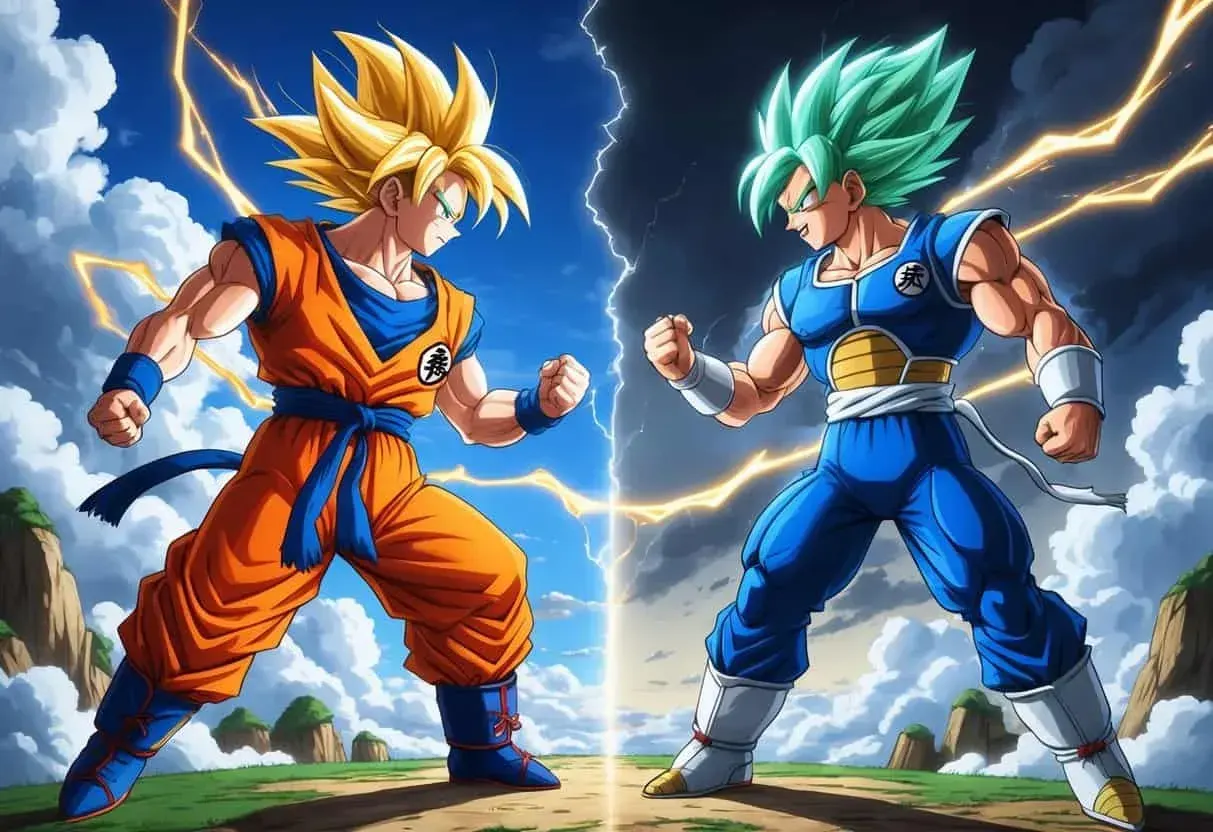
Few rivalries in anime carry the weight and complexity of Goku versus Vegeta. What began as a violent clash between two surviving Saiyans has slowly transformed into one of the most compelling dynamics in pop culture, shaping not just the Dragon Ball series but also the very definition of what a rivalry can be.
Key Takeaways
- The rivalry stems from opposite upbringings: Prince Vegeta’s royal arrogance versus low-class Kakarot’s accidental Earth upbringing.
- Saiyan Saga, Cell Games, and the Buu arc forced confrontations that redefined their motivations and mutual respect.
- Family bonds and shared threats turned animosity into a brotherly bond, culminating in fusions like Gogeta and Vegito.
- The competition continues through Dragon Ball Super, influencing new challenges and carrying a massive cultural legacy.
Origins of the Goku and Vegeta Rivalry
The seeds of the Goku-Vegeta conflict were planted long before they met. Their extreme differences in birth, culture, and purpose instantly set the stage for a feud that would define Dragon Ball Z.
Saiyan Roots and First Contact
Vegeta was the crown prince of Planet Vegeta, raised under the thumb of Frieza’s empire and indoctrinated with the belief that Saiyan nobility is absolute. From childhood, his strength was measured against the highest expectations; he was the prodigy who would one day rule the strongest warrior race. The genocide of his people, orchestrated by Frieza, only deepened his obsession with superiority.
Goku, born Kakarot, was a low-ranked infant sent to conquer Earth—only to bump his head, lose his bloodthirsty nature, and become the planet’s greatest defender. He grew up oblivious to his heritage until the arrival of his brother Raditz. When Vegeta finally faced him, it was a collision of ego and innocence: the prince could not fathom that a low-class soldier could match him, while Goku simply saw a terrifying opponent blocking his path to protect his friends.
The Saiyan Saga: Birth of Enmity
The battle on Earth during the Saiyan Saga remains one of the most brutal opening acts in anime history. Vegeta and Nappa attacked with genocidal intent, and after Nappa’s defeat, the one-on-one duel between Goku and Vegeta became a test of ideals. Goku pushed his newly learned Kaio-Ken and Spirit Bomb beyond their limits, while Vegeta fought with wounded pride and a great ape transformation that nearly crushed everyone.
That fight ended with Vegeta barely escaping, humiliated by a “third‑class Saiyan” who not only matched his power but also showed mercy. For Goku, the episode planted a seed of curiosity—he saw in Vegeta a rare rival who could push him beyond his own limits. For Vegeta, it was an obsession: if a weakling like Kakarot could reach such heights, then his own throne was threatened. That angry obsession would fuel every subsequent training arc.
Pride, Motivation, and the Search for Meaning
At the core of their opposing drives are two distinct flavors of Saiyan instinct. Vegeta’s pride is existential—tied to his lineage, his people’s extinction, and a desperate need to reclaim superiority. Fighting isn’t fun; it’s about dominance and validation. He carries the weight of a dead planet on his shoulders and constantly feels the need to prove that a Saiyan elite belongs at the top.
Goku’s motivation, by contrast, is almost pure. He fights because he loves the challenge. He trains to protect loved ones, but the rush of battle remains his deepest joy. This fundamental difference makes their encounters volatile. Vegeta cannot stand Goku’s casual attitude toward the power that the prince desperately craves, while Goku simply cannot understand why Vegeta clings so tightly to pride over teamwork.
This clash of philosophies runs through the entire series.
Major Battles That Defined the Rivalry
The Goku-Vegeta dynamic was not built on words but on fists, ki blasts, and moments of near-death. Each major fight peeled back another layer of their relationship.
The Climactic Fight of the Saiyan Invasion
The Saiyan Saga battle is the blueprint. Goku arrives late, injured comrades scattered across the wasteland. He faces Vegeta with everything he has, even breaking his own body under the Kaio-Ken x4. Vegeta, equally battered, proves both ruthlessly cunning and monstrously durable. In the end, it’s teamwork—Krillin, Gohan, and Yajirobe—that stops the prince, but Goku’s solo performance remains the catalyst.
Vegeta leaves Earth with the first cracks in his royal armor, obsessed with surpassing the man who humbled him.
The Cell Saga: Pride and Unforced Errors
Although the android and Cell arcs often spotlight Gohan, the rivalry simmers beneath the surface. Vegeta’s arrogance during his fight with Semi-Perfect Cell is legendary—his decision to let Cell absorb Android 18, purely to face a stronger opponent, stems directly from his need to outshine Goku. Meanwhile, Goku’s calculated gamble to train Gohan as the savior highlights his own pride: he believes his son’s dormant power can surpass both him and Vegeta.
The Cell Games see the two Saiyans constantly measuring themselves against each other. Vegeta watches Goku’s full-power Super Saiyan bout against Cell with a mixture of frustration and grudging respect. The eventual team effort to wear down Cell—and Goku’s ultimate sacrifice—mark a turning point. Even Vegeta, who swore to surpass him, is forced to acknowledge that Goku’s sense of sacrifice defines a different kind of strength.
A Galaxy of Upgrades: Super Saiyan and Beyond
The rivalry accelerated on Planet Namek when Goku achieved the legendary Super Saiyan transformation against Frieza. Vegeta had already been killed by Frieza moments earlier, his desperate plea for a Saiyan savior answered by Goku’s golden fury. Seeing that same transformation, which Vegeta had once believed was his birthright, wielded by Kakarot ignited an inferno of competitive fire.
Vegeta’s later training would become legendary in its intensity, pushing his body beyond limits to finally unlock Super Saiyan himself. From that point, the race was on: Super Saiyan 2, Ascended Saiyan forms, and eventually the divine energies of Super Saiyan God and Blue. Each new tier represented another lap in a marathon neither runner intended to finish.
Majin Vegeta: Pride Unleashed
Perhaps the most emotionally charged chapter of their rivalry is the Majin Vegeta arc. Frustrated by his perceived stagnation and by Goku’s habit of holding back, Vegeta deliberately submits to Babidi’s control to resurrect the cold-hearted warrior inside him. The resulting duel between Super Saiyan 2 Goku and Majin Vegeta is a masterclass in raw emotion: destructive, blindingly fast, and punctuated by Vegeta’s anguished confession about his jealousy.
The fight is never truly about winning; it’s about Vegeta admitting that Goku has always been the better man. And yet, by the end, he redirects that pride into the ultimate sacrifice, detonating himself against Majin Buu to save his family and even his rival. The Majin episode shattered Vegeta’s armor completely, opening a path to redemption.
Redemption Through Sacrifice
Goku and Vegeta each make defining sacrifices that transcend their rivalry. Goku’s decision to stay dead after the Cell Games, trusting Gohan to protect the Earth, speaks to his belief in the next generation. Vegeta’s self-destruction against Buu—yielding his life in an explosion with no recovery—proves that the prince can value others above his own pride. These moments bind them in a shared understanding: the rivalry is no longer about hate, but about two warriors who hold the safety of the world on their shoulders.
From Enemies to Allies: The Evolution of a Dynamic Duo
The transition from bitter enemies to dependable allies is Dragon Ball’s greatest character arc. It wasn’t a sudden flip but a gradual build nourished by training, trauma, and family.
Growing Respect on and off the Battlefield
After the Cell Games, Vegeta initially renounces fighting. Yet his respect for Goku quietly grows. Watching Goku train in Otherworld, and later observing his selfless demeanor, Vegeta learns that power can coexist with compassion. The two begin sparring together, each match a lecture in the other’s mindset. By the Buu saga, Vegeta’s anger is tinged with admiration—he wants to beat Goku, but now he wouldn’t want to destroy him.
The pair’s first real test as allies comes against Majin Buu’s various forms. During the fight with Super Buu inside his own body, Vegeta’s determination to cooperate is remarkable; he swallows his pride to allow the fusion that creates Vegito. Even when the fusion separates, their teamwork strengthens, proving that the old grudges have evolved into a grudging partnership built on trust.
Family: The Anchor That Changed Everything
Vegeta’s family life on Earth becomes the transformative anchor his violent past never provided. His love for Bulma, Trunks, and later Bulla teaches him that strength has a purpose beyond conquest. Goku, too, fights for his wife Chi-Chi, his sons Gohan and Goten, and his friends. While Goku’s family life is chaotic, it grounds him in a tangible world he will die to protect. When threats like Majin Buu or Beerus emerge, both warriors realize they share the same priority—the innocent people behind them.
That shared mission often overtakes personal rivalry, turning grudging allies into true partners.
Fusion: The Ultimate Symbol of Unity
There is no better metaphor for their bond than their ability to fuse. Whether through the Fusion Dance to become Gogeta or the Potara earrings to create Vegito, Goku and Vegeta combine into a single entity of staggering power. The act of fusion requires perfect synchronization of ki and spirit—something unthinkable in their earlier days. During Vegito’s fight against Super Buu, the fused warrior’s cocky banter contains constant clues that both personalities are alive and well, bickering internally even as they dominate the battle.
Gogeta’s flawless execution in the Dragon Ball Super: Broly movie cements the fusion as a trademark of their partnership. They no longer need to argue about who is stronger; they simply need to win together. The fusion dance, once a comedic failure, becomes a triumphant declaration that the rivalry can transform into perfect harmony when the situation demands it.
The Rivalry Expands: Dragon Ball Super and Beyond
Dragon Ball Super breathed new life into the Goku-Vegeta dynamic by placing them against god-like foes and multiversal tournaments, constantly testing their individual limits and their fragile teamwork.
Universe 6 and the Tournament of Power
In the Universe 6 saga, Vegeta’s determination to train with Whis mirrors Goku’s. Their friendly yet fierce competition under the angel’s guidance sharpens their divine ki. The Tournament of Power, a battle royal for survival, cements their status as a two-man army. While Goku masters Ultra Instinct, Vegeta pursues his own path, evolving Super Saiyan Blue into a perfected form and later unlocking Ultra Ego—a technique rooted in his Saiyan pride.
Against Jiren, the ultimate wall, both warriors are forced to abandon their solo ambitions. Goku fights until his body gives out, and Vegeta, bruised and drained, throws himself back into the fray, not to surpass Goku but to buy him a few precious seconds. That silent act of trust encapsulates how far they have come: the rivalry now fuels a desperate desire to protect the other, even at the cost of personal glory.
The Legendary Super Saiyan Broly
The movie Dragon Ball Super: Broly reintroduced the Legendary Super Saiyan and gave fans one of the most spectacular tag-team battles ever animated. Faced with Broly’s uncontrolled rampage, Goku and Vegeta realize no single fighter can win. They perform the Fusion Dance—this time with flawless execution—and bring forth Gogeta. The battle is a testament to how far their relationship has come; they fuse without hesitation, fight with synchronized precision, and utterly overwhelm an enemy neither could handle alone. The rivalry finally completes its transformation into a true fellowship.
Dragon Ball GT: A Different Continuity
Though not part of Toriyama’s original manga, Dragon Ball GT offers an interesting coda. In the Baby saga, Vegeta falls under the Tuffle parasite’s control and becomes a terrifying enemy whom Goku—now a child again—must subdue. Vegeta’s pride here is weaponized against him, but the arc also forces Goku to fight without holding back. Later, the two achieve Super Saiyan 4 and stand together against syn Shenron, a union that, while brief, echoes the established growth of their partnership.
New Challenges, Same Rivalry
The manga arcs of Moro and Granolah prove that even after decades, the spark between Goku and Vegeta never dims. Against the planet‑eating Moro, Vegeta leaves Earth to train on Planet Yardrat, seeking techniques to atone for his past sins, while Goku hones Ultra Instinct. Their separate journeys converge on a battlefield where each fights for the other’s safety. In the Granolah saga, Vegeta’s Ultra Ego and Goku’s Ultra Instinct represent opposite philosophies—destruction and tranquility—yet they complement each other beautifully. The series continuously demonstrates that the rivalry is not about surpassing one another; it’s about making each other stronger through constant challenge.
Cultural Impact and Lasting Legacy
Goku and Vegeta’s rivalry has transcended the anime, embedding itself into global pop culture. Their contrasting personalities—Goku’s cheerful, battle-hungry heart and Vegeta’s brooding, prideful intensity—create a magnetic dynamic that resonates far beyond Shonen tropes. You see them on t-shirts, video game covers, and in endless fan art that reimagines their clashes. The question “Who would win, Goku or Vegeta?” is a cultural meme that spans continents and generations.
Licensed merchandise and action figures almost always feature the pair together, illustrating that they are inseparable icons. The partnership between Dragon Ball’s official brand and major apparel lines often highlights both characters, cementing their status as a duo even when they fight. The rivalry’s psychological depth is frequently analyzed, with outlets like Anime News Network exploring how their mutual development reflects real-world themes of pride, humility, and self-improvement.
Fans continue to debate power scaling with religious fervor, spawning countless forum threads, YouTube breakdowns, and reaction videos. But beyond the numbers, the real legacy is emotional: Vegeta’s journey from genocidal prince to loving father who can proudly stand beside the man he once despised is one of anime’s finest redemption arcs. Goku’s unwavering belief that rivals can become friends encourages viewers to see competition as a path to growth rather than destruction. Together, they elevated Dragon Ball from a martial arts adventure into a story about finding strength in the people you once called enemies.