Table of Contents
Key Takeaways
- Fansubbing in Southeast Asia began as a grassroots response to limited official translations, allowing rapid access to foreign media in native languages.
- It cultivated robust communities that bridged cultural gaps, sparking language learning and creative collaboration among members.
- The practice reshaped media distribution, prompting faster official releases while also generating lasting legal and cultural dialogues.
- Digital platforms have accelerated both the quality and reach of fan subtitles, expanding beyond anime into K-pop, indie film, and beyond.
Origins and Historical Context
The roots of fan subbing in Southeast Asia intertwine personal passion, transnational media flows, and the persistent gap between audience demand and official supply. What began as a niche hobby among a few devotees soon evolved into a broad, participatory movement that mirrored the region’s long history of absorbing and reinventing foreign cultural forms.
Early Roots of Fan Subbing
Fan subbing’s earliest traces appear in the 1980s, when VHS tapes of Japanese anime trickled into Southeast Asian households through expatriate networks, niche video stores, and informal traders. These analog recordings often had no subtitles, leaving non-Japanese speakers eager for a way to understand the dialogue. In response, small circles of enthusiasts—often university students or young professionals—took it upon themselves to translate scripts, time subtitles, and share the results on copied tapes. This labor-intensive process demanded not just linguistic skill but also patience and a deep love for the material.
The arrival of home internet in the late 1990s transformed the scene. IRC channels, early forums, and file-sharing services allowed fans to distribute softsubs (separate subtitle files) and hardsubs (subtitled video) at unprecedented speed. Groups like AnimeJunkies, though based elsewhere, inspired local offshoots in the Philippines, Indonesia, and Thailand. The spirit of do-it-yourself media access resonated with a region where official licensing often lagged by years—if it existed at all. This early phase was not only about translation; it was about claiming a right to participate in global pop culture on one’s own terms.
Influence of Anime and Manga
Japanese anime and manga acted as the primary catalyst for fansubbing in Southeast Asia. Iconic series such as Dragon Ball Z, Sailor Moon, and later Naruto and One Piece captivated millions with stories of adventure, loyalty, and self-discovery. The themes proved remarkably relatable across diverse cultures, but the linguistic barrier remained formidable. Fans who grew up watching dubbed versions on local television soon realized that subtitled originals preserved subtle emotions, honorifics, and cultural references that dubs erased.
This preference for authenticity drove a massive wave of amateur subtitling. Beyond dialogue, fans began translating manga chapters, light novels, and even doujinshi. The practice not only fed consumption but also nurtured a deeper engagement with Japanese language and customs. Aspiring translators honed their skills by cross-referencing multiple English fansubs before creating local-language versions. The anime subbing groups that flourished in the early 2000s—many still operating on private trackers or Discord today—laid the technical and social groundwork for the broader fan subbing ecosystem.
For a detailed look at anime’s global spread through fan efforts, Anime News Network’s lexicon offers historical context.
Development in Southeast Asian Countries
Fan subbing cultures emerged differently across the region, shaped by local media environments, language diversity, and government policies. In the Philippines, English proficiency meant early access to internationally shared fansubs, but Tagalog-speaking communities soon formed to create localized versions, often mixing English and Filipino in the same subtitle track to match the code-switching patterns of everyday speech. Indonesian groups, by contrast, faced a massive archipelago with hundreds of languages; the dominant groups standardized on Bahasa Indonesia, but local variants for Javanese or Sundanese occasionally appeared in hyper-local communities.
Thailand’s scene grew alongside the country’s vibrant otaku culture, with major fan events like Anime Songkran sometimes featuring subbing workshops. In Vietnam, the cracking of internet censorship barriers in the mid-2000s unleashed a torrent of fan-translated content, often shared through forum-based repositories like VN-ZOOM. Meanwhile, Singapore, with its stricter intellectual property regime, saw smaller, more discreet communities that operated under the radar. Across all these settings, the shared experience of watching a newly subtitled episode hours after its Japanese broadcast created a cross-border Southeast Asian fan solidarity that endures today.
Social and Cultural Impact
Beyond mere translation, fan subbing has fundamentally reorganized how you relate to media, community, and identity. It has turned passive viewers into active producers, forged tight-knit communities, and given rise to expressive subcultures that bridge local traditions and global trends.
Formation of Fandom Communities
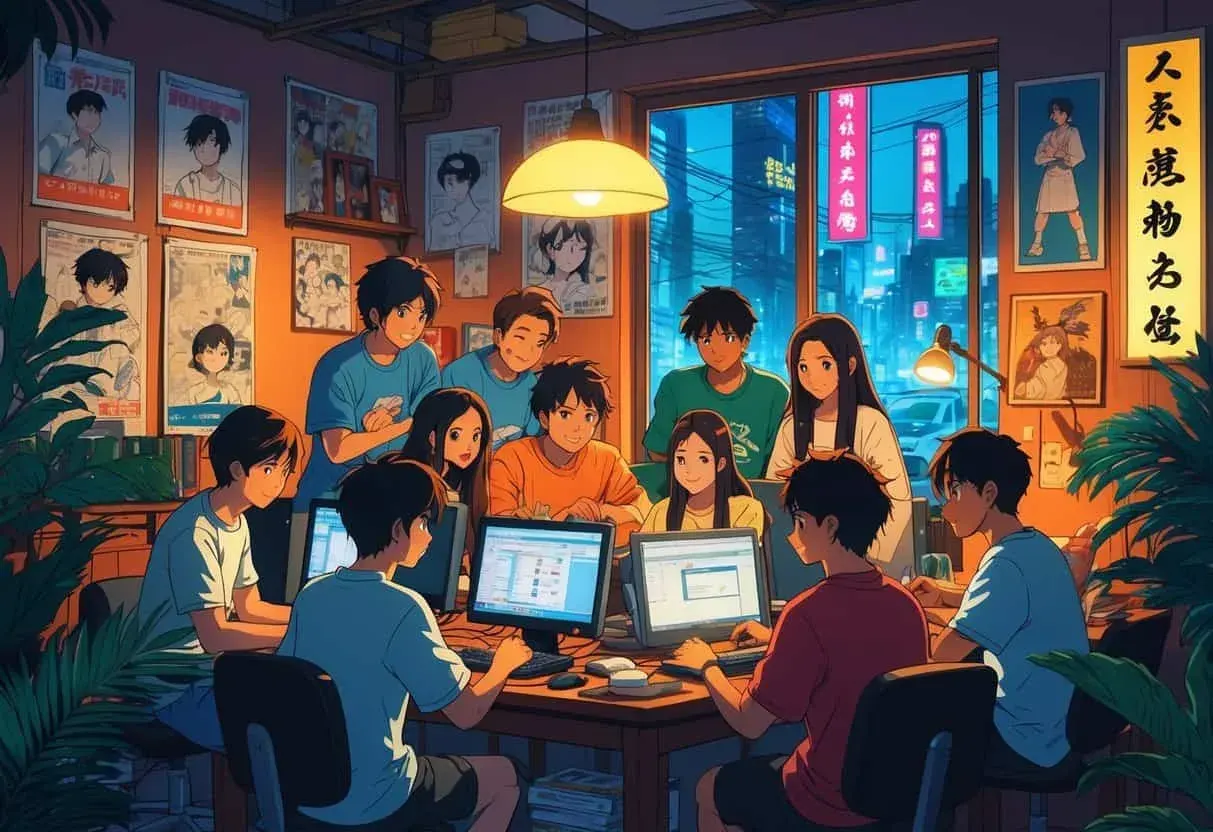
When you join a fansubbing team or simply comment on a newly released subtitle file, you enter a social ecosystem built on reciprocity and shared passion. Groups often form around a single show, a specific genre, or even a particular translator’s style. These communities operate with a remarkable degree of internal organization—members take on roles such as translators, timers, typesetters, encoders, and quality checkers—mirroring a small media production house run entirely by volunteers.
On platforms like Facebook Groups, X (formerly Twitter), and dedicated forums, these groups become spaces for cultural analysis, meme creation, and emotional support. They often extend far beyond the original content: fans organize meet-ups, charity drives, and collaborative language-learning sessions. The bonds formed through such shared labor can be as meaningful as those in offline social circles, providing a sense of belonging that transcends geographic and economic boundaries.
Youth Culture and Subcultures
Fan subbing sits at the heart of contemporary Southeast Asian youth culture, directly connecting you to the symbolic worlds of K-pop, anime, and Hollywood. This access fuels the adoption of stylistic codes—fashion, slang, music preferences—that distinguish digital-native generations from their predecessors. For example, Indonesian teens might incorporate Korean words like daebak or Japanese kawaii into daily speech, all learned through subtitled content.
These dynamics form what sociologists term neo-tribes: fluid subcultures that coalesce around shared media experiences rather than geographic proximity. The K-pop fansubbing scene, in particular, illustrates this. Volunteers translate not only music videos but also variety shows, live streams, and social media posts, creating a 24/7 stream of accessible idol content. This participatory youth culture often challenges conservative values in the region, opening conversations about gender, self-expression, and mental health that mainstream channels might avoid.
Shaping Identities Through Media
The media you consume with fan-made subtitles doesn’t just entertain—it actively shapes your understanding of self and society. Watching stories from Japan, Korea, and the West gives you a window into alternative norms around family, career, and relationships. For many Southeast Asian youth, these narratives offer scripts for identity that differ from local traditions. A Thai viewer might see herself in a Japanese anime character who prioritizes friendship over filial duty, or a Filipino teen might find comfort in a K-drama’s portrayal of non-traditional masculinity.
This constant exposure fosters a hybrid identity formation, blending local, Asian, and Western influences into something uniquely personal. It also cultivates critical awareness: you learn to decode cultural stereotypes, recognize production values, and even critique translation choices. Over time, the act of comparing official subtitles with fan versions becomes a form of media literacy training, sharpening your ability to resist misinformation and appreciate nuance.
Participatory Culture and Social Media
Social media has supercharged the participatory nature of fan subbing, turning it from a solitary act of translation into a collaborative spectacle. Twitter threads break down translation decisions in real time; TikTok clips compare fansub versions with machine translations; YouTube channels host live subtitle creation sessions. The line between consumer and producer blurs. You might watch a video, suggest a translation fix in the comments, and see your correction implemented within hours.
This participatory culture also exerts pressure on official media distributors. When a Japanese anime or Korean drama remains unsubbed for more than a day after broadcast, a swarm of fan subbers steps in, often completing localized translations in under 24 hours. The speed and quality of these unofficial efforts have forced companies to rethink their strategies, leading to faster official simulcasts and the hiring of fan translators. A prime example is the platform Viki, which built its business model around community subtitling, demonstrating how fan subbing can evolve into legitimate cultural brokerage—more on this can be found at Viki’s about page.
Legal, Political, and Educational Dimensions
While fan subbing thrives on community goodwill, it operates in a grey zone that raises pressing questions about copyright, censorship, and knowledge production. Understanding these dimensions helps you grasp the full stakes of the practice.
Copyright Laws and Enforcement
Copyright frameworks in Southeast Asia are a patchwork of national laws, international treaties, and inconsistent enforcement. In principle, fan subbing without permission infringes the exclusive rights of rightsholders—primarily Japanese anime studios, Korean entertainment companies, and Hollywood distributors. Singapore, with its robust IP regime, has witnessed occasional crackdowns on websites hosting fansubbed content, while Indonesia’s Directorate General of Intellectual Property has issued warnings but rarely pursued individuals.
A landmark incident occurred in 2020 when a major anime distributor sent takedown notices to several Indonesian fansubbing groups for distributing episodes of a popular series. The groups complied by moving to private servers and encrypted chats, but the episode highlighted the vulnerability of fan projects. Some legal scholars argue that fan subbing can fall under fair use or fair dealing provisions when no official translation exists, but such defences remain largely untested in the region. Rights-holders themselves are divided: some quietly tolerate fan subbing because it builds markets and fosters brand loyalty, while others view it as lost licensing revenue. For a deeper analysis of copyright tensions in fan communities, see the Electronic Frontier Foundation’s intellectual property resources.
Political Awareness and Censorship
Fan subbing can become an unintended vehicle for political consciousness. By translating documentaries, news clips, and even politically charged music videos that are absent from state-controlled media, fan groups introduce you to perspectives that might otherwise be censored. In countries with tight information controls, such as Vietnam or Myanmar, fan-subbed content on platforms like Facebook has circumvented official narratives on human rights, environmental issues, and governance.
This same dynamic creates risks. Governments have blocked access to fan subbing sites during politically sensitive periods, and some group administrators practice self-censorship to avoid legal trouble. The tension between open access and political safety pushes many groups to adopt invite-only structures and to carefully vet both the content they translate and the comments they allow. Nonetheless, the sheer volume of fan-subbed material makes comprehensive censorship nearly impossible, granting you a degree of informational freedom that formal mass media cannot provide.
Educational Value and Language Learning
Perhaps the most uncontested benefit of fan subbing is its educational power. Watching a J-drama with Indonesian subtitles can teach you Japanese sentence structure, while a K-pop vlog with Thai subtitles reinforces Korean particles and honorifics. Research in applied linguistics confirms that multimodal input—hearing audio while reading captions—accelerates vocabulary acquisition and listening comprehension. One study published on ResearchGate demonstrates how fansubbing participants often achieve near-professional language proficiency through informal practice alone.
In Southeast Asia, where access to formal language classes can be expensive, fan subbing acts as a free, self-paced learning tool. Communities often maintain glossaries, translation guides, and style manuals, effectively functioning as peer-led classrooms. Learners move from passive consumption to active translation, first by editing machine-generated subtitles and later by translating whole episodes. This progression builds not only language skills but also cultural literacy, as subbers must research idioms, slang, and context. For many, what starts as a hobby opens doors to careers in localization, journalism, and academia.
Current Trends and Continuing Influence
Fan subbing is far from static; it constantly adapts to new technologies, new media forms, and the shifting strategies of official distributors. Today’s scene looks very different from the VHS-and-IRC days, yet the core ethos of passionate, community-driven translation remains intact.
Fan Subbing and the Rise of Digital Platforms
The proliferation of digital platforms has made fan subbing more efficient and more visible than ever. Collaborative tools like Aegisub, subtitling plugins, and cloud-based editing allow teams distributed across Malaysia, Thailand, and beyond to synchronize subtitles with millisecond precision. Live-streaming of the subbing process on Discord or Twitch adds a performative layer, turning translation into a social event where viewers give instant feedback.
Platforms like YouTube and Vimeo have become primary distribution channels, while dedicated subtitle repositories index files for thousands of shows. The Korean content wave especially benefited: the global K-pop explosion was partly fueled by an army of fan subbers who made idol variety shows and behind-the-scenes clips comprehensible within hours of release. Even official broadcasters like JTBC and tvN now acknowledge the role of fansub networks in expanding their international reach. Crowdsourced subtitle sites have matured to the point where they rival commercial offerings in quality, and some even use blockchain-based tokens to reward contributors—a trend still nascent but emblematic of the scene’s adaptability.
Expanding Beyond Anime: K-pop, Film, and Music
While anime remains a cornerstone, fan subbing has diversified explosively. K-pop dominates: groups like ARMY (BTS fans) organize massive translation teams that cover everything from lyrics and live broadcasts to official merchandise guides. The speed is staggering—a major K-pop comeback video often receives subtitles in a dozen Southeast Asian languages within a single weekend. This goes beyond entertainment; it helps drive the Korean Wave’s economic impact, influencing tourism, beauty product sales, and language enrollment across the region.
Film and independent music have also entered the fansubbing fold. Southeast Asia’s own film industries benefit when local movies are subtitled into English and other regional languages by fans, boosting festival visibility and diaspora audiences. Thai indie cinema, Philippine horror, and Indonesian auteur works travel further thanks to volunteer translators who value cultural promotion over profit. Even traditional soundscape—underground hip-hop in Vietnam, or experimental pop in Malaysia—gains subtitled lyric videos that circulate across borders, creating intra-Asian cultural dialogues that bypass corporate gatekeepers. For a taste of how K-pop fan translation networks operate, browse through the community-curated database at Koreaboo.
Future Prospects in Southeast Asia
Looking ahead, fan subbing in Southeast Asia will likely grow in sophistication as artificial intelligence and machine translation improve. AI-powered tools already generate rough subtitles that human fan subbers then refine, slashing turnaround times. Rather than making humans obsolete, this symbiosis could raise the bar for accuracy and stylistic flair, with human editors serving as cultural gatekeepers who catch nuance that algorithms miss.
Regulatory dynamics will remain a wildcard. Some countries may introduce safe harbour provisions for non-commercial fan translation, recognizing its cultural and educational value. Others might tighten restrictions under pressure from international trade agreements. Regardless, the infrastructure of decentralized, platform-agnostic fan subbing—backed by encrypted chat apps, torrent-sharing protocols, and redundant file hosting—will ensure resilience. You can also expect deeper integration with augmented reality and virtual reality experiences, where subtitles will need to adapt to 360-degree environments.
Ultimately, the future belongs to a hybrid model: official media and fan communities co-existing, sometimes cooperating, and jointly shaping a more linguistically accessible media landscape across Southeast Asia.