Table of Contents
The Eternal Duel: More Than Just Mascots
Few trading card game icons have the instant recognizability of Dark Magician and Blue-Eyes White Dragon. They are the twin pillars upon which the Yu-Gi-Oh! empire was built, representing not just powerful cards but entire philosophies of play. Their faces adorn starter decks, anniversary sets, and the memories of millions of duelists worldwide. But treating them as mere marketing mascots would be a profound disservice to the rich mechanical identity and cultural footprint each has carved over two decades of competitive and casual play.
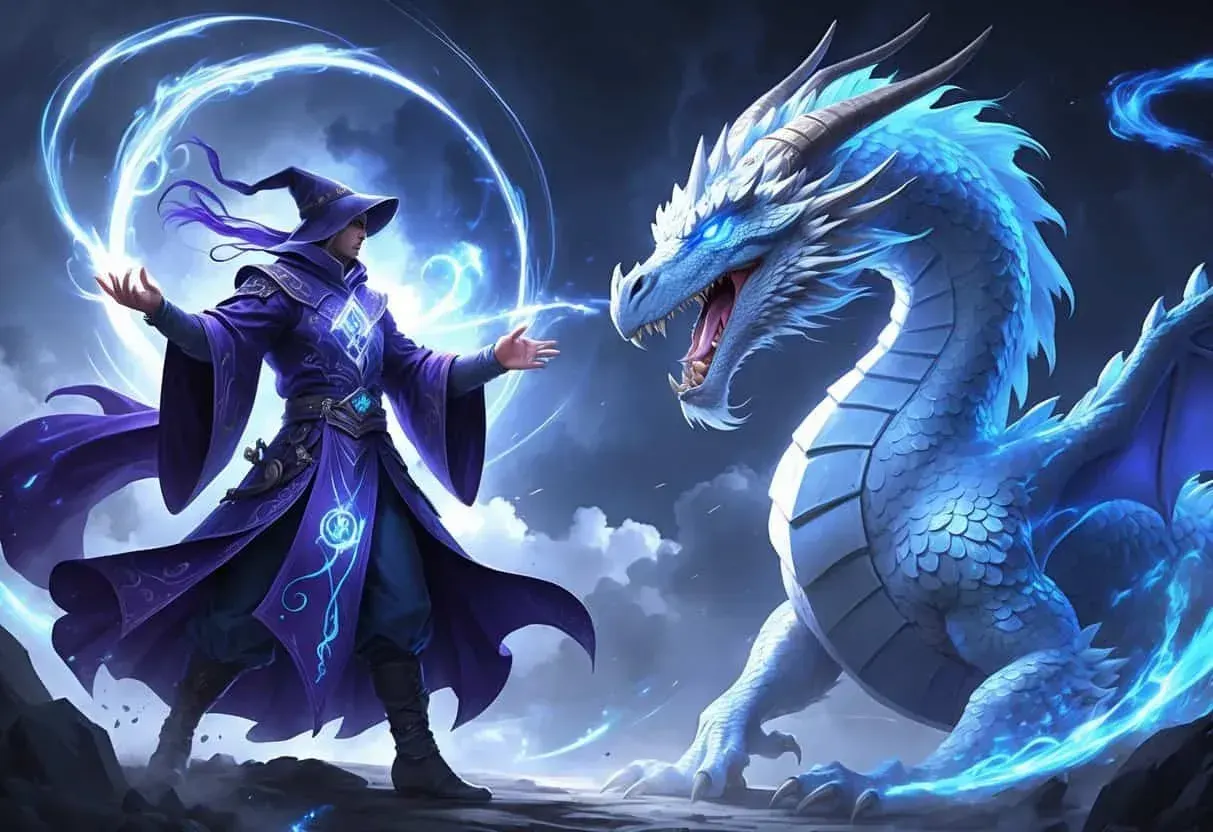
Blue-Eyes White Dragon, with its towering 3000 ATK, became the yardstick for raw power the moment it debuted. Dark Magician, the favored card of protagonist Yugi Muto, wove itself into the very fabric of the anime’s narrative as a symbol of loyalty, destiny, and the bond between a pharaoh and his vessel. The rivalry between these two cards goes far beyond stats and aesthetics—it is a clash between aggressive domination and methodical control, between dragon lords and spellcaster sages. Understanding their true impact requires diving deep into their origins, deck-building DNA, competitive history, and the passionate communities they continue to inspire.
Origins and Iconic Status
Both cards trace their real-world roots to the very first booster packs and starter decks. Released in the Legend of Blue Eyes White Dragon set in 2002 for the TCG, Blue-Eyes instantly captured imaginations. Dark Magician followed shortly after in Spell Ruler and Yugi’s starter deck, cementing itself as the signature card of the series’ hero. Their anime lore, however, imbued them with mythic weight that no other card could claim.
The Rise of Dark Magician
Dark Magician wasn’t simply a monster; it was an extension of the Pharaoh’s spirit. In the anime, it was depicted as the loyal servant of the ancient Pharaoh Atem, a guardian of magical secrets who fought alongside his master across lifetimes. This narrative depth turned a normal-rare monster into a cultural artifact. Early in the physical game, its 2500 ATK was respectable but not game-breaking, and its lack of inherent effect meant it relied entirely on external support to shine.
That support came slowly at first, then in a flood. Cards like Thousand Knives and Dark Magic Attack gave it spell-based removal, while Magical Dimension allowed a tribute summon straight from the hand. Over time, Dark Magician evolved from a beatstick into the centerpiece of an entire spellcaster engine, a role that would eventually define a fully-fledged archetype. Even its visual design—a purple-robed sorcerer with a staff and an enigmatic gaze—drew heavily from classic RPG wizard imagery, making it instantly relatable to fantasy fans. The card’s connection to Egyptian mythology through the Millennium Items only deepened its mystique, turning it into a symbol of hidden wisdom and ancient power.
Blue-Eyes White Dragon’s Legendary Debut
If Dark Magician embodies subtlety, Blue-Eyes White Dragon is a spectacle of unrestrained force. Seto Kaiba’s ace monster was declared “the most powerful card in the game” from the very first episode, and its 3000 ATK backed up that claim in the early formats. The lore established that only four copies ever existed, with Kaiba tearing up the fourth to prevent its use against him—a moment that amplified its mythic rarity and established Kaiba’s obsessive drive. This narrative scarcity mirrored the real-world scarcity of its first-edition prints, especially the LOB 1st Edition, which became one of the most sought-after cards in the hobby.
Its dragon design is classical yet imposing: a stark white body, crystalline blue eyes, and a silhouette that screams power. The card operates as a standalone threat, a monster you summon and then swing into the opponent’s life points with no extra steps required. This straightforward philosophy attracted players who valued efficiency and intimidation. Unlike Dark Magician’s intricate web of support, early Blue-Eyes was about drawing into your big dragon and overwhelming your opponent before they could build a response.
Influence of Yugi and Seto Kaiba
The legacy of both cards cannot be separated from their masters. Yugi Muto’s dueling style was reactive and adaptive, often using trap cards and spell combos to turn the tide. Dark Magician fit that mold perfectly—a monster that rarely fought alone but instead coordinated with Dark Magician Girl, Magician’s Rod, and countless backrow tools to create airtight control boards. For Yugi, the card wasn’t just a tool; it was a symbol of his bond with the Pharaoh and a moral compass in the Shadow Games.
Contrast that with Seto Kaiba, whose every move screamed dominance. Blue-Eyes White Dragon was the physical manifestation of his ambition to be the best, literally crushing opposition underfoot. Kaiba’s deck revolved around getting Blue-Eyes onto the field as quickly as possible, using cards like Ancient Rules and Birthright to cheat the summoning cost. This aggressive, high-roll playstyle became a hallmark of the Blue-Eyes genre. When the two faced off in the anime’s iconic duels, it was more than a card game—it was a philosophical battle between patience and aggression, between calculated defense and unyielding offense.
| Card | Owner | Symbolism | Core Strengths |
|---|---|---|---|
| Dark Magician | Yugi Muto | Magic, loyalty, strategy | Spellcaster synergy, backrow control, floating effects |
| Blue-Eyes White Dragon | Seto Kaiba | Power, ambition, dominance | High ATK, explosive summoning, OTK potential |
Comparing Deck Strategies and Archetypes
Modern Yu-Gi-Oh! is defined by archetypes—groups of cards with explicit synergy that go far beyond vanilla beatsticks. Both Dark Magician and Blue-Eyes have received robust archetypal support that completely transforms how they play compared to their earliest appearances. While the anime presented them as singular aces, the real game asks you to build an entire deck around their themes. The results are two starkly different playstyles that have each carved out niches in casual and competitive environments.
Dark Magician’s Spellcaster Support
A Dark Magician deck today is a well-oiled control machine. At its heart lies Eternal Soul, a continuous trap that special summons Dark Magician from hand or graveyard and protects all your spellcasters from card effects. Combine that with Dark Magical Circle, which allows you to banish a card your opponent controls each time a Dark Magician is summoned, and you have a repeatable removal loop that can grind even the most resilient boards into dust.
The engine relies heavily on spellcasters that search and recycle. Magician’s Rod is the quintessential starter, fetching Circle or Soul directly from the deck. Soul Servant stacks the deck and draws cards while serving as a powerful recovery tool from the graveyard. Magicians’ Souls sends spellcasters from the deck to the grave to generate advantage and can even special summon Dark Magician from hand. The deck’s goal is to establish the Circle-Eternal Soul lock as quickly as possible, using hand traps and board wipes to stall until the engine comes online.
It’s a strategy that rewards patience and careful resource management, often winning incrementally rather than in a single explosive turn.
Blue-Eyes Dragon Synergy
Blue-Eyes decks are engines of explosive aggression. The archetype doesn’t just want one 3000 ATK dragon; it wants to flood the field with them. Blue-Eyes Alternative White Dragon is the cornerstone, revealing a vanilla Blue-Eyes in hand to special summon itself and then destroying a monster each turn. Dragon Shrine sends Blue-Eyes to the grave, setting up revival plays, while Melody of Awakening Dragon searches out both vanilla and Alternative in one fell swoop.
The extra deck is where the archetype truly shines. Blue-Eyes Spirit Dragon locks graveyard effects and can tag out into other synchro dragons. Azure-Eyes Silver Dragon protects all dragons from destruction and floats back into the game. The legendary Blue-Eyes Chaos MAX Dragon is a ritual monster with 4000 ATK and double piercing damage that can end games out of nowhere. A typical Blue-Eyes board might end with multiple large bodies and a negate or two, presenting a lethal clock that forces the opponent to have an immediate answer.
The deck thrives on high-roll hands, and when it opens well, it can tear through established boards with raw ATK and relentless pressure.
Signature Cards: Dark Magician Girl and Allies
No discussion of Dark Magician’s army is complete without its most famous companion. Dark Magician Girl gains 300 ATK for each Dark Magician or Magician of Black Chaos in either graveyard, turning her into a surprisingly dangerous beatstick later in the duel. She also fuels fusion and synergy cards like The Dark Magicians, a fusion that draws two cards whenever a spell/trap or effect activates while Dark Magician is on the field.
Other allies flesh out the toolbox. Apprentice Illusion Magician can be special summoned from the hand by discarding a card, then searches a Dark Magician upon summon. Skilled Dark Magician can tribute itself to special summon a Dark Magician from hand after three spell counters, though it’s largely nostalgic now. Illusion of Chaos searches for Dark Magician and recycles itself, offering even more consistency. These smaller spellcasters aren’t just tribute fodder; they form a layered network that ensures the core threat is never far away, rewarding players who master the intricate timing of their effects.
Power Plays: Fusion and Ritual Tactics
Both archetypes dip heavily into fusion and ritual summoning, but they do so with entirely different goals. Dark Magician offers Dark Paladin, a fusion with Buster Blader that gains ATK for every dragon in either graveyard and can negate any spell card by discarding a card. Dark Magician the Dragon Knight, fused with a dragon, protects all backrow from destruction and can float into another Dark Magician if it leaves the field. These fusions emphasize flexibility and defense, turning the tide of a duel through negation and protection rather than sheer damage.
Blue-Eyes fusion monsters are pure stat bombs. Blue-Eyes Ultimate Dragon sits at a colossal 4500 ATK but requires three Blue-Eyes White Dragons. Neo Blue-Eyes Ultimate Dragon improves on the formula by letting you double-attack and recycle a Blue-Eyes from the graveyard each turn. The ritual monster Blue-Eyes Chaos MAX Dragon is the ultimate expression of the archetype’s philosophy: it cannot be targeted or destroyed by card effects, and its 4000 ATK with double piercing damage can instantly end games against any defense-position monster. These plays don’t ask for complicated setup; they demand a straightforward commitment to overwhelming force, perfectly encapsulating Kaiba’s dueling ideology.
Competitive Evolution and Deck-Building Philosophy
While both archetypes are fan favorites, their journeys through the competitive meta have been vastly different. Understanding their tournament histories reveals why certain players gravitate toward one or the other, and how Konami has carefully managed their power levels to keep them relevant without breaking the game.
Dark Magician in the Meta
Dark Magician has rarely been a tier-1 threat in the traditional sense, but it has enjoyed moments of genuine competitive viability. During the Link era, the release of Eternal Soul and Magicians’ Souls gave the deck a consistent first-turn setup that could banish two cards and set up a near-unkillable monster. The deck’s biggest strength is its ability to win the grind game—once the Circle-Soul loop is established, few decks can out-resource its constant removal and floating. However, it suffers from a heavy reliance on its normal summon and is vulnerable to common hand traps like Ash Blossom and Ghost Belle. A well-placed D.D. Crow on an Eternal Soul target can also unravel the entire strategy.
Despite its middling tier placements, Dark Magician has always been a top contender in fan-organized events and in formats like Duel Links, where its compact engine thrives. The deck’s dedicated player base continues to innovate, often teching in floodgates and spell/trap protection to shore up its weaknesses. This adaptability is a testament to the deep card pool and the loyalty of those who see the deck as more than just a nostalgia trip.
Blue-Eyes in the Meta
Blue-Eyes White Dragon, by contrast, has tasted world championship glory. In 2016, the World Championship was won by a Blue-Eyes deck that dominated with a combination of Blue-Eyes Spirit Dragon lockdowns and the raw power of Dragon Spirit of White. The deck could cycle through its dragons with frightening speed, setting up boards of 3000 ATK monsters backed by Return of the Dragon Lords protection. It was the epitome of a mid-range beatdown strategy that could pivot from control to OTK in a single turn.
In modern formats, Blue-Eyes has fallen from its tier-0 heights but remains a dangerous rogue pick. The addition of Blue-Eyes Jet Dragon and link monsters like Striker Dragon have given the deck more speed and recursion. It still struggles with consistency and can brick on multiple high-level dragons, but its sheer explosive capability means it can steal wins against any unprepared opponent. The deck-building philosophy remains aggressive: maximize your chances of seeing your combo pieces and push for lethal damage before your opponent stabilizes. This high-risk, high-reward style attacts duelists who enjoy the thrill of the big dragon drop.
Cultural Impact and Card Rarity
The reach of Dark Magician and Blue-Eyes extends far beyond tournament tables. They are cultural icons whose imagery is woven into apparel, accessories, and digital media. Their collectible status has created an entire sub-economy within the TCG, with rare printings commanding prices that rival high-end sports cards. Understanding this facet of their legacy means examining both their animated stardom and their tangible market value.
Animated Legacy and Media Appearances
From the original Yu-Gi-Oh! Duel Monsters series to the latest Master Duel video game, Dark Magician and Blue-Eyes have been inescapable. They have appeared in every major spin-off anime, often as cameo characters or as the cornerstone of alternate-reality versions of Yugi and Kaiba. The card artworks have been reimagined dozens of times—from the iconic Kazuki Takahashi original to anniversary alts by modern manga artists. In Duel Links, both characters have their own dedicated summoning animations and voice lines, and in Master Duel, players eagerly save currency to pull from their respective secret packs.
The visual language of these cards has become shorthand for Yu-Gi-Oh! itself. A silhouette of Blue-Eyes or a stylized Dark Magician hat instantly communicates the franchise, whether on a t-shirt, a skateboard deck, or a limited-edition figure. This omnipresence reinforces their status not just as game pieces but as fashion statements and identity markers for the community.
Collectibility and Investment Value
The collectible market for both cards is staggering. A 1st Edition LOB Blue-Eyes White Dragon in near-mint condition can fetch several hundred dollars, while a PSA 10 graded copy shatters four figures. The ultra-rare DDS-001 promo Blue-Eyes, given away with the Dark Duel Stories video game, is one of the most expensive Yu-Gi-Oh! cards ever printed. Similarly, Dark Magician has its own suite of chase rarities: the Magician's Force 1st Edition secret rare, the Collector's Rare versions from modern sets, and the breathtaking Anniversary Art promos regularly command premium prices.
For collectors, these cards represent more than profit potential; they are pieces of a shared history. Many duelists hold onto their childhood copies not for resale but as mementos of after-school duels and Saturday morning cartoon rituals. The steady release of high-rarity reprints keeps both demand and accessibility high, ensuring that new players can own a piece of the icon while vintage aficionados chase the originals.
Beyond the Duel: Iconic Status in Pop Culture
The influence of Dark Magician and Blue-Eyes has spilled into mainstream awareness in surprising ways. They have been referenced in other video games, in music, and in internet memes that celebrate the absurdity of a children’s card game with world-ending stakes. The “screw the rules, I have money” meme, intrinsically tied to Kaiba and his Blue-Eyes, persists as a shorthand for any situation where wealth overrides fairness. Dark Magician Girl has become a cosplay staple at conventions worldwide, further cementing the archetype’s place in geek culture.
Collaborations with brands like Uniqlo and Hot Topic have put these monsters on apparel worn by people who may never have played a single duel. Meanwhile, Konami’s own Yu-Gi-Oh! Cross Duel and other experimental titles continue to feature them as marquee characters. This cross-media ubiquity ensures that even as the TCG evolves and new summoning mechanics are introduced, Dark Magician and Blue-Eyes remain the anchors that tether the game’s ever-expanding universe back to its nostalgic roots. They are not just cards; they are the enduring face of a franchise that has shaped the childhoods of multiple generations.
The rivalry between Dark Magician and Blue-Eyes White Dragon will never truly fade. As long as Konami releases new support, and as long as players gather around tables to relive the ancient battle between magician and dragon, these two titans will continue to inspire deck building, fan art, and spirited debates over which is truly superior. Their impact goes far beyond the printed cardboard—they are living legends in the truest sense.