Table of Contents
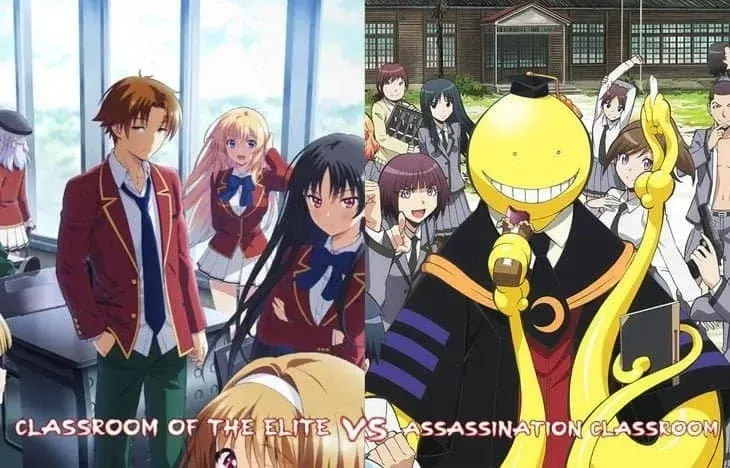
When two anime series both take place in a high school setting where students are pitted against a system that judges them by their class rank, it’s natural to compare them. Classroom of the Elite and Assassination Classroom are often mentioned in the same breath by fans of psychological thrillers, school dramas, and clever character writing. Yet they couldn’t be more different in tone, philosophy, and execution. This guide breaks down every aspect that matters — plot, characters, animation, fan reception, and more — so you can decide which one deserves a spot on your watchlist.
Plot and Thematic Core
Classroom of the Elite: A Psychological Chess Match
Classroom of the Elite (Youkoso Jitsuryoku Shijou Shugi no Kyoushitsu e) takes place at the Tokyo Metropolitan Advanced Nurturing School, a government-funded institution that promises students a 100% employment rate and a life of luxury — provided they can hold on to their class standing. The catch is that the school operates on a ruthless meritocracy. Every class competes for points that translate directly into money, privileges, and status. The protagonist, Kiyotaka Ayanokouji, deliberately landed in Class D, the lowest rung, because he wanted to fly under the radar. As the story unfolds, he quietly manipulates classmates, teachers, and rivals while hiding his exceptional intelligence and true nature.
The series thrives on mind games, hidden agendas, and dark revelations. Each story arc introduces a new special exam — ranging from survival challenges on a deserted island to chess-like paper shuffles — that forces students to betray one another, form fragile alliances, and confront the ugly truths of their own psyche. Unlike many high school anime, there are no lighthearted field trips; every interaction is a potential trap. The atmosphere is heavy with tension, and trust is a luxury no one can afford.
Assassination Classroom: A Heartfelt Action Comedy with a Deadline
On the surface, Assassination Classroom (Ansatsu Kyoushitsu) could not be further from the cold cynicism of Classroom of the Elite. The students of Class 3-E at Kunugigaoka Junior High are the school’s perpetual outcasts, exiled to a rundown classroom on a mountain. Their lives change when a yellow, octopus-like creature destroys 70% of the moon and announces he will do the same to Earth in one year — but first, he demands to become their homeroom teacher. The Japanese government agrees, on the condition that the students train to assassinate him, with a 10 billion yen reward.
Koro-sensei, the unkillable teacher, turns the assassination training into a uniquely inspiring educational experience. He helps socially awkward students gain confidence, teaches academic subjects with a flair no ordinary teacher could match, and becomes a genuine father figure to the class. The anime balances slapstick comedy, heartfelt character arcs, and thrilling action set pieces — all while a planetary doomsday clock ticks away. The underlying themes of redemption, the value of every life, and the power of a nurturing mentor give the show an emotional weight that resonates long after the final episode.
Character Analysis
Protagonists: The Hidden Genius vs. The Empathetic Assassin
Kiyotaka Ayanokouji of Classroom of the Elite is an enigma. He presents himself as an unremarkable, brooding student who barely reacts to the world around him. In reality, he was raised in a facility that turned him into a perfect human weapon, a genius who can outthink and outfight almost anyone. His emotional detachment is both his greatest weapon and his most unsettling trait. He views people as tools; even his friendships are calculated.
Watching him slowly reveal his true abilities — while the audience questions whether he’s a hero or a monster — is the anime’s main hook.
Nagisa Shiota of Assassination Classroom is the opposite in almost every way. Initially a timid, androgynous boy who is constantly belittled, Nagisa discovers a hidden talent for assassination through careful observation and a chilling calm under pressure. Unlike Kiyotaka, however, his growth is fueled by empathy and his deep bond with Koro-sensei. He learns to value himself and his classmates, and he becomes a natural leader not through domination but through understanding. The contrast between the two leads — one who hides his light and the other who finds it — defines the emotional core of each series.
Antagonists: Systemic Oppression vs. Government Conspiracies
The antagonistic forces in Classroom of the Elite are rarely a single villain. The true enemy is the school’s system itself, which reinforces class division and rewards those who step on others. Student council president Manabu Horikita and other high-ranking pupils often act as direct challengers, but they are products of the same environment. Even the teachers are complicit, and the shadowy Chairman’s motives remain murky. This structural antagonism makes the series feel philosophical; the fight is against an ideology, not just a person.
In Assassination Classroom, the conflict is more tangible. The government and a mysterious organization named the Reaper constantly push to kill Koro-sensei by any means necessary. Professional assassins, morally gray scientists, and even a ruthless defense minister all take their shot. Yet the show complicates the black-and-white nature of these villains by revealing Koro-sensei’s own past and the reasons he became what he is. The antagonists often serve to test the students’ loyalty and force them to decide what kind of world they want to protect.
Supporting Casts: Chess Pieces vs. Found Family
The classmates in Classroom of the Elite often function as extensions of Ayanokouji’s strategy. Characters like Suzune Horikita, Kikyou Kushida, and Kakeru Ryuuen all possess layered personalities, hidden traumas, and shifting loyalties. The series invests heavily in their development, but the tone remains pessimistic — friendships can be transactional, and betrayal is always around the corner. The large cast is a web of schemes, and every smile might be a mask. This complexity rewards attentive viewers who enjoy piecing together character motivations.
Assassination Classroom opts for a warmer approach. The entire Class 3-E — from the athletic Maehara to the tech-savvy Ritsu — gets moments to shine. Each student has a distinct quirk and a personal hurdle, and Koro-sensei tailors his lessons to help them overcome those obstacles. The camaraderie feels genuine and organic. While some arcs may follow a formula (student struggles → Koro-sensei intervenes → student overcomes), the emotional payoff is consistently strong.
The series becomes a celebration of the underdog, and by the end, you genuinely care about every single kid.
Animation Style and Visual Direction
Classroom of the Elite: Controlled Realism
Classroom of the Elite is animated by Lerche, the same studio behind Assassination Classroom, but the visual approach could not be more different. The color palette is muted — grays, blues, and desaturated tones dominate the screen. Character designs are refined and realistic, with a focus on subtle facial expressions. Match cuts and long pauses are used to build tension, and the action sequences rely more on psychological impact than flashy choreography. The first season, in particular, has static camera work that some viewers find rigid, but this deliberate stillness reinforces the oppressive atmosphere of the school.
Season 2 and 3 introduced stronger action cuts and more dynamic lighting, though the overall aesthetic remains grounded.
Assassination Classroom: Vibrant Expressiveness
Lerche took a completely opposite route for Assassination Classroom. The show is bursting with color — from the bright yellow of Koro-sensei to the lush greenery of the mountain campus. Character expressions are exaggerated for comedic effect, and the assassination training sessions feature fluid, acrobatic movement that feels like a Saturday morning cartoon. The animators play with art styles frequently, switching to chibi modes, rough sketches, or even live-action parody filters for gags. This visual energy mirrors the series’ emotional range: one moment you’re laughing at a ridiculous face, the next you’re tearing up at a quiet sunset conversation.
The contrast between the two anime is a testament to Lerche’s versatility as a studio, but it also means your preference will heavily depend on which visual language you enjoy more.
Fan Reception and Cultural Impact
Ratings and Popularity
Looking at major anime databases, Assassination Classroom maintains a higher overall score. On MyAnimeList, the first season sits at an 8.09 rating, while the second season climbs to 8.56, placing it among the platform’s top anime. IMDb users have rated the series 8.0/10. Classroom of the Elite, by comparison, scores around 7.87 on MyAnimeList for its first season, with the second season earning 8.02 and the third season 8.26. IMDb scores hover around 7.8.
These numbers suggest that while both are well-liked, Assassination Classroom’s blend of humor, heart, and satisfying payoff resonates with a broader audience. However, Google Trends data from the last 12 months shows Classroom of the Elite often generates higher search interest worldwide, likely fueled by the buzz around its long-awaited Season 2 and 3 releases as well as TikTok edits focusing on Ayanokouji’s “sigma male” persona. Popularity is not always synonymous with quality, but the online conversation around both series remains highly active.
Praise and Criticism
Assassination Classroom receives near-universal praise for its original premise, the unforgettable Koro-sensei, and its ability to make viewers laugh and cry in equal measure. The final arc, in particular, is frequently cited as one of the most emotionally devastating yet uplifting endings in anime. Criticisms tend to focus on the repetitive mission structure — some episodes follow a “target of the week” pattern — and the occasionally clichéd side character development. A small contingent also finds the series’ sentimental tone too saccharine.
Classroom of the Elite splits opinions more sharply. Supporters love the dense plotting, the morally ambiguous protagonist, and the ruthless social commentary. Fans dub it “the thinking person’s anime,” celebrating every twist and hidden clue. Detractors argue that the first season’s pacing drags, that the anime adaptation deviates too much from the light novel (including shifting pivotal scenes to different characters), and that Ayanokouji’s calculated cruelty can feel alienating. The show’s incomplete adaptation also leaves many plot threads dangling, though the third season has brought the first-year arc to a reasonable close.
Still, those who appreciate subtle character work and layered narratives find it deeply rewarding.
Which One Should You Watch?
There is no objective winner in the Classroom of the Elite vs. Assassination Classroom debate; the choice hinges entirely on what you want from an anime. Use the following guidelines to pick your starting point.
Choose Classroom of the Elite if you want:
- A psychological thriller with high-stakes mind games and a cold, calculating protagonist.
- A darker, more cynical tone that explores themes of meritocracy, manipulation, and identity.
- Complex character arcs where no one is entirely trustworthy.
- A slow-burn mystery that rewards close attention to dialogue and foreshadowing.
Choose Assassination Classroom if you want:
- An action comedy that seamlessly blends humor, heart, and genuine emotional depth.
- An inspiring mentor figure who teaches life lessons as often as academic skills.
- Lighthearted escapism that still carries meaningful messages about self-worth and growth.
- A complete, emotionally satisfying story told in two seasons.
If you have the time, watching both is a fascinating experience. Together, they showcase how a similar setup — a class of misfits fighting against a system — can yield wildly different stories. Start with Assassination Classroom for a feel-good journey that will make you cry twice, then shift to Classroom of the Elite for a colder, strategic narrative that will make you question everyone’s motives.
Frequently Asked Questions
What are protagonists?
Protagonists are the central characters of a story, the ones whose goals and challenges drive the plot forward. They can be heroes, anti-heroes, or even villains, but they always occupy the narrative’s focus.
What are antagonists?
Antagonists are characters, groups, or forces that oppose the protagonist and create conflict. In psychological anime, the antagonist can also be an institution, an ideology, or a person’s inner demons, not just a villain.
Who is smarter — Karma Akabane or Kiyotaka Ayanokouji?
Both characters are prodigies in their respective series. Karma excels at strategy and improvisation within the assassination battles, while Ayanokouji is a master manipulator with a nearly superhuman capacity for pattern recognition and long-term planning. Since they come from different genres and never meet, any direct comparison is speculative. In terms of raw intellectual feats as depicted, Ayanokouji’s calculated manipulations are presented as more unassailable.
Can Karma defeat Ayanokouji in a fight?
In a physical confrontation under normal rules, Karma is a highly trained junior high student with some combat skills, while Ayanokouji possesses exceptional martial arts training from his White Room upbringing. Most fans agree Ayanokouji would dominate a straight duel. However, in an assassination-style scenario where Karma can set traps and use surprise, the outcome would be far less certain.
Is Assassination Classroom considered one of the best anime ever?
Opinions differ, but Assassination Classroom is widely regarded as a modern classic, especially among fans of emotional school stories. It has a strong critical consensus, high ratings, and a loyal following that often recommends it as a beginner-friendly anime with a unique concept. While it may not top lists of "deepest" anime, it frequently appears on lists of most heartwarming and most rewatchable series.
Who is the most powerful character in Assassination Classroom?
Without question, Koro-sensei is the most powerful being in the series. He can move at Mach 20, regenerate from nearly any wound, shift his size and shape, and outpace all known weapons. His abilities are both comedic and terrifying, but his true strength lies in his protective love for his students, which repeatedly allows him to surpass his own limits.