Table of Contents
How Nonlinear Anime Breaks the Rules of Time
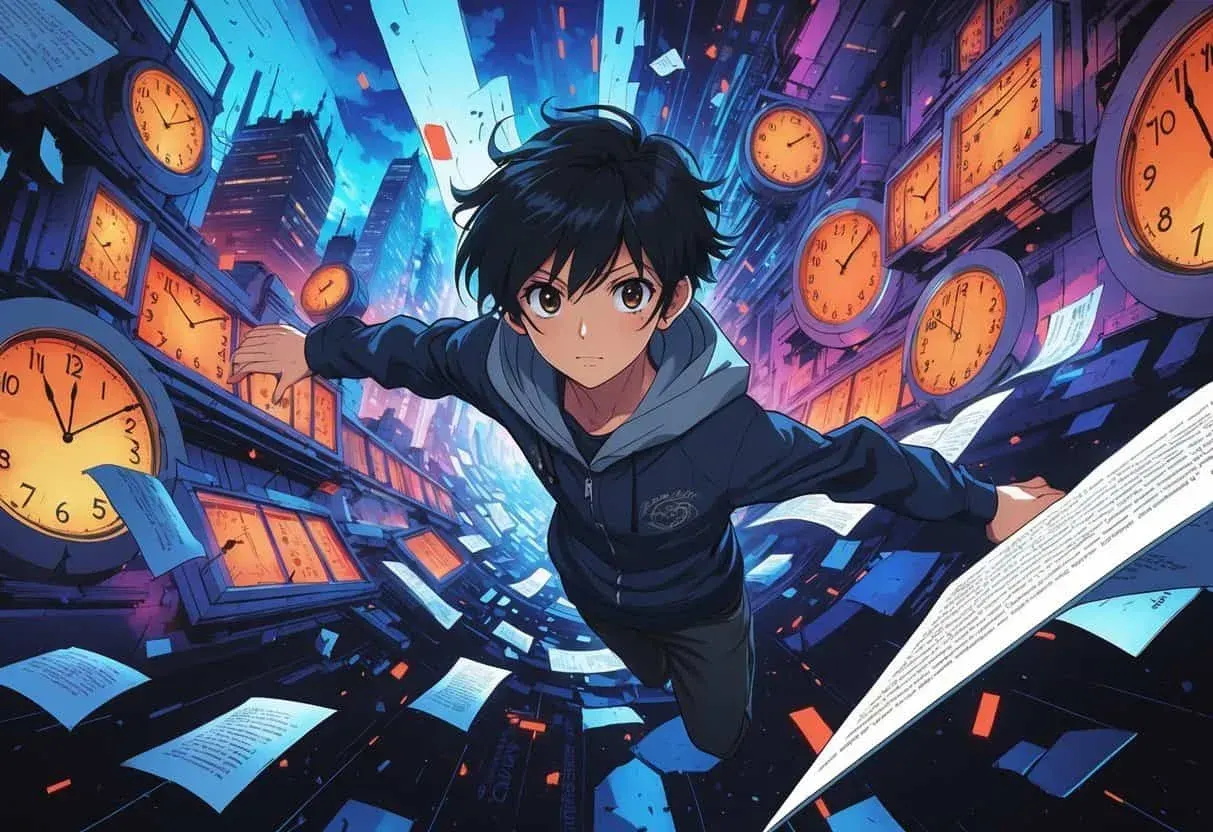
Conventional narratives move in a tidy straight line: first this happened, then that, and finally everything resolves. Nonlinear anime gleefully tosses out that structure, forcing you to assemble the story like scattered pieces of a mosaic. You’re dropped into scenes that leap between past, present, and future, sometimes without warning, and often across multiple viewpoints. The result is a viewing experience that feels active rather than passive, rewarding curiosity and careful attention.
Series such as Baccano!, Durarara!!, and The Tatami Galaxy have built loyal followings by refusing to hand you a straightforward timeline. Instead, they treat narrative structure as a puzzle box. You watch events unfold out of sequence, gather clues, and slowly understand how each piece locks into place. This approach doesn’t just create suspense—it reshapes the way you interpret character motivations, thematic echoes, and even the reliability of what you see.
Beyond the thrill of untangling timelines, nonlinear techniques allow anime to explore memory, trauma, and identity in ways that linear plots rarely match. When a story loops back on itself or fractures into parallel threads, emotions become layered and contradictions feel intentional rather than confusing. You’re not just a spectator; you become an active participant in meaning-making, connecting dots that the creators have hidden across episodes. For many fans, that collaborative puzzle-solving is the heart of the appeal.
Anime as a medium thrives on this kind of invention. Hand-drawn or digital animation can visually render time shifts, psychological breaks, and symbolic landscapes with an immediacy that live-action material often struggles to achieve. An explosion of color might signal a memory, a jagged cut could fracture reality, and the sound design can flip between calm and disorienting in an instant. This fluidity makes nonlinear storytelling feel organic rather than gimmicky.
As you explore the genre, you’ll notice recurring patterns: fragmented chronologies that mirror a character’s mental state, repeated motifs that link seemingly separate vignettes, and abrupt perspective changes that challenge your assumptions about who the real protagonist is. Nonlinear anime doesn’t simply tell you a story—it trains you to question how stories are built in the first place.
What Is Nonlinear Storytelling in Anime?
Nonlinear storytelling refers to any narrative that intentionally disrupts chronological order. In anime, this might mean frequent flashbacks, flash-forwards, parallel timelines running side by side, or even a story that spirals backward from its ending. The defining feature is that events are not presented in the order they occurred within the fictional world. Instead, the sequence serves a specific artistic or thematic purpose, often demanding that viewers piece together the real timeline themselves.
Breaking the Linear Chain
In a linear story, cause flows smoothly into effect. A character is introduced, a conflict arises, and the plot marches forward in one direction. A nonlinear anime might start at the climax, then rewind years, then cut to a side character’s perspective from a completely different moment, and finally reveal how all those threads interlock. This isn’t confusion for its own sake. It’s a way to mold suspense, emotional impact, and meaning.
By withholding certain pieces, the show forces you to hold multiple possibilities in your head, making the eventual revelations land with greater force.
The technique also allows creators to emphasize connections that a chronological telling would bury. Two events separated by years might be placed back-to-back to highlight a recurring theme or a character’s unresolved trauma. The juxtaposition itself becomes a storytelling tool.
Core Building Blocks of Nonlinear Anime
While each series invents its own rules, most nonlinear anime rely on a recognizable set of devices:
- Disjointed chronology: Scenes are arranged by emotional logic or thematic parallel rather than calendar order. You might see a tragic outcome before the events leading up to it, reframing everything that follows.
- Multiple perspectives: The same incident is revisited from different characters’ viewpoints, each offering conflicting details. This approach suggests that truth is subjective and memory unreliable.
- Recurring symbols and motifs: A color, object, or musical phrase appears across timelines, serving as a connective thread. These symbols often accumulate meaning as the story progresses, rewarding repeat viewing.
- Puzzle-like assembly: Information is intentionally fragmented, encouraging viewers to diagram relationships, compare details, and theorize about gaps. The narrative becomes a collaborative experience between creator and audience.
- Temporal loops and repetitions: Some anime trap characters in cycles of time, replaying events with subtle variations. This technique explores choice, fate, and desperation with surgical precision.
These elements aren’t just storytelling tricks; they reflect the inner landscapes of the characters. When a protagonist’s mind is shattered, the narrative structure often shatters along with it. The medium becomes the message.
Why Anime Is Uniquely Suited to Nonlinear Plots
Animation can visualize abstractions in ways that live action struggles to replicate. A character’s fractured psyche can be represented through surreal shifts in art style, distorted environments, or impossible camera movements. Time jumps can be signaled by a sudden change in color palette or the dissolution of the screen itself. This visual vocabulary makes nonlinear storytelling feel intuitive, even when the timeline is objectively chaotic.
Furthermore, anime’s episodic television format allows for long-form narrative experiments. A series can plant seeds in early episodes that only bloom seasons later, or structure an entire cour around a single non-chronological principle. The commitment audiences develop over many episodes deepens the payoff when hidden connections finally surface. On the film side, directors like Satoshi Kon built entire careers around dreamscapes and fractured realities that live comfortably within the animated frame.
Anime That Redefine Narrative Structure
Some titles didn’t just dabble in nonlinear storytelling—they built their identity around it. These works use temporal disorientation not as a garnish but as a core ingredient, reshaping how viewers understand character, plot, and even the nature of reality.
Neon Genesis Evangelion: The Timeline of a Fractured Mind
Neon Genesis Evangelion remains one of the most analyzed anime ever made, in part because its timeline refuses to behave. The series begins as a mecha action show but gradually dissolves its own continuity. Flashbacks interrupt present-day battles, internal monologues distort objective events, and the final episodes abandon physical reality altogether, retreating into a collage of abstract imagery and psychological confession. You’re never fully sure whether a scene is occurring in the tangible world or inside a character’s head—and that ambiguity is exactly the point.
By scrambling chronology, Hideaki Anno turned the series into a direct expression of Shinji Ikari’s mental state. Moments of trauma resurface at unexpected times; key revelations are withheld until their emotional weight can be maximized. The disjointed structure mirrors depression, isolation, and the slipperiness of self-knowledge. Evangelion’s nonlinearity teaches you that understanding someone often requires abandoning the comfort of a linear biography.
Berserk (1997): Memory as a Living Wound
The 1997 adaptation of Berserk employs flashbacks as an essential narrative engine. The story opens on a hardened, vengeful Guts in the present, then devotes much of its run to an extended flashback arc that reveals how he became this broken figure. The shift between timelines isn’t a simple framing device; it creates a constant emotional pressure. Knowing the grim destination makes every moment of the past feel fragile and doomed, while the brutality of the present gains context from the tenderness it crushed.
This structure also emphasizes how trauma erupts mid-action. Memories of the Band of the Hawk surface during fights, bleeding into the present and reminding you that Guts cannot outrun his history. The line between recollection and hallucination blurs, as the narrative itself seems to fracture under the weight of its protagonist’s suffering.
Ghost in the Shell: Consciousness Across Time
The Ghost in the Shell franchise, particularly Mamoru Oshii’s 1995 film, uses nonlinear sequences to explore questions about memory and identity in a cybernetic future. The story interweaves investigative scenes with philosophical digressions, flashbacks, and digitally induced hallucinations. Major Motoko Kusanagi’s own sense of self is destabilized by the possibility that her memories could be fabricated, and the film’s structure mirrors that uncertainty.
By refusing to present a clean, linear investigation, Ghost in the Shell turns the viewer’s disorientation into a thematic statement. If identity is just a collection of stories we tell ourselves, and those stories can be edited, then what exactly remains? The nonlinear approach transforms a cyberpunk thriller into a meditation on the nature of consciousness.
Studio Ghibli’s Dream Logic
While not always associated with aggressive timeline fractures, certain Studio Ghibli works embrace a softer, more poetic nonlinearity. Spirited Away follows a dreamlike internal logic where scenes feel connected by emotional rather than causal threads. You often can’t map the passage of time in the spirit world, and transitions happen with the suddenness of a child’s imagination. The Tale of the Princess Kaguya juxtaposes idyllic memories with harsh present realities, creating a visual representation of temporal dislocation.
This approach invites you to experience the film rather than follow it. Cause and effect recede, replaced by associative leaps that mimic the way memories actually work. Ghibli’s nonlinearity is gentle but profound, proving that a story doesn’t need an overt time-jump device to feel untethered from ordinary chronology.
Other Masterpieces of Disrupted Time
Many other anime have pushed nonlinear storytelling to remarkable extremes. The Melancholy of Haruhi Suzumiya (especially the broadcast order) spun episodes out of sequence, forcing viewers to construct the timeline themselves and adding a layer of mystery to everyday school life. Steins;Gate weaponized time loops, showing the same events from shifting angles to build agonizing tension around the concept of fate. Monogatari Series presents its arcs in a non-chronological order that reflects the narrator’s selective memory and psychological defenses. Paprika and Perfect Blue by Satoshi Kon practically dissolve the boundary between reality and fantasy by cross-cutting between timelines and mental states with breathtaking fluidity.
Each of these titles demonstrates that nonlinear structure isn’t a single technique but an entire creative language.
Thematic Currents in Nonlinear Anime
Nonlinear stories tend to gravitate toward certain universal questions. The structure itself becomes a vehicle for examining how we perceive reality, how memory defines us, and what it means to search for hope in a world that often feels broken.
Reality, Perception, and the Unreliable Self
When a narrative jumps between timelines or perspectives, the status of what’s “real” becomes murky. You can’t assume that what you’re watching is objective truth; it might be a memory distorted by emotion, a lie a character tells themselves, or even an alternate reality. This ambiguity forces you to engage critically, weighing evidence and recognizing your own biases as a viewer. In many cases, the anime itself withholds a definitive answer, leaving you to sit with the discomfort of uncertainty.
Characters in these stories often confront the possibility that their memories have been altered or that their identity is a construct. The nonlinear form externalizes that internal crisis, showing you the cracks in the timeline that mirror the cracks in a person’s sense of self.
Symbolism as Narrative Glue
Because nonlinear plots can feel fragmented, skilled creators embed recurring visual and auditory motifs to provide continuity. A specific color might appear during moments of revelation; a melody might echo across different eras. These symbols act as anchors, helping you track emotional through-lines even when chronology is scrambled. They also accumulate meaning, so that a seemingly simple image—a red thread, a broken clock, a butterfly—gains devastating resonance by the finale.
Music, in particular, becomes a structural element. A sudden shift in the score can signal a temporal jump before the visuals even change, conditioning you to anticipate narrative turns. Conversely, a consistent theme played across disparate scenes can suggest that two events, separated by years, are linked in ways not yet understood.
Redemption, Apocalypse, and the Weight of Time
Nonlinear anime frequently orbits themes of redemption and catastrophe. When you witness the outcome of a character’s choices before understanding their original intentions, the tragedy—or the grace—lands with amplified force. A flashback to a moment of kindness can recontextualize an act of violence; a glimpse of a ruined future can make a present-day decision feel monumental.
Apocalyptic settings, from desolate wastelands to psychological end times, thrive on nonlinear structures. The collapse of the world often mirrors the collapse of linear time, and characters are forced to navigate meaning in a cosmos that no longer follows familiar rules. The resulting stories feel urgent, haunted, and deeply human.
Why Nonlinear Anime Leaves a Lasting Mark
Nonlinear storytelling in anime doesn’t just manipulate plot—it rewires the relationship between the work and the audience. It demands more from you, and often gives more in return.
Active Engagement and Character Revelation
When you can’t rely on a simple timeline, you start paying attention to details that would otherwise fade into the background. A brief reaction shot, a line of dialogue that seems insignificant, a prop that appears in two otherwise unrelated scenes—all become potential clues. This transforms viewing into a form of detective work, and when the pieces snap together, the satisfaction is profound.
Characters, too, benefit from being presented in fragments. You encounter them at different points in their emotional journeys, sometimes before you understand what shaped them. This creates a richness that a purely linear introduction might smooth over. Flaws, contradictions, and hidden strengths emerge gradually, mirroring how we come to know people in real life.
A Natural Home for the Supernatural and Surreal
Anime that incorporates supernatural elements—psychic powers, time travel, alternate dimensions—finds a natural ally in nonlinear structure. Since these concepts already challenge conventional reality, a fractured timeline feels like an extension of the world’s rules rather than a stylistic affectation. You accept that a character’s ability to reset events might loop the narrative structure along with the plot.
In slice-of-life or seemingly mundane settings, a nonlinear approach can introduce a quiet surrealism. A summer vacation story might circle back on itself, revealing hidden connections between events that initially appeared random. The result is a texture of reality that feels both familiar and slightly off-kilter, inviting you to look beneath the surface.
Cross-Media Influence and Evolving Traditions
The impact of nonlinear anime extends beyond its own medium. Manga creators have increasingly adopted complex chronologies, using page turns and panel layouts to simulate temporal jumps. Light novels routinely fragment their narratives across volumes, trusting readers to assemble the bigger picture. Even Western animation and film have drawn inspiration from anime’s willingness to fracture time, integrating nested flashbacks and unreliable viewpoints into mainstream storytelling.
Online communities dedicated to diagramming these plots—creating elaborate timelines, theory posts, and visual maps—have turned consumption into a shared analytical practice. The nonlinear anime experience often continues well after the final episode, as fans compare notes and uncover details that a single viewing might miss. This ongoing conversation deepens the work’s cultural footprint and encourages creators to keep pushing boundaries.
The Puzzle That Keeps Giving
Nonlinear anime doesn’t ask you to sit back and be entertained. It asks you to lean in, to get a little lost, and to find your own way through the labyrinth. By breaking time, these stories illuminate truths about memory, identity, and connection that linear narratives sometimes obscure. Whether you’re untangling the psychological spiral of Evangelion, enduring the emotional echoes of Berserk, or surrendering to the dream logic of a Ghibli film, you’re engaging with a tradition that treats storytelling as a living, evolving art. The best nonlinear anime sticks with you precisely because it doesn’t explain everything—it trusts you to complete the picture, and in doing so, it becomes a little bit yours.